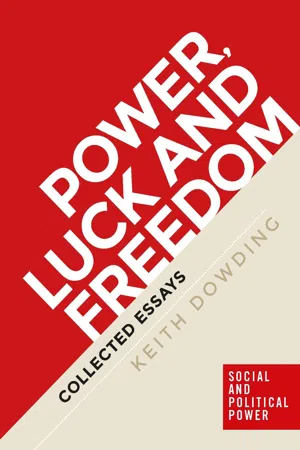
This book presents thirteen essays from a leading contemporary political scientist, with a substantial introduction bringing together the themes. The topics covered include political and social power, freedom, choice, rights, responsibility, the author's unique account of luck and systematic luck and the nature of leadership. There are also discussions of conceptual analysis, the structure-agency debate, luck egalitarianism, Sen's liberal paradox, problems in the measurement of freedom and choice and the differences between instrumental and intrinsic accounts of the value of freedom and related concepts.
The wide-ranging material will provide an excellent text for students at all levels. It is appropriate reading for a host of courses in the fields of political science, political sociology and political theory at both undergraduate and graduate level. Whilst addressing some philosophically difficult and advanced subjects, the accessible writing makes the subject-matter comprehensible for all levels of students.
- 344 pages
- English
- ePUB (mobile friendly)
- Available on iOS & Android
eBook - ePub
About this book
Information
Publisher
Manchester University PressYear
2016Print ISBN
9781526104564
9781526107282
eBook ISBN
9781526104571
Part I
Power
1
Why should we care about the definition of power?
Introduction
Power is a contested concept; of that there is no doubt. There are many dimensions in which it is contested. Some see it as a property of agents, whether these agents are individuals or collective entities such as firms, governments or political parties (Simon 1953; Dahl 1957; Weber 1978; Dowding 1991; Morriss 2002). Others insist that power is a property of systems or structures (Foucault 1980; Ward 1987; Clegg 1989; Hindess 1989). Some argue that power is ubiquitous and obscure and therefore cannot be measured (Lukes 2005); others that we can measure it (Dowding 1991). Some see power as necessarily conflictual. It always involves the clash of interests or plans and what one gains another loses (Dahl 1957; Weber 1978; Mann 1986, 1993; Lukes 2005): the power game is always zero-sum. Others believe that power is consensual: social power is about people working together to accomplish aims that could not be accomplished alone, hence increasing their collective power (Arendt 1972, 2004; Parsons 1963; Barnes 1988); in other words, power games are positive-sum. Others use definitions of power that encompass conflictual and consensual elements (Foucault 1980; Giddens 1984; Clegg 1989; Dowding 1991, 1996; Haugaard 1997; Morriss 2002). Scholars also debate whether power should be defined in terms of ‘power over’ – where the ‘real’ meaning of power is the power of one agent over another (or of the system over agents) – or in terms of ‘power to’ – where power is the power to attain what one aims for and ‘power over’ is simply a subset, a means by which some agents attain their goals (Pansardi 2011). Other concepts of power are, in themselves, general theories about the nature of relationships between people. Foucault’s notion of biopolitics or biopower is one example (Rose 2007; Foucault 2008).
In addition to these more general accounts, there are related concepts that are used in a variety of contexts: authority, autonomy, domination, freedom, hegemony, influence, legitimation and manipulation, each of which might be as contestable as the concept of power itself. There are also subsets of some of the accounts of power that are used in specific contexts or within certain treatments of power relations. Such types of power include power as control (Sen 1982b) P-Power and I-Power (Felsenthal and Machover 1998), soft power (Nye 2004), voting power, agenda and veto power (Tsebelis 2002); or more general accounts of power that are used in certain explanatory frameworks such as ‘balance of power theory’ (Morgenthau 1949; Little 2007); bureaucratic power, hierarchy, pressure politics, power of business; and so on. It is not my purpose to review any of these concepts (for a comprehensive account of many of the issues, see the entries in Dowding 2011). Rather, I ask more general questions. Why do we have so many different concepts of power? Are they actually competing concepts or simply diverse uses of a general term contextualized in different settings? If the different uses are not actually competing, why is there so much disputation over the term? Why should we care about the definition of power?
Certainly there is a general underlying notion of social or political power. There is something that holds these diverse uses together. Haugaard (2010) suggests power is a ‘family resemblance’ concept. It is also clear that many uses are not competing. Some specific concepts of power are contextualized to a specific purpose – the most obvious examples derive from the more formal approaches, in terms such as I-Power and P-Power, agenda and veto power. I-Power is the degree of a voter’s ability, under a given decision rule, to influence the outcome of a voting division (Machover and Felsenthal 2011a). P-Power is the voter’s expected relative share, under a given decision rule, of the constant sum reward of any given outcome from a voting division (Felsenthal and Machover 1998; Machover and Felsenthal 2011b). In the context of decision theory, agenda power is the power to order the items for consideration under any set of divisions under different decision rules, whilst veto power is the power to stop any outcome by one’s vote.
Some other usages are defined in terms of what they are contrasted with and are developed to make a specific point or to be used within a given explanatory framework. Joseph Nye’s concept of ‘soft power’, for example, is contrasted with ‘hard power’ and designed to make a specific policy-relevant point in international relations. (I discuss this example in a little more detail below.) However, some of the ways in which power is defined directly compete with each other. Indeed, some are designed to do so since the conceptual dispute is part and parcel of the theoretical or normative debate. Those who claim that ‘power over’ or ‘zero-sum’ uses constitute the real meaning of power are claiming that usages of power in terms of ‘power to’ or in a ‘positive-sum’ manner are illegitimate in social discourse (for example, Barry 2002, 2003). Similarly, to proclaim that power relationships necessarily involve a clash of interests (usually an important element for those who see ‘power over’ as the only legitimate use of the concept of social or political power) is also to bring into the concept a strongly moralized component.
It is these strongly moralized components of some uses of the term power that lead it to be proclaimed ‘essentially contestable’. What is essentially contested, of course, is different views about the way society ought to be governed. If these moral or ideological viewpoints are built into our very concepts, by which we also try to describe and explain the social world, then those descriptions and explanations will be equally moralized or ideological. It is for this reason I suggest below that all of our concepts should be kept as ‘non-normative as possible’. I will argue that to deliberately moralize concepts by bringing normative commitments into their basic definition is an ideological move that tries to win dispute by sleight of hand. Our basic concepts should be kept as non-normative as possible to ensure that we can be as clear as possible wherein lies our normative disputation. In truth, of course, the crudest attempts to colonize behaviour by inappropriately normative language fail, sometimes in spectacular ways. The propensity of dictatorial communist regimes to place ‘democratic’ in the title of their countries is one obvious example. Other well-meaning attempts to shift attitudes can also fail. To label children with learning disabilities as ‘special’ can be seen to fail when ‘special’ becomes a playground term of abuse, replacing ‘moron’ and other older, less deliberately moralized, descriptive terms.1
I will suggest that moralized definitions of power or social scientific concepts are normative or ideological ruses that should be kept out of analytic conceptual dispute. I do not claim that it is possible to define power in a completely non-normative manner, nor that any given definition might tend to support one ideological viewpoint over another. I do claim that some ways of looking at the world are superior to others, and if these support some viewpoints over others so much worse for the latter perspective. To deny such a claim is to deny that disputes in the social sciences can ever have any status beyond ritualized abuse. It is to give the status of social science that of the old logical positivist ‘boo–hurrah’ theory of morality and politics where all we ever do in moral and political debate is express our preferences. Rather, I argue that all definitions of power have normative implications, but those implications need to be kept in their proper place. The normative issue partly explains the degree of disputation over the concept of ‘power’. (The profession of academia and its ‘publish or perish’ imperative explains the bulk of the rest. The residual is what we should be doing.)
The last question – why should we care about the definition of power? – is the harder one to answer. We have different concepts of power, since people have different normative commitments and political views about the world. Power is a key concept in social analysis and people want to stake out their own territory using a concept that is friendly towards their own views. There is so much disputation because there are different normative commitments and political viewpoints and these views matter to people. We care about the definition since we care about the disputation. However, that is not enough. If we leave the issue to the idea that people have different normative commitments and political viewpoints, hence the disputation, then we leave the concept of power not just contested, but essentially so. Essentially so, because there are different normative commitments and political views and that is all that can be said. Again, we are in danger of seeing such dispute as simply expressions of moral preference; and if we try to examine those different expressions as scientific observers we should then not care about the definition of power: let it be contested. But we do care.
I shall argue that power is a theoretical concept that can play a different role in different theories or mechanisms that seek to explain aspects of human society. ‘Power’ can sensibly have plural meanings. ‘Power’ might be used in different ways, but in that sense those meanings are not rival. It does not follow from such pluralism, however, that all definitions are equally good. Some ways of analysing power might be more useful than others. Some definitions might be preferable to others, since the theories or mechanisms in which they are utilized are superior in some manner. In other words, even when concepts are non-rival in normative contexts, we might choose to use some rather than others, since some are explanatorily preferable. Nevertheless, we can define power differently without there being any fundamental empirical or normative conflict that is implicated in the definition (Dowding 1991: ch. 8).
Such pluralism does not suggest that ‘anything goes’ in power studies; certainly, I think, some ways of looking at power are preferable to others. Nevertheless, non-rival but different accounts of power can be used in different contexts, depending upon the research question. Thus, rather than seeing ‘power’ as a battleground concept for which one version needs to triumph (a zero-sum ‘power game’ version of academic debate), we can accept different uses in different contexts. Power debate can become a positive game where we allow different conceptions to be utilized in very different contexts and for very different theoretical questions.
Even so, as I have shown, there are some fundamental disputes where the notion of power is contested and where some academics (apparently) believe that it is very important that we see ‘power over’ as the ‘real meaning’ of power rather than as a subset, albeit an important if not the key morally important subset, of ‘power to’ (Barry 2002). This issue is deeper than mere dispute over the concept of power, for it involves dispute over conceptual analysis in empirical and normative theorizing. Here I want to argue that we should keep our basic concepts, such as power, freedom and equality as ‘non-normative as possible’. All of these concepts (indeed I will suggest all concepts period) are normative to some extent. However, some concepts are ‘more normative’ than others. Even so, I will argue, despite differing in degrees of normativity, each concept should be defined in as non-normative a manner as possible.
Conceptual construction
Our language designates patterns in the universe, whether they are the nominal denoting of similar objects or processes or more theoretical concepts that enable the generation of hypotheses. We pattern the universe in this manner to enable us to make predictions (Dennett 1998). Patterning the world allows us to see how our environment will affect us and how it will respond to our actions upon it. We see patterns in our fellow creatures and adopt the intentional stance about animals at least in part because it enables predictability (Dennett 1987). Predictions are thus built into our very language and understanding of the world. It is for this reason that explanation always entails prediction in this sense. Explanation is about patterning the universe through descriptive or causal inferences. It follows, however, that prediction and therefore explanation are in themselves normative. We want predictability because it is useful to us and such utility is normative – we want to be able to predict. We want to be able to explain. And we want to predict and explain those elements of our environment that are of most interest to us. (At its most basic we need predictability to be able to survive as an animal and reproduce as a species.) All concepts thus have an element of normativity and the better they enable predictions, the better the concept. Providing better predictions is the first test of the utility of any theoretical term.
Science refines our concepts as scientific study discovers new aspects about the world. Terms such as ‘cat’ or ‘water’ might not seem theoretical; nevertheless, they are theorized to the extent that we might shift some animal from the class of ‘cats’ to some other related mammalian class if we were to discover morphological features that suggest re-categorization. Water has an obvious folk meaning, but chemical and atomic analysis enables us to understand it theoretically and relate it via its base elements to other aspects of the world, and to further understand features about it that affect its texture and taste. For example, natural water is ‘harder’, depending upon the quantity of dissolved minerals. ‘Soft’ water (generally treated to make it so) has only one positively charged ion through its sodium content. The minerals in water give it a characteristic flavour, hence some natural mineral waters are desired for their taste and purported health benefits. Science tells us much more about ‘water’ than our folk understanding, but its referent remains the same; we simply understand more about it. For that reason, such terms are often considered ‘natural kinds’ which might be thought of as terms for which science is authoritative or the identity of which is fixed by reality. The terms are rigid designators (Kripke 1980). Such an understanding might be based upon distinctions we make which denote real patterns (Dennett 1998). Patterns are real to the extent that they constrain prediction and hence conceptual, theoretical and descriptive analysis.
Concepts such as ‘centre of gravity’ or ‘gene’ are more theoretical still. In the first case, ‘centre of gravity’ has no physical form, but as a theoretical concept can be given a location that enables predictions about the attraction of bodies. In the second, the term ‘gene’ is used in somewhat different ways in different contexts, but again enables prediction. We identify a given gene or allele at a specific locus by the effects it has. An allele can be regarded as having a certain selection coefficient relative to another at the same locus at a given moment. The coefficient is a number that can be treated algebraically and inferences drawn from one locus to other loci. In that sense, we identify genes by their statistical effects in terms of their function, location and relationship to other genes. So across subjects, we note differences in a specific locus on a chromosome and see statistical differences in the phenotype. Not all who have the gene will display all those characteristics associated with it, and some of those without the gene might well display some of them. In context, though, those with the gene are more likely to display those behavioural qualities. In other words, genes are identified by their predictive capacities and those predictions are always relative to environmental conditions.
Some real concepts are entirely theoretical. ‘The centre of gravity’ is the centre of the mass of any object in the presence of a gravitational field. There is nothing to be seen there to mark the centre of gravity, but it can be perceived in the sense that enables...
Table of contents
- Cover
- Half Title
- Title Page
- Copyright
- Contents
- List of figures
- Series editor’s foreword
- Acknowledgements
- Introduction: power, luck and freedom
- Part I Power
- Part II Luck
- Part III Freedom
- References
- Index
Trusted by 375,005 students
Access to over 1.5 million titles for a fair monthly price.
Study more efficiently using our study tools.
Frequently asked questions
Yes, you can cancel anytime from the Subscription tab in your account settings on the Perlego website. Your subscription will stay active until the end of your current billing period. Learn how to cancel your subscription
No, books cannot be downloaded as external files, such as PDFs, for use outside of Perlego. However, you can download books within the Perlego app for offline reading on mobile or tablet. Learn how to download books offline
Perlego offers two plans: Essential and Complete
- Essential is ideal for learners and professionals who enjoy exploring a wide range of subjects. Access the Essential Library with 800,000+ trusted titles and best-sellers across business, personal growth, and the humanities. Includes unlimited reading time and Standard Read Aloud voice.
- Complete: Perfect for advanced learners and researchers needing full, unrestricted access. Unlock 1.5M+ books across hundreds of subjects, including academic and specialized titles. The Complete Plan also includes advanced features like Premium Read Aloud and Research Assistant.
We are an online textbook subscription service, where you can get access to an entire online library for less than the price of a single book per month. With over 1.5 million books across 990+ topics, we’ve got you covered! Learn about our mission
Look out for the read-aloud symbol on your next book to see if you can listen to it. The read-aloud tool reads text aloud for you, highlighting the text as it is being read. You can pause it, speed it up and slow it down. Learn more about Read Aloud
Yes! You can use the Perlego app on both iOS and Android devices to read anytime, anywhere — even offline. Perfect for commutes or when you’re on the go.
Please note we cannot support devices running on iOS 13 and Android 7 or earlier. Learn more about using the app
Please note we cannot support devices running on iOS 13 and Android 7 or earlier. Learn more about using the app
Yes, you can access Power, luck and freedom by Keith Dowding in PDF and/or ePUB format, as well as other popular books in Politics & International Relations & Social Philosophy. We have over 1.5 million books available in our catalogue for you to explore.