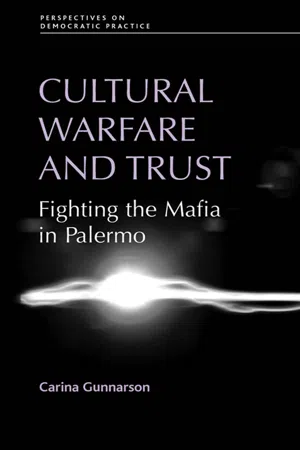
Cultural warfare and trust: fighting the Mafia in Palermo concentrates on a central issue in research on democratic processes: the development of generalised trust. The existence of generalised trust and confidence in a society is decisive for economic development and an effective democracy. Is it possible to fight persistent values of distrust and non-cooperation? Is it possible to support the development of generalised trust through public action and education?
The book addresses these questions by examining political efforts to combat Palermo's Mafia-controlled heritage and to turn a tradition of non-cooperation and distrust into cooperation and trust. In particular, it focuses on the school program launched in Palermo during the mid-1990s, which was designed to break the Mafia's territorial and mental control.
Combining theories on social capital and civic education, the author presents and analyses new quantitative and qualitative research carried out in seven public schools in Palermo.
This book will be valuable to students, academics and researchers interested in social capital and trust, Italian politics, civic education, organised crime, local government and democratic practice.
- 246 pages
- English
- ePUB (mobile friendly)
- Available on iOS & Android
eBook - ePub
About this book
Information
Topic
HistoriaSubtopic
Historia británica1
Introduction
Can you tell me, Socrates, whether virtue is acquired by teaching or by practice; or if neither by teaching nor practice, then whether it comes to man by nature, or in what other way? (Plato, Meno)
Is it possible to fight persistent values of distrust? Is it possible to support the development of generalised trust between citizens through public action from above, through civic education?
Fukuyama once described the accumulation of social capital as ‘a complicated and in many ways mysterious cultural process. While governments can enact policies that have the effect of depleting social capital, they have great difficulties understanding how to build it up again.’1 Stolle said that questions about how the norms of reciprocity and values of trust are generalised and institutionalised represent ‘the most under-researched area in social capital studies, supporting only a few hypotheses, all of which need more development and empirical testing’.2 There is also wide disagreement among scholars as to whether social capital is created from above, by institutions, or from below, from civil society.
Research shows that the existence of social capital in a society – or, in the context of the study described in this book, more specifically generalised trust – could be decisive not only in the prevention of crime, but also for economic development3 and an effective democracy.4 Moreover, the presence of generalised trust in society leads to better government, more redistribution and economic growth and less corruption.5 The existence of generalised trust in society is connected to positive outcomes such as personal happiness, safer neighbourhoods and solutions to various problems of collective action. As Uslaner describes it: ‘life in a trusting society is pleasant, life in a country where a majority distrusts other people is highly contentious. Where mistrust runs rampant, daily life can be a struggle to survive.’6 Generalised trust is related to optimism and possibilities for change. ‘Generalised trusters’ ‘believe that they can right wrongs and leave the world a better place than they found it’.7 Generalised trust is also necessary for the establishment of civil society, as it makes people more inclined to participate voluntarily in different kinds of collective institutions, such as political parties and trade unions, or any other kind of organisation that is beneficial for democracy in general.8 In a cross-national survey of 24 societies, Inglehart showed a close link between generalised trust and subjective well-being and the long-term survival of democratic institutions.9 Increased knowledge about the origins of generalised trust is also crucial for new democracies or states where trust has been destroyed by warfare or massive violations of civil rights, for example in Rwanda and the former Yugoslavia.
Although generalised trust and cooperation are highly desirable for any society – and many societies are indeed marked by high levels of trust and cooperation – societies may fall into a negative cycle of distrust and non-cooperation, which is difficult to break. The situation is described by Rothstein as a ‘social trap’, or a situation where individuals, groups or organisations are unable to cooperate owing to mutual distrust and lack of social capital, even where cooperation would benefit all.10 The logic of a society that has fallen into that social trap is that even persons who have strong incentives for fair play will continue to be disloyal, as they will assume that everybody else will continue to cheat, that is, to defect from the cooperative line. Rothstein emphasises that such behaviour is not based on any specific personal characteristics but on rational calculations and expectations about other people’s behaviour. As long as we suspect that most people will cheat others, our incentives to cooperate will remain weak. The challenge is to change citizens’ perceptions of society in order to break the vicious circle of distrust.
Why vicious circles of distrust are difficult to break is frequently explained with reference to Hardin’s example, ‘the tragedy of the commons’. In his example, we are asked to imagine a common meadow that is threatened by over-grazing. No herder can limit the grazing of anyone else’s flock. If individual herders limit their own use of the common meadow, they alone lose. Yet unlimited grazing destroys the common resource on which the livelihood of all depends. All parties would be better off if they could cooperate and come to an agreement to limit grazing. But, in the absence of a credible mutual commitment, each individual has an incentive to defect from the cooperative line and become a ‘free rider’. The message is that without trust between citizens, it is difficult to establish the cooperation needed and citizens find themselves in a vicious circle of non-cooperation. Speaking in game theoretic terms, the strategy of non-cooperation is a stable equilibrium. Trust is the lubricant for social relations: without trust, there can be no cooperative equilibrium; with it, there can be a stable cooperative equilibrium. In a situation where trust and resources are scarce, and values of individualism and non-cooperation are strong, the use of clientelistic relations is likely to be more beneficial for realising one’s immediate and short-term interests. From a long-term perspective, however, the outcome is sub-optimal, since non-cooperation leads to less development, less democracy and a poorly functioning economy and state.
In his study of Italy, Putnam argued that lack of social capital and weak mutual understanding explained the poor performance of democratic institutions and weak economic development in southern Italy.11 The economic, political, social and cultural divide between northern and southern Italy is nothing new to scholars in Italian studies. The ‘southern question’, la questione meridionale, has marked Italian politics ever since unification in 1860. Despite massive public investment and cash flows into southern Italy after the Second World War through the regional development fund Cassa per il Mezzogiorno, economic development in the south remained weak. The gap between north and south widened rather than narrowed between 1950 and 1975.12 In 1990, the youth unemployment rate reached 44 per cent in the south, in contrast to almost 15 per cent in the centre–north. In the same year, the south’s gross domestic product (GDP) was, in proportional terms, only 59 per cent of that of the rest of the peninsula – lower than it had been in 1970 or 1980.13
Putnam traced the origins of these differences to medieval Italy. Whereas governance in the north stimulated the development of horizontal relations, the rule of the king in the south was more favourable to the development of hierarchical and vertical relations. In northern Italy, a practice of self-government was established in the communal republics during the eleventh century. These communes had sprung from voluntary associations and, as communal life progressed, a vibrant organisational life developed. The norms and networks of civic engagement that emerged explain why the economy developed and governmental performance improved, Putnam argues. At the same time as communal life in the north spread beyond the traditional elite, feudal authority was strengthened in the south. The Norman kingdom established in southern Italy from the eleventh century fostered the development of mutual distrust and conflict, and the different regimes that ruled between 1504 until 1860 destroyed horizontal ties of solidarity in favour of vertical ties of dependence and exploitation. Hence, as early as the fourteenth century, two different models of governance had already settled on the Italian peninsula.14 These differences laid the ground for a tradition of cooperative behaviour, or ‘civicness’, in the north, whereas a tradition of non-cooperation and distrust became dominant in the south, Putnam argues. Putnam’s explanation for the differences in economic and democratic performance in northern and southern Italy today rests on the assumption that the social context for institutions was more favourable in the north than in the south.15 The social context itself is determined by some key factors, including civic networks, trust and norms of reciprocity. History determines which of these two stable equilibria – cooperation or non-cooperation – characterises any given society.
Institutionalists have criticised Putnam for presenting a static view of political culture. It is argued that his model does not sufficiently take into account the fact that the degree of civicness is also influenced by political policies, the behaviour of governments or their policy performance in more recent times.16 Focusing on more recent explanations for the differences between the ‘two Italies’, Pasquino argues that the behaviour of government matters more than civic traditions. If Emilia-Romagna in the centre–north scores high on Putnam’s civic community index, some weight has to be attributed to politics, and in particular the fact that the local government has known how to invest in and exploit the existence of social capital.17 The ‘path dependency’ of Putnam’s model has also been criticised. If everything was ‘decided’ in medieval times, then why should we care about political action today? And why is the present situation conditioned more by events during those times than by more recent events? It is argued that a more convincing explanation for the lack of good governance and ‘civicness’ in southern Italy is the patronage system and the clientelism established by the Italian state during the post-war period.18
Another factor that has not been sufficiently considered in Putnam’s explanatory model is the presence of the Mafia. The effects of organised crime on democracy are often ignored in the literature on social capital, but of course central in the literature on southern Italy. Although southern Italy has enjoyed formal democracy, democratic practices have been undermined and distorted by the presence of the Mafia. In this context, similarities exist between the Mafia and the ability of authoritarian regimes to limit the civil rights of citizens by preventing the development of civil society and by keeping citizens in a state of atomisation and isolation. In the past, the Mafia actively hindered the development of cooperation between citizens, by killing those who openly opposed it and by creating a culture of domination, threat and fear. Despite the presence of formal institutions in Sicily, the influence of the Mafia continues to greatly distort the mechanisms of democracy. The Mafia also undermines citizens’ possibilities to express their legal, civil and democratic rights in these areas. As described by Siebert, the Mafia creates a culture of fear that leads to conformist behaviour, which in turn implies a mental surrender to the Mafia’s exercise of power:19
Where the Mafia rules, there is a fear of leading a private life, of boasting personal spaces that could arouse suspicion. Caution, in the private and personal sphere, suggests conformism; fear, in the public sphere, requires that personal rights be waived. Hence those who have the right to vote do not exercise it, or vote against their convictions, and those who have the right to apply for public work contracts withdraw for no apparent reason, or cheat…. Connivance with Mafia terror is wide-ranging and also includes various forms of consensus; what, however, typifies the surrender of the individual both in a private and in a public sphere is mortal anxiety, evoked and re-evoked systematically by violent and brutal threats.20
This book will focus on institutional explanations and analyse more recent political efforts to break the heritage of the past, that is, to turn the vicious circle of non-cooperation into a virtuous circle based on trust and cooperation, and to change citizens’ perceptions of society. While there is quite extensive knowledge today of the mechanisms that rule the two states of equilibrium – cooperation and non-cooperation – there is less knowledge about change.21 We will now turn to our case study, Palermo, and have a look at the political efforts made during the 1990s to change Palermo’s trajectory.
Cultural warfare
After the killings of two judges, Giovanni Falcone and Paolo Borsellino, in 1992, Palermo’s mayor, Leoluca Orlando, was re-elected in 1993 on a strong anti-Mafia platform, with 75 per cent of the vote. Orlando successfully used the moment of emotion provoked by the assassinations of the two judges to launch a new programme for Palermo, focusing on three sectors: culture, public schools and infrastructure. The major aims of Orlando’s political programme were to reclaim control over the city’s territory, to restore citizens’ rights and to promote a civic consciousness based on the rule of law. Efforts were made to improve Palermo by renovating buildings and monuments, and restoring green areas in the city centre. Better public transport and illumination of the city centre were other examples of those efforts. Orlando’s anti-Mafia platform consisted of breaking the Mafia’s territorial and mental control. Orlando also emphasised the importance of making a distinction between Mafia values and Sicilian culture:
Speaking about the Mafia is an effective way of fighting it. The Mafia is identified with Sicily: the Mafiosi would like Sicilians to become their cultural accomplice. They think that Mafia and Sicily identify with one another. But the Mafia is Sicily’s worst enemy because it has used the history of Sicily against Sicily, the identity of Sicily against Sicily. The culture of Sicily against Sicily. This is why it’s a good thing to speak about the Mafia and remember that the Mafia is not Sicily.22
There is no doubt that Orlando was able to put Palermo on the right track, starting with the so-called ‘Palermo spring’ during his first period in office (1985–90) and continuing with the ‘cultural revolution’ during the first years of his second term as mayor (1993–2000), thanks to his charisma and massive public support. Many consider his school policy one of the most successful parts of Orlando’s programme. New schools were built, enrolment procedures were improved, efforts to fight drop-out were reinforced, the use of ‘double turns’23 was stopped, new teaching methods were introduced, the project ‘School adopts a monument’ was launched and more attention was given to education in good citizenship and th...
Table of contents
- Cover Page
- Title Page
- Copyright Page
- Dedication
- Contents
- List of tables
- Acknowledgements
- 1 Introduction
- 2 The origins of generalised trust
- 3 Methods
- 4 The Mafia
- 5 Cultural warfare
- 6 Students’ trust in political institutions
- 7 Students’ perceptions of generalised trust
- 8 Explaining generalised trust
- 9 The Letter Project – students’ own stories
- 10 Conclusion
- Appendix: the distribution of the questionnaires
- References
- Index
Trusted by 375,005 students
Access to over 1.5 million titles for a fair monthly price.
Study more efficiently using our study tools.
Frequently asked questions
Yes, you can cancel anytime from the Subscription tab in your account settings on the Perlego website. Your subscription will stay active until the end of your current billing period. Learn how to cancel your subscription
No, books cannot be downloaded as external files, such as PDFs, for use outside of Perlego. However, you can download books within the Perlego app for offline reading on mobile or tablet. Learn how to download books offline
Perlego offers two plans: Essential and Complete
- Essential is ideal for learners and professionals who enjoy exploring a wide range of subjects. Access the Essential Library with 800,000+ trusted titles and best-sellers across business, personal growth, and the humanities. Includes unlimited reading time and Standard Read Aloud voice.
- Complete: Perfect for advanced learners and researchers needing full, unrestricted access. Unlock 1.5M+ books across hundreds of subjects, including academic and specialized titles. The Complete Plan also includes advanced features like Premium Read Aloud and Research Assistant.
We are an online textbook subscription service, where you can get access to an entire online library for less than the price of a single book per month. With over 1.5 million books across 990+ topics, we’ve got you covered! Learn about our mission
Look out for the read-aloud symbol on your next book to see if you can listen to it. The read-aloud tool reads text aloud for you, highlighting the text as it is being read. You can pause it, speed it up and slow it down. Learn more about Read Aloud
Yes! You can use the Perlego app on both iOS and Android devices to read anytime, anywhere — even offline. Perfect for commutes or when you’re on the go.
Please note we cannot support devices running on iOS 13 and Android 7 or earlier. Learn more about using the app
Please note we cannot support devices running on iOS 13 and Android 7 or earlier. Learn more about using the app
Yes, you can access Cultural warfare and trust by Carina Gunnarson in PDF and/or ePUB format, as well as other popular books in Historia & Historia británica. We have over 1.5 million books available in our catalogue for you to explore.