Viewing the poem as a social agent and product in women's lives, the essays in this collection examine factors influencing the relationships between writers and readers of poetry in seventeenth-century England and Scotland. The archival and theoretical research on literary authorship, textual transmission and socio-literary networks invites a re-examination of the production and reception of poetry, and alters our understanding of the way poetry participated in social, literary and political life.
The volume takes account of the expansion and changes to the canon of women's poetry and emerging research on key aspects of literary production and reception. It builds on and responds to both recent critical emphasis on literary form and on archival scholarship in women's writing, understanding the two emphases to be mutually informative.
This book explores the way women understood the poem, examines how the poem was shared, circulated and rewritten, and traces its path through wider social relations. It will appeal to any scholar of literature and gender working in Renaissance and seventeenth century studies.
- 262 pages
- English
- ePUB (mobile friendly)
- Available on iOS & Android
eBook - ePub
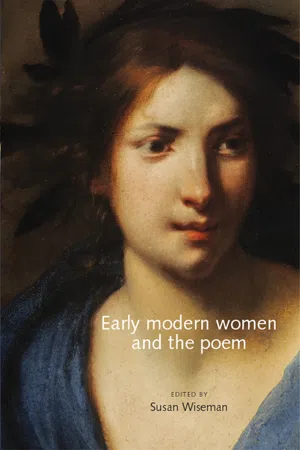
Early modern women and the poem
About this book
Information
Publisher
Manchester University PressYear
2016Print ISBN
9781526116840
9780719090721
eBook ISBN
9781526110893
CHAPTER 1
Women’s poetry and classical authors: Lucy Hutchinson and the classicisation of scripture
Introduction: the distant muses – early modern women poets and classical antiquity
EARLY modern women poets’ search for cultural authority and poetic voice involved a vexed, sometimes contradictory relationship to literary models (as Sarah Ross and Line Cottegnies explore further in chapters 2 and 3). Classical poetry was especially awkward for women writers to accommodate and imitate, for a variety of social and cultural reasons. Greek and Roman literature – poetry, drama, oratory and historiography – was a central component of the education of high-status males in the early modern period. It was studied for an understanding of the Greek and Latin languages (grammar), and also to supply students with resources of discourse (rhetoric) and argument (dialectic). These skills could be put to use in the fields of employment open to educated men, whether administrative or diplomatic service or the professions of law, medicine and divinity. They could also, exceptionally, be perfected in a scholarly environment, facilitating enquiries into other areas of learning or elucidation of the texts themselves. But invariably they also served a social function, advertising gentility and membership of the ruling class. The writing of Latin or more rarely Greek poetry in the style of classical writers, a skill specifically taught and tested at grammar school and university, was an acknowledged means of performing educational attainment. Within this broad sociological context for the reception of ancient literatures, unsurprisingly much vernacular writing measured itself against classical models.1
Although women did not attend the great humanist institutions of grammar school and university, and were not expected to seek public employment, some clearly did receive what we now call a classical education. As well as princesses like Elizabeth Tudor, who were given a man’s education to perform a man’s role, a few English women, typically of high status, became accomplished readers and sometimes imitators of classical poetry.2 Frequently these fortunate few were beneficiaries of a family tradition of educating daughters: the Mores and Sidneys, for example. It has also been suggested that in a marriage market peopled by humanistically educated men, educated women had enhanced prospects.3 Towards the end of the seventeenth century, arguments promoting the equal education of women began to appear alongside the development of girls’ schools teaching some Greek and Latin; probably the two phenomena were related. However, even in the case of women who were, exceptionally, given access to classical literature, the ideological and social endorsement classical learning carried for men was still lacking.
Learned women poets, specifically, also faced other difficulties. When men surveyed classical literature, they instantly confronted a vast range of possible voices from which to draw auctoritas via imitation. Women did not. The names of several ancient women poets, to be sure, were well known. They were regularly rehearsed by pedagogues, from Juan Luis Vives onwards.4 But with a few fragmentary exceptions, such as Sappho or ‘Sulpicia’, their actual writings did not survive. There were whole genres (epic, for example) in which there were no extant examples of ancient women’s writing. The problem is encapsulated in Abraham Cowley’s clever praise of Katherine Philips:
Of Female Poets, who had names of old
Nothing is shewn, but only told,
And all we hear of them, perhaps may be
Male Flattery onely, and Male Poetry;
[…]
The certain proofs of our Orinda’s Wit
In her own lasting characters are writ,
And they will long my praise of them survive,
Though long perhaps that too may live.5
Here, ancient literature’s routine function as cultural legitimation and aesthetic standard is underlined yet, in the context of women’s writing, ironised. Cowley’s prophecy of immortality for Philips, given the mortality of ancient women’s writings and the possible mendacity of ‘Male Flattery’ such as his own, seems (at the very least) somewhat precarious.
Nonetheless, women writers who wished to enter the potentially compromising spheres of print or manuscript publication often felt compelled to reach for whatever classical models were available to them, or have them imposed. A tradition of calling such ‘published’ women poets ‘Sappho’, which worked to restrict how they were perceived as well as what they could be expected to write, runs from the late sixteenth century through to the Restoration. Even later seventeenth-century female writers continued to filter engagements with classical literature through the prism of gender.Aphra Behn’s praise of Thomas Creech’s translation of Lucretius, for example, conveys the distinct sense of treading on a male preserve; her renditions of Ovid’s Heroides, another popular model for women’s poetry, indicate similar constraints.6 An equally good example is the posthumously published poetry of the writer and artist Anne Killigrew (1660–85), another ‘Sappho’.7 Killigrew also offers an imitation of the Heroides, but of greater interest is her unfinished epic on Alexander, which actually begins with a description of women Amazons. This promise of a feminised classical epic is not sustained, the editor declaring of the ‘first essay of this young Lady in poetry’ that ‘finding the Task she had undertaken hard, she laid it by till Practice and more time should make her equal to so great a work’.8 Thus, although by the Restoration increasing numbers of women read increasing amounts of classical literature, not least in translation, their ability to engage as male poets did with such works in their writings remained subject to obstacles and compromises.
The poetry of Lucy Hutchinson, née Apsley (1620–82), places this vexed relationship to the exemplary authority of mostly male classical authors in a particularly intriguing light. In some ways, Hutchinson is not representative of contemporary female poets: her pronounced Puritan political and religious prejudices, difficult to voice openly in the Restoration, ensured that the publication of her work was largely left until later centuries. Hutchinson was like other educated gentlewomen, however, in owing her learning to her parents’ encouragement (and financial standing), and probably their wish to enhance her marital prospects.9 That learning was considerable: according to Hutchinson herself, she was from an early age a gifted linguist and Latinist, easily outstripping her school-educated brothers.10 She credits her husband’s attraction to her to his chance discovery of her ‘Latin books’ (probably her commonplace or composition books) before he had even met her – only one of several anecdotes in her life writings to insinuate exceptional literary gifts.11 Hutchinson’s classicism is demonstrated by her verse translation of Lucretius’s De Rerum Natura, the first complete example in English. It is also apparent in her commonplace book transcriptions, which included contemporary translations of Virgil by Denham and Godolphin. A fragmentary translation of book I of Ovid’s Metamorphoses also survives.
The following discussion centres on Hutchinson’s verse paraphrase on Genesis, composed in the 1660s to 1670s, although ascribed to her only in the late twentieth century.12 It exists in two versions, a manuscript narrative of twenty cantos, stretching to Genesis 31:25 and apparently unfinished (and untitled), and a printed version of the first five cantos, published anonymously in 1679 under the title Order and Disorder, or The World Made and Undone: Being Meditations Upon the Creation and Fall, as it is recorded in the beginning of Genesis. While the first five cantos do not differ hugely between versions, the printed text can be taken as a coherent work in its own right, a ‘hexameral’ epic on the Creation and Fall.13 The manuscript, contrastingly, is neither obviously hexameral (it goes far beyond ‘the beginning’ of Genesis) nor indisputably epic; nor, strictly speaking, can it be termed Order and Disorder. Although neither version explicitly acknowledges female authorship, Hutchinson’s moving discussion of the ‘golden fetters’ of matrimony – probably an intended classical reminiscence – and the punishing labours of childbirth strongly hints that the work is a woman’s.14 The decision to publish (part of) it remains curious: elsewhere, writing for her daughter, Hutchinson claimed ‘I write not for the presse, to boast my owne weaknesses to the world’.15 More research is still needed into its likely occasion and circulation: as Jane Stevenson points out, ‘publication’, when it comes to early modern women’s writing, can mean many different things.16
Critical discussion often relates Hutchinson’s Genesis work to her Lucretius translation, either identifying traces of quasi-Epicurean materialism in her theology, or stressing her affiliation to Lucretius’s sublime poetics. A rather different argument is that it exemplifies Hutchinson’s Puritan scripturalism.17 While acknowledging there are links to the De Rerum Natura, I shall argue that Hutchinson does not use Lucretius differently or in a more privileged way than other classical authors. I will also contend that, despite its scripturalist assertions and recent attempts to see her as a neo-Epicurean, Hutchinson’s work is that of an identifiably humanist poet, sharing literary techniques and a general concern for performed erudition with elite poetic approaches to scripture from the late sixteenth century onwards. After working through a number of examples, I conclude by arguing that the tension in her text between Calvinistic theology and a classicising poetics expresses also aspects of Hutchinson’s situation as a woman writer.
Ovidian creation and Ovidian pathos: Hutchinson, Genesis and the Metamorphoses
IN the ‘Preface’ to the published, five-canto Order and Disorder, the anonymous author we know to be Hutchinson explains the work as a reassertion of scripturalism (‘I disclaim all doctrines of God and his works, but what I learnt out of his own word’) against ‘the account some old poets and philosophers give of the original of things’, to which she had been attracted by ‘youthful curiosity’, and indeed sought to translate, but now vehemently rejects as ‘blasphemously against God, and brutishly below the reason of man’, as ‘vain, foolish, atheistical poesy’.18 Critics interpret these words as disavowing Hutchinson’s earlier translation of Lucretius, not least because they parallel her abusive discussion of the De Rerum Natura in dedicating her translation to the Marquis of Anglesey.19 Her use of the word ‘some’ in the passage quoted above, however, indicates more than one pagan authority, while the attack on pagan creation mythology in general aligns Hutchinson’s published text with reassertions of scripture’s authority in the early Restoration by Anglicans such as Edward Stillingfleet or Cal...
Table of contents
- Cover
- Half Title Page
- Title Page
- Copyright Page
- Contents
- List of contributors
- Preface and acknowledgements
- Introduction. Researching early modern women and the poem
- Part I: Inheritance
- Part II: Circulation
- Part III: Narrative
- Afterword. Reading early modern women and the poem
- Index
Trusted by 375,005 students
Access to over 1.5 million titles for a fair monthly price.
Study more efficiently using our study tools.
Frequently asked questions
Yes, you can cancel anytime from the Subscription tab in your account settings on the Perlego website. Your subscription will stay active until the end of your current billing period. Learn how to cancel your subscription
No, books cannot be downloaded as external files, such as PDFs, for use outside of Perlego. However, you can download books within the Perlego app for offline reading on mobile or tablet. Learn how to download books offline
Perlego offers two plans: Essential and Complete
- Essential is ideal for learners and professionals who enjoy exploring a wide range of subjects. Access the Essential Library with 800,000+ trusted titles and best-sellers across business, personal growth, and the humanities. Includes unlimited reading time and Standard Read Aloud voice.
- Complete: Perfect for advanced learners and researchers needing full, unrestricted access. Unlock 1.5M+ books across hundreds of subjects, including academic and specialized titles. The Complete Plan also includes advanced features like Premium Read Aloud and Research Assistant.
We are an online textbook subscription service, where you can get access to an entire online library for less than the price of a single book per month. With over 1.5 million books across 990+ topics, we’ve got you covered! Learn about our mission
Look out for the read-aloud symbol on your next book to see if you can listen to it. The read-aloud tool reads text aloud for you, highlighting the text as it is being read. You can pause it, speed it up and slow it down. Learn more about Read Aloud
Yes! You can use the Perlego app on both iOS and Android devices to read anytime, anywhere — even offline. Perfect for commutes or when you’re on the go.
Please note we cannot support devices running on iOS 13 and Android 7 or earlier. Learn more about using the app
Please note we cannot support devices running on iOS 13 and Android 7 or earlier. Learn more about using the app
Yes, you can access Early modern women and the poem by Susan Wiseman in PDF and/or ePUB format, as well as other popular books in Literature & Literary Criticism in Poetry. We have over 1.5 million books available in our catalogue for you to explore.