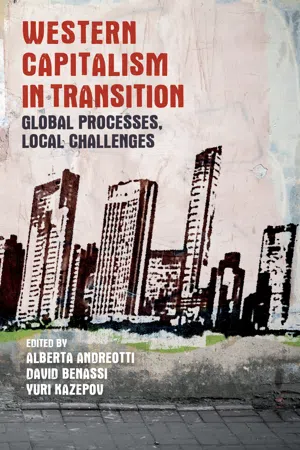
Since its emergence at the end of the seventeenth century, industrial capitalism as a specific form of social organisation has set recurrent challenges to its own persistence, and until today, it has proved to be successful to develop new ways of accumulation based on its capacity of adaptation. Is this process of transition now accelerating or reaching an end point? This book is a critical exploration of capitalism in transition, bringing together cutting edge, world renowned scholars who reflect from different disciplinary points of view. This collection engages with the primarily Western themes of welfare capitalism and social fragmentation. Structured over three parts, the book analyses; the transformations of welfare societies and capitalism with a focus on South European welfare states and their (in)capacity to tackle poverty; the transformation of work and migration with a special attention to informality and the question of social rights; and the transformation of cities.
- 336 pages
- English
- ePUB (mobile friendly)
- Available on iOS & Android
eBook - ePub
About this book
Information
Part I
THE TRANSFORMATIONS OF GLOBAL CAPITALISM
3 David Harvey
Abstract from the concrete: capitalism spiralling out of control
Astonishingly, between 1900 and 1999 the United States consumed, according to a US Geological Survey, 4,500 million tons of cement (USGS 2012). In 2011 and 2013, China consumed around 4,250 million tons of cement (USGS 2013). So in just two years, the Chinese consumed the same amount of cement as the United States had consumed in the whole of the preceding century. That scale of magnitude of spreading cement around is unprecedented. Those living in the United States have seen plenty of cement used over the years. But what has happened in China is extraordinary in terms of its environmental, political and social consequences. So the question I want to ask is: Why did this happen? However, less and less do researchers ask ‘why?’. Since the 1970s, there has been a gradual shift of emphasis, and instead they ask ‘how?’ and ‘where?’.
Concentrating on the ‘how and where’ leaves us much better equipped to unravel the intricacies of how things happen. It frees us from the chains of dogmatic assertions. Instead we describe in detail how it is that, say, developers get together with lawyers and construction companies, with financiers, landowners and state officials, to launch fantastic megaprojects that require masses of cement even as they spark protests from evicted homeowners and tenants from this or that space in the city, as well as from citizens in general. We pay far closer attention to local conditions. We are much more sensitive to cultural and environmental differences. The ‘where’ matters, but it also has some perverse consequences. It introduces national character into the debate in ways that can mask what the underlying dynamic of endless capital accumulation is about and the social consequences it produces.
Concentrating on the ‘how and where’ might bring us to the point where we forget entirely to ask ‘why?’. We ignore the power of metatheory on principle rather than as a convenient practice in certain research situations.
The concrete crisis
Why has all of that cement been spread around in China? Cement is used in construction. This obviously suggests a massive investment in the creation of built environments, in urbanisation and the construction of physical infrastructures. Recently, there has been an immense amount of that investment in construction worldwide, but China stands out in the data as by far the most spectacular example (Agence Presse Français 2016; Reuters 2016). And this concerns other raw materials such as steel, iron, copper, sand and minerals of all sorts.
Raw material prices have, until recently, tended to soar. Mining activity has been accelerating everywhere. The terms of trade for raw material producers have tended to turn positive in the last twenty years or so. From India to Latin America to Australia, whole mountains are being moved in the search for minerals, with all sorts of political, economic and environmental consequences. The question of why China has been involved in such a huge expansion of its urbanisation and infrastructural investment has global ramifications. And I argue that it is undoubtedly one of the reasons that a troubled global capitalism has survived in the last few years. More by consequence than design, the leadership in Beijing effectively saved global capitalism from a great depression – particularly since 2008, when the global economy went into a tailspin.
First, the ‘how and where’ of what happened. In 2007–08 a financial crisis arose out of the United States, and merely for this reason it was defined as a global crisis. Other crises occurred in South-East Asia in 1997–98; they were defined as regional crises. There is also considerable evidence that, faced with crisis conditions, US institutions and policy-makers actively sought to disperse their effects around the world by globalising them. In so doing they used many multilateral financial institutions and financial interrelations to do their bidding (Hudson 2015).
The crisis of 2007–08 was at first instance quite localised. It originated particularly in the southern and south-western United States, and arose largely out of intense speculation in housing and property markets in those regions. Speculative money poured into US property markets (as it did in Ireland and Spain, among other places) when the stock market crashed in 2001. The world was awash with surplus liquidity at that time and much of it was absorbed in property markets, forcing prices up and up. When the speculative housing bubble burst, there was a foreclosure crisis on housing loans. A ‘fictitious demand’ had been created when sub-prime mortgage financing was offered to people who had very little creditworthiness. In 2007, property values collapsed in these regions and many people lost their homes (Harvey 2010).
People who have been foreclosed upon and who are unemployed consume less. So the consumer market in the United States collapsed and many people lost their jobs. But the primary supplier to that consumer market was China. This was one link whereby the local crisis went global. The other link was through the financial system. Financial institutions had structured mortgage debt on housing so as to be able to pass it on to others as an investment yielding good returns that were supposedly ‘as safe as houses’. But many of the mortgages were not secured by an ability to pay. Anyone who had been gulled into investing in the new financial instruments lost money. The banks that held that debt were threatened and tightened credit, including credit to consumers. The weakness in the US consumer goods market spread and deepened. The downward spiral threatened to engulf the whole world in depression.
In 2008, China suddenly found its export industries contracting if not collapsing. A 20 per cent or more drop in exports occurred in a matter of months (Jing 2011). Chinese statistics are notoriously unreliable as to what is real and what is not, but by some accounts, something like 20 million jobs were lost in China through the collapse of export markets (UN 2011). That is a huge job loss. The Chinese government has traditionally been very nervous about potential social unrest. And 20 million unemployed workers presented a rather dangerous situation. I believe the Chinese government did what it did mainly to avert that obvious danger.
By the end of 2009, a joint report from the International Monetary Fund and the International Labour Organization tallied up estimates of the global net job loss from the crisis (ILO-IMF 2010). The United States had the largest loss, while China’s net job loss was only about three million (IMF 2010). Somehow, China had managed to absorb 17 million people back into the labour market in the space of about one year. This is an astounding and totally unprecedented performance.
How did China absorb such vast amounts of surplus labour so fast? It seems the central government told everybody to create as many projects and megaprojects as possible. The banks were told to lend without restraint. In the United States, when the Federal Reserve and the US Treasury gave money to the banks to lend, the banks ignored their instruction. The US banks used much of the money they were given to retire their bad debts and even buy back their own stock. The Chinese banking system does not work that way. In China, if bankers are told by the central government to lend, they lend. And they evidently did, incidentally making a lot of people ultrawealthy in the process.
China absorbed a massive amount of labour by launching a huge urbanisation and infrastructure development programme, building whole new cities, integrating the space economy of the nation with highways and high-speed rail networks, more strongly connecting southern and northern markets, developing the interior so that it was much better linked to the coast. While clearly the central government had wanted to do something like this for some time (plans were laid for the high-speed rail network during the 1990s), it now mobilised everything it could to absorb the surplus and potentially restive labour force. In 2007 there were zero miles of high-speed rail in China, but by 2015 there were nearly 12,000 miles linking all the major cities. This is phenomenal by any standard (Shepard 2015).
At the end of the Second World War, the US economy needed to absorb the huge increase in productive capacity created during the war and create well-paying jobs for a large number of returning veterans. If veterans were to be faced with unemployment on the scale of the 1930s, then there would surely be serious political and economic consequences. The problem for the US capitalist state and class was: How do we not go back into depression? How do we absorb all of that productive capacity in ways that are going to be profitable and satisfy the wants and needs of a vast army of demobilised military? What would happen if the returning veterans faced a return to depression conditions, when the war against fascism had been fought in alliance with the Soviet Union?
One answer was the repression of all left-wing thinking through a fierce anti-communist movement known as McCarthyism. But that in itself could not have succeeded were it not for initiatives to solve economic problems. The US economy had to expand rapidly enough to absorb the surpluses of capital and labour. In part this was done through US imperialism, the Cold War (also anti-communist) and a vast expansion of militarism. These operations certainly played a role in boosting the economy, but were not enough to prevent another depression. The United States was a largely selfcontained economy – not so dependent on foreign trade. Economic expansion had to be internal to the United States itself.
The big thing accomplished after 1945 in the United States was a huge wave of investment in the built environment, in urbanisation, and in physical and to some extent social infrastructures such as the higher education system. The interstate highway system pulled together the West Coast and the South, and spatially integrated the US economy in new ways. Los Angeles was an ordinary-sized city in 1945, but by 1970 it had become a megalopolis. Metropolitan areas were totally re-engineered with transport and highways and automobiles and suburbs and the development of a whole new suburban lifestyle. Well-paid jobs were required to support the effective demand for a suburban lifestyle. Labour and capital came to an uneasy compromise at the urging of the state apparatus in which a white working class made economic gains, while minorities were left out. As a result, the 1950s and 1960s were, in many respects, the golden years of capital accumulation in the United States: very high rates of growth, a satisfactory situation for a white working class, even as a powerful civil rights movement and uprisings in central cities showed that all was not well for the African-American and immigrant populations. But the aggregate effect was to solve the over-accumulation problem through urbanisation and investments in the built environment. As a Federal Reserve report later put it, the United States has the habit of ‘getting out of crises by building houses and filling them with things’ (Applebaum 2011). However, this is also how capital gets into crises.
In response to the employment crisis in 2008, the Chinese in effect did much the same as the United States had done after the Second World War, but they did it much more quickly and at a far higher rate. Although the strategy of solving economic and political problems through urbanisation is not new, this change of scale is very important. Following the economic crisis of 1848, which prompted working-class and bourgeois revolutions in Paris, the French economy flourished again on the back of Napoleon’s public works projects and Haussmann’s new plan for Paris, funded by associated capital. Capital and labour were fully and profitably employed, creating new boulevards, department stores and the like. Daily life was transformed into the consumerism of the city of light. The crisis of over-accumulation of both capital and labour in the period after 1848 was solved by transformations in lifestyle as well as transformations in the built environment. We still see the consequences of this effort when we walk Haussmann’s boulevards today (Harvey 2003). But the scale of these changes is nowhere near that of the changes in the United States after 1945, which in turn is nowhere near the scale and speed of transformation that has recently occurred in China.
But in each of these cases, there was an underlying problem. The construction had to be debt-financed. New institutions and methods of financing had to be created to sustain building efforts. A new kind of credit-driven banking became more prominent in Paris. But at a certain point, debt creation and scepticism as to the value that stood behind the debt came to the fore. Paris’s debt crisis of 1867–68 engulfed not only the speculative financial institutions but also the finances of the city. Paris was mired in debt and close to bankruptcy. Haussmann was ultimately forced to resign.
Unemployment and unrest ensued in Paris. It eventually resulted in the Paris Commune of 1871 – one of the greatest urban uprisings in human history. The people took back ‘their’ city from the bourgeoisie and the capitalists who had plundered it (Marx and Lenin 1940).
Solving the over-accumulation problem through rapid urbanisation comes at a certain cost. In the cases of both Paris and the United States, it meant relying heavily upon debt finance and the deployment of fictitious capital. In the United States, new mortgage finance and other institutions had been put in place in the 1930s, but even greater levels of state intervention occurred after 1945. The system worked well for a time, but stresses were evident as early as 1967. The whole process came to a crashing halt with the property market collapse and the technical bankruptcy of New York City in 1973–75 (one of the largest public budgets in the capitalist world at that time) (Tabb 1982). This initiated a period of serious recession and capitalist restructuring in the United States that also affected the United Kingdom, Europe and the rest of North America, as well as many other countries and regions such as Australia and Latin America. In a somewhat similar fashion, the crash of the US stock market in 2001 led money to flee the stock market and produced the property market boom that helped sustain global capitalism up until the Lehmann Brothers collapse of 2008. And the impact of the Lehman Brothers collapse was felt throughout the global financial system.
China likewise debt-financed its way out of its difficulties in 2008. But unlike Greece and other places, China didn’t debt-finance using dollars or euros. It had enough foreign exchange surplus from the United States to be insulated from foreign pressures. So China could borrow in its own currency. The great advantage of borrowing in your own currency is that you can always issue more money and if necessary inflate away the debt and recapitalise the banking system (as happened at...
Table of contents
- Cover
- Half Title
- Title Page
- Copyright
- Contents
- List of figures and tables
- Notes on contributors
- Preface
- Acknowledgements
- Framing the issues at stake
- Part I: The transformations of global capitalism
- Part II: Welfare capitalism and rights
- Part III: Citizenship and migration
- Part IV: Cities and urban transformation
- Part V: Segregation and the spatial dimension of poverty
- Perspectives on the future of Western capitalism
- Index
Trusted by 375,005 students
Access to over 1.5 million titles for a fair monthly price.
Study more efficiently using our study tools.
Frequently asked questions
Yes, you can cancel anytime from the Subscription tab in your account settings on the Perlego website. Your subscription will stay active until the end of your current billing period. Learn how to cancel your subscription
No, books cannot be downloaded as external files, such as PDFs, for use outside of Perlego. However, you can download books within the Perlego app for offline reading on mobile or tablet. Learn how to download books offline
Perlego offers two plans: Essential and Complete
- Essential is ideal for learners and professionals who enjoy exploring a wide range of subjects. Access the Essential Library with 800,000+ trusted titles and best-sellers across business, personal growth, and the humanities. Includes unlimited reading time and Standard Read Aloud voice.
- Complete: Perfect for advanced learners and researchers needing full, unrestricted access. Unlock 1.5M+ books across hundreds of subjects, including academic and specialized titles. The Complete Plan also includes advanced features like Premium Read Aloud and Research Assistant.
We are an online textbook subscription service, where you can get access to an entire online library for less than the price of a single book per month. With over 1.5 million books across 990+ topics, we’ve got you covered! Learn about our mission
Look out for the read-aloud symbol on your next book to see if you can listen to it. The read-aloud tool reads text aloud for you, highlighting the text as it is being read. You can pause it, speed it up and slow it down. Learn more about Read Aloud
Yes! You can use the Perlego app on both iOS and Android devices to read anytime, anywhere — even offline. Perfect for commutes or when you’re on the go.
Please note we cannot support devices running on iOS 13 and Android 7 or earlier. Learn more about using the app
Please note we cannot support devices running on iOS 13 and Android 7 or earlier. Learn more about using the app
Yes, you can access Western capitalism in transition by Alberta Andreotti in PDF and/or ePUB format, as well as other popular books in Economia & Economia politica. We have over 1.5 million books available in our catalogue for you to explore.