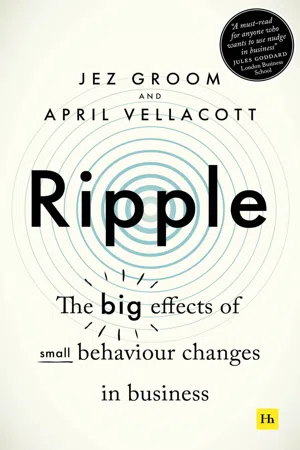
eBook - ePub
Ripple
The big effects of small behaviour changes in business
- English
- ePUB (mobile friendly)
- Available on iOS & Android
eBook - ePub
Ripple
The big effects of small behaviour changes in business
About this book
How do you get people who work in pig abattoirs to wash their hands? How does painting the walls of a canteen pink make construction workers behave more safely? And how can baby faces spray painted onto shop shutters reduce anti-social behaviour?
Ripple is about how small behaviour changes can have wide-reaching effects in the real world. By applying behavioural science in your working life, you can have positive ripple effects on the world around you.
While nudging is now commonplace in politics, most of our daily interactions with companies, products, and services have not yet been transformed with behavioural science. Doing so is often a messy process but, armed with this book, you'll have the practical toolkit to get started.
Through storytelling and practical tips, Ripple takes you on a journey across the globe which will leave you inspired to start applying behavioural science to improve the world around you.
www.ripple-book.com
Information
Chapter 1: Year of the Rabbit, London
Bringing behavioural science out of the lab and into real life
Can you remember what first piqued your interest in nudging? For April, it was when a lecturer during a Psychology seminar asked the class to take out their matriculation cards and write down the last two digits of their student ID number.
“Now, I’d like you all to write down how much you’d be willing to pay for this lovely vintage,” the lecturer said, pointing to an image of a bottle of wine projected onto the whiteboard.
Amazingly, each class member’s bid for the bottle was affected by the student number they’d written down moments before. Despite being completely irrelevant to the value of the wine, this arbitrary number had served as an anchor for their subsequent judgements of value. The surprise at having the anchoring effect brought to life in this way was, frankly, unforgettable. Having fallen for this psychological bias moments before, it was impossible to deny the existence of the effect.
The start of anyone’s journey with behavioural science begins with a light-bulb moment, realising the counterintuitive and often humorous ways in which human behaviour is susceptible to nudging. It follows that if you want to get other people excited about applying behavioural science, you need to create these light-bulb moments. And to create that light-bulb moment you must move beyond the often dry academic case studies, to bring behavioural science to life in a way which feels relevant to people’s lives.
Imagine that you’re trying to explain the beauty of applied behavioural science to someone at a party. You want to capture their imagination by telling them the classic story of the fly in the urinal at Amsterdam’s Schiphol airport. You could try explaining it to your new friend as follows:
“To test a hypothesis that male attention could be directed into a particular domain by re-establishing a new environmental context, we did a randomised controlled trial with men in operational hygiene facilities. We found that the simple etching of an image on the urinal motivated them to hit the desired target, thus changing their behaviour and reducing urine spillage.”
Alternatively, you could add some colour to the story:
“From personal experience, most men I pass in the airport toilets tend to be incredibly bored, incredibly drunk, or often a combination of both. And that means that they pay little attention to weeing in the toilet, so often end up weeing on the floor. But, if you etch a fly onto the bowl of the urinal, men subconsciously aim for it, which reduces spillage by 80%.”
Which story would you rather hear? The second version is more likely to trigger the light-bulb moment, as your listener can relate to it more easily. Rather than blinding people with science, however impressive it is, get them excited by helping them to appreciate the applications of behavioural science in relation to their own lives, their roles at work, or their relationships.
Knowing that this was the case, this is exactly what Jez set out to do when launching a behavioural science practice within Ogilvy, the global advertising agency.
“Why should I care about behavioural science?”
The year was 2011 and Jez was an Integrated Strategy Director. Having worked closely with Rory Sutherland, who was Vice Chairman of Ogilvy, together they wanted to launch a team whose sole purpose was to apply behavioural science to advertising. They’d settled on the name Ogilvy Change and now needed to get their colleagues as excited about behavioural science as they were. In order to get the rest of the company to embrace behavioural science, they needed to capture their colleagues’ imaginations.
One option would have been to spend an hour lecturing about various heuristics and biases. They could have told them about how in America there is a wonderful ‘Save More Tomorrow’ programme developed by academics,1 which found that behavioural economics could be used to increase people’s savings from their salary from 3.5% to 13.6% over 40 months.
Alternatively, they could have talked about how The Economist had engineered its subscription choice architecture in order to generate more print and digital sales. Would-be subscribers had the option of a $59 digital subscription, a $125 print subscription, or a $125 print and digital subscription. Who would choose the print-only subscription, when for the same price you could get online access? Indeed, Dan Ariely found that with this decoy option, significantly more people chose the more expensive package.2 But without the print-only option, significantly more people chose the cheaper, digital-only option. Proof, right there, that our decisions are influenced by choice architecture and that behavioural science can have big impacts on business outcomes.
If they’d taken this route to convert colleagues into behavioural science enthusiasts, they might have got through to a couple of them at best. And this, in the early days of the field, is where it often fell down. Many of the learnings from behavioural science are theoretical and the challenge in a business context is bringing the application possibilities to life.
Similarly, it’s ironic that books such as the New York Times Best Seller Thinking, Fast and Slow,3 written by one of the forefathers of behavioural economics, was specifically written to appeal to an academic audience. The book was published with small, hard to read text, and very few pictures. Who knows how many more copies it may have sold had it also been published in a more populist format? Chunked into several books, with a bigger text size and plenty of pictures, this would have conveyed the virtues of behavioural science to a lay audience in a more engaging way.
The Year of the Rabbit
Instead of a lecture, Jez and Rory set out to conduct a series of playful studies in the agency to bring the applications of behavioural science to life. It was the Chinese Year of the Rabbit and so their experiments were all tied to this theme. Could they make people eat like rabbits, move like rabbits, bounce like rabbits and copulate like rabbits? Whilst these studies were inspired by findings from academic journals, their versions were far from being academically robust. But for their purpose this didn’t matter. The point was to bring the theories to life and to demonstrate the ways in which behavioural science could be used to nudge behaviour.
Eating like rabbits
Their first experiment was conducted in the agency canteen, where they set out to nudge their colleagues to eat more carrots. We are more likely to choose healthy foods if they are easy to reach, or first in line. For example, one study found that the location of desserts had a significant effect on whether customers in a hospital cafeteria chose the healthy or unhealthy options, with people more likely to choose the dessert that was easy to reach.4 In order to nudge their colleagues to eat more carrots, therefore, they moved the carrots earlier in the canteen line and doubled the quantity normally available. They also changed the description of the carrots to ...
Table of contents
- Contents
- About the authors
- Glossary
- Introduction
- Chapter 1: Year of the Rabbit, London
- Chapter 2: Babies of the Borough, Greenwich, London
- Chapter 3: Reducing Pickpocketing by PutPocketing, England
- Chapter 4: Selling SIM Cards, South Africa
- Chapter 5: Still or Sparkling, Paris and London
- Chapter 6: Clothes Washing Habits, Thailand
- Chapter 7: Tackling Obesity, Mexico
- Chapter 8: From Initial Pilot to Business Growth, Scotland
- Chapter 9: Reducing Criminal Reoffending, UK
- Chapter 10: Saving More Money, UK
- Chapter 11: Designing Ethical Nudges, Scotland
- Chapter 12: Transforming a Customer Value Proposition, UK
- Chapter 13: Ink Stamps and Clean Hands, Chile
- Chapter 14: Preventing Falls with Pink Walls, London
- Your toolkit for using behavioural science in business
- References
- Acknowledgements
- Publishing details
Trusted by 375,005 students
Access to over 1.5 million titles for a fair monthly price.
Study more efficiently using our study tools.
Frequently asked questions
Yes, you can cancel anytime from the Subscription tab in your account settings on the Perlego website. Your subscription will stay active until the end of your current billing period. Learn how to cancel your subscription
No, books cannot be downloaded as external files, such as PDFs, for use outside of Perlego. However, you can download books within the Perlego app for offline reading on mobile or tablet. Learn how to download books offline
Perlego offers two plans: Essential and Complete
- Essential is ideal for learners and professionals who enjoy exploring a wide range of subjects. Access the Essential Library with 800,000+ trusted titles and best-sellers across business, personal growth, and the humanities. Includes unlimited reading time and Standard Read Aloud voice.
- Complete: Perfect for advanced learners and researchers needing full, unrestricted access. Unlock 1.5M+ books across hundreds of subjects, including academic and specialized titles. The Complete Plan also includes advanced features like Premium Read Aloud and Research Assistant.
We are an online textbook subscription service, where you can get access to an entire online library for less than the price of a single book per month. With over 1.5 million books across 990+ topics, we’ve got you covered! Learn about our mission
Look out for the read-aloud symbol on your next book to see if you can listen to it. The read-aloud tool reads text aloud for you, highlighting the text as it is being read. You can pause it, speed it up and slow it down. Learn more about Read Aloud
Yes! You can use the Perlego app on both iOS and Android devices to read anytime, anywhere — even offline. Perfect for commutes or when you’re on the go.
Please note we cannot support devices running on iOS 13 and Android 7 or earlier. Learn more about using the app
Please note we cannot support devices running on iOS 13 and Android 7 or earlier. Learn more about using the app
Yes, you can access Ripple by Jez Groom,April Vellacott,April Vellacott in PDF and/or ePUB format, as well as other popular books in Business & Business Communication. We have over 1.5 million books available in our catalogue for you to explore.