Exploring the unintentional production of seemingly feminist outcomes
In India, elite law firms offer a surprising oasis for women within a hostile, predominantly male industry. Less than 10 percent of the country's lawyers are female, but women in the most prestigious firms are significantly represented both at entry and partnership. Elite workspaces are notorious for being unfriendly to new actors, so what allows for aberration in certain workspaces?
Drawing from observations and interviews with more than 130 elite professionals, Accidental Feminism examines how a range of underlying mechanisms—gendered socialization and essentialism, family structures and dynamics, and firm and regulatory histories—afford certain professionals egalitarian outcomes that are not available to their local and global peers. Juxtaposing findings on the legal profession with those on elite consulting firms, Swethaa Ballakrishnen reveals that parity arises not from a commitment to create feminist organizations, but from structural factors that incidentally come together to do gender differently. Simultaneously, their research offers notes of caution: while conditional convergence may create equality in ways that more targeted endeavors fail to achieve, "accidental" developments are hard to replicate, and are, in this case, buttressed by embedded inequalities. Ballakrishnen examines whether gender parity produced without institutional sanction should still be considered feminist.
In offering new ways to think about equality movements and outcomes, Accidental Feminism forces readers to critically consider the work of intention in progress narratives.
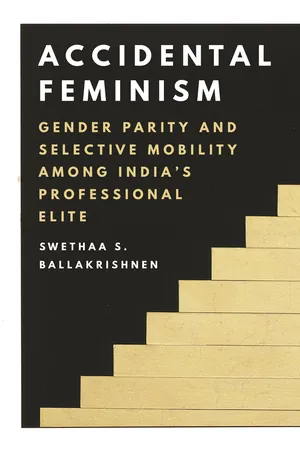
eBook - ePub
Accidental Feminism
Gender Parity and Selective Mobility among India’s Professional Elite
- English
- ePUB (mobile friendly)
- Available on iOS & Android
eBook - ePub
Accidental Feminism
Gender Parity and Selective Mobility among India’s Professional Elite
About this book
Information
Publisher
Princeton University PressYear
2021Print ISBN
9780691182537
9780691213606
eBook ISBN
9780691199993
ONE
FOCI
Market Liberalization and the Changing Nature of Professional Work
GLOBAL PROFESSIONAL OPPORTUNITY following India’s liberalization in 1991 has been an important lens through which to study new kinds of economic opportunity (Singh 2000; Dossani 2008; Evans 1995; Fuller and Narasimhan 2014; Subramanian 2015) and theorize about its implications for stratification and possibilities for mobility (Deshpande 2003; Fernandes and Heller 2006; Jodhka and Newman 2007; Jodhka 2012; Jodhka and Prakash 2016; Jodhka and Naudet 2017). But whereas the mainstay of that research has been the Information Technology (IT) sector, as I mention in the previous chapter, this book tracks a slightly different sort of mobility. The legal and consulting professionals in my study were similar to IT professionals in that they were products of a neoliberal country, employed in organizations and sectors that did not exist in the same vein before liberalization. But they varied distinctly in that they were a much smaller cohort of selectively recruited professionals who, upon graduation, entered a very different class bracket from their counterparts in IT. This difference in cohort size and scope means that the narratives of the professionals in this book are not as pervasive as those of IT professionals when it comes to “ushering global ideologies in public imagination” (Deshpande 2003, 2006; Upadhya 2016). At the same time, this smaller cohort affords a portrait of a different sort of mobility because it consisted of professionals with access to newly elite firms with high—and, importantly, “merit-based”—barriers to entry. Many of my informants insisted that their new status was a function of individual merit rather than inherited privilege. But accounts of Indian mobility processes,1 especially for women, have traditionally also emphasized women’s need to—despite visible and more widespread success—additionally navigate codes of appropriateness and “respectable” middle-class morality (e.g., Radhakrishnan 2011; Freeman 2015). Particularly, even (and, perhaps especially) high-caste women have traditionally had to manage this precarious balance. Here too, the stories in my data offered variation. Professionals in my sample were relatively homogenous in that they were urban, middle-class, and English-speaking. But they felt entitled to their new class position especially because they did not inherit it in obvious ways. Because they had graduated from a specific kind of school that was valorized in a specific sort of market, their success felt “earned.” Many of the people I spoke to were quick to justify their lifestyles on exactly this kind of basis—their dads did not get them their jobs, their dads did not even know of these jobs. How could access to these spaces be tainted?
Merit-based justifications of mobility like “earned” and “just” are not unique to the Indian case. And the idea that cultural “fit” and cultural capital can skew what we otherwise think of as merit is not new. That cultural capital can signal different kinds of class beyond economic wealth has been a long instituted theoretical core of the literature on social reproduction (Bourdieu 1972). More recent studies on elite professional work (e.g., Rivera 2012, 2016; Friedman and Laurison 2019) and elite education (e.g., Armstrong and Hamilton 2013; Khan 2012, 2013) have rebuked the myth that meritocracy is truly committed to “fair” access. Instead, this line of research has shown how inequality occurs anew within the guise of merit (Armstrong and Hamilton 2013; Khan 2013), by offering what looks like truly equal opportunity but in fact is based on a range of cultural “fits” and activities (Rivera 2016) that reinforce the “class ceiling” protecting those with preexisting advantage (Friedman and Laurison 2019).2 Indian accounts of social reproduction (e.g., Fuller and Narasimhan 2014; Subramanian 2015) have reinforced these arguments about merit, cultural capital, and access, especially when considering the role of caste privilege in determining new kinds of sociocultural capital that look like merit while still doing the work of innate social reproduction and elite hierarchies.3
Yet, even graduates from similar class positions experienced their environments across different elite organizations in different ways. Neela, for instance, who made more in her first year as a mid-tier consultant at a global firm than her parents likely made at retirement, was part of a first generation of elites who lived and spoke in the rhetoric of the elite without having emerged from it. Neela wasn’t the daughter of a wealthy businessman who maintained his class position by not working in industry. She was, instead, the daughter of a bank officer and a schoolteacher who, with their middle-class upbringing, never could have imagined living the life she did as an adult. Neela’s middle-class roots no doubt socialized her into thinking of education as the ultimate mobility “teleporter”; and her private-school, English-speaking upbringing—classic signposts of the urban, upper-caste family—were crucial in schooling her about what was “cool” and a “cultural fit.”
Globalization and its effect on institutions has been viewed mainly as an economic or political project. The case of emerging Indian law firms, however, suggests that it is also a social and cultural project, often maneuvered by invisible scripts and cues that have implications for how these environments are navigated. Institutionalization of global norms is not usually observed at this level because data like these are often unavailable—a micro-perspective gives us fresh insight and complicates our understanding of the mimetic isomorphism of global firms. By focusing on activity and meaning-making processes across different organizational sites, this research draws from micro- and meso-level data that institutional scholarship acknowledges as critical (Powell and DiMaggio 1991:16) but rarely employs in its macro-level inquiry. Doing so gives us unique empirical access to observe how potent concepts like legitimacy and decoupling actually play out in these international organizations. Additionally, by investigating at this micro-level with a multi-site case study, this research not only joins a growing effort to observe institutionalism playing out in organizations (see Thornton 2004; Hallett 2010; Greenwood et al. 2017 for review), it adds rigor to this reorientation by situating it in a comparative case-study context.4
This chapter outlines the macro market reforms that framed the context within which personal career trajectories like Neela’s took shape, highlighting the exceptional case—and incidental factors—that framed the emergence of India’s corporate legal elite. I begin by describing the exceptional mobility of these particular global professionals, highlighting the ways that their case differs from the kinds of mobility and praxis widely associated with other Indian professionals, both historically and in the present day. Then I use the variations between the different kinds of global work in India to describe how the novel forms of institutional emergence within the legal profession were especially crucial in establishing the unique—and accidental—circumstances that allowed for the emergence of these women lawyers in elite transactional firms.
Leisure, Membership, and Agency: Praxis of Elite Professionals
Nita was a partner at an elite law firm in Mumbai. Sipping herbal iced tea in one of Mumbai’s “Midtown”5 bistros, she was relatively blasé as she told me about her marital status: “If I find a guy and it works out, great—but I am not looking. I don’t know if I want to be married or have kids—and without it, I know I am not unhappy. Doing something for the sake of doing it makes no sense.” Nita was one of several women in their mid-thirties I interviewed for whom marriage and children were not a foregone conclusion. She had just bought her first apartment in Mumbai, minutes from where her parents lived, so she lived “near but not with” her family. Her commute downtown in her chauffeur-driven car (that she had bought with her own money a few years ago and was looking to upgrade) was, following new construction in Mumbai, only one new super-fast expressway drive away but comfortable enough so she could take calls on her commute. She described her family as “middle-class and traditional in many ways” but also said that they understood that she was happy and didn’t push her to do the “traditional marriage thing.” When we finally managed to meet for lunch after weeks of trying to schedule it, she apologized for her crowded calendar. In fact, she said, she was leaving that night for a vacation with her girlfriends (all of whom were her age and two of whom were also unmarried), heading to Barcelona for the long bank-holiday weekend when work was, as she described it, “light.” When I asked her if there was a special reason for the trip, her explanation revealed that the trip itself was the event: as she put it, “What is the point of all this if you don’t travel?” For Nita, “all this”—her long hours at work and the stress involved in her job—made her feel she deserved time away for leisure.
This book is not original in suggesting we focus on leisure and consumption as a way of understanding the ways class and caste are “done” (Veblen 1899; Deshpande 2003; Currid-Halkett 2016). Yet, Nita’s choices demand particular attention beyond the classic social consumption patterns that determine category constituencies of elite, non-elite, and middle class. Nita’s class status was not just a matter of ownership and location—professionals and elites alike had iPhones and went to malls—or even just about using these things to intermingle with an imagined world community. What distinguished Nita’s class access was that she did not automatically need to worry about how her life choices would be read in her actual, immediate communities or her community of origin. Vacationing in Barcelona with other professional women her age was exactly the sort of expenditure—and life choice—that stood sharply against the chaste relationship to consumption that forms a foundation for Indian middle-class legitimacy (e.g., Donner and Santos 2016; Kesavan 2016). Nita identified her family as “middle class,” but her life was marked by kinds of praxis not available to the average middle-class woman in India.6 Instead, in a single generation, Nita had ridden on her own mobility from a family with “traditional values” to a position from which she was able to disassociate herself from the pressures of her class morality. It is this transition that this book examines.
Nita’s “bank-holiday” trip to Barcelona with her friends suggests another currency at the disposal of this new elite professional class—discretionary time. While accounts of their middle-class peers observed the ways in which women felt they owed explanations to their families and communities for how they used their time, many of the professional elites in my research did not feel that their schedules needed to be vetted by others, especially when it came to their personal leisure. Aditi, a young law firm partner in her early thirties who lived by herself in her Bandra apartment, explained the hard, but in her mind fair, way she balanced home and work:
I still manage on most days to [get to] sleep at 10 pm, get up at 6 am, play squash every day, have my breakfast and read my paper with my morning tea. I work solid hours, yes—but I have not had to compromise on anything.
Similarly, Aarushi, another senior partner—married and in her forties—who took her personal time seriously commented on how she worked around the long hours in the firm by waking up early and making the mornings her personal time. “No one gets here [to the firm] till about 10:30 or 11:00,” she said, “and I am an early riser—so I just make the mornings mine. I play golf, I catch up with my friends, I get some nariyal pani [tender coconut water]—and then I am ready to start the day and put in all the long hours.” For many of these women, personal time had to be carved out of the long hours that their professional lives demanded. But, unlike most traditional middle-class women, they seldom explained their use of time in the context of those they shared their lives with. At the same time, playing squash and golf as the balance for working long hours did not fit the traditional Indian model of upper-class leisure activities for women. Instead, respondents demonstrated the more hybrid cultural praxis that sets this class apart—one that overturns both old notions of leisure as well as the constructed demands of middle-class domesticity.
As members of this new elite professional class, these women were also part of a cosmopolitan clique. On a sultry Saturday in the summer of 2013, I met Kumar, an up-and-coming lawyer in his mid-thirties, in one of Mumbai’s newer country clubs where he and his wife Ira—who worked in another, similarly prestigious firm—had just secured a membership. In the welcome air-conditioning of the club’s “members only” coffee shop, they told me over cool fresh lime sodas and masala peanuts how they were the first in their respective families to have this sort of membership because these clubs, unlike the “old Bombay clubs,” did not require existing family referrals. The conversation was rhythmically interrupted by their respective cell phones—a melody I’d come to expect in these interviews—but when they apologized for it, they explained that it was not work, but the weekend that they were planning for. Each of them had been traveling so much the past weeks that they had not had a chance for proper downtime with their friends in the city, so all the coordination was for a party at their house later that day—a “night of debauchery” as Kumar described it. In this conversation about leisure and socializing, in which it was obvious Kumar and Ira were both equal partners and purveyors, Kumar recalled how he was called out early in his career about gendered assumptions that unfairly excluded his female colleagues:
And I remember once all the guys got together and have a night out and we were drinking away. So a friend of mine, a female counsel, she calls me the next day and she says, “What is wrong with you guys? Why can’t you call us and now make us a part of your network. So we drink with you, we party with you. And you start referring work to us.” And I was stunned, hearing that. And I said okay, I should make it a point. It’s not fair at all. We should make it more inclusive. Get over this stupid childish concept of “boys’ night.”
These were not men and women, then, who had conventional moral scruples about “smoking and drinking”: two classic harbingers of universal modernity (and the doom of globalization) according to the Indian middle class (e.g., Nadeem 2009). In particular, these were not women who were averse to gender-blind socializing after work hours with their colleagues. In fact, there was a certain sense that being excluded from these spaces was offensive. Within these class coordinates, a new kind of professional elite was emerging—one that upended the typical balance between nation, morality, and modernity.
What made this transgression of middle-class norms possible was the promise of membership within a more cosmopolitan, nation-agnostic cohort of global professionals, a “fit” among like-minded community members that was conceived and valorized as early as when these professionals applied for these positions. Neela, a mid-tier consultant introduced earlier in this chapter, who was in her late twenties who worked for a global consulting firm, explained that it was exactly this “cultural fit” that had her excited to be part of this “cool” crew. She recalled the “Day Zero” placement event at her business school, and how the recruiting team from the consulting firm she eventually joined stood out against the vast number of other kinds of employers:
If I think about all the events I attended, the reason consultants stand out is that, by nature of what they do, they are a lot more—do not know what the word is—presentable. They are incredibly smart people, they know how to talk about anything, they have a wide range of experience, and the best part of meeting them in a [recruitment] event is that it’s not like an interview … they are there and they are like “Hey, we just want to speak to you as a person, we want to see if you fit culturally.” … I had a great conversation with a partner about travel experiences.… We both spoke about disastrous flight experiences … and it was great. They do not seem as single-dimensional as others in industry.
Neela revealed that she had since realized that all this casual posturing by partners of “pulling up their sleeves” or saying “what’s up?” or “let’s just talk” was just standard strategy to seem “cool” to students. At the same time, she admitted that the personal connection forged by this familiarity had been paramount in her decision to join this firm, and that that informal spirit continued to convince her that the firm was the right “fit” for her.
Professional spaces have undergone a sea change since 1991, but this transformation has been largely limited to enlarging and stabilizing the middle class (Fernandes and Heller 2006; Radhakrishnan 2009; Fuller and Narasimhan 2010; Patel 2010; Nadeem 2013; Vijayakumar 2013). In contrast, the kinds of pathways and praxes employed by people like Nita, Neela, or Kumar ...
Table of contents
- Cover Page
- Title Page
- Copyright Page
- Dedication
- Epigraphs
- Frontispiece
- Contents
- Preface: Can Feminism Be Accidental?
- Introduction: The Accidental Emergence of India’s Elite Women Lawyers
- Chapter 1. Foci: Market Liberalization and the Changing Nature of Professional Work
- Chapter 2. Frames: Women Can’t Match Up: The Sticky Assumptions of Gender and Work
- Chapter 3. Firms: Just Like an International Firm: The Advantage of Not Being Global
- Chapter 4. Facings: My Clients Prefer a Woman Lawyer: New Returns to Essentialism
- Chapter 5. Families: It Is (Not Always) Difficult Once You Have a Family: Work, Life, and Balance
- Chapter 6. Futures: Now What? What Do We Do with the Accidental?
- Appendix: Research Methods: Design, Discipline, Discursive Distance
- Acknowledgments
- Notes
- Bibliography
- Index
Trusted by 375,005 students
Access to over 1.5 million titles for a fair monthly price.
Study more efficiently using our study tools.
Frequently asked questions
Yes, you can cancel anytime from the Subscription tab in your account settings on the Perlego website. Your subscription will stay active until the end of your current billing period. Learn how to cancel your subscription
No, books cannot be downloaded as external files, such as PDFs, for use outside of Perlego. However, you can download books within the Perlego app for offline reading on mobile or tablet. Learn how to download books offline
Perlego offers two plans: Essential and Complete
- Essential is ideal for learners and professionals who enjoy exploring a wide range of subjects. Access the Essential Library with 800,000+ trusted titles and best-sellers across business, personal growth, and the humanities. Includes unlimited reading time and Standard Read Aloud voice.
- Complete: Perfect for advanced learners and researchers needing full, unrestricted access. Unlock 1.5M+ books across hundreds of subjects, including academic and specialized titles. The Complete Plan also includes advanced features like Premium Read Aloud and Research Assistant.
We are an online textbook subscription service, where you can get access to an entire online library for less than the price of a single book per month. With over 1.5 million books across 990+ topics, we’ve got you covered! Learn about our mission
Look out for the read-aloud symbol on your next book to see if you can listen to it. The read-aloud tool reads text aloud for you, highlighting the text as it is being read. You can pause it, speed it up and slow it down. Learn more about Read Aloud
Yes! You can use the Perlego app on both iOS and Android devices to read anytime, anywhere — even offline. Perfect for commutes or when you’re on the go.
Please note we cannot support devices running on iOS 13 and Android 7 or earlier. Learn more about using the app
Please note we cannot support devices running on iOS 13 and Android 7 or earlier. Learn more about using the app
Yes, you can access Accidental Feminism by Swethaa S. Ballakrishnen in PDF and/or ePUB format, as well as other popular books in Social Sciences & Indian & South Asian History. We have over 1.5 million books available in our catalogue for you to explore.