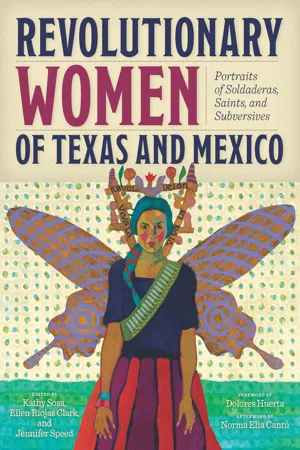
Much ink has been spilled over the men of the Mexican Revolution, but far less has been written about its women. Kathy Sosa, Ellen Riojas Clark, and Jennifer Speed set out to right this wrong in Revolutionary Women of Texas and Mexico, which celebrates the women of early Texas and Mexico who refused to walk a traditional path.
The anthology embraces an expansive definition of the word revolutionary by looking at female role models from decades ago and subversives who continue to stand up for their visions and ideals. Eighteen portraits introduce readers to these rebels by providing glimpses into their lives and places in history. At the heart of the portraits are the women of the Mexican Revolution (1910–1920)?—women like the soldaderas who shadowed the Mexican armies, tasked with caring for and treating the wounded troops. Filling in the gaps are iconic godmothers? like the Virgin of Guadalupe and La Malinche whose stories are seamlessly woven into the collective history of Texas and Mexico. Portraits of artists Frida Kahlo and Nahui Olin and activists Emma Tenayuca and Genoveva Morales take readers from postrevolutionary Mexico into the present.
Portraits include a biography, an original pen-and-ink illustration, and a historical or literary piece by a contemporary writer who was inspired by their subject's legacy. Sandra Cisneros, Laura Esquivel, Elena Poniatowska. Carmen Tafolla, and other contributors bring their experience to bear in their pieces, and historian Jennifer Speed's introduction contextualizes each woman in her cultural-historical moment. A foreword by civil rights activist Dolores Huerta and an afterword by scholar Norma Elia Cantú bookend this powerful celebration of women who revolutionized their worlds.
eBook - ePub
Revolutionary Women of Texas and Mexico
Portraits of Soldaderas, Saints, and Subversives
- English
- ePUB (mobile friendly)
- Available on iOS & Android
eBook - ePub
Revolutionary Women of Texas and Mexico
Portraits of Soldaderas, Saints, and Subversives
About this book
Information
Subtopic
Social Science BiographiesIndex
Social SciencesTWO
Las Antepasadas: Women Revolutionaries Prior to 1910
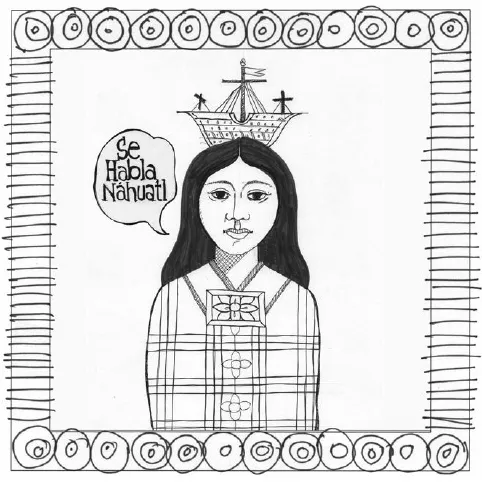
Malinalli, or Malintzín (b. Yucatán, ca. 1500; d. ca. 1529), as a young girl was traded to be a slave to Hernán Cortés following his defeat of a Mayan tribe near Tabasco. She served as Cortés’s translator and an emissary as he made his way toward Mexico City and later bore two children with him. More frequently known as La Malinche, she is a highly contested figure in Mexican history, sometimes faulted for facilitating the Mexican conquest at the side of Cortés and other times honored as a true soldier and mother of the Mexican people. In this excerpt from Laura Esquivel’s novel La Malinche, Malinalli, who has just begun to find pride in her position as an interpreter, is sexually humiliated by Cortés.
La Malinche
LAURA ESQUIVEL
Never before had she felt what it was like to be in charge. She soon found that whoever controls information, whoever controls meaning, acquires power.
MALINALLI WAS WASHING CLOTHES IN THE RIVER, ON THE OUTSKIRTS OF the town of Cholula. She was upset. There was too much noise. Far too much. Not just the noise made by her hands when she scrubbed and rinsed the clothes in the water, but the noise inside her head.
Everything around her spoke of this agitation. The river where she washed the clothes charged the place with music through the force of the waters crashing on the stones. Added to this sound was that of the birds, who were as agitated as ever, the frogs, the crickets, the dogs, and the Spaniards themselves, the new inhabitants of this land, who contributed with the clamorous sounds of their armor, their cannons, and their harquebuses. Malinalli needed silence, calm. In the Popol Vuh, the Sacred Book of their elders, it stated that when everything was at silence—in complete calm, in the darkness of night, in the darkness of the light—then would creation arise.
Malinalli needed that silence to create new and resonant words. The right words, the ones that were necessary. Recently she had stopped serving Portocarrero, her lord, because Cortés had named her “The Tongue,” the one who translated what he said into the Náhuatl language, and what Montezuma’s messengers said, from Náhuatl to Spanish. Although Malinalli had learned Spanish at an extraordinary speed, in no way could it be said that she was completely fluent. Often she had to turn to Aguilar to help her to translate it correctly so that what she said made sense in the minds of both the Spaniards and the Mexicas.
Being “The Tongue” was an enormous responsibility. She didn’t want to make a mistake or misinterpret, and she couldn’t see how to prevent it since it was so difficult translating complex ideas from one language to the other. She felt as if each time she uttered a word she journeyed back hundreds of generations. When she said the name of Ometéotl, the creator of the dualities Omecíhuatl and Ometecuhtli, the masculine and feminine principles, she put herself at the beginning of creation. That was the power of the spoken word. But then, how can you contain in a single word the god Ometéotl, he who is without shape, the lord who is not born and does not die; whom water cannot wet, fire cannot burn, wind cannot move, and earth cannot bury? Impossible. The same seemed to happen to Cortés, who couldn’t make her understand certain concepts of his religion. Once she asked him what the name of God’s wife was.
“God doesn’t have a wife,” Cortés answered.
“It cannot be.”
“Why not?”
“Because without a womb, without darkness, light cannot emerge, life cannot emerge. It is from her greatest depths that Mother Earth creates precious stones, and in the darkness of the womb that gods and humans take their forms. Without a womb there is no god.”
Cortés stared intently at Malinalli and saw the light in the abyss of her eyes. It was a moment of intense connection between them, but Cortés directed his eyes somewhere else, abruptly disconnected himself from her, because he was frightened by that sensation of complicity, of belonging, and he immediately tried to cut off the conversation between them, for, aside from everything else, it seemed too strange speaking about religious matters with her, a native in his service.
“What do you know about God! Your gods demand all the blood in the world in order to exist, while our God offers His own to us with each Communion. We drink His blood.”
Malinalli did not understand all of the words that Cortés had just uttered. What she wanted to hear, what her brain wanted to interpret, was that the god of the Spaniards was a fluid god, for he was in the blood, in the secret of the flesh, the secret of love; that he was contained in the eternity of the Universe. And she wanted to believe in such a deity.
“So then your god is liquid?” Malinalli asked enthusiastically.
“Liquid?”
“Yes. Didn’t you say that he was in the blood that he offered?”
“Yes, woman! But now answer me, do your gods offer you blood?”
“No.”
“Aha! Then you shouldn’t believe in them.”
Malinalli’s eyes filled with tears as she replied. “I don’t believe that they have to offer blood. I believe in your liquid god, I like that he is a God who is constantly flowing and that he manifests himself even in my tears. I like that he is stern, strict, and just, that his anger could create or make the universe vanish in one day. But you can’t have that without water or a womb. For there to be songs and flowers, there needs to be water; with it, words rise and matter takes on form. There is life that is born without a womb, but it does not remain long on the earth. What is engendered in darkness, however, in the profundity of caves, like precious gems and gold, lasts much longer. They say that there is a place beyond the sea, where there are higher mountains, and there, Mother Earth has plentiful water to fertilize the earth; and here, in my land, we have deep caves and within them, great treasures are produced.”
“Really? What treasures? Where are these caves?”
Malinalli did not want to answer him and said that she did not know. His interruption bothered her. It proved that Cortés was not interested in talking about his religion, or his gods, or his beliefs, or even about her. It was clear that he was only interested in material treasures. She excused herself and went to weep by the river.
This and many other things made it difficult for them to understand each other. Malinalli believed that words colored memory, planting images each time that a thing was named. And as flowers bloomed in the countryside after a rainfall, so that which was planted in the mind bore fruit each time that a word, moistened by saliva, named it. For example, the concept of a true and eternal God, which the Spaniards had proclaimed, in her mind had borne fruit because it had already been planted there by her ancestors. From them, she had also learned that things came to exist when you named them, when you moistened them, when you painted them. God breathed through his word, gave life through it, and because of this, because of the labor and grace of the God of All Things, it was possible to paint in the mind of the Spaniards and Mexicas new concepts, new ideas.
Being “The Tongue” was a great spiritual duty, for it meant putting all her being at the service of the gods so that her tongue was part of the resounding system of the divinity so that her voice would spread through the cosmos the very meaning of existence. But Malinalli did not feel up to the task. Very often, when translating, she let herself be guided by her feelings, and then the voice that came out of her mouth was no other than the voice of fear, fear of being unfaithful to the gods, of failure, fear of not being able to bear responsibility. And truthfully, also fear of power, of taking power.
Never before had she felt what it was like to be in charge. She soon found that whoever controls information, whoever controls meaning, acquires power. And she discovered that when she translated, she controlled the situation, and not only that but that words could be weapons. The finest of weapons.
Words were like lightning, swiftly crossing valleys, mountains, seas, bringing needed information as readily to monarchs as to vassals, creating hope or fear, establishing alliances, abolishing enemies, changing the course of events. Words were warriors, be they sacred warriors like the Lord Aguila, or simple mercenaries. As to their divine character, words transformed the empty space in the mouth into the center of Creation, repeating there the same act with which the universe had been made, by uniting the feminine and masculine principles into one.
Malinalli knew that if life was to thrive, and these two principles remain united, she had to position herself in a circular place to safeguard them, to blanket them, since circular forms were what best contained and protected all of creation. Sharp forms, on the other hand, broke things apart, separated them. The mouth, as a feminine principle, like empty space, as a cavity, was the best place for words to be engendered. And the tongue, as a masculine principle, sharp, pointed, phallic, was the one to introduce the created word, that universe of information, into other minds in order to be fertilized.
But what would fertilize it? That was the great unknown. Malinalli was convinced that there were only two possibilities: union or separation, creation or destruction, love or hatred, and that the outcome would be influenced by “The Tongue,” that is, by herself. For she had the power with her words to include others in a common purpose, to clothe them, to shelter them. Or she could exclude them, making them into foes, separate beings with irreconcilable ideas; or into solitary beings who were isolated and destitute as she had been in her status as slave, feeling for so many years what it was like to live without a voice, without being taken into account and forbidden to make any decisions on her own.
But that past now seemed very far away. She, the slave who listened to orders in silence, who couldn’t look directly into the eyes of men, now had a voice, and the men, staring into her eyes, would wait attentively to hear what her mouth uttered. She, who had so often been given away, who so many times had been gotten rid of, now was needed, valued, as much as if not more than cacao.
Unfortunately, this privileged position was unstable and could change at any moment. Even her life was in danger. Only a victory by the Spaniards would guarantee her freedom, for reasons that she had not been afraid to state on various occasions in veiled language, that the Spaniards truly had been sent by the Lord Quetzalcóatl, and not only that but that Cortés himself was the incarnation of the revered god.
Now it was she who could decide what was said and what went unsaid, what to confirm and what to deny, what would be made known and what kept secret. It was a grave dilemma, for it wasn’t simply a matter of saying or not saying, or substituting one name for another, but that in doing so she ran the risk of changing the meaning of things. When translating, she could change what things meant and impose her own vision on events, and by doing so enter into direct competition with the gods, which horrified her. Because of her insolence, the gods could very well become annoyed with her and mete out their punishment, and this absolutely frightened her. She could avoid this fate by translating everything as closely to the meaning of the words as possible. But if the Mexicas were to question for a moment—as she herself had—whether the Spaniards had been sent by Quetzalcóatl, she would be destroyed along with them in the blink of an eye. So she found herself in a delicate position. Either she remained faithful to the gods and to the meaning that they had given to the world, or she followed her instincts, her most earthly and primary instincts, and made sure that each word and each action acquired the meaning that most suited her. The second choice was clearly a rebellion against the gods, and their eventual reaction filled her with fear and guilt, but she saw no other alternative.
Malinalli’s feelings of fear and guilt were at the least as powerful as those of Montezuma. Weeping, trembling, filled with dread, he awaited the punishment of the gods for how the Mexicas had destroyed Tula long before and in that sacred place dedicated to Quetzalcóatl, had engaged in human sacrifice. Before, in the Toltecan Tula, there had been no need for such practices. It was enough that Quetzalcóatl lit the new fire and accompanied the sun on its path through the celestial dome to maintain balance in the cosmos. Before the Mexicas, the Sun did not feed on human blood; it did not ask for it, did not demand it.
The great guilt that Montezuma bore on his shoulders made him certain that not only was it time to pay old debts but that the arrival of the Spaniards signaled the end of his empire. Malinalli could prevent this from happening. She could proclaim that the Spaniards had not been sent by Quetzalcóatl, and they would be destroyed in a moment—along with her, and she did not want to die a slave. She yearned to live in freedom, no longer to be given from one to another, no longer to lead such an errant life.
There was no going back, no way to come out unharmed. She knew too well Montezuma’s cruelty, and she knew that if the Spanish were defeated in their venture, she would be condemned to death. Faced with this possibility, she understandably wanted the Spanish to triumph. And if to assure their victory she had to keep alive the idea that they were gods come from the sea, she would do so, although by now she wasn’t very convinced of the idea. The hope that one day she would be able to do whatever she wanted, marry whom she wanted, and have children without the fear that they might be taken into slavery or destined as sacrifices, was enough to make her take a step back. What she most wanted was a piece of earth that belonged to her and where she could plant her grains of corn, the ones that she always carried with her and that had come from her grandmother’s cornfield. If the Spaniards could make sure that her dreams would crystallize, then it was worthwhile helping them.
Of course, this didn’t assuage her guilt or make clear to her what she should say and what she should keep silent about. What kind of a life is worth defending with lies? And who could confirm that they were lies? Perhaps she was being too harsh. Perhaps the Spaniards had been sent by Quetzalcóatl and it was her duty to collaborate with them until she died, sharing with them privileged information that had come directly from the mouth of a woman in Cholula. This woman had loved Malinalli’s confident personality, her beauty, and her physical strength, and she wanted her as a wife for her son. With the intent of saving Malinalli’s life, she had confided in her, warning her that in Cholula they were preparing an ambush against the Spanish. The plan was to arrest them, wrap them up in hammocks, a...
Table of contents
- Cover
- Title Page
- Copyright
- Dedication
- Contents
- Foreword. Reflections on Revolutionary Women
- Preface
- Introduction. Setting the Scene of Revolutionary Women in Texas and Mexico
- One Women Revolutionaries During the Era of the Mexican Revolution of 1910
- Two Las Antepasadas: Women Revolutionaries Prior to 1910
- Three The Legacy: Women Revolutionaries of the Postrevolutionary Era
- Epilogue
- Notes
- Acknowledgments and Credits
- Contributor Notes
Trusted by 375,005 students
Access to over 1.5 million titles for a fair monthly price.
Study more efficiently using our study tools.
Frequently asked questions
Yes, you can cancel anytime from the Subscription tab in your account settings on the Perlego website. Your subscription will stay active until the end of your current billing period. Learn how to cancel your subscription
No, books cannot be downloaded as external files, such as PDFs, for use outside of Perlego. However, you can download books within the Perlego app for offline reading on mobile or tablet. Learn how to download books offline
Perlego offers two plans: Essential and Complete
- Essential is ideal for learners and professionals who enjoy exploring a wide range of subjects. Access the Essential Library with 800,000+ trusted titles and best-sellers across business, personal growth, and the humanities. Includes unlimited reading time and Standard Read Aloud voice.
- Complete: Perfect for advanced learners and researchers needing full, unrestricted access. Unlock 1.5M+ books across hundreds of subjects, including academic and specialized titles. The Complete Plan also includes advanced features like Premium Read Aloud and Research Assistant.
We are an online textbook subscription service, where you can get access to an entire online library for less than the price of a single book per month. With over 1.5 million books across 990+ topics, we’ve got you covered! Learn about our mission
Look out for the read-aloud symbol on your next book to see if you can listen to it. The read-aloud tool reads text aloud for you, highlighting the text as it is being read. You can pause it, speed it up and slow it down. Learn more about Read Aloud
Yes! You can use the Perlego app on both iOS and Android devices to read anytime, anywhere — even offline. Perfect for commutes or when you’re on the go.
Please note we cannot support devices running on iOS 13 and Android 7 or earlier. Learn more about using the app
Please note we cannot support devices running on iOS 13 and Android 7 or earlier. Learn more about using the app
Yes, you can access Revolutionary Women of Texas and Mexico by Kathy Sosa,Lionel Sosa, Kathy Sosa,Ellen Riojas Clark,Jennifer Speed, Kathy Sosa, Ellen Riojas Clark, Jennifer Speed in PDF and/or ePUB format, as well as other popular books in Social Sciences & Social Science Biographies. We have over 1.5 million books available in our catalogue for you to explore.