This book provides a global and thematic examination of the relationships between archaeology and tourism, and a critical analysis of thinking in the area of archaeology-based tourism. It focuses on the differences and similarities between archaeology-based tourism and heritage tourism and highlights the interdependence and dissonance between tourism and archaeology and archaeological traditions. The volume offers a systematic investigation of current issues and implications in the relationship between tourism and archaeology from both tourism and archaeological perspectives. It is a key academic resource for students, researchers and practitioners in tourism, archaeology, cultural heritage management and anthropology.
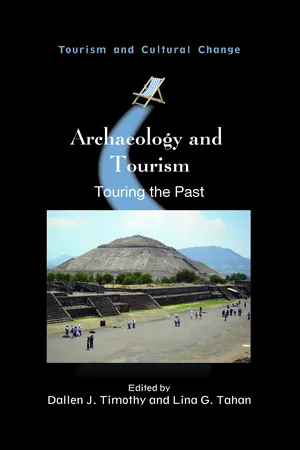
- 248 pages
- English
- ePUB (mobile friendly)
- Available on iOS & Android
eBook - ePub
About this book
Information
1Archaeology and Tourism: Consuming, Managing and Protecting the Human Past
Dallen J. Timothy and Lina G. Tahan
Introduction
Human beings have a long history of mobility for many social and economic purposes, including hunting and fishing, trade, warfare, celebrations and religious pilgrimages. Some archaeologists believe the Turkish site of Göbekli Tepe (10th–8th millennium BCE) to be one of the earliest spiritual gathering places or centers of worship ever discovered. Evidence of religious pilgrimages has also been found from the Vedic age in northern India (c. 1500–500 BCE) during the early stages of Hinduism. Pilgrimages thrived during the Middle Ages in Asia and Europe, although portrayals of this as an early form of tourism have focused largely on the movement of Christians between Europe and Jerusalem, and throughout the lands of the Bible, until the 16th-century Christian Reformation prohibited pilgrimage travel for many Europeans.
Other types of tourism also have a long history. There are records of pleasure travel and ‘sightseeing’ in Egypt as early as 1500 years BCE (Casson, 1994). During antiquity and the Middle Ages, social elites traveled for ‘holiday-making’. Many ancient accounts suggest that nobility, merchants, traders and the aristocracy during antiquity traveled to see sites and places that were already considered quite old. The seven wonders of the ancient world were important destinations during the Greek and Roman empires. In fact, the earliest Greek guidebooks included descriptions and travelers’ reviews of the Egyptian Pyramids, the Temple of Artemis at Ephesus, the Colossus of Rhodes, the Mausoleum of Mausolus, the Ishtar Gate and the Statue of Zeus at Olympia (Timothy, 2011).
As well, the Grand Tour of Europe (17th–19th centuries) was an activity wherein young aristocratic males traveled to various European destinations on set itineraries to view great works of art, historic cities, ancient ruins, and to learn from the artistic masters. This became a right of passage for many youth of the upper classes and is frequently cited as the early forerunner to modern-day tourism (Towner, 1985). The destination foci of the Grand Tour, the sightseeing and holidaymaking activities during classical antiquity and the Middle Ages, and the contemporary manifestations of modern tourism, as exemplified by Thomas Cook in 19th-century Great Britain, almost always pointed to archaeological sites and other parts of the historic environment.
Even today, archaeology remains one of the most ubiquitous assets of present-day tourism, and many worldwide destinations depend largely, or almost entirely, on archaeological remains and other heritage for their tourism economies. While cultural heritage covers a very broad range of resources, of particular interest in this book is built and tangible heritage, namely archaeology. Although heritage and archaeology are not synonymous, they are overlapping concepts; in fact, the archaeological record is part of the broader realm of heritage (Emerick, 2009). This introductory chapter provides an overview of many of the issues in the crossover between tourism and archaeology and sets the conceptual tone for the remainder of the book. It first examines the relationship between archaeology and heritage, suggesting that they are not synonymous but overlapping. The chapter then examines several of the many relationships between archaeology and tourism, and highlights the contents of the book.
Archaeology and Heritage
Archaeology is the scientific field that studies humankind’s past activities by analyzing remnants of material culture. It utilizes techniques, concepts, theories and interpretive tools from the social sciences, physical sciences and humanities. Archaeologists seek to understand past and present human behavior, the origins of humans and their cultures, and the ways in which societies develop over time (Ashmore & Sharer, 2014). Archaeologists use manufactured tools, bones, burial sites, food remains, buildings and other artifacts to discover how people lived in the past and to draw parallels to how we live today. Their work is typically done in three main phases: site surveys to learn as much as possible about the area under study, excavations to uncover buried cultural artifacts or assessments of uncovered buildings and artifacts, and data analysis and publishing the findings.
Site surveys may involve remote sensing to analyze satellite imagery, aerial photographs and drone images, as well as surface surveys. This often entails soil sampling, ‘shovel tests’, radar and laser checks, metal detecting and other similar exercises. Excavations involve digging layers of strata, artifact discovery, measuring and recording contexts, photographing, sifting soil and cleaning. Data analysis requires researchers to catalogue and compare the results with previous findings; artifacts are also dated and their compositions studied. Many different tests are available to evaluate the biotic and abiotic composition of artifacts and estimate their ages (Ashmore & Sharer, 2014).
Contrary to popular belief, not all archaeologists or archaeological studies utilize buried artifacts in their quests for knowledge. Many also analyze historic buildings above ground and their environs, landscapes and settings to understand past social and cultural contexts. All material remnants of human civilizations are important parts of the archaeological record. In fact, although mainstream archaeology continues to use the material past as scientific evidence and discovery, some archaeologists are increasingly interested in intangible culture as a means of understanding the broader cultural context of archaeological remains (Akagawa & Smith, 2019; Carman, 2009; Smith & Akagawa, 2009).
There is a wide range of sub-disciplines in archaeology. These are frequently classified by geographical/regional specialization (e.g. Near Eastern archaeology), particular cultures or civilizations (e.g. Assyriology), chronological concentrations (e.g. Neolithic archaeology), specific themes (e.g. Biblical archaeology), methods (e.g. carbon dating), purposes (e.g. rescue archaeology) or materials (e.g. stone tools). Although not all of them are noted here, there are many other ways of categorizing archaeological specialties.
Concerns over protecting the archaeological record led to the establishment of a specific field known as cultural resource management (CRM) or cultural heritage management (CHM) during the 1970s, with archaeology being among the most important tools used by CHM specialists (Emerick, 2009). CRM/CHM derived originally from the subfield of rescue archaeology and is primarily concerned with the protection, documentation and assessment, curation, interpretation, preservation and restoration of archaeological remains. More recently, it includes efforts to protect and interpret intangible culture. This subfield of archaeology also draws heavily on history, anthropology, geography, and ecology to understand how best to analyze and protect the built environment and intangible heritage. The employment of CRM as a professional field also entails working with archaeology consumers, including tourists.
Public archaeology, or community archaeology, is a way of practicing the science that is ‘by the people, for the people’. While community archaeology has existed in one form or another for decades (e.g. volunteer archaeology), the term and its practice became particularly popular during the 1970s in the United States, the United Kingdom and other areas of Europe and the Middle East. While it initially meant publicly funded explorations, the term has since come to represent an approach to archaeology that democratizes heritage by engaging the public in archaeological work through participation in excavations and building assessments, tours of sites and digs, public lectures, interpretive programs and archaeological site-oriented events and activities.
Through these outreach actions, the archaeological record becomes better embedded in the community with the aim of stimulating public awareness and interest in heritage, increasing recognition for the need to protect archaeological resources, and helping people connect to their own heritage (Moshenska, 2017). This is especially important for descendent communities, such as indigenous peoples or diasporic groups, who might recognize the value of archaeology in connecting them with their ancestors and deepening their sense of place and rootedness (Davidson & Brandon, 2012). These participatory practices are also viewed as an important way to decolonize archaeology (Tahan, 2010a), which traditionally had been done in a top-down manner by the colonists largely for the good of the colonial metropoles.
This book is first and foremost about the relationships between tourism and archaeology. We recognize that archaeology and heritage are not synonymous, although we do acknowledge that archaeology and its practices and discoveries are a salient part of the much broader domain of heritage and have been considered such for many years (Watson, 2009). Heritage has been variously defined as the present-day use of the past and how modern societies value the past, both its tangible and intangible manifestations (Emerick, 2009; Graham et al., 2000; Timothy, 2011).
Waterton and Smith (2009) have suggested that heritage is more fluid than archaeology, that heritage is a cultural process rather than a measurable ‘thing’. Thus, archaeological findings are objectively verified phenomena, whereas heritage reflects more dynamism, subjectivity and negotiable interpretations that may exclude certain communities and elements of the past while including others. This distinction is critical, because for archaeology purists, the vagaries, subjectivity and manipulation of heritage defile the purity of archaeology as the singular and accurate interpretation of material culture (Watson, 2009). From this perspective, then, archaeology itself alone is not heritage, but its use and the social ‘collectivism’ surrounding it may be manifestations of heritage (Fouseki, 2009), particularly in relation to how archaeology provides the fodder for the development (and manipulation) of popular memory, race and nationhood (Hodder, 2012; Watson, 2009; Wilson, 2009).
As previously noted in relation to CRM/CHM, many contemporary archaeologists study the broader notion of heritage to understand the human past more holistically and within broader sociocultural, economic, political and historical contexts. For the purposes of this book, archaeology and heritage are not synonymous. However, the archaeological record as it is used today is part of a long tradition of conflating heritage and archaeology within the cultural industries and in the field of cultural heritage management (Watson, 2009). Thus, the use of archaeology can be seen as part of the broader heritage movement. Although the focus of this book is archaeology, concepts related to other aspects of heritage manifest as well in a variety of settings that are highlighted throughout the book. The very utilization of archaeology and its findings by the tourism industry by definition reflects the heritagization process and renders them a consumable heritage commodity.
Archaeology and Tourism: Relationships and Perspectives
Tourism has several direct relationships with archaeology, but perhaps the most obvious one is cultural artifacts as regional assets for tourism. Many worldwide destinations boast of their archaeological heritage in their marketing activities and branding efforts, where iconic national symbols are imbued with images of famous ancient monuments (Holtorf, 2007). For example, tourism in India is nearly always associated with the Taj Mahal. Peru’s tourism is closely attached to images of Machu Picchu and Jordan’s tourism is linked to Petra, just as Ch...
Table of contents
- Cover-Page
- Half-Title
- Series
- Title
- Copyright
- Contents
- Tables and Figures
- Contributors
- 1. Archaeology and Tourism: Consuming, Managing and Protecting the Human Past
- 2. Archaeologists and Tourism: Symbiosis or Contestation?
- 3. Tourism and the Economic Value of Archaeology
- 4. Privatization, Archaeology and Tourism
- 5. Marketing Archaeological Heritage for Tourism
- 6. Archaeological Heritage and Volunteer Tourism
- 7. Archaeology and Religious Tourism: Sacred Sites, Rituals, Sharing the Baraka and Tourism Development
- 8. Archaeological Destruction and Tourism: Sites, Sights, Rituals and Narratives
- 9. Plundering the Past: Tourism and the Illicit Trade in Archaeological Remains
- 10. Protecting the Archaeological Past in the Face of Tourism Demand
- 11. Interpreting the Past: Telling the Archaeological Story to Visitors
- 12. Archaeology, Nationalism and Politics: The Need for Tourism
- 13. Understanding Perspectives on Archaeology and Tourism
- Index
Trusted by 375,005 students
Access to over 1.5 million titles for a fair monthly price.
Study more efficiently using our study tools.
Frequently asked questions
Yes, you can cancel anytime from the Subscription tab in your account settings on the Perlego website. Your subscription will stay active until the end of your current billing period. Learn how to cancel your subscription
No, books cannot be downloaded as external files, such as PDFs, for use outside of Perlego. However, you can download books within the Perlego app for offline reading on mobile or tablet. Learn how to download books offline
Perlego offers two plans: Essential and Complete
- Essential is ideal for learners and professionals who enjoy exploring a wide range of subjects. Access the Essential Library with 800,000+ trusted titles and best-sellers across business, personal growth, and the humanities. Includes unlimited reading time and Standard Read Aloud voice.
- Complete: Perfect for advanced learners and researchers needing full, unrestricted access. Unlock 1.5M+ books across hundreds of subjects, including academic and specialized titles. The Complete Plan also includes advanced features like Premium Read Aloud and Research Assistant.
We are an online textbook subscription service, where you can get access to an entire online library for less than the price of a single book per month. With over 1.5 million books across 990+ topics, we’ve got you covered! Learn about our mission
Look out for the read-aloud symbol on your next book to see if you can listen to it. The read-aloud tool reads text aloud for you, highlighting the text as it is being read. You can pause it, speed it up and slow it down. Learn more about Read Aloud
Yes! You can use the Perlego app on both iOS and Android devices to read anytime, anywhere — even offline. Perfect for commutes or when you’re on the go.
Please note we cannot support devices running on iOS 13 and Android 7 or earlier. Learn more about using the app
Please note we cannot support devices running on iOS 13 and Android 7 or earlier. Learn more about using the app
Yes, you can access Archaeology and Tourism by Dallen J. Timothy,Lina G. Tahan in PDF and/or ePUB format, as well as other popular books in Business & Museum Studies. We have over 1.5 million books available in our catalogue for you to explore.