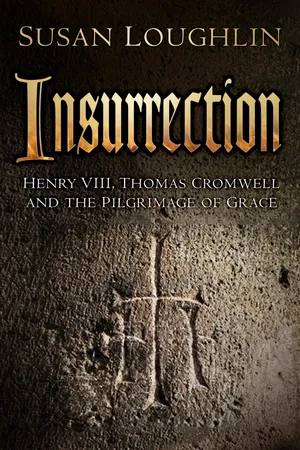
Autumn 1536. Katherine of Aragon and Anne Boleyn are dead. Henry VIII has married Jane Seymour, and still awaits his longed for male heir. Disaffected conservatives in England see an opportunity for a return to Rome and an end to religious experimentation, but Thomas Cromwell has other ideas. The Dissolution of the Monasteries has begun and the publication of the Lutheran influenced Ten Articles of the Anglican Church has followed. The obstinate monarch, enticed by monastic wealth, is determined not to change course. Fear and resentment is unleashed in northern England in the largest spontaneous uprising against a Tudor monarch – the Pilgrimage of Grace – in which 30,000 men take up arms against the king. This book examines the evidence for that opposition and the abundant examples of religiously motivated dissent. It also highlights the rhetoric, reward and retribution used by the Crown to enforce its policy and crush the opposition.
- 224 pages
- English
- ePUB (mobile friendly)
- Available on iOS & Android
eBook - ePub
About this book
Information
1
Background: Government and Religion in 1536
When looking back at the year 1536, Thomas Cromwell must have questioned the merits of astrology. In January, one astrologer, John Robyns, advised him that ‘nothing noteworthy is to be expected’.1 Robyns clearly did not predict the imminent death of Katherine of Aragon, the fall of Anne Boleyn or the outbreak of an insurrection so large that it had the potential to threaten Henry VIII’s grasp on the throne – the largest popular revolt in English history.2 The Pilgrimage of Grace was indeed a massive rebellion against the policies of the Crown and those closely identified with Thomas Cromwell. The underlying causes of the insurrection and the motivation of the participants has been the subject of much debate and controversy among historians and a consensus has not been achieved.
At the start of the New Year 1536, it is probable that Henry VIII thought that the worst of his tribulations in matters of religion had passed. Rome had been repudiated and Parliament had acquiesced in the king’s desire to be recognised as the Supreme Head of the Church within his own realm. His treatment of Katherine of Aragon may have aroused condemnation and censure but Henry had escaped any meaningful retribution by her nephew, the Holy Roman Emperor, Charles V. Anne Boleyn had borne him (another) daughter and was pregnant again, undoubtedly desperate for the chance to present Henry with his longed-for son and heir. The queen and her evangelical adherents must have had grounds for optimism – the Succession Act of 1534, which named Henry and Anne’s issue as heirs, and the executions of Sir Thomas More and Bishop John Fisher all pointed towards a new era.
What, then, did happen to bring about the Pilgrimage of Grace? And to what extent was it religiously motivated? How did a situation arise where such a vast uprising in the region was made possible? What was the perception of Henry’s behaviour abroad? Northern power structures will be examined in due course but initially the religious flux in the realm needs to be addressed. To explore the religious motivation, the events preceding the rebellion and the use of rhetoric (from both sides) in harnessing religious sympathy will be identified.
The Act of Supremacy of 1534 is crucial to the Henrician Reformation/experiment. Clearly the king could not have legally pursued his policies and reformation without it. It is therefore fundamental to an appreciation of the context in which the Reformation was enforced. The king had annexed the power of visitation, the power to discipline the clergy, the right to correct opinion, supervision of canon law and doctrine and the right to try heretics.3 However, in 1535, Henry delegated his ecclesiastical powers to the Lord Privy Seal, Thomas Cromwell, when he appointed him vicegerent, or vicar general, and Cromwell has become synonymous with the ‘policy and police’4 or the enforcement of the Reformation in the 1530s. According to Bush, ‘Cromwell’s vicegerency arose from the government’s urgent need to conduct a survey of the English Church following the break with Rome’.5 Whilst this might well be true, it also was typical of Henry to delegate power to a favoured minister, as he himself had such distaste for everyday administration and the minutiae of detail this concerned. As might be expected, Thomas Cranmer, as Archbishop of Canterbury, also had a role to play in the Henrician Reformation, but it is interesting to note that the experiment became synonymous with Cromwell, a layman.
Before examining any evidence for resistance to the Henrician Reformation in these years, it is necessary to highlight the significance of An Act Extinguishing the Authority of the Bishop of Rome6 and both the First and Second Henrician Injunctions. The 1536 act, extinguishing the ‘pretended power and usurped authority of the Bishop of Rome, by some called the Pope’, was the final piece of legislation severing England’s ties with Rome. The act made it illegal to ‘extol, set forth, maintain or defend the authority, jurisdiction or power of the Bishop of Rome’ with effect from the first day of August 1536. Anyone guilty of so doing and ‘being thereof lawfully convicted according to the laws of this realm … shall incur … penalties, pains and forfeitures’. Clearly this statute is absolutely central to the enforcement of the Royal Supremacy and any changes, doctrinal or otherwise, resulting from it. These statutes and the promulgation of the Ten Articles of the Faith of the Church of England and the dissemination of the First Henrician Injunctions underpinned the king’s religious policy prior to the autumn of 1536.
In early January 1536, the Imperial Ambassador to Rome, Dr Pedro Ortiz, wrote to Katherine of Aragon that the ‘intention of the pope is that … prayers shall be offered for the Queen and Princess, and the Saints who are fighting for the faith in England’.7 Dr Ortiz’s communications throughout 1536 do appear to be both lively and dogmatic but they are also prone to exaggeration and a scant regard for detail. However, his letter to Katherine as she lay dying at Kimbolton (exiled by Henry and forbidden from seeing her daughter, Princess Mary) does illustrate that the English Reformation was by no means perceived abroad as the abject capitulation of Henry’s subjects. This can also be seen in the writings of Johannes Cochlaeus. On 6 January, he wrote to Henry that he was encouraged by the constancy of Fisher and More, whom Henry had put to death, and enlarged on the crimes into which the king has been led by his ‘lawless passion’.8
The Reformation was disseminated and enforced by injunctions, proclamations and statutes and in February 1536, a draft Act of Parliament was drawn up ‘against pilgrimages and superstitious worship of relics’.9 In March 1536, we witness Cranmer hard at work on the preliminaries. Eustace Chapuys, the imperial ambassador, wrote to Charles V:
The prelates here are daily in communication in the house of the archbishop of Canterbury for the determination of certain articles and for the reform of ecclesiastical ceremonies … they do not admit … purgatory … the use of chrism … the festivals of the saints and images …10
It would be only natural that fear and uncertainty would have been present within the realm, as previously held certainties and practices were swept away. In February, Chapuys reported that the people were in despair and seeking help from abroad; and in April, a priest in Cumberland was reported to Cromwell for having said that 40,000 would rise up in one day. Henry himself was ‘apprehensive of some commotion’ in June when the people expected the restoration of the Princess Mary, following the fall and execution of Anne Boleyn in May.11
The pace of reform, however, continued. The Act Extinguishing the Authority of the Bishop of Rome was followed by an Act of Convocation for the Abrogation of Certain Holydays, especially during harvest time, which was passed in August.12 The First Henrician Injunctions were drawn up by Thomas Cromwell and issued in August 1536 and instructed the clergy on the changes in religion – they were an accompaniment to the Ten Articles of the Anglican Church.13 The clergy in convocation had acquiesced with the Ten Articles and rejected Purgatory, as well as accepting the abrogation of holy days. Purgatory and prayers for the dead had been a central tenet of the medieval Church and were woven into the fabric of local religious culture, which also set great store by the veneration of local saints and pilgrimages.14 At the same time as these disturbing innovations were taking place, the monasteries were being dissolved (the legislation of empowerment having been enacted in February–April of 1536).15 The timing of the outbreak of the Northern Rebellions is significant. It surely can be no coincidence that a rebellion which commenced no more than eight weeks after the First Henrician Injunctions would have been motivated by the changes in religion.
It is appropriate, at this juncture, to look at some instances of opposition to the Henrician religious innovations prior to the outbreak of the Lincolnshire and Yorkshire risings. Yorkshire and Lincolnshire were by no means the only counties where dissent was evident; it was indeed a concern in ‘every part of the realm’.16 For example, the Vicar of Stanton-Lacy in Shropshire was examined before the Council in the Marches in September–October 1535 for having failed to delete the pope’s name from his service books. Bishop Rowland Lee forwarded the papers to Cromwell but no more was heard of it.17 Bristol, which had been the base of the evangelical Hugh Latimer, was the setting for what Elton has described as ‘violent exchanges’ from the pulpit between the old and new.18
Preaching was an important tool in promulgating the Crown’s religious message throughout the country prior to and after the Pilgrimage. A Friar Brynstan preached at Glastonbury Abbey in March 1536, and clearly his views would have been at odds with Cromwell’s but perhaps more representative of the groundswell of opinion. He spoke about those who embraced the ‘new books’, calling them ‘adulterers’ and ‘filthy lechers’. He further accused them of being full of envy and malice, whilst being ready to wrong their neighbours. Master Lovell, in Dorset, was reported for disloyal preaching in the summer of 1536. He had encouraged the people to keep holy days and offer candles, as well as cautioning them against heretics and the practice of reading the New Testament in English. A prior in St Alban’s Abbey, Hertfordshire, denounced Cromwell and Anne Boleyn as the maintainers of all heresies and asked what should be done about those whose purpose it was to destroy his religion?19 However, the sub-prior of Woburn, Bedfordshire, sought pardon for the scruples he had entertained regarding the Royal Supremacy and his erroneous estimation of More and Fisher.20 The First Injunctions were issued in August 1536 and as early as 30 September, Sir Henry Parker was reporting of opposition in Hertfordshire: the curates and sextons of Stortford and Little Hadham had kept the holy day with high and solemn ringing and singing, contrary to the king’s injunctions.21
How were events in England perceived outside the realm prior to the Lincolnshire Rising and the Pilgrimage? Charles V and King Francis I of France had done little to interfere in developments in England since the break with Rome. It would be hard to determine a motive for any potential French involvement, apart from wanting to appease the papacy and perhaps stir up some more trouble for their perennial enemies, the English. The ‘Most Christian King’, Francis, was more than preoccupied with Hapsburg–Valois rivalry and the Italian Wars. Indeed these priorities had led him to form an alliance with Suleiman the Ma...
Table of contents
- Cover
- Title
- Acknowledgements
- Contents
- Introduction
- 1 Background: Government and Religion in 1536
- 2 The Pilgrimage of Grace: A Holy Crusade?
- 3 Resumption of Revolts and Royal Retribution
- 4 Rehabilitated Rebels and Reward
- 5 Loyalty and Patronage
- 6 Perceptions and the Pilgrimage: The Crown’s Response
- 7 The Rhetoric of Resistance and Religiosity
- Conclusion
- List of Abbreviations
- Bibliography
- Plates
- Copyright
Trusted by 375,005 students
Access to over 1.5 million titles for a fair monthly price.
Study more efficiently using our study tools.
Frequently asked questions
Yes, you can cancel anytime from the Subscription tab in your account settings on the Perlego website. Your subscription will stay active until the end of your current billing period. Learn how to cancel your subscription
No, books cannot be downloaded as external files, such as PDFs, for use outside of Perlego. However, you can download books within the Perlego app for offline reading on mobile or tablet. Learn how to download books offline
Perlego offers two plans: Essential and Complete
- Essential is ideal for learners and professionals who enjoy exploring a wide range of subjects. Access the Essential Library with 800,000+ trusted titles and best-sellers across business, personal growth, and the humanities. Includes unlimited reading time and Standard Read Aloud voice.
- Complete: Perfect for advanced learners and researchers needing full, unrestricted access. Unlock 1.5M+ books across hundreds of subjects, including academic and specialized titles. The Complete Plan also includes advanced features like Premium Read Aloud and Research Assistant.
We are an online textbook subscription service, where you can get access to an entire online library for less than the price of a single book per month. With over 1.5 million books across 990+ topics, we’ve got you covered! Learn about our mission
Look out for the read-aloud symbol on your next book to see if you can listen to it. The read-aloud tool reads text aloud for you, highlighting the text as it is being read. You can pause it, speed it up and slow it down. Learn more about Read Aloud
Yes! You can use the Perlego app on both iOS and Android devices to read anytime, anywhere — even offline. Perfect for commutes or when you’re on the go.
Please note we cannot support devices running on iOS 13 and Android 7 or earlier. Learn more about using the app
Please note we cannot support devices running on iOS 13 and Android 7 or earlier. Learn more about using the app
Yes, you can access Insurrection by Susan Loughlin in PDF and/or ePUB format, as well as other popular books in History & Historical Biographies. We have over 1.5 million books available in our catalogue for you to explore.