As an interpreter in the German Foreign Ministry, Paul-Otto Schmidt (1899–1970) was in attendance at some of the most decisive moments of twentieth-century history. Fluent in both English and French, he served as Hitler's translator during negotiations with Chamberlain, the British declaration of war and the surrender of France, as well as translating the Führer's infamous speeches for radio. Having gained favour with the Nazi Party – donning first the uniform of the SS then that of the Luftwaffe – Paul Schmidt was given 'absolute authority' in everything to do with foreign languages. He later presided over the interrogation of Canadian soldiers captured after the 1942 Dieppe Raid. Arrested in May 1945, Schmidt was freed by the Americans in 1948. In 1946 he testified at the Nuremberg Trials, where conversations with him were noted down by the psychiatrist Leon Goldensohn and later published. After the war he taught at the Sprachen und Dolmetscher Institut in Munich. Hitler's Interpreter presents a highly atmospheric account of the bizarre life led behind the scenes at the highest level of the Third Reich. Roger Moorhouse is a historian of the Third Reich. He is the author of the acclaimed Berlin at War, Killing Hitler and The Devil's Pact. He has contributed to He Was My Chief, I Was Hitler's Chauffeur, With Hitler to the End and Hitler's Last Witness.
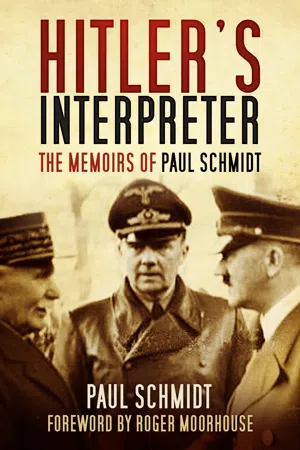
- 272 pages
- English
- ePUB (mobile friendly)
- Available on iOS & Android
eBook - ePub
About this book
Information
FIVE
JANUARY TO 3 SEPTEMBER
1939
Although Germany had not plunged into war in 1938, I realised from the words I had to translate for Hitler and Ribbentrop in the first months of the fateful year 1939 that Germany was again approaching the abyss, slowly at first and then at an ever increasing speed.
There can have been no period in my career when I took part in such a plethora of separate talks as between the Munich Conference and the disastrous 3 September 1939. Part of my duties was to make reports on all these conversations, many of which have since been published. I was aware when I wrote them that, together with other documents, they would be the raw material from which historians would form an impartial judgment of the events with which the reports were concerned. At the same time I bore in mind that my fellow Germans might see for themselves from these reports how Hitler was conducting his foreign policy. Soon after the Munich Conference my fear intensified that catastrophe was inevitable although I had as yet no concept of its extent.
All I can do is indicate the theme running through all these discussions and events. After the fateful German march into Prague, which my friends and I regarded with horror as the prelude to disaster, there followed the shrill, jarring symphony of August 1939 that culminated in the final agreement between Britain and France to declare war on Germany.
During this period there was a significant absence of the brilliant festivals that had dazzled the world in 1937 and at the beginning of 1938. In retrospect, the main feature of those last months before the outbreak of the Second World War seems to me to have been the wide contrast between the continued protestations of peace to the outside world and the busy preparations for war at home. From the position where I saw it, this was the vital feature of the last years before the outbreak of the Second World War.
An Italo-German tribunal met in October 1938 in the magnificent setting of Schloss Belvedere in Vienna, once the summer residence of Prinz Eugen of Savoy, to settle Hungary’s territorial claims on the remnants of Czechoslovakia. A map of the disputed territories was spread out on a large table, around which stood Ribbentrop and Ciano with their advisers. Each of the Foreign Ministers had a thick pencil, and as they spoke they corrected the frontier line that had been drawn up by experts as the basis for arbitration.
‘If you go on defending Czech interests like that,’ Ciano exclaimed to Ribbentrop with a malicious smile, ‘Hacha will give you a decoration.’ He altered the line with thick pencil strokes in Hungary’s favour.
A Foreign Office expert whispered to Ribbentrop who then protested, ‘That’s definitely too far,’ and he redrew part of the line. The Foreign Ministers went on arguing in this way for quite a while, rubbing out and drawing in new lines, the pencils getting blunter and the frontiers thicker. ‘The boundary commission will find it hard to determine the line,’ a colleague whispered to me, ‘those thick pencil marks are each a few kilometres broad.’
Seldom have I been made so acutely aware of the contrast between the light-hearted decisions on frontiers taken by statesmen in the splendid apartments of historic castles and the consequences of their decisions in terms of everyday life in the territories affected.
I was aware of a similar conflict between outward form and inner significance in the ‘friendly visits’ on which I accompanied Ribbentrop to Paris and Warsaw in December 1938 and January 1939. ‘The German and French governments share the conviction that peaceful and good-neighbourly relations between Germany and France constitute one of the most essential elements for stabilising conditions in Europe and maintaining peace’, ran the statement solemnly signed by Ribbentrop and Bonnet on 6 December 1938 in the Salle de l’Horloge at the Quai d’Orsay. It was in the same room that ten years earlier I had seen Stresemann, Briand and Kellogg put their signatures to the pact outlawing war.
‘Both governments … solemnly recognise as final the frontier between their countries as it runs at present,’ the text continued. I read out the German version while photographers cluttered the room with their apparatus, robbing the occasion of much of its dignity. ‘Both governments are resolved,’ I read on, ‘subject to their special relations with third powers, in all questions affecting their two countries … to enter into consultation if the future development of such questions should lead to international difficulties.’
This was the deceptive facade behind which a rather disjointed discussion of the general situation took place in another room of the French Foreign Office between Bonnet and Ribbentrop a short time after the statement was signed. Ribbentrop sometimes spoke in French, and sometimes I translated into French from German for him. Nothing was translated into German, and this perhaps is how the misunderstanding arose that marked this conversation.
At one point Bonnet, who had previously expressed the intention of France to vigorously develop her colonial empire, had stated that at the Munich Conference France had shown herself to be disinterested in Eastern Europe. These words were in fact spoken during that earlier discussion, although they were later disputed by the French. Bonnet had probably meant them to refer only to past events in Czechoslovakia. Ribbentrop on the other hand applied them also and primarily to the future attitude of France towards Poland, the more so as Bonnet referred to the desirability of a German-Polish agreement about the Corridor and Danzig.
Ribbentrop had some grounds for this interpretation in the tension that had then existed for some time between Paris and Warsaw. This had found expression in severe attacks against Poland in the French and British press because of the way the Polish government, taking advantage of the Czechoslovak weakness following the Sudeten crisis, had occupied the Olsa area. ‘If Hitler now invades Poland, I will shout, Sieg Heil!’ the well-known British author and broadcaster Stephen King-Hall wrote.
Another feature of this conversation was Ribbentrop’s violent outburst against Britain. In the harsh words he uttered against the British government, press and individual MP’s such as Duff Cooper and Eden, I recognised immediately the angry voice of his master.
Hitler at that time was wont to shout ‘Britain is to blame for everything!’ with the same tenacity in foreign affairs as that with which his declaration ‘The Jews are to blame for everything!’ occurred in internal matters. Ribbentrop made such a point in Paris of this ‘Britain is to blame for everything’ that even the gentle Bonner replied rather emphatically that in no circumstances would there be any change in Anglo-French cooperation, which must provide the basis for detente between France and Germany.
I saw at once that Ribbentrop was merely echoing Hitler’s dislike of Britain and was not trying to drive a wedge between Britain and France when, after Bonnet’s emphatic reply, he changed his tune at once and said he approved of close Anglo-French cooperation. This was the counterpart to Italo-German understanding. Thus the atmosphere during this ‘friendship visit’ was anything but one of friendly understanding between France and Germany.
The French could not have taken more pains on the material side, even having sent to Berlin for our journey to Paris a special train with Pullman coach built recently for the visit of King George VI, but during Ribbentrop’s talks we kept coming up against French distrust, particularly from the permanent officials such as Alexis Leger.
In due course, we in our Foreign Office ‘admiral’s’ uniforms laid a large wreath on the Tomb of the Unknown Soldier at the Arc de Triomphe. The swastika ribbon for it had to be flown by special courier from Berlin because our protocol department had forgotten to include it in the hurry of our departure. We all had the feeling that it was only a theatrical gesture, however.
Such also was probably the feeling of the people of Paris with regard to the whole visit. In so far as the rigorous police precautions enabled us to get a sight of the Parisians, they showed themselves to be completely apathetic and uninterested. At the time the attention of the world was fixed on Paris in some suspense suspecting that much more lay behind the three hours’ conversation at the Quai d’Orsay than in fact there was in that very superficial exchange of views.
I had a most interesting personal experience during this visit when I had the good fortune to have a long talk at a German Embassy reception with the famous French writer Jules Romains. I esteemed him highly as the author of the monumental Les Hommes de Bonne Volonté. He was clearly agreeably surprised that someone who had come to Paris with Ribbentrop should speak with so much enthusiasm of his work and even be able to quote from it. I had met enough men de bonne volonté, of goodwill, in politics to realise that the salvation of the world, then as now, depends upon these men and that fanatics, of whatever nationality or race, are the real enemies of mankind.
At the end of January 1939 I accompanied Ribbentrop to Warsaw on another ‘goodwill’ visit. Here the difference between the outward show and the inner reality was greater even than in Paris.
The station of the Polish capital, when we arrived there on the afternoon of 26 January 1939, was decorated with swastika banners, there was a guard of honour and military bands played the national anthems. Beck, the Polish Foreign Minister, received us. He was accompanied by a numerous entourage as well as by his wife, who presented Frau von Ribbentrop with a bouquet. Here also we laid a wreath on the tomb of Poland’s unknown soldier. Although protestations of friendship were expressed only moderately in the toasts proposed at a banquet, none of the dangerous outward difficulties between the two countries, which had surfaced fairly sharply during a visit made by Beck to Obersalzberg early in the year, were mentioned, although they did become the theme afterwards in discussions between Ribbentrop and Beck.
During the course of Beck’s earlier visit to Hitler, I had been able to plainly foresee the impending Polish-German trouble that was to culminate in the British Ambassador handing me, on 3 September 1939, the ultimatum that plunged the world into war.
At the Obersalzberg talk in January, Hitler had spoken again of a proposal that had just emerged after the Munich Agreement. Incidentally, the meeting had been arranged at a time when Polish objections were being made known regarding the declaration of independence by the Carpathian Ukraine, which had previously been part of Czechoslovakia. It was the stated Polish view that the Carpathian Ukraine should be annexed by Hungary, and Poland opposed the undertaking given by Hitler at Munich in connection with his guarantee to the remaining part of Czechoslovakia.
German demands were concerned principally with the return of Danzig, although Poland’s economic interests in that city were to be safeguarded. Hitler also demanded the construction of an extraterritorial highway and railway track through the Corridor to secure communications between Reich territory and East Prussia, and in return offered a guarantee of the German-Polish frontier and a renewal of their non-aggression pact. The conclusion of this pact on 26 January 1934 had been Hitler’s first major act of foreign policy.
The day before Beck saw Hitler at the Obersalzberg, Ribbentrop had hammered away at him for hours with that peculiar insistence that observers and victims have rather aptly called ‘insistent penetration’ in order to get him to accept the German requirements at least in principle. With equal obstinacy Beck had refused persistently, being especially resolute over Danzig. If he had had his way, he would have offered a precisely opposite arrangement, offering Germany safeguards for her economic interests in the city but refusing to consider any political reincorporation. ‘I cannot ask public opinion in Poland to agree to that,’ was his stock answer.
This argument had been repeated standing by the large window in Hitler’s study at the Berghof, although Beck had then put his refusal more mildly. He had gone so far to agree to an examination of the question as a whole, but with the clear implication that the Polish attitude would be negative.
These differences were naturally very fresh in my mind during the outwardly friendly meetings at Warsaw at the end of January. Ribbentrop tried again, with even greater persistence than before, to get Beck to agree to the German proposals. He was again met with a refusal that was no less definite for the polite and tortuous form in which the Polish Foreign Minister knew how to deliver it. This was the last major attempt to reach agreement with Poland by peaceful negotiation.
In the early hours of the fateful 15 March 1939, a date that I personally regard as the beginning of the end, Hitler received the Czech President Dr Hacha and his Foreign Minister, Chvalkovsky, in a huge room at the newly completed Reich Chancellery for the mysterious discussion that resulted in the sensational creation of a German protectorate over Bohemia and Moravia. The detailed circumstances of this move caused much speculation both at the time and later. The dark panelling of the room, lit only by a few bronze lamps, produced a sinister atmosphere, so gloomy that the portraits on the walls and the statue of Frederick the Great could hardly be made out – a fitting framework for the tragic scene of that night.
President Hacha was the successor to Benes. A short, elderly man with dark eyes set in a face flushed with agitation, he was shown into this room shortly after 1 a.m. He had done his best to give no occasion for criticism to his giant neighbour Germany, which bordered the diminished Czechoslovakia on three sides. I had often been present at discussions in Berlin when Chvalkovsky had tried to divine Ribbentrop’s wishes from his expression, as it were, lest by some mischance he should give Ribbentrop the least offence. In the commercial field he had expressed his readiness for a customs union and for granting Germany preferential treatment in general, and in political matters he had acquiesced in every way conceivable. The short, dark Foreign Minister expressed his pathetic anxiety to please in a sentence that could not have summed up the situation better: ‘And in foreign matters we would like to depend on you, Herr Reichsminister, if we may.’
All this had been to no avail, however, for the Czechs were like a red rag to Hitler. At the time I ascribed this to his Austrian past, whereas I now connect his irrational rage against the Czechs to the theory that he himself had Czech blood. I had already heard it being said in the Chancellery in early January that Hitler had decided to liquidate the Czech State. I was appalled by this report for several times during the Sudeten crisis in 1938 I had translated Hitler’s assurance to Chamberlain that the Sudeten problem constituted his last territorial demand. The phrase ‘We want no Czechs’ from his Sports Palace speech still resounded in my ears. Hitler and Chamberlain had assured each other that they were ‘resolved to deal with other matters also … by the method of consultation.’ The day of reckoning could not be long delayed if Chamberlain, the exponent of a friendly policy towards the Reich, were to be so blatantly repudiated; if this man, highly esteemed throughout the world (including in Germany as I had seen for myself) were made to look ridiculous by having all promises, written or verbal, torn up and flung defiantly at his feet.
My awareness of Hitler’s true intentions showed me the motives behind the press campaign against the remnant of Czechoslovakia, and against the declarations of independence by Slovakia and Carpathian Ukraine. Accordingly a few days before 13 March I was not surprised to learn that German troops would march into Czech territory in the early hours of 15 March.
Hacha and Chvalkovsky had also seen disaster approaching and this was their last-minute desperate effort to save their country. They sought an interview with Hitler, who agreed to receive them in Berlin. They were met at the Berlin-Anhalter station with all the honours due a head of state, and when they reached the Chancellery they were welcomed in the courtyard by the watch company of the SS Leibstandarte Panzer Division, whose band played the regimental march and who, as a final touch of grotesque irony, were then inspected by Hacha.
In Hitler’s gloomy office the realities of the situation emerged by contrast even ...
Table of contents
- Cover
- Title
- Contents
- Foreword
- Extracts from the Editor’s Preface, 1951 Edition
- Introduction
- One 1935
- Two 1936
- Three 1937
- Four 1938
- Five January to 3 September 1939
- Six 3 September 1939 to End of 1940
- Seven 1941
- Eight 1942 and 1943
- Nine 1944 and 1945
- Epilogue 1945 to 1949
- Plates
- Copyright
Trusted by 375,005 students
Access to over 1.5 million titles for a fair monthly price.
Study more efficiently using our study tools.
Frequently asked questions
Yes, you can cancel anytime from the Subscription tab in your account settings on the Perlego website. Your subscription will stay active until the end of your current billing period. Learn how to cancel your subscription
No, books cannot be downloaded as external files, such as PDFs, for use outside of Perlego. However, you can download books within the Perlego app for offline reading on mobile or tablet. Learn how to download books offline
We are an online textbook subscription service, where you can get access to an entire online library for less than the price of a single book per month. With over 1.5 million books across 990+ topics, we’ve got you covered! Learn about our mission
Look out for the read-aloud symbol on your next book to see if you can listen to it. The read-aloud tool reads text aloud for you, highlighting the text as it is being read. You can pause it, speed it up and slow it down. Learn more about Read Aloud
Yes! You can use the Perlego app on both iOS and Android devices to read anytime, anywhere — even offline. Perfect for commutes or when you’re on the go.
Please note we cannot support devices running on iOS 13 and Android 7 or earlier. Learn more about using the app
Please note we cannot support devices running on iOS 13 and Android 7 or earlier. Learn more about using the app
Yes, you can access Hitler's Interpreter by Paul Schmidt in PDF and/or ePUB format, as well as other popular books in History & Military Biographies. We have over 1.5 million books available in our catalogue for you to explore.