The apostrophe causes more problems in the English language than any other aspect of grammar. Grown adults with a university education don't know how to use it properly, and our high streets are filled with hilarious examples of its misuse. Join the pedants as they revolt against the misuse of this essential piece of punctuation and with one simple rule learn how to use the apostrophe correctly – once and for all.
eBook - ePub
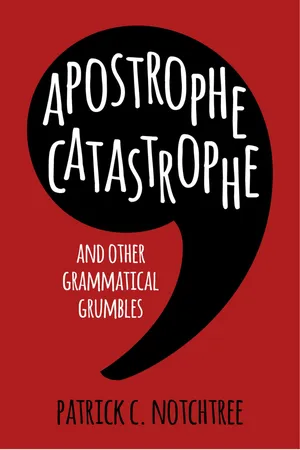
Apostrophe Catastrophe
And Other Grammatical Grumbles
- 160 pages
- English
- ePUB (mobile friendly)
- Available on iOS & Android
eBook - ePub
About this book
Information
Topic
Personal DevelopmentSubtopic
Grammar & PunctuationFREQUENTLY ASKED QUESTIONS
Not very long after my website first went online some years ago, I started to receive requests for help and clarification. I have done my best to help and I think by and large I have. I have even been called an angel, and told that my correspondent is in love with me! Hyperbole I’m sure, but the sentiment is appreciated. I have also been assumed to be a 40-year-old lady librarian. I’m not.
© www.broadsheet.ie
I have no doubt that the reader of this book will also have questions and you may well find it has been asked before and that the answer here. One would think that after several years every question about apostrophes would have been asked, and I think most possibilities are covered in these FAQ pages. The questions keep coming though, and many have raised interesting topics and led to some fascinating discussions
You may find what appear to be inconsistencies and variations in what seem to be the same problem. In my defence all I can say is that on each occasions I try to look at each problems in its own context and answer as best I can. Also, although I talk a lot about the single ‘rule’, I am not using the word rule in some kind of grammatical legal sense. As far as I’m aware there is no legislation in any jurisdiction that lays down rules for the English language. That is one of the reasons for its success as a language; it is dynamic, growing and ever changing. That’s not to say there isn’t good practice and no standards of literacy that should be maintained. But the guiding principle should be clarity of communication and lack of ambiguity.
This section contains the Q&As of a general nature or where it is hard to classify the nature of the question being asked. Where a questioner has a query that covers more than one category it might also be included in this general category, or placed where the principal or more interesting question would indicate. In order to help the reader find the answer to a specific topic, further sections of Q&A follow gathered, I hope, into logical groups.
I encourage the reader to browse through the various Q&A sections as some of the discussions are quite enlightening, both about the confusion the little apostrophe can cause and the solutions to the problems that arise. I hope that these will add to the reader’s understanding of the dreaded apostrophe.

Q: I am a Year 3 teacher. Please help clarify an amiable dispute between a colleague and myself. How would you HANDwrite contractions such as:
don’t; couldn’t
I think you would join the don, leave a gap, then write the t, then put the apostrophe in the gap. My colleague insists that you would write the do, leave a small gap, then the nt written together, with the apostrophe just between them.
Your advice would be much appreciated.
A: Well, this is a handwriting issue more than a grammatical one, especially as you both agree where the apostrophe should be.
I’m on your side here, although I can see your colleague’s reasoning. Although don’t is a contraction of do not it is established as a single ‘word’ and if it is never printed with a gap why would one want to make a difference when writing it? Does your colleague type it with a gap? If not, why is he or she inconsistent in this respect? How does he or she actually say it? With a small gap? :-)
I have never tried my method with Year 3, but it does work with Year 5 and especially Year 6.
Q: Here at the Glasgow Centre for Population Health (where the three of us discussing this have seven degrees between us!) we are having a heated debate about the correct place for the apostrophe in a title of research. The research is considering the response of 720 unconnected individuals to external effects of stress, including psychological, biological and social. We want to know how to phrase the...
Table of contents
- Cover
- Title
- Contents
- Introduction
- One Easy Rule
- Possessives
- The Olden Days
- The Book of Cassius
- Test Yourself
- Some Other Grammatical Grumbles
- Frequently Asked Questions
- Postscript
- By the Same Author
- Copyright
Trusted by 375,005 students
Access to over 1.5 million titles for a fair monthly price.
Study more efficiently using our study tools.
Frequently asked questions
Yes, you can cancel anytime from the Subscription tab in your account settings on the Perlego website. Your subscription will stay active until the end of your current billing period. Learn how to cancel your subscription
No, books cannot be downloaded as external files, such as PDFs, for use outside of Perlego. However, you can download books within the Perlego app for offline reading on mobile or tablet. Learn how to download books offline
Perlego offers two plans: Essential and Complete
- Essential is ideal for learners and professionals who enjoy exploring a wide range of subjects. Access the Essential Library with 800,000+ trusted titles and best-sellers across business, personal growth, and the humanities. Includes unlimited reading time and Standard Read Aloud voice.
- Complete: Perfect for advanced learners and researchers needing full, unrestricted access. Unlock 1.5M+ books across hundreds of subjects, including academic and specialized titles. The Complete Plan also includes advanced features like Premium Read Aloud and Research Assistant.
We are an online textbook subscription service, where you can get access to an entire online library for less than the price of a single book per month. With over 1.5 million books across 990+ topics, we’ve got you covered! Learn about our mission
Look out for the read-aloud symbol on your next book to see if you can listen to it. The read-aloud tool reads text aloud for you, highlighting the text as it is being read. You can pause it, speed it up and slow it down. Learn more about Read Aloud
Yes! You can use the Perlego app on both iOS and Android devices to read anytime, anywhere — even offline. Perfect for commutes or when you’re on the go.
Please note we cannot support devices running on iOS 13 and Android 7 or earlier. Learn more about using the app
Please note we cannot support devices running on iOS 13 and Android 7 or earlier. Learn more about using the app
Yes, you can access Apostrophe Catastrophe by Patrick C. Notchtree,Patrick Notchtree in PDF and/or ePUB format, as well as other popular books in Personal Development & Grammar & Punctuation. We have over 1.5 million books available in our catalogue for you to explore.