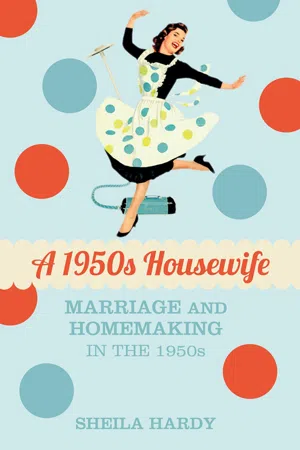
Being a housewife in the 1950s was quite a different experience to today. After the independence of the wartime years, women had to leave their jobs when they married and support their husband by creating a spotless home, delicious meals and an inviting bedroom. A 1950s Housewife collects heart-warming personal anecdotes from women who embarked on married life during this fascinating post-war period, providing a trip down memory lane for any wife or child of the 1950s. This book will prove an eye-opener for those who now wish they had listened when their mothers attempted to tell them stories of the 'old days', and will provide useful first-hand accounts for those with a love of all things kitsch and vintage. From ingenious cleaning tips, ration-book recipes and home decor inspiration, the homemaking methods of the fifties give an entertaining and poignant insight into the lives of 1950s women.
- 192 pages
- English
- ePUB (mobile friendly)
- Available on iOS & Android
eBook - ePub
About this book
Information
Print ISBN
9780752469898
Subtopic
Historia del mundo1
Going Out
In the 1950s young men and women ‘went out’ together. Embarrassing uncles were likely to ask, in the sort of whisper that was audible to everyone else sitting round the Sunday tea table, if you were ‘courting’ yet. Auntie would look coy before saying she was sure it wouldn’t be long before you found yourself a nice young man. Like as not, your mother, as she poured tea into the best china cups that came out of the glass cabinet only when you had visitors, as well as at Christmas and for funerals, would assert firmly that there was plenty of time for that sort of nonsense! And the company would all nod in agreement as they worked their way through a salad with ham or even a precious tin of red salmon, followed by pineapple chunks accompanied by a dollop of thick cream from a tin or evaporated milk (both decanted, of course, into a small glass bowl or a jug).
But was there time? For a girl in the 1950s there was still great pressure to find herself a husband. It was expected, or at least accepted, that she would find a ‘nice’ young man, marry in her early 20s, have children and be a grandmother by her mid-40s. Any young woman who reached the age of 30 without being married or engaged was regarded as being ‘on the shelf’, soon to be labelled as one of life’s spinsters. And the mother who had been certain that there was plenty of time had to start finding excuses for her daughter’s lack of matrimonial prospects. Onlookers wondered what was wrong with her: why didn’t she catch a man like all her friends? The unattached female who could claim that she was far too busy pursuing a career was fortunate. That is, until her peers let her down by having a career and a husband!
So where did the 1950s girl find her man? In the early part of the decade single-sex secondary schools were the norm, certainly in towns. Traditionally, from the days of the introduction of compulsory education in 1870, the sexes had been taught in separate classes even if in the same building. There are still some very old school buildings in existence with entrances labelled ‘Boys’, ‘Girls’ and ‘Mixed Infants’, the last designation providing comedians with the opportunity for jokes. There were also different playgrounds for each group to make sure there was no fraternising during school hours. Even the 1930s wave of new buildings for grammar and senior schools tended to be just for one sex, frequently situated on sites at a distance from each other. In those cases where the Local Education Authority had restricted land available, the boys’ and girls’ schools might be on adjoining sites, in which case a sturdy high fence down the middle of the playing fields ensured that ‘ne’er the twain shall meet’. But, of course, they did! Teenage boys and girls met as they made their way to and from school; the establishment might segregate the sexes but the local bus service didn’t, and many a romance began at the bus stop. Boys soon got to know which routes, whether on foot or bicycle, were followed by the object of their interest. Once a friendship had begun, it was not long before the pair was deemed to be ‘going out’.
‘It will be a waste of time, she’ll only get married’ was often to be heard when discussing a schoolgirl’s future.
The second most popular place for young people to meet was through attendance at church or chapel. During the 1940s most young children were sent to Sunday School as a matter of course and well-organised churches made sure that their young adolescents – teenagers was not a word in common use – did not drop their attendance by offering other activities during the week. A Bible class for example, a youth choir perhaps, or membership of the affiliated Scouts and Guides or the Nonconformist Boys’ and Girls’ Brigade. How many young men wearing that neat little cap at a jaunty angle had set a girl’s heart on fire as they marched to chapel through the streets on a Sunday morning, blowing a cornet or banging a drum? The biggest heart-throb, a handsome youth usually slightly older than the rest, marched at the front of the procession, carrying the silver-headed mace with which he performed such miracles of artistry as he tossed it, so nonchalantly, into the air. One had to admit that in the attraction stakes, the Boys’ Brigade uniform beat the Scouts’ hands down! So, romance often blossomed through the church and this, of course, was an advantage because the parents of the couple would already know each other, at least slightly, and the respective mothers could be content that their son or daughter was ‘going out’ with someone ‘nice and respectable’. Ah, ‘respectable’, how often we heard that word in the 1950s!
In 1947 the school-leaving age was raised from 14 to 15 for most pupils. However, those in grammar schools were expected to stay until they were 16 in order to sit the School Certificate or Matric, as it was known. Their parents had to sign a bond, which carried a forfeit of £10 (more than a week’s wages) if it was broken, agreeing to this extra year. Doing well in the exam meant you could leave and enter certain professions; alternatively it qualified you to enter the sixth form to study for the Higher School Certificate, which in turn could lead to university or college entry. There was a strong feeling among many parents at the time that it was most important for their sons to receive the very best education they could get, while many bright girls were denied the opportunity to stay on into the sixth form and go on further. ‘It will be a waste of time, she’ll only get married’ was often to be heard when discussing a schoolgirl’s future. So they, like the majority of the 15-year-olds from the senior schools that had now become secondary moderns, had to find a job.
Once she was out to work, then 1950s Miss was free to enjoy a social life. This was most likely to include dancing. During the wartime period of the 1940s dance halls had flourished throughout the country and had provided a pleasant and innocuous pastime for troops billeted away from home. Saturday night dances were held in village halls, school and church halls, right up to the commercially run Lyceums and Mecca ballrooms. Girls usually went with their best friend to enjoy the music and to practise the dance steps they had learned from other girls, usually during wet dinner hours at school, or at home from the wireless. Victor Sylvester, with his strict tempo dance orchestra, regularly broadcast an evening programme, during the course of which he would give instruction on how to perform a particular dance. Up and down the country girls would be stepping across the living room floor listening carefully to his well-known voice intoning, ‘slow, slow, quick, quick, slow’. Some even got as far as the tango! But there was a problem. If you practised with your friend and you were taller than she was, then you got landed with taking the man’s part. This could make for confusion when you got to a proper dance and a young man asked you to dance.
Once inside the hall, having paid the 1s entry fee, and the 3d to leave your coat in the cloakroom – a coloured ticket with a number on it was given as a receipt – the girls tended to sit or stand together while the young men congregated at the other end of the room, thus creating something of a male mini-stampede when the music started. This was the moment when some girls stared into space, hoping and praying that they wouldn’t be left unpartnered, while the more blasé decided to be picky in their choice. Throughout the evening a live band played traditional ballroom dances, interspersed with the dreaded Paul Jones, supposed to be a bit of an icebreaker by mixing folk up, but a nightmare for some who were suddenly faced with Mr Flatfoot, Mr Toecrusher or worst of all Mr Breathe-down-your-ear as a partner. For the truly energetic – and if you were fortunate with your band – there would also be a chance to jive. This was something the girls could do as a pair; in fact, if there was a shortage of men willing to dance, it was quite usual for girls to dance together.
What everyone was really waiting for was the last waltz. This dance signalled the end of the evening and was the moment many young men had been waiting for. Having decided early on which young woman had caught his eye, he would make sure that he partnered her for the last waltz and, as the lights dimmed and they slowly circled the floor, he would ask if he could see her home. If she liked the look of him she would agree, if not then she would come up with an excuse to extricate herself. The chances were that she was in a dilemma because she had come with her friend who was still sitting with the other wallflowers. Should she remain loyal to her friend or take the nice young man’s offer? If she accepted, then he and she would stroll leisurely back to her house and when they reached her front door he might suggest they meet again, perhaps to go to the pictures. With a chaste kiss, he would leave, just before her father or mother came to put out the milk bottles on the doorstep. And thus might begin another ‘going out’ that could eventually lead to marriage.
The workplace offered another popular way to meet one’s future husband. From offices to factories to department stores, all with a large number of employees, it was easy to make friends with a colleague who might one day become one’s husband. For some people a more preferable way of meeting a suitable soulmate was through a social function such as a friend’s wedding, a cocktail party or a dance at the Young Farmers’ Club, the tennis club or the youth wing of one of the political parties. A shared interest in politics, or a particular sport or hobby seemed sensible. From the parents’ point of view this was much more satisfactory than having your daughter ‘picked-up’ by a stranger whom she met somewhere by chance. The man who had picked up her dropped glove in the library, the one who had talked to her in the park when she was out with the dog, the sailor who had asked his way to his ship, even the blind date arranged by a friend, all these were greeted with decided suspicion when they came to call for her and inevitably, should the romance progress, the young man would have to face the parental third degree when invited to a rather stiff Sunday tea. The prime concern of parents was that any future son-in-law should have a good steady job with at least the prospect of a decent income and so be in a position to provide their daughter with a comfortable home. If they were honest, most mothers hoped that their daughter would eventually settle near them, as they themselves had done – meaning that they would be on hand to help when necessary. But the war had changed that.
A great many girls fell in love with servicemen who came from different parts of the country, and who expected their wives eventually to go with them to their native area. We must not forget that there were still a great many servicemen around in the 1950s, as every able-bodied young man was expected to do two years of National Service in one of the three armed services. Those young men who had joined the Merchant Navy straight from school were exempt from National Service, provided they remained at sea for at least six years. They were expected to undertake certain training courses that would enable them to take part in defensive action should a national emergency arise. There were also still large numbers of American personnel in air bases all around the country. Most of the girls marrying them found that they would ultimately follow the GI brides of the late 1940s who had sailed the Atlantic to that vast continent, and discover for themselves that it was not necessarily the same as it appeared on the cinema screen. Other 1950s brides-to-be, particularly in the early years, found themselves facing life with an unpronounceable surname, when they married German or Italian former prisoners of war. These young women often had to face strong prejudice from both their families and neighbours. Post-war, many Polish ex-servicemen chose to remain in England, as did those from Hungary who were drafted in to undertake the very dangerous task of clearing mines from the beaches of Britain’s coastal areas. Girls who married these men were not subjected to criticism, especially as often they had met them through social activities at the local Roman Catholic church. But it has to be said that there was a very strong colour prejudice in the 1950s. Girls who were brave enough to date a black American serviceman were often ostracised by their communities, never mind their parents, and matters did not improve when migrants from the Caribbean arrived. The hostility and hardship faced by these men and women has fortunately now been well documented.
So, our 1950s girl has been going out with her man for some time and at last he has plucked up the courage to ask her to marry him – or at least decided he loves her enough to want to spend the rest of his life with her. She has probably dropped enough hints that what she wants is marriage. To be brutally frank, in the 1950s that was the only way a couple were going to enjoy a fulfilling sex life. It is difficult to work out what was the average length of time that a couple knew each other before committing themselves to an engagement. Amongst my contributors the longest was seven years, while for sheer speed it is hard to beat the couple who met and married in eight weeks! Few, however, would have been in a position to save up enough to buy the all-important engagement ring. Once the pair had established that marriage was what they both wanted, the young man sought out an opportunity to ask the girl’s parents or guardian for their permission. One rarely heard of the request being refused; if it was, then it was likely that, provided the girl was over the age of consent, the couple would go ahead anyway. That would probably have involved a family rift, the girl leaving home and missing out on all the preparations involved in the period up to the wedding.
The Miss who had followed the conventional path was now proudly displaying her lovely new engagement ring. Well, it might be new to her but bearing in mind the cost involved in the purchase, some girls were quite happy to accept a second-hand one. It might have come from a shop – pawnbrokers often had unredeemed ones for sale – but often the future bridegroom offered his loved one a ring that had been in his family; perhaps it had once belonged to his grandmother or his mother, a tradition carried on in more recent times in the royal family. Quite often the couple chose the ring together and were frequently seen on a Saturday afternoon, hand-in-hand, gazing into the windows of H. Samuel’s, the affordable jewellers, where it was possible in 1950 to buy a three-diamond ring from their second-hand range for £25. Bravingtons, another well-known jewellers, presented the couple who purchased a wedding ring – and it was usually just the one for the bride, the idea of an exchange of rings came later – with a free gift. How many 1950s brides still have at least one of the six silver-plated teaspoons that Bravingtons gave them?
She has probably dropped enough hints that what she wants is marriage.
The now extinct Woolworths was an option for those with little money for, in the days before stores were arranged on an open plan, among the many deep maroon-painted counters there was one devoted to jewellery. There it was possible to choose from a wide selection of rings, which included the all-important wedding band. Many a young girl would have tried on a Woolies ring in order to decide which style would best suit her hand when the time came. And when it did, if she did settle for a ‘fashion’ ring, she was promised that it would be replaced with the real thing when the couple’s economic situation improved. With luck that would be before the ‘gold’ had tarnished. As in everything else, fashion dictated the current designs for rings, with new shapes chosen for the setting of the jewel. The solitaire diamond remained a favourite for many, but others opted for rubies, sapphires and emeralds, all of which had imitation versions, while the more daring went for unusual stones, perhaps one associated with a birthstone. Brave indeed was the girl who chose either an opal or a pearl. If she had a superstitious mother she would be warned that the gift of an opal indicated a changeable nature, while the pearl was said to bring tears. A sharp intake of breath from mother and the marriage was doomed before it started!
2
Something New, Something Borrowed …
During the period between the engagement and the wedding, saving became the watchword for most couples. This often meant that they severely curtailed their social life, twice-weekly visits to the cinema were cut to one and even that might have to alternate with the Saturday night dance. With both of them still living at home, they were expected to follow the family’s house rules, going home after work for their evening meal before meeting up. Most parents expected their sons and daughters, engaged or not, to be home by half past ten at the latest during the week. In those days most cinema performances ended just after ten o’clock and if one was dependent on public transport the last trolley bus or tram was likely to be not many minutes after that. The closeness of the end of a film and the last bus meant leaving the cinema as quickly possible to secure a place in the bus queue, but to do that you had to get out before having to stand for the National Anthem. The whole of the first verse was played and people who dared to walk out before it had finished were severely frowned upon. If you missed the bus, then it meant a long walk home and possibly an irate parent waiting when you got there. Girls rarely had a key to let themselves in but the parents of young men were somewhat more tolerant in allowing that after their son had taken his fiancée home, he was bound to be home closer to eleven o’clock. A concession was made if it was known that the couple was going to a Saturday dance which, by law, had to finish at midnight. If the pair then dawdled home because there was no transport, it might be nearly two o’clock by the time the chap reached his own home. One astute young man soon realised that if he timed his arrival home just before the Westminster chiming clock in the living room struck once for the quarter, he could be sure that, if he had disturbed his mother’s sleep, when she asked over breakfast, ‘and what time did you get in last night?’ he would be able to answer in all honesty that it had struck one just after he came in.
Occasionally, instead of going out, the couple would stay in during the evening, most often at the girl’s home where they might be offered the chance to sit in ‘the front room’, ‘parlour’ or whatever the room was called that contained the three-piece suite, the potted plant, china cabinet, a folding card table with a green baize top, a selection of dull paintings and grim photographs and possibly the piano. This room was usually used only on Sundays, when you had visitors or at Christmas time, and in those days before central heating became the norm it was rarely heated except for special occasions. A single bar of the electric fire might be turned on if it was chilly, but parents were likely to remind you about the cost of electricity. In the depth of winter when snow was on the ground, mother might take a shovelful of burning coals from the fire in the living room and, carefully holding the end of the shovel against a metal dustpan for safety, transfer it to the grate in the front room where it was banked up with one more shovelful of coal. When that had died down almost to ash, it was time for the young man to go home.
Worse was the giggly little sister listening for times when the conversation stopped, a sure sign the couple was kissing.
The problem with staying in was that one could be plagued by younger members of the family, such as the 12-year-old sister who suddenly remembered she hadn’t done her piano practice, or the 11-year-old brother who barged in to ask for male help with the algebraic equations with which he was wrestling. Worse was the giggly little sister who stood in the hall listening for times when the conversation stopped, a sure sign the couple was kissing. That particular child had been told to learn the Ten Commandments by heart for Sunday School, so when she heard silence, she opened the door and confronting the pair, who had quickly jumped apart in embarrassment, intoned in a sombre voice, ‘Thou shalt not commit adultery!’ So often in the 1950s, children did not receive satisfactory information on certain subjects. The child had been told, when she asked her Sunday School teacher the meaning of ‘adultery’, that it was ‘something grown-ups did’. The reader can imagine the hullabaloo that broke out after, the bride-to-be screaming to her mother to remove the offending child, who was promptly given a ‘good talking to’ and sent straight to bed. In retrospect, it’s possible that the bride-to-be was not totally certain of the meaning either.
While the pair were busy saving what they could from their weekly wages, the girl started collecting for her ‘bottom drawer’. This was a hangover from the distant past when part of a bride’s dowry took the form of her com...
Table of contents
- Cover
- Title
- Dedication
- Acknowledgements
- Contents
- Author’s Note on Illustrations
- Introduction
- 1 Going Out
- 2 Something New, Something Borrowed …
- 3 A Home of their Own
- 4 Making It Like Home
- 5 The Daily Routine
- 6 ’Twas on a Monday Morning …
- 7 Putting on the Style
- 8 Leisure Time
- 9 Which Twin Had the Toni?
- 10 In Her Shopping Basket She Has …
- 11 A Bicycle Made for Two …
- 12 Health and Beauty
- 13 The Status of Women in the 1950s
- 14 ’Fings Ain’t Wot They Used T’be
- 15 Let’s Talk About Sex
- Sources
- Appendices
- Plates
- Copyright
Trusted by 375,005 students
Access to over 1.5 million titles for a fair monthly price.
Study more efficiently using our study tools.
Frequently asked questions
Yes, you can cancel anytime from the Subscription tab in your account settings on the Perlego website. Your subscription will stay active until the end of your current billing period. Learn how to cancel your subscription
No, books cannot be downloaded as external files, such as PDFs, for use outside of Perlego. However, you can download books within the Perlego app for offline reading on mobile or tablet. Learn how to download books offline
Perlego offers two plans: Essential and Complete
- Essential is ideal for learners and professionals who enjoy exploring a wide range of subjects. Access the Essential Library with 800,000+ trusted titles and best-sellers across business, personal growth, and the humanities. Includes unlimited reading time and Standard Read Aloud voice.
- Complete: Perfect for advanced learners and researchers needing full, unrestricted access. Unlock 1.5M+ books across hundreds of subjects, including academic and specialized titles. The Complete Plan also includes advanced features like Premium Read Aloud and Research Assistant.
We are an online textbook subscription service, where you can get access to an entire online library for less than the price of a single book per month. With over 1.5 million books across 990+ topics, we’ve got you covered! Learn about our mission
Look out for the read-aloud symbol on your next book to see if you can listen to it. The read-aloud tool reads text aloud for you, highlighting the text as it is being read. You can pause it, speed it up and slow it down. Learn more about Read Aloud
Yes! You can use the Perlego app on both iOS and Android devices to read anytime, anywhere — even offline. Perfect for commutes or when you’re on the go.
Please note we cannot support devices running on iOS 13 and Android 7 or earlier. Learn more about using the app
Please note we cannot support devices running on iOS 13 and Android 7 or earlier. Learn more about using the app
Yes, you can access A 1950s Housewife by Sheila Hardy in PDF and/or ePUB format. We have over 1.5 million books available in our catalogue for you to explore.