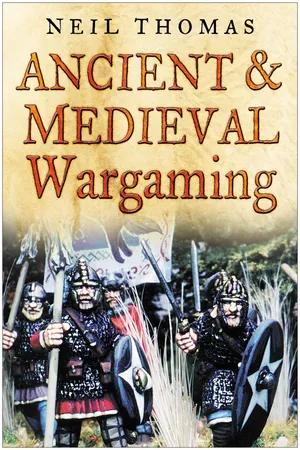
Re-fight some of the bloodiest battles of the ancient and medieval worlds! Seasoned wargamer and author Neil Thomas brings historical perspective to the hobby with a description and interpretation of significant military developments from 3,000BC to AD1500. Wargaming is the simulation of accurate historical battles using miniature figures to fight over three dimensional terrain, their movement and combat being regulated by clearly defined rules. Neil Thomas' new book provides specific coverage of ancient and medieval wargaming, thanks to its division into biblical, classical, Dark Age and medieval sections. Each section has its own set of rules and much expanded army lists. The wargamer gains additional perspective from data panels containing facts about weaponry, personalities and chroniclers, and quotations from original document sources. Useful suggestions for further reading are also included, while battle reports in each section provide tactical insights for both novice and veteran wargamers.
- 273 pages
- English
- ePUB (mobile friendly)
- Available on iOS & Android
eBook - ePub
Ancient and Medieval Wargaming
About this book
Information
Print ISBN
9780750945721
Subtopic
Histoire antiqueChapter 1
Biblical Warfare
3000 BC–500 BC
3000 BC–500 BC
KEY EVENTS
| Date | Event |
| 2500–900 BC | Bronze Age. |
| 2500–2100 | Growth of Sumerian city states. |
| 2100 | Sargon of Akkad captures Sumerian cities. |
| 1920 | Fall of Akkadian Empire. Sumerian cities regain independence. |
| 1793 | Fall of Ur to Amorites. End of Sumerian city states. |
| 1565 | Hammurabi ascends Babylonian throne. |
| 1400 | Egypt invaded by Hyksos (Canaanite) armies. |
| 1362 | Babylon sacked by Hittites. End of Hammurabic Empire. |
| 1185 | Hyksos expelled from Egypt. New Kingdom created. |
| 1115 | Battle of Megiddo. Egypt defeats (Canaanite) King of Kadesh in history’s first recorded battle. |
| 1050 | Rise of Hittite Empire. |
| 1010–1000 | Creation of Israelite Kingdom as David defeats Philistines. |
| 941 | Battle of Kadesh. In the most famous encounter of the period, Egypt and the Hittite Empire fight in a bloody but inconclusive clash. |
| 910–900 | Mycenean Greek invaders besiege and take Troy. |
| 900 | Iron Age. |
| 867–855 | Sea Peoples invade Hittite Empire and Egypt. |
| 858 | Hittite Empire disintegrates as Hattusas falls to Sea Peoples. Replaced by confederation of minor Kingdoms. |
| 855 | Battle of the Nile. Sea Peoples’ invasion of Egypt repulsed. |
| 850 | Mycenean Greece falls to Sea Peoples. |
| 810 | Civil war in Egypt. New Kingdom divided in two. |
| 745 | Rise of New Assyrian Empire under Tiglath-Pileser III. |
| 721 | Samaria falls to Assyrians. New Assyrian Empire dominates Syria and Palestine. |
| 720–700 | Assyria dominates, but never entirely controls, Babylonian region. |
| 675–650 | Assyrians take Egypt, but are eventually expelled. |
| 650–600 | Scythian invasions of Middle East. |
| 630–610 | Babylonian revival under Nabopolassar. |
| 612 | Fall of Ninevah to Babylonians and Medes. Destruction of New Assyrian Empire. |
| 587 | Fall of Jerusalem to Babylonians. Downfall of Israelite Kingdom. |
| 550 | Rise of Persia as Cyrus overthrows Median overlords. |
| 539 | Babylon falls to Persians. |
A NOTE ON CHRONOLOGY
One of the greatest drawbacks in the study of this period is the lack of any reliable chronology until the year 763 BC (the latter date being identified thanks to the accurate modern backdating of a solar eclipse noted by Assyrian chroniclers). The last fifteen years have seen a challenge to the conventional dating, which has naturally enough been referred to as the New Chronology (which will doubtless become the Old Chronology over the next century or so). This new approach has been endorsed by Nigel Stillman in his Chariot Wars (Warhammer Historical Wargames, 1999), and has been followed by me.
To simplify the argument somewhat, the New Chronology rests upon archaeological evidence that the Egyptian 21st and 22nd Dynasties reigned concurrently in different parts of Egypt, rather than in succession as previously assumed. This actually helps matters greatly for any historian, since the new dating effectively abolishes the previous 350-year chronological gap from which no evidence has survived. With no fallacious gulf, there is no otherwise inexplicable ‘dark age’. The New Chronology also provides support for the account provided in the history books of the Old Testament, and can in addition be confirmed by radiocarbon dating from Egyptian excavations (which previously tended to be ignored by scholars on the grounds that it rather inconveniently contradicted the conventional dating).
Readers who wish to examine the arguments supporting the New Chronology in greater detail might like to consult the following books:
James, Peter et al. Centuries of Darkness, Pimlico, 1991
Rohl, David. A Test of Time, Century, 1995
WHY WARFARE DEVELOPED
Warfare needs civilisation (although any decent civilisation neither wants nor needs warfare). This somewhat cryptic statement needs clarification. In essence, organised warfare can only occur between distinct political entities, be they formal states, an identifiable band of rebels, or a homogenous tribal grouping. It can therefore be seen that Stone Age hunter-gatherers may have fought between themselves, but such contests (even when involving different groups) were brief clashes that could not be dignified with the epithet of ‘warfare’. Wars only started when humans settled in territories where greater food reserves could be garnered by cultivating land, rather than by following herds of wild animals around and killing beasts as required. One of the first environments where climatic conditions proved conducive to permanent settlement was what we now call the Middle East, especially the areas around the Rivers Tigris, Euphrates and Nile.
Once settlement occurred, civilisation could develop. Cities grew, and literacy arose; the latter being an aid to trade, a facilitator of good administration and a means of glorifying the local ruler and his favoured god(s). It is a somewhat depressing fact that the desirability of acquiring culture, poetry and philosophy provided little impulse for the development of literacy.
However, once small states arose, they began to find themselves at war with each other. By far the best explanation of why this state of affairs arose can be found from the great philosopher Thomas Hobbes:
So that in the nature of man, we find three principal courses of quarrel. First, competition: secondly, diffidence; thirdly, glory. The first maketh men invade for gain; the second, for safety; and the third, for reputation.
Thomas Hobbes, Leviathan (1651), quoted in Dawson, Doyne, The First Armies, Cassell, 2001, p. 14.
Although I would argue that man has no natural predisposition towards strife, unlike Hobbes (his rather gloomy thesis takes no account of the equally powerful human impulses of compassion for the plight of the helpless and disabled), his account does provide a good summary of the possible causes of strife. All three occurred in the first real civilisations, namely the Sumerian city states that grew in what is now Iraq. The original impulse was to seek safety and security, which explains the early development of fortified cities. However, a run of bad harvests would create a scarcity of resources, resulting in competition between neighbouring cities, and the consequent growth of aggressive campaigning and pitched battles. Finally, Kings found it necessary to assert their political primacy, both over proximate political entities and their own nobility. As a result, such monarchs would engage in warfare, commemorating their victories in court propaganda extolling both the king and his god(s).
The Sumerian states did moreover have new and potent weaponry at their disposal. Whereas the flints and wooden clubs of Stone Age man could prove lethal, the invention of bronze allowed for the development of infinitely more dangerous pointed weapons (such as spears, swords and arrows). Moreover, the domestication of asses and eventually (albeit not by the Sumerians) horses resulted in the invention of the war chariot.
BIBLICAL INFANTRY
Although forming a large proportion of all Biblical armies, infantry was not highly regarded. This was principally due to the fact that the nobility fought from chariots, and spent little time with their foot soldiers. As a consequence of this neglect, many early Biblical armies only provided the most basic equipment for their infantry. They tended to be given a wooden shield and metal helmet for protection, but no body armour. Their chief weapon was the spear, either a long version used to thrust, or a shorter type that could be thrown at very close range (up to 10 or 20m). Provided that the infantry remained in the close formation that is clearly depicted on existing pictorial evidence, they could both engage their enemy counterparts with reasonable effectiveness, and ward off any frontal assaults from chariots.
Other foot soldiers were even less comprehensively equipped. These were unprotected by any armour or shield, but were given javelins (which could be thrown between 30 and 50m). Such skirmishers operated in dispersed formation; their role was to avoid hand-to-hand combat, and protect the flanks of close-order infantry. Nevertheless, the chief role of foot soldiers did not lie in pitched battle. Their major functions were to besiege and garrison fortresses (in which sphere chariots were utterly useless) and to protect friendly chariots from surprise attack, both by guarding the latter on the march and by providing sentry duty at night.
To generalise somewhat, infantry were regarded as the poor relations of chariots – a fact of which they were all too aware. Consisting as they did of conscripted men, neglected by the noble elite, and given limited protective equipment, morale and performance tended to be low. The one great exception to this was the army of New Kingdom Egypt, whose infantry eventually acquired body armour (albeit not metallic) in addition to their shields, as well as a degree of training which served them well. As a rule however, all foot (including the Egyptians) was far from highly disciplined, and as a result proved vulnerable to archery and chariot attack.
ARCHERY
Although simple bows had been around ever since the Stone Age, their effectiveness was limited by their short range (no more than 100m at best). All this changed by the time of the Akkadian Empire, which saw some foot soldiers (operating at close order) equipped with a new weapon, the so-called composite bow. This used a combination of wood, horn and sinew. It worked on the basis that when drawn, the ends of the bow would be pulled back to a much greater extent than the centre (the old bows, being made solely of wood, effectively had even pressure exerted all the way along the weapon). This allowed for much greater velocity for the arrow, and hence an increase both in range (up to 250m) and penetrative power. All this had major implications. Close-order Biblical Infantry was now vulnerable to long-range archery; the spearmen’s limited discipline and enthusiasm made them especially vulnerable to effective bowfire.
As a consequence, foot archers equipped with composite bows proved to be important auxiliaries to spearmen. The Babylonian armies followed the Akkadians in equipping some troops with bows, and the Egyptian archers eventually replaced their simple wooden weapons with the composite version, after being subjected to its ill effects at the hands of the Hyksos invaders.
However effective it may have been in the hands of foot soldiers operating in close-order formation, the composite bow really came into its own as the weapon of choice for chariot warriors, to whom we must now turn.
CHARIOT WARFARE
As soon as asses became domesticated, the Sumerians hit upon the idea of using them as draught animals for battle wagons, and the chariot was born. It was however rather primitive at this stage. Of somewhat ramshackle construction, with four heavy solid wheels, and drawn by asses (onagers) noted chiefly for their foul temperament and contrary disposition, Sumerian chariots were not at first glance an especially formidable weapon – especially as the fighting crewman (as opposed to the unarmed driver) was equipped with javelins rather than a composite bow. Moreover, the onagers could only be controlled by having the chariot driver’s reins attached to a nose ring, as the bit had not yet been devised. Some writers have therefore assumed that such limited performance meant that Sumerian chariots were little more than personnel carriers, being used to transport the warrior to the decisive point of the battlefield, at which time he would dismount and fight on foot.
Such a conclusion may appear plausible, but it would be mistaken. For one thing, modern tests with replicas of Sumerian chariots have shown them to be surprisingly manoeuvrable. Accordingly, it is possible to envisage their being used to drive up to javelin range, discharge a few missiles, and either retire or charge the enemy. For although it is true that the aforementioned modern tests showed that nothing would induce asses to charge a solid obstacle, bodies of men only form a rigid wall for as long as their morale holds. It is certainly possible to envisage a unit of Sumerian chariots head towards a body of enemy infantry with apparently murderous intent, which would have the effect of seeing the latter waver and run from the (socially superior) noble charioteers.
It is therefore clear that chariots could either engage their enemy equivalents with missilry; or fire at enemy infantry in order to create panic, prior to charging at their victims and thereby inducing a rout. The potential of the chariot was greatly increased once horses were introduced into the region, originally by Aryan invaders crossing the Caucasus Mountains into what is now Turkey. Although too small to ride, the early horses were easily domesticated (unlike the onagers), and provided ex...
Table of contents
- Cover
- Half Title
- Title
- Copyright
- Contents
- Acknowledgements
- Key to Symbols
- Introduction
- 1 Biblical Warfare 3000 BC–500 BC
- 2 Biblical Wargaming
- 3 Biblical Wargames Rules
- 4 Biblical Wargames Armies
- 5 Biblical Battle Report
- 6 Classical Warfare 500 BC–AD 300
- 7 Classical Wargaming
- 8 Classical Wargames Rules
- 9 Classical Wargames Armies
- 10 Classical Battle Report
- 11 Dark Age Warfare 300–1100
- 12 Dark Age Wargaming
- 13 Dark Age Wargames Rules
- 14 Dark Age Wargames Armies
- 15 Dark Age Battle Report
- 16 Medieval Warfare 1100–1485
- 17 Medieval Wargaming
- 18 Medieval Wargames Rules
- 19 Medieval Wargames Armies
- 20 Medieval Battle Report
- Appendix I Figure Sizes, Scales and Prices
- Appendix II Useful Addresses
Trusted by 375,005 students
Access to over 1.5 million titles for a fair monthly price.
Study more efficiently using our study tools.
Frequently asked questions
Yes, you can cancel anytime from the Subscription tab in your account settings on the Perlego website. Your subscription will stay active until the end of your current billing period. Learn how to cancel your subscription
No, books cannot be downloaded as external files, such as PDFs, for use outside of Perlego. However, you can download books within the Perlego app for offline reading on mobile or tablet. Learn how to download books offline
Perlego offers two plans: Essential and Complete
- Essential is ideal for learners and professionals who enjoy exploring a wide range of subjects. Access the Essential Library with 800,000+ trusted titles and best-sellers across business, personal growth, and the humanities. Includes unlimited reading time and Standard Read Aloud voice.
- Complete: Perfect for advanced learners and researchers needing full, unrestricted access. Unlock 1.5M+ books across hundreds of subjects, including academic and specialized titles. The Complete Plan also includes advanced features like Premium Read Aloud and Research Assistant.
We are an online textbook subscription service, where you can get access to an entire online library for less than the price of a single book per month. With over 1.5 million books across 990+ topics, we’ve got you covered! Learn about our mission
Look out for the read-aloud symbol on your next book to see if you can listen to it. The read-aloud tool reads text aloud for you, highlighting the text as it is being read. You can pause it, speed it up and slow it down. Learn more about Read Aloud
Yes! You can use the Perlego app on both iOS and Android devices to read anytime, anywhere — even offline. Perfect for commutes or when you’re on the go.
Please note we cannot support devices running on iOS 13 and Android 7 or earlier. Learn more about using the app
Please note we cannot support devices running on iOS 13 and Android 7 or earlier. Learn more about using the app
Yes, you can access Ancient and Medieval Wargaming by Neil Thomas in PDF and/or ePUB format. We have over 1.5 million books available in our catalogue for you to explore.