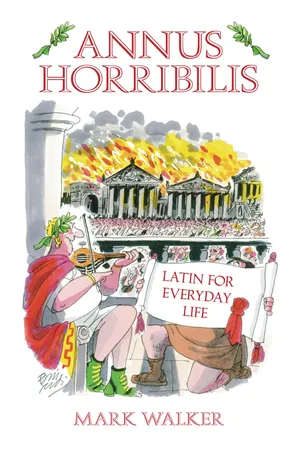
Everyone remembers the Queen's ' Annus Horribilis', but what do 'quid pro quo' and 'habeas corpus' mean? Why do plants have Latin names? Why do families, towns, countries and even football teams have Latin mottoes? What do the Latin epitaphs in churches say? What are the words of Mozart's Requiem? These are just a few of the topics covered in this book. As Mark Walker makes clear, present-day English is still steeped in its Roman and Latin origins. As a result English still has many thousands of Latin words in everyday use. Caveat emptor!
- 191 pages
- English
- ePUB (mobile friendly)
- Available on iOS & Android
eBook - ePub
About this book
Information
CHAPTER 1
A BRIEF HISTORY OF LATIN
Have you ever done something ad hoc or on a quid pro quo basis? Do you get paid per annum or pro rata? Have you ever been caught in flagrante and been in need of an alibi, an alias or an alter ego?
If you think you don’t know any Latin, think again. In fact, though you might not realise it yet, you already know thousands of Latin words. Here are just a few them:
| Actor | Exit |
| Agenda | Insomnia |
| Alibi | Interim |
| Alias | Propaganda |
| Audio | Referendum |
| Circus | Tandem |
| Curriculum | Tedium |
| Data | Trivia |
| Decorum | Ultimatum |
| Doctor | Video |
These are all real Latin words that any ancient Roman would recognise. And you thought learning Latin was going to be tough!
The reason this book is subtitled Latin for Everyday Life – with the emphasis on Everyday – is because there really is that much Latin in modern English. But why should our language, so remote in time from that of Ancient Rome, contain great chunks of Latin? In order to answer that question a quick sketch of Latin history is called for. That’s the purpose of this chapter, before we move on to Chapter 2 and actually start learning some Latin. So here goes.
A VERY BRIEF HISTORY OF LATIN
Latin was originally the dialect of the region of Italy called Latium (modern Lazio), but as a result of the military and political dominance of Rome it soon spread throughout Italy and then to all the provinces of the Roman Empire, right round the Mediterranean into the Middle East and Africa and as far north as Hadrian’s Wall. Throughout this vast geographical area, Latin was the language of law, administration, commerce and literature.
Although in the East it didn’t entirely displace Greek, which was already well established as the lingua franca (literally ‘Frankish language’) of that region, in the Western Empire Latin was rapidly adopted as the principal language of the Iberian Peninsula (Spain and Portugal) and Gaul (France and Belgium). This is the origin of the so-called ‘Romance’ languages as we know them today: ‘Roman’ was what people in these territories called their spoken tongue, whereas ‘Latin’ gradually came to be reserved for the more formal written language – though no distinction was made between the two for many centuries.
To illustrate the process of change from Latin to the Romance languages, just take a look at the most common verb in any language, ‘to be’ – esse in Latin. This is essere in Italian, ser in Spanish, and être in French. In the table below it is conjugated in Latin then Italian, Spanish and French:
| Latin | Italian | Spanish | French |
| sum | sono | soy | je suis |
| es | sei | eres | tu es |
| est | é | es | il/elle/on est |
| sumus | siamo | somos | nous sommes |
| estis | siete | sois | vous êtes |
| sunt | sono | son | ils/elles sont |
The family resemblance is clear at a glance. (It’s worth noting in passing that both Italian and Spanish can dispense with the personal pronouns ‘I’, ‘You’ etc. just as Latin does.)
By contrast, ‘to be’ in English conjugates like this:
I am
you are
he/she/it is
we are
you are
they are
As we’ve already noted, the Romance languages developed from the spoken form of Latin – the sermo cotidianus or daily speech – which was not necessarily the same as the written form that has come down to us in the remnants of Latin literature. Take, for example, the Latin word for horse: this is equus in literary Latin. Compare this with the Romance language words for ‘horse’:
| Latin | Italian | Spanish | French |
| Equus | Cavallo | Caballo | Cheval |
Clearly, equus is not the source word. But Latin has another word for ‘horse’, a slang word meaning ‘pack-horse’ or ‘nag’: caballus. This slang word was presumably the one in common use on the streets of Rome, hence the one that found its way into the spoken Romance languages, while equus only survived in polite literature. English gets ‘chivalry’, ‘cavalry’ and ‘cavalier’ from caballus, via French, but ‘equine’ and ‘equestrian’ from Latin.
After the fall of the Western Roman Empire, Latin continued to be the official language of the Catholic Church (in the Byzantine territories of the East, Greek was still used). Christian Latin thus spread into Germany and Scandinavia and was reintroduced to the British Isles where it had all but disappeared following the withdrawal of Roman forces. This Church Latin, exemplified by Jerome’s Vulgate Bible (Chapter 9), had a somewhat different syntax and vocabulary to Classical Latin, although Christian scholars still studied pagan authors such as Virgil.
Table of contents
- Cover
- Title Page
- Table of Contents
- ACKNOWLEDGEMENTS
- INTRODUCTION
- CHAPTER 1 : A BRIEF HISTORY OF LATIN
- CHAPTER 2 : CONVERSATIONAL LATIN
- CHAPTER 3 : FAMILIAR LATIN PHRASES
- CHAPTER 4 : ACRONYMS & ABBREVIATIONS
- CHAPTER 5 : ROMAN NAMES, NUMERALS, DATES & DAYS
- CHAPTER 6 : LATIN FOR GARDENERS
- CHAPTER 7 : MOTTOES
- CHAPTER 8 : LATIN FOR DOCTORS & LAWYERS
- CHAPTER 9 : CHURCH LATIN
- CHAPTER 10 : THE LATIN MASS
- CHAPTER 11 : THE REQUIEM MASS
- CHAPTER 12 : LATIN CHRISTMAS CAROLS & HYMNS
- CHAPTER 13 : CARMINA BURANA & SECULAR LATIN
- CHAPTER 14 : ROMAN INSCRIPTIONS
- CHAPTER 15 : LATIN EPITAPHS
- ENGLISH TRANSLATIONS : CHAPTERS 9-15
- APPENDIX : A BRIEF GUIDE TO LATIN (AND ENGLISH!) GRAMMAR
- ABOUT THE AUTHOR
- Copyright
Trusted by 375,005 students
Access to over 1.5 million titles for a fair monthly price.
Study more efficiently using our study tools.
Frequently asked questions
Yes, you can cancel anytime from the Subscription tab in your account settings on the Perlego website. Your subscription will stay active until the end of your current billing period. Learn how to cancel your subscription
No, books cannot be downloaded as external files, such as PDFs, for use outside of Perlego. However, you can download books within the Perlego app for offline reading on mobile or tablet. Learn how to download books offline
Perlego offers two plans: Essential and Complete
- Essential is ideal for learners and professionals who enjoy exploring a wide range of subjects. Access the Essential Library with 800,000+ trusted titles and best-sellers across business, personal growth, and the humanities. Includes unlimited reading time and Standard Read Aloud voice.
- Complete: Perfect for advanced learners and researchers needing full, unrestricted access. Unlock 1.5M+ books across hundreds of subjects, including academic and specialized titles. The Complete Plan also includes advanced features like Premium Read Aloud and Research Assistant.
We are an online textbook subscription service, where you can get access to an entire online library for less than the price of a single book per month. With over 1.5 million books across 990+ topics, we’ve got you covered! Learn about our mission
Look out for the read-aloud symbol on your next book to see if you can listen to it. The read-aloud tool reads text aloud for you, highlighting the text as it is being read. You can pause it, speed it up and slow it down. Learn more about Read Aloud
Yes! You can use the Perlego app on both iOS and Android devices to read anytime, anywhere — even offline. Perfect for commutes or when you’re on the go.
Please note we cannot support devices running on iOS 13 and Android 7 or earlier. Learn more about using the app
Please note we cannot support devices running on iOS 13 and Android 7 or earlier. Learn more about using the app
Yes, you can access Annus Horribilis by Mark Walker in PDF and/or ePUB format, as well as other popular books in Languages & Linguistics & Ancient Languages. We have over 1.5 million books available in our catalogue for you to explore.