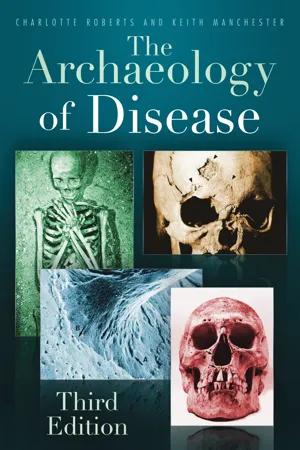
The Archaeology of Disease shows how the latest scientific and archaeological techniques can be used to identify the common illnesses and injuries that humans suffered from in antiquity. In order to give a vivid picture of ancient disease and trauma the authors present the results of the latest scientific research and incorporate information gathered from documents, from other areas of archaeology and from art and ethnography. This comprehensive approach to the subject throws fresh light on the health of our ancestors and on the conditions in which they lived, and it gives us an intriguing insight into the ways in which they coped with the pain and discomfort of their existence.
Trusted by 375,005 students
Access to over 1.5 million titles for a fair monthly price.
Disease is an inevitable part of life, and coping with disease is a universal aspect of the human experience . . . the experience of disease . . . is as inescapable as death itself. (Brown et al., 1996: 183)
INTRODUCTION AND DEFINITIONS
The study of palaeopathology examines the origin, evolution and progress of disease through long periods of time and looks at how humans adapted to changes in their environment. Relevant to evolutionary medicine (Nesse and Williams, 1994), it provides primary evidence for the state of health of our ancestors and, combining biological and cultural data (the ‘biocultural or bioarchaeological approach’), palaeopathology has become a wide-ranging holistic discipline. Current developments, and the future of palaeopathology, are exciting and are discussed further in the final chapter of this book.
Pathology is the study (logos) of suffering (pathos). In practice, pathology is defined as the scientific study of disease processes. Palaeopathology was defined in 1910 by Sir Marc Armand Ruffer (Aufderheide and Rodríguez-Martín, 1998) as the science of diseases whose existence can be demonstrated on the basis of human and animal remains from ancient times. Palaeopathology can be considered a subdiscipline of biological anthropology and focuses on abnormal variation in human remains from archaeological sites. The study of palaeopathology is multidisciplinary in approach and concentrates on primary and secondary sources of evidence. Primary evidence derives from skeletons or mummified remains. This type of evidence is the only reliable indication that a once-living person suffered from a health problem; whether a specific diagnosis can be made is more of a challenge. However, as Horden (2000: 208) indicates, palaeopathology ‘would seem to provide our . . . hardest evidence for past afflictions’. Secondary forms of evidence include documentary and iconographic (art form) data contemporary with the time period under investigation. Unfortunately, artists and authors in the past have tended to illustrate and describe the more visual and dramatic diseases and ignored those which may have been more commonplace; the mundane, common illnesses and injuries are lost to the palaeopathologist if this type of evidence is considered alone. For example, the mutilating deformities of the infection leprosy, the devastating effects of the Black Death, and the curiosity factor in dwarfism have led to abundant representations of these conditions in art, but coughs, colds, influenza and gastrointestinal upsets, along with cuts, bruises, burns and sprains, would probably have been so common that they would have been ‘irrelevant’ in the eyes of the writer or artist. In antiquity, those diseases with the greatest impact in terms of mortality, personal disfigurement or social and economic disruption probably evoked the greatest response from society (and its authors and artists). In the past, attitudes towards illness have often been due to the failure in understanding the nature of the disease itself. However, when interpreting disease in the past from secondary sources care must be taken – opinions and preferences about what should be described and drawn will affect what is read and seen. Imprecise and incomplete representation may transmit incorrect information. All literary works must be studied carefully within the traditional framework in which their facts are presented (Roberts, 1971). Those aspects of an illness which we consider to be of vital importance in the understanding of a disease may have been considered of no consequence to the observer in the past and may not therefore have been given due prominence in the record. There are also circumstances where a disease description does not correspond with any known disease in the modern world. This may be because it actually does not exist or the disease is just not recognized because of the inaccuracy of its representation. Relevant too is the need to appreciate that different diseases may produce similar signs and symptoms. For example, how does one differentiate between the skin rash of chickenpox, leprosy and measles? It is true to say that specific areas of the body may be affected by the different conditions, and the nature of the ‘lesion’ may differ, but to be able to determine what disease is being displayed in writing or art necessitates a very detailed representation. Another example is the clinical picture associated with respiratory disease. Cancer, chronic bronchitis and tuberculosis can all result in coughing up blood (haemoptysis) and shortness of breath (dyspnoea), but how would they be distinguished from one another in the written record if only haemoptysis and dyspnoea were being described? However, the diseases which are not displayed in the skeletal record, i.e. those affecting only the soft tissue (e.g. malaria, childhood diseases such as whooping cough and mumps, cholera and typhoid), may be recorded only in art and documentary sources, and therefore, in these cases, this type of evidence is especially invaluable. We do recognize that solely considering skeletal remains for the evidence of disease allows us to deal with only a very small percentage of the disease load in a population. However, as Horden (2000: 208) states: ‘the greater the number and variety of perspectives on the pathological past with which we can engage, the greater the chance that our analysis will not be completely disabled by problems of retrospective diagnosis.’
The study of human remains within their cultural context, i.e. the period of time, geographic area and material culture, aids enormously in the interpretation of the history of disease. For example, precise dating of skeletons with bone changes consistent with venereal syphilis is important for the discussion of the pre- or post-Columbian nature and origin for this disease (Baker and Armelagos, 1988; Dutour et al., 1994). Some researchers also study populations in geographic areas which sustain contemporary traditional societies (e.g. Merbs, 1983; see McElroy and Townsend, 1996 on medical anthropology). For palaeopathologists it is useful to interpret the archaeological (dead) population in the context of the living group if it is accepted that the latter bears close resemblances, in terms of culture, to the dead population. Furthermore, medical anthropology has been likened to palaeopathology because it considers disease within the population’s context of living environment, diet, economy, work, etc. Of course, there are many limitations to this type of study, not least the vast differences in time and space between the living and dead populations in many cases. However, these societies are often unaffected by change (in the modern western sense) and their health and the effect of disease on their bodies is ‘natural’ and not influenced or changed by drug therapy. They can be, thus, useful analogues although very few societies today are immune to ‘alien influences’. Nevertheless, appreciating how ‘traditional’ groups of people today perceive an illness, its causes and how it may be prevented undoubtedly broadens our horizons when we try to understand the impact of disease on past populations (for example, see Roberts and Buikstra, 2003).
HISTORY OF STUDY (See Buikstra and Roberts, forthcoming)
Aufderheide and Rodríguez-Martín (1998) categorize the history of the development of palaeopathology into four phases: Antecedent (Renaissance to mid-nineteenth century), Genesis (mid-nineteenth century to First World War), Interbellum Consolidation Phase (1913–45) and New Palaeopathology (1946 to present). In the first phase work concentrated mainly on prehistoric animals (e.g. by the German naturalist Johann Friederich Esper), but there was a recognition that studying human disease would be beneficial to exploring the history of past human populations. At the end of this period the first application of the microscope to examining Egyptian mummified tissue is noted, but there was ‘little scientific precision and . . . specimens (were viewed) as curiosities, not as sources of medical, pathological or historical knowledge’ (Aufderheide and Rodríguez-Martín, 1998: 3). The second phase had much more of an anthropological focus, and large skeletal collections were available for study. As Aufderheide and Rodríguez-Martín (1998) point out, although ‘racial’ studies were the norm, pathological conditions in these collections were noted, especially by the German physician Rudolf Virchow (1821–1902). Again, it was mainly case studies that were reported and there was little consideration of what the occurrence of disease meant in epidemiological terms. Although cases provide information on, for example, the first occurrence of a disease, they are limited in providing broader views on the history of disease, unless the data are collated, for example for a time period or geographic location. Jarcho (1966: 5) also notes that researchers were so obsessed with crania they assumed ‘that some diseases ended in the foramen magnum’. Happily, the study of palaeopathology today is such that students do now know that the whole of the skeleton (or as complete as possible) needs to be considered in disease diagnosis. However, as Buikstra and Cook note (1980: 435): ‘we learn[t] little about population dynamics or disease evolution’ from case studies. Focusing on individual experience of disease in both modern and ancient contexts can quickly lead to biased and ‘patient’-centred data that may not represent the population experience from which that person derived. The French were instrumental from the late nineteenth century in developing the discipline of palaeopathology (e.g. Paul Broca, 1824–80, who published work particularly on the evidence for Peruvian trepanation (Buikstra and Cook, 1980)). At this time, too, the first palaeopathology manual was published in America in 1886 by William Whitney.
In the third phase palaeopathology expanded and methods beyond visual (macroscopic) examination were used more often to investigate pathological lesions and improve diagnosis, in addition to statistical analysis (Buikstra and Cook, 1980). This is described as the evolution of palaeopathology as a scientific discipline. Sir Marc Armand Ruffer (1858–1917) promoted the term ‘palaeopathology’ as defining the scientific study of disease observed in human and animal remains. A trained physician and Professor of Medicine in Cairo, Egypt, he made detailed records of his observations particularly on mummified remains (e.g. Ruffer, 1913 in Aufderheide and Rodríguez-Martín, 1998), although, as Aufderheide and Rodríguez-Martín (1998) note, the interest in mummies then waned. Other work in Egypt came from the enormous efforts of Grafton Elliot-Smith and Frederic Wood Jones (1910; Waldron, 2000), both trained physicians, and in the early twentieth century Roy Lee Moodie in North America published two very influential books on palaeopathology (Moodie, 1923a and b, cited in Aufderheide and Rodríguez-Martín, 1998). Aleš Hrdl
cka was also instrumental in the development of palaeopathological studies in the Americas (1941). Located at the Smithsonian Institution (National Museum of Natural History), he created a Division of Anthropology there and accumulated large skeletal collections from North and South America for study. In tandem, Earnest Hooton of Harvard University introduced a demographic perspective to palaeopathology and used an ecological and cultural approach (and statistical analysis) to understand the disease load in the Pecos Pueblo population (1930, in Aufderheide and Rodríguez-Martín, 1998). He also advocated the accumulation of pathological specimens with known histories as a tool for comparison with the past. Aufderheide and Rodríguez-Martín (1998: 7) note that this third phase is characterized by the ‘introduction and gradual standardization both of new methods and of new interpretive concepts, resulting in the emergence of palaeopathology as a scientific discipline’.
The final phase is marked by an increased recognition of the link between palaeopathology and epidemiology and demography (Aufderheide and Rodríguez-Martín, 1998), with much more of a focus on raising hypotheses and testing them with skeletal data from large numbers of individuals. Wood et al. (1992: 344) also note that in the 1980s and early 1990s there was a move away from ‘a particularistic concern with individual lesions or skeletons to a population-based perspective on disease processes’. Notable figures in the exploration of specific diseases early in the second half of the twentieth century included Møller-Christensen (1967) on leprosy and Hackett (1963) on the treponematoses. There has also been a focus on developing standardised methods for collecting palaeopathological data (Ortner, 1991, 1994; Lovell, 2000). Additionally, the use of biomolecular methods of analysis to identify diseases, primarily the extraction, amplification and analysis of ancient DNA specific to pathogens, has seen a considerable increase in use since the early 1990s.
The Paleopathology Association, formerly the Paleopathology Club, was formed in 1973 and the first meeting was held in 1974 (and the first European meeting a year later in London). This still thriving Association of several hundred members worldwide brings together people interested in, and studying, palaeopathology from a wide range of disciplines including anthropology, archaeology, medical history, medicine, pathology, genetics, biology and many more (www.paleopathology.org). Additionally, the World Committee on Mummy Studies, formed in 1992 after the first World Mummy Congress, ‘looks after’ the interests of people researching mummies, although the Paleopathology Association encompasses many of the same members. A survey of the membership of the American Association of Physical Anthropologists shows that palaeopathology as a field of physical (or biological) anthropology remains a prominent area for Ph.D. study. It also showed that the majority of people practising palaeopathology were female, a feature that increased from the 1970s into the 1990s (Turner, 2002), and remains with us today.
In Britain some key people in the development of palaeopathology as a discipline have included Calvin Wells (1964a), Don Brothwell and Andrew Sandison (1967), Juliet Rogers (Rogers and Waldron, 1995), Simon Hillson (1986, 1996), Theya Molleson (Molleson and Cox, 1993) and Tony Waldron (1994). However, as Mays (1997; 2010) notes, when comparing the publication content of US and UK researchers in palaeopathology, the emphasis in the UK is on ‘case studies of health’, whereas in the United States it is on ‘population’ health. In order that palaeopathology advances as a recognized discipline, the UK needs to turn more to this population approach to palaeopathology. North America, being a larger country with more research in palaeopathology being undertaken, has also seen a much longer history of study. Notable researchers here include: the late J. Lawrence Angel (1966a), George Armelagos (1990), Arthur Aufderheide (Aufderheide and Rodríguez-Martín, 1998), Jane Buikstra (1981), Della Cook (1994), Alan Goodman (Goodman et al., 1988), Anne Grauer (1993), Robert Jurmain (1999), Clark Larsen...
Table of contents
Cover
Title
Copyright
Contents
Acknowledgements
1 The Study of Palaeopathology
2 Back to Basics
3 Congenital Disease
4 Dental Disease
5 Trauma
6 Joint Disease
7 Infectious Disease
8 Metabolic and Endocrine Disease
9 Neoplastic Disease
10 Conclusions: The Next Ten Years
References
Frequently asked questions
Yes, you can cancel anytime from the Subscription tab in your account settings on the Perlego website. Your subscription will stay active until the end of your current billing period. Learn how to cancel your subscription
No, books cannot be downloaded as external files, such as PDFs, for use outside of Perlego. However, you can download books within the Perlego app for offline reading on mobile or tablet. Learn how to download books offline
Perlego offers two plans: Essential and Complete
Essential is ideal for learners and professionals who enjoy exploring a wide range of subjects. Access the Essential Library with 800,000+ trusted titles and best-sellers across business, personal growth, and the humanities. Includes unlimited reading time and Standard Read Aloud voice.
Complete: Perfect for advanced learners and researchers needing full, unrestricted access. Unlock 1.5M+ books across hundreds of subjects, including academic and specialized titles. The Complete Plan also includes advanced features like Premium Read Aloud and Research Assistant.
Both plans are available with monthly, semester, or annual billing cycles.
We are an online textbook subscription service, where you can get access to an entire online library for less than the price of a single book per month. With over 1.5 million books across 990+ topics, we’ve got you covered! Learn about our mission
Look out for the read-aloud symbol on your next book to see if you can listen to it. The read-aloud tool reads text aloud for you, highlighting the text as it is being read. You can pause it, speed it up and slow it down. Learn more about Read Aloud
Yes! You can use the Perlego app on both iOS and Android devices to read anytime, anywhere — even offline. Perfect for commutes or when you’re on the go. Please note we cannot support devices running on iOS 13 and Android 7 or earlier. Learn more about using the app
Yes, you can access The Archaeology of Disease by Charlotte Roberts,Keith Manchester,Mary Lewis,Jacalyn Duffin in PDF and/or ePUB format, as well as other popular books in Medicine & Diseases & Allergies. We have over 1.5 million books available in our catalogue for you to explore.