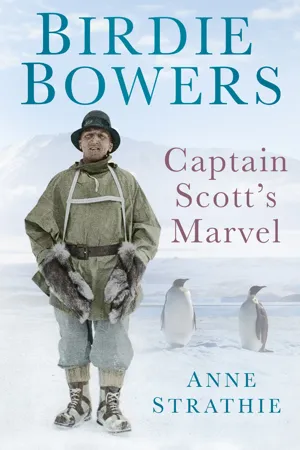
Henry 'Birdie' Bowers realised his life's ambition when he was selected for Captain Scott's Terra Nova expedition to the Antarctic, yet he also met his death on the journey. Born to a sea-faring father and adventurous mother on the Firth of Clyde, Bowers' boyhood obsession with travel and adventure took him round the world several times and his life appears, with hindsight, to have been a ceaseless preparation for his ultimate, Antarctic challenge. Although just 5ft 4in, he was a bundle of energy; knowledgeable, indefatigable and the ultimate team player. In Scott's words, he was 'a marvel'. This new biography, drawing on Bowers' letters, journals and previously neglected material, sheds new light on Bowers and tells the full story of the hardy naval officer who could always lift his companions' spirits.
- 160 pages
- English
- ePUB (mobile friendly)
- Available on iOS & Android
eBook - ePub
About this book
Information
1
FAMILY ROOTS
When 7-year-old Henry Bowers wrote to his ‘friend’ in Wilkes Land, Antarctica, he was living in London with his widowed mother, former missionary teacher Emily Bowers, and his elder sisters, Mary and Edith. His father, Captain Alexander Bowers, had died some three years previously in Burma where he had worked as a master mariner for many years.
Henry was born in Greenock, a major centre of shipbuilding, trade and sugar-refining,1 which lay about 20 miles down the Firth of Clyde from Glasgow, the British Empire’s second city. His father, son of a Greenock shipwright (also Alexander), was born there in 1827 but had left home at the age of 13 to work on the eastern trade routes of the British Empire. He rose swiftly to the rank of captain, steered the Geelong2 to victory in the China to London tea-clipper race (thus winning a substantial cash prize) and reached a new high navigation point for British ships on the Yangtse Kiang. The Captain’s ships largely carried cargo but, as a staunch Christian, he regularly offered free passage to missionaries travelling along Britain’s trade routes. In 1857, during the Indian Mutiny, his ship was also used as a government troopship. By 1864, Captain Bowers’ reputation was such that the Glasgow-based British India Steam Navigation Company (known as BI) offered him command of a brand-new ship, the Madras; his first duty was to return to the Firth of Clyde to supervise his vessel’s construction.
The Captain returned to his family home at Rue-End Street in the centre of Greenock, where his parents still lived. Since he had left home one of his younger twin sisters, Jane, had married a shipmaster, William Allan, and given birth to a son (also William) at the Cape of Good Hope; following William Allan’s death she had married another shipmaster, James Smith.3 Jane’s twin sister Mary was still unmarried. The now-prosperous Captain decided to buy a larger home for himself and his extended family, and settled on a ten-roomed villa (yet to be built) at Battery Point, which lay a mile or so from the centre of Greenock and offered extensive views over the Firth of Clyde. The Captain christened his new home West Bank, although locals jokingly referred to it as Bowers’ Folly due to its remote location and grand scale compared to the family’s more modest abode in Rue-End Street.
Before West Bank was ready for occupation the Captain and the Madras left Greenock. During her maiden voyage she encountered a violent storm in the Bay of Bengal and was swept onto an uncharted reef.4 No lives were lost but cargo had to be jettisoned, and while passengers praised the Captain’s ‘decisive and energetic’ actions, his employers tried to demote him to a less responsible post. The Captain, indignant at the slur on his good name, tendered his resignation. The following year, 1866, he heard that his father had died in Greenock, leaving him as head of the family. By then he had found work, thanks to Todd, Findlay & Company, a Glasgow-based shipping company, as head of Rangoon’s Dalla dockyard, headquarters of the expanding Irrawaddy Flotilla Company (in which Todd, Findlay & Co. was a shareholder).5
The Captain, by now also a Freemason and member of the Royal Naval Reserve, soon became an integral part of Rangoon’s business community. He was asked to join a British expedition up the Irrawaddy, the aim of which was to establish the feasibility of reopening a long-dormant trade route between Burma and neighbouring China.6 The expedition party led by Captain Edward Sladen, British Resident in Mandalay, numbered over a hundred, including representatives of the Irrawaddy Flotilla Company and other businesses, an eminent naturalist, interpreters, servants, an armed escort, and elephants loaded with British-made goods and gifts for local rulers and potential trading partners.
Before leaving Mandalay Captain Sladen obtained the King of Burma’s formal approval for the expedition to enter the politically unstable border area of Upper Burma.7 The party sailed over 300 miles up the increasingly narrow Irrawaddy to Bhamo, the last major trading post on the river; then, with the consent of local rulers, it travelled through the jungle to the frontier city known to the Burmese as Momein and to the Chinese as Tengyueh-chow. Tribesmen who had seen few Europeans before greeted them with random volleys of gunfire and invited them to join in trance-inducing and other mysterious ceremonies. When they finally reached the border country, which lay at an altitude of 6,000ft, they found fruit, vegetables and other produce growing in abundance. For six weeks they explored routes, showed their wares and promoted the benefits of trade with the British Empire. Captain Bowers recorded every detail of their journey and the countryside through which they passed; he noted that some of the native sheep resembled Scottish sheep and that some gently sloping valleys had an English character. He praised the Burmese for their industriousness, the Chinese for their aptitude for manufacture, and the Shans for their cleanliness, smart attire, and neat homes and gardens. He recorded details of places of worship and schools, and, having approvingly noted similarities between Buddhism and Christianity, came to the conclusion that British missionaries should not seek to impose Christianity on Buddhists who preferred to follow their own faith.
Following a somewhat hazardous return journey to Bhamo (during which several local guides and interpreters deserted the party), the Captain returned to Rangoon and produced a 200-page formal report on the expedition. He admitted that the British did not have a spotless record in the region – partly due to the introduction of opium – but decided that the King of Burma seemed less interested in his people’s well-being than in amassing riches, indulging himself and keeping his people in thrall by propagating superstitions. The Captain made a strong case for investment in the railway lines, roads and bridges that would be required to support the reopening of the trade route to China, a development which would both serve Britain’s commercial interests and provide a counter-balance to the growing influence in the region of the French, Americans and Russians.
Although his involvement in the expedition further enhanced the Captain’s reputation, he received no remuneration for his participation for almost two years, during which time a fire at his house in Rangoon destroyed much of his personal property, including his precious bagpipes and Scottish books.8 But there was considerable interest in the expedition in Britain and Captains Sladen and Bowers received invitations to speak about their findings in both England and Scotland. Captain Bowers visited his Scottish home for the first time for many years; by now, West Bank, with its high-ceilinged rooms, fine plasterwork and stained glass, was home to his 70-year-old widowed mother, his sisters Mary and Jane, and the latter’s son Willie and second husband James Smith.9
During his visit home, the Captain addressed Glasgow’s Chamber of Commerce and the Greenock Philosophical Society. He was also elected, on 27 November 1871, as a Fellow of the Royal Geographical Society in recognition of the 50ft-long chart he had made of the 1,000-mile Irrawaddy.10 With his family continuing to expand ( Jane was pregnant again and Mary was now engaged to Henry Robertson, a produce broker from Dundee11), the 44-year-old Captain needed more work. Through his connections he obtained an appointment as a ship’s master with Patrick Henderson & Company (another Glasgow-based shareholder in the Irrawaddy Flotilla Company), which was expanding its cargo services between Glasgow and Burma. As part of his contract the Captain was required to invest in the British & Burmese Steam Navigation Company, a new company established by Henderson’s to finance the construction of his ship, the Ananda, an arrangement which kept the Captain’s financial interests aligned with those of his new employers.12
The Captain bade his family farewell and set sail for the East. Following early success with the Ananda’s new service, Henderson’s commissioned two more ships – the Shuay de Gon and the Peah Pekhat – which would be owned by another new company, the Burmah Steamship Co., in which the Captain was also required to purchase shares. The Captain’s three-vessel fleet offered modestly priced passenger, goods and mail services between Singapore and Penang, and to more remote areas including Perak, Penang’s southern neighbour which had recently been annexed by the Indian Office.13 Although much of his money was now tied up in the ships he commanded, the entrepreneurial Captain took the opportunity of buying some potentially lucrative timber rights in Perak.14
The rotund, jovial Captain, now entering his fifties, was prosperous, well-regarded within the local commercial community and had a wide social circle, including those with whom he worshipped at church on Sundays.15 He had never married, however, so his friends were pleased when he began spending time in the company of Miss Emily Webb, a teacher at an Anglican mission school, who had recently arrived in Penang from Sidmouth in Devon.

Emily Webb was born in early 1847 in Cheltenham, Gloucestershire.16 Her father, Frederick Webb, had as a young man moved from Stroud, a centre of the Cotswolds wool industry, to Cheltenham where he worked initially as a journeyman tailor.17 At that time Cheltenham was a thriving, expanding town with health-giving springs (given the royal seal of approval by George III in 1788), a mild climate, a wide range of ‘entertainments’ and good transport links to London. These features combined to make it attractive to visitors and new residents, including growing numbers of civil servants and military personnel retiring from work in India and other parts of the British Empire.18
By 1851, 30-year-old Frederick Webb had his own tailor’s business at 3 St George’s Terrace, where he lived with his London-born wife Mary Ann, 3-year-old Emily, her younger sister (also Mary Ann) and two lodgers.19 The Webbs were regular church-goers and their minister was the Reverend Francis Close, a famously fiery preacher from the Evangelical wing of the Anglican Church and founder of several educational establishments in Cheltenham.20 Close had come to Cheltenham in 1824 at the behest of Charles Simeon, a leading Evangelical preacher, co-founder of the Church Missionary Society, advisor to the East India Company on recruitment of miss...
Table of contents
- Cover
- Title
- Dedication
- Acknowledgements
- Contents
- Maps
- Introduction
- Prologue
- 1 Family Roots
- 2 Learning the Ropes
- 3 Sailing the Seven Seas
- 4 Entering New Worlds
- 5 In Captain Bowers’ Footsteps
- 6 Scotland, Dangerous Waters and a Beautiful Island
- 7 Uncertain Times and a New Beginning
- 8 Heading South
- 9 To the Point of Departure
- 10 Down to the Ice
- 11 The Depot Journey
- 12 Deepest Winter
- 13 Getting Ready
- 14 Across the Barrier to the Beardmore
- 15 To the Pole
- 16 The Long Haul Back
- 17 Breaking the Silence
- Epilogue
- Appendix A Expedition Personnel
- Appendix B Glossary
- Appendix C Notes on Measurements
- Notes and Sources
- Selected Bibliography
- Plates
- Copyright
Trusted by 375,005 students
Access to over 1.5 million titles for a fair monthly price.
Study more efficiently using our study tools.
Frequently asked questions
Yes, you can cancel anytime from the Subscription tab in your account settings on the Perlego website. Your subscription will stay active until the end of your current billing period. Learn how to cancel your subscription
No, books cannot be downloaded as external files, such as PDFs, for use outside of Perlego. However, you can download books within the Perlego app for offline reading on mobile or tablet. Learn how to download books offline
Perlego offers two plans: Essential and Complete
- Essential is ideal for learners and professionals who enjoy exploring a wide range of subjects. Access the Essential Library with 800,000+ trusted titles and best-sellers across business, personal growth, and the humanities. Includes unlimited reading time and Standard Read Aloud voice.
- Complete: Perfect for advanced learners and researchers needing full, unrestricted access. Unlock 1.5M+ books across hundreds of subjects, including academic and specialized titles. The Complete Plan also includes advanced features like Premium Read Aloud and Research Assistant.
We are an online textbook subscription service, where you can get access to an entire online library for less than the price of a single book per month. With over 1.5 million books across 990+ topics, we’ve got you covered! Learn about our mission
Look out for the read-aloud symbol on your next book to see if you can listen to it. The read-aloud tool reads text aloud for you, highlighting the text as it is being read. You can pause it, speed it up and slow it down. Learn more about Read Aloud
Yes! You can use the Perlego app on both iOS and Android devices to read anytime, anywhere — even offline. Perfect for commutes or when you’re on the go.
Please note we cannot support devices running on iOS 13 and Android 7 or earlier. Learn more about using the app
Please note we cannot support devices running on iOS 13 and Android 7 or earlier. Learn more about using the app
Yes, you can access Birdie Bowers by Anne Strathie in PDF and/or ePUB format, as well as other popular books in History & Historical Biographies. We have over 1.5 million books available in our catalogue for you to explore.