By investigating the sites of historical battlefields, this book shows that an insight can be developed into the minds of those who fought, and into some of our own expectations about war. It reveals differences in landscape type between battlefields from the tenth to nineteenth century in Britain, Belgium, France, Spain and Portugal.
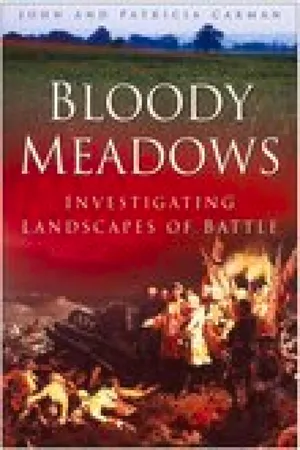
- 242 pages
- English
- ePUB (mobile friendly)
- Available on iOS & Android
eBook - ePub
About this book
Information
ONE
RESEARCHING BATTLEFIELDS
The aim of the Bloody Meadows Project is to contribute to current debates upon the place of war in the world by developing an understanding of changes in warfare practice and ideology over the long term. In operation, it is an exercise in the comparative study of battlefields from all periods of history and in all parts of the world. Treating battlefields as landscapes, and drawing upon recent approaches adopted in landscape archaeology, the project focuses on the battlefield as a place. Battles as events are a main focus of military history in all periods, and battlefields are also increasingly being taken up as part of a nation’s ‘official’ cultural heritage and as the focus of research by archaeologists and others who also seek to elucidate the sequence of events at such sites. By placing the focus upon the battlefield itself, however – and by looking at those from all periods – it becomes possible to gain an insight into the underlying cultural imperatives guiding the practice of war, and to discover aspects of war-making in the past that challenge modern perceptions and expectations. From this emerges the possibility of reaching new understandings of war as a cultural phenomenon.
The approach taken to battlefields by the Bloody Meadows Project is to treat them as particular types of landscape because there is more to the human response to landscape than treating it as a purely ‘natural’ phenomenon (Bender, 1993; Tilley, 1994). It is learned sets of taken-for-granted ideas, understandings and responses that provide the framework within which landscapes are experienced, turning landscape from a mere ‘natural’ backdrop into a cultural artefact. These culturally informed ideas, understandings and responses in turn structure the military use or non-use of landscape. Being part of a commonly held cultural frame of reference, attitudes towards landscape, expectations of landscape, and thus understanding of landscape – all of which differ for different peoples in different times and different places – are not usually part of express military discourse and are thus not open to examination. The consequence is that to understand the underlying attitudes towards battlefields held by different peoples at different times requires an investigation of the place itself as well as of the battle as an event. In doing so, we must move beyond the conventional discourses of military history and indeed military archaeology, which so often consider landscape only in terms of its direct effect on the events of battle.
The Bloody Meadows Project therefore takes an explicitly comparative approach to the study of battlefields: rather than devoting efforts to one or a few sites, the aim is to discover how one battlefield differs from another and how they differ across time and across space. The search is not for the decisive, the spectacular or the distinctive, but for the typical ‘norm’ in any period. There is an acute awareness throughout that fighting set-piece battles at particular places is not the only way of conducting wars, and the institution of ‘battle’ as we know it may be a relatively late invention in human history (perhaps no earlier than the Bronze Age of Egypt, c. 1500 BC). The Bloody Meadows Project is therefore concerned with understanding battle as a particular cultural form, and we work from the premise that battlefields have something to tell us about the nature of human violence as expressed in war, and this makes them important as culturally constructed locales.
The contribution of such a study to understanding war as a cultural activity lies in the culturally driven assumptions that lie behind the choice of place in which to fight in particular historical periods. Work from 1998 to 2002 (and reported upon in detail for the first time here) has highlighted the range of different landscapes in which battles are fought: but while similar types of place may be chosen in one period of history, these will differ significantly and noticeably from those chosen in other periods. The choice of battleground, we believe, therefore reflects unstated ideas about how war should be conducted, and these ideas vary across history. By studying the places themselves where these acts took place we can develop an insight into the minds of soldiers in the past, which challenges our own assumptions about the place of war in our society and forces us to look again at our own assumptions and expectations.
The project has its origin in some of the shared interests of the authors. One of these concerns the nature of heritage places of all kinds. Another concerns the place of war in human history. A third concerns the attempt to develop a specifically archaeological contribution to one of the important debates of our time (Carman, 1997b, 1–23). Coming as we do out of archaeology, we are concerned ultimately with the way humans interact with each other and with their physical surroundings, as represented to us by the traces left upon those physical surroundings. Not all such traces are tangible, although these intangible traces may themselves subsequently be represented by physical marks. This is what happens when we return to a place or an object and mark it as a special kind of object or place, by putting a barrier around it, by putting a marker on it, or by (at a place) building a memorial. The relevance of this to the category of place called the ‘battlefield’ will be evident: the mass act of violence constituting the battle may leave little in the way of clear traces, but they are frequently marked out as special, particularly by the construction of monuments to the event and those who died during it.
The very specific focus of the project arose initially out of the interest of one of us (JC) in the way in which particular heritage objects are selected, categorised and given value (an issue addressed in terms of the legal frameworks available in Carman, 1996). The desire was felt to take this theme further – in particular to take it more deeply into specific categories – and also to develop a fieldwork project that would allow some contact with fresh air rather than the stuffy gloom of the academic law library. Accordingly, a suitable category of heritage object was sought for examination, and one that would also provide the opportunity to do more in the way of research than merely note its existence and the bureaucratic arrangements for its treatment, or simply add to its number by identifying new sites that fit the category. At the same time, and in order especially to avoid duplicating the work of others, the category needed to be one not yet being systematically addressed either in terms of heritage or some other possible research question. It needed to be a category sufficiently large – and preferably with some international recognition – to allow a reasonable amount of specific fieldwork time, but not one so broad as to cover almost anything or any place marked as ‘heritage’.
The happy accident of the production of the English Heritage Register of Historic Battlefields (1995) coincided with the period of this search for a focus of fieldwork. Its production combined with both our interests in war as a contemporary and historical problem – especially in the light of the return of war to Europe after the end of the Cold War – and also with the simultaneous rise of battlefield archaeology as a distinct specialism (Doyle and Bennett, 2002; Freeman and Pollard, 2001). A focus on battlefields appeared to be a good way of meeting the needs of the desired fieldwork project and at the same time incorporating a concern with human violence. A project that also expressly combined issues of heritage with research into an aspect of the past would represent a new kind of project: we know of no others that combine these two aspects from the outset and where the two interact so closely.
SOME INSPIRATIONAL TEXTS ON WAR
The Face of Battle (Keegan, 1976) represented a new turn in the traditional military historian’s approach to battle as a historical event. The book concentrates on understanding the reality for combatants at three well-known and well-recorded battles from the past, which were fought within a relatively small distance from one another: Agincourt (1415), Waterloo (1815) and the first day of the Somme (1916). Opening with a sustained critique of the accepted manner of writing military history – and especially the ‘battle piece’ – the book goes on to examine in some detail the sequence of the events of each battle in terms of their experiential aspects: the effects of particular weapons on the human frame, the means of keeping men in the fighting line or of urging them to the attack, and the aftermath. Instead of a distanced, ‘general’s-eye view’ and rationalistic account of battle, the book offers the possibility of constructing a view ‘from the inside’ and of understanding the experience of war at the sharp end. In terms of the interests of the authors of the Bloody Meadows Project, Keegan’s work opened up the possibility of taking an overtly ‘materialist’ approach to battle (see also Carman, 1997b, 1–23) – in the simple sense of looking at its physical characteristics and consequences, rather than dealing with battle as the outcome of purely cerebral activity. Keegan’s directly comparative approach across several centuries also strikes a chord with our own interest in taking a long-term perspective on battles (Carman, 1997c, 220–39).
The Western Way of War (Hanson, 1989) offered something similar to Keegan’s in terms of ancient Greek hoplite warfare. Taking the elements of Greek warfare apart, the book explores the contexts within which Greek city-state wars took place, the place of the hoplite in Greek society, the relationship of men to their weapons and their fellows, the devices used to overcome fear, the organisational systems of command and control, the specific phases of combat, and the aftermath. It also, however, went one step further in attempting to use this as a window to consider the approach to war generally taken in the Western world. Arguing that the single, decisive clash of arms represented by hoplite battle has been taken in the West as the model for how war ought to be, Hanson points up the inappropriateness of such an understanding to modern conditions in an age of long-range weapons of mass destruction. He thus uses an understanding of war in historical times as a means to critique our own age. Keegan develops this theme in his own History of Warfare (1993), which seeks to draw on history for alternative but subordinate models of war which contain elements that may be more appropriate for an age where placing limits on war may be the more rational course. Both of these works thus contain the seeds of investigating the ideology of warfare by an examination of its specific form in particular historical periods.
Archaeological Perspectives on the Battle of the Little Bighorn (Scott et al., 1989) is not (as it is sometimes taken to be) the first application of archaeology to a site of military action. It was, however, the inspiration for the current phase of military archaeology. Taking advantage of the cutting of the grass at the Custer Memorial site, Scott and his colleagues used metal detectors to trace the fall of bullets and the ejection of cartridges across the space of the fight between units of the 7th US Cavalry and Lakota and Cheyenne warriors. Differences in weapons used by one group of participants from those used by others allowed the researchers to identify Native American shot from that of the soldiers, and the distribution especially of cartridge cases across the space identified the movement of men and formations through the space. From this, a model of the sequence of events emerged which confirmed Native American accounts frequently dismissed. Other work on soldier burial sites allowed also the identification of individuals, the opportunity to infer the location of the bodies of missing soldiers, and the chance to develop a picture of the ‘typical’ soldier for the late nineteenth century in North America. The techniques applied and the results achieved have since been taken as a model for similar work in the USA and other parts of the world (as represented in, for instance, Freeman and Pollard, 2001). The work at the Little Bighorn has accordingly made the historic battlefield a suitable object of archaeological enquiry.
Elliot’s Twentieth-Century Book of the Dead is a strange but interesting work, described by its author as ‘a necrology … [meaning] a naming or listing of the dead’ (1972, 11). As such, the book seeks to chart and quantify the various ghastly ways in which human beings have slaughtered each other over a particular period of history. In the case of this work, the title is somewhat of a misnomer, since the ‘twentieth century’ covered ends in 1970, thus comprising a mere 70 per cent of the total. A distinctive feature of the book is its focus less upon the direct experience of individuals than upon charting the types of ‘man-made death’ by orders of magnitude: typically, deaths due to direct military action are far fewer than those caused by public terror, guerrilla action, habitual ‘ethnic’ violence, and privation such as hunger and exposure. Indeed, it is shown that those caused by privation – both deliberate and collateral – by far exceed all the others. The book goes on to analyse the processes by which these deaths were made and draws some preliminary moral consequences from the lessons learned. This last clearly makes a connection with the origins of the Bloody Meadows Project, but there is another aspect of Elliot’s approach which has a more direct link. As Elliot puts it: ‘Much of what is written about violence is based on theories and attitudes extraneous to violence, and I cannot think of anything more lacking and more necessary to the study of violence than a discipline based on the facts of violence’ (1972, 15). A crucial fact at the centre of military activity is the place where that activity was carried out. To the extent that the Bloody Meadows Project is a contribution to the discipline of ‘necrology’, it lies in the focus upon the place of military activity as a constitutive fact of violence.
Like Elliot’s necrology, Postmodern War (Gray, 1997) and Violent Cartographies (Shapiro, 1997) are works coming from disciplines beyond and separate from both archaeology and military history. They represent the return to war as a topic in the social sciences (in these cases sociology and geography), and a new critical approach to the study and understanding of war in our own age. Postmodern War (Gray, 1997) charts the rise of the cyborg-soldier as a part of twentieth-century existence and the domination of a discourse of war in modern Western society. Like Violent Cartographies (Shapiro, 1997) and Keegan’s History of Warfare (1993), it thus seeks to reveal the cultural basis for the modern project of making war appear a realm of rational decision-making and one subject to human control. As Shapiro explains his own purpose: ‘I have had to mount a resistance to many familiar languages of analysis, in particular the rationalistic discourses that dominate “security studies”. [The aim] is to juxtapose such rationalism to a more ethnographic mode of thinking, to make rationalistic and logistical thinking appear to be a peculiar preoccupation rather than an edifying pedagogy’ (1997, xi). Gray (1997) chooses to address the components of modern war systems, unpacking the illogic and untruth that lie at the heart of military organisation and planning. He ends by suggesting alternative futures: one dominated by the out-of-control war machine, the other by the concomitant rise of soldiers who are themselves opposed to wars. Shapiro (1997) addresses the rhetoric of military activity, mapping in a series of chapters the ways in which – at least in the American imagination – enemies have their humanity stripped from them, creating a moral space in which the military preference for violence can prevail. In thus taking a critical perspective upon war in our own time, these works – and others like them – inspire the possibility of a critical examination of war in the past, one not limited to the professional expectations of military history held by the soldier nor to dominant traditions of enquiry. Instead, it opens up the possibility of examining aspects of war in the past in their own terms. It is this that the Bloody Meadows Project aims to do in relation to the places where military violence was carried out.
A SHORT HISTORY OF BATTLEFIELD RESEARCH
While battles as events have been the focus of historical interest since the discipline of history was first invented, a specific interest in battlefields took longer to develop. Foard (1995, 343–82) records the early efforts of Edward Fitzgerald from 1842, whose work at Naseby in England includes the recording of field names and other topographical features, drawing the contemporary appearance of the landscape, noting where local people had found artefacts from the battle, and recording where local tradition placed particular events of the battle. Fitzgerald’s work went on to include the digging of test-pits and finding a mass grave (Foard, 2001). At about the same time, Richard Brooke was pursuing his interest in the battlefields of the Wars of the Roses, inspired in him by his birth near the site of the battle of Stoke. His Visits to the Fields of Battle in England of the Fifteenth Century (Brooke, 1854) is largely a discussion of the historical sources he drew upon and concerns the events of the fight and the names of the prominent killed and wounded. He does, however, provide useful sketch maps of each site, some of which are of more practical use today than more modern ones.
Subsequent interest has largely remained in the realm of Brooke’s primary concern, of identifying the places where battles took place, rather than using them as research objects in their own right. Once identified, the tendency is to assume that the landscape as seen today is similar, if not identical, to that on the day of the battle. Accordingly, Keegan – although aiming to gain an insight into the experience of battle in particular historical periods, which might have included gaining an insight into how the space of the battle might be ‘read’ by participants – makes no attempt to confirm that the location of the woods at Agincourt has not altered since the early fifteenth century (1976, 88) and the topography of battlefields is not discussed anywhere in his text. Similarly, as Foard (2001) makes clear in his criticism of both the standard form of battlefield ‘guide’ and the English Heritage Register (1995) which so closely resembles such guides, most publications on battlefields continue to ‘place stylised battle formations and key topographical features … almost arbitrarily against a modern map base’. Frequently, however, students of military history have taken the trouble to visit the sites of the battles they discuss and to relate the topography to contemporary accounts: accordingly, both Oman (1902) and Weller (1962) travelled extensively through Spain and Portugal to visit the sites of the battles of the Peninsular campaign, and Oman in particular took care to relate General Napier’s recollections of the war to what he saw. Authors of the volumes contained in such popular series as ‘British Battles’ (e.g. Naylor, 1960; Tomasson and Buist, 1962; Woolrych, 1966) have also been assiduous in relating action to landscape features, and the best battlefield guides (among them Burne, 1950; Seymour, 1975) have done the same. However, the primary focus has always been upon the literary evidence for battle action, rather than what the place itself could provide.
However, a group of unrelated twentieth-century researches have moved closer to a direct concern with the battlefield itself, and while all have much to teach us in pursuing this field, only the last has led to the recent explosion of interest in battlefield archaeology. The first exercise in battlefield archaeology in the twentieth century took place in the late 1950s and early 1960s, when the then military government of Portugal sought, among other things, to celebrate Portugal’s military past by promoting the deeds of its medieval chivalry. Excavations in advance of building a monument and a museum at the site of the battle of Aljubarrota, where Portugal first emerged as an independent state, revealed a mass grave (do Paço, 1962, 115–63) and battlefield features. Not widely published, and incompletely at that, this exercise in battlefield archaeology has gone largely unnoticed by the battlefield archaeology community. A decade later in England, work at Marston Moor (Newman, 1981) and roughly contemporary geological work at M...
Table of contents
- Cover
- Dedication
- Title
- Copyright
- Contents
- List of Illustrations, Tables and Figures
- Acknowledgements
- 1 Researching battlefields
- 2 Understanding battlefields
- 3 Battlefield reports fieldwork from 1998 to 2001 on twenty-three sites of battle in western Europe
- 4 Interpreting battlefields
- 5 Experiencing battlefields
- 6 Marking battlefields
- 7 Going forward
- References
Trusted by 375,005 students
Access to over 1.5 million titles for a fair monthly price.
Study more efficiently using our study tools.
Frequently asked questions
Yes, you can cancel anytime from the Subscription tab in your account settings on the Perlego website. Your subscription will stay active until the end of your current billing period. Learn how to cancel your subscription
No, books cannot be downloaded as external files, such as PDFs, for use outside of Perlego. However, you can download books within the Perlego app for offline reading on mobile or tablet. Learn how to download books offline
Perlego offers two plans: Essential and Complete
- Essential is ideal for learners and professionals who enjoy exploring a wide range of subjects. Access the Essential Library with 800,000+ trusted titles and best-sellers across business, personal growth, and the humanities. Includes unlimited reading time and Standard Read Aloud voice.
- Complete: Perfect for advanced learners and researchers needing full, unrestricted access. Unlock 1.5M+ books across hundreds of subjects, including academic and specialized titles. The Complete Plan also includes advanced features like Premium Read Aloud and Research Assistant.
We are an online textbook subscription service, where you can get access to an entire online library for less than the price of a single book per month. With over 1.5 million books across 990+ topics, we’ve got you covered! Learn about our mission
Look out for the read-aloud symbol on your next book to see if you can listen to it. The read-aloud tool reads text aloud for you, highlighting the text as it is being read. You can pause it, speed it up and slow it down. Learn more about Read Aloud
Yes! You can use the Perlego app on both iOS and Android devices to read anytime, anywhere — even offline. Perfect for commutes or when you’re on the go.
Please note we cannot support devices running on iOS 13 and Android 7 or earlier. Learn more about using the app
Please note we cannot support devices running on iOS 13 and Android 7 or earlier. Learn more about using the app
Yes, you can access Bloody Meadows by John Carman,Patricia Carman in PDF and/or ePUB format, as well as other popular books in History & Historical Geography. We have over 1.5 million books available in our catalogue for you to explore.