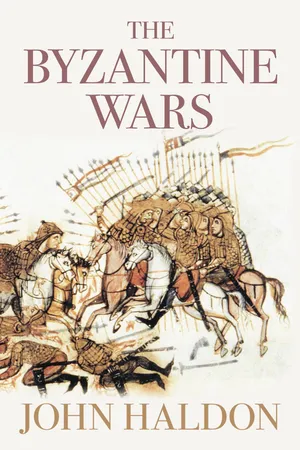
By the middle of the sixth century the Byzantine emperor ruled a mighty empire that straddled Europe, Asia and North Africa. Within 100 years, this powerful empire had been cut in half. Two centuries later the Byzantine empire was once again a power to be reckoned with, and soon recovered its position as the paramount East Mediterranean and Balkan power, whose fabulous wealth attracted Viking mercenaries and central Asian nomad warriors to its armies, whose very appearance on the field of battle was sometimes enough to bring enemies to terms. No book has ever attempted a survey of Byzantine wars, and few accounts of Byzantine battles have ever been translated into a modern language. This book will provide essential support for those interested in Byzantine history in general as well as a useful corrective to the more usual highly romanticised views of Byzantine civilisation.
- 240 pages
- English
- ePUB (mobile friendly)
- Available on iOS & Android
eBook - ePub
The Byzantine Wars
About this book
Information
1
The Geography of Byzantine Warfare
Before beginning our survey of warfare and military organization, it is worth glancing briefly at the physical context in which these are to be situated, since it is obvious that neither can really be understood without some appreciation of the landscape and other related factors which affected them. Resources, communications, population size and settlement patterns are all relevant here, and just as modern strategists must take these features into account, so Roman and Byzantine generals and politicians had to pay serious attention to such matters in planning and executing any military strategy.
The Byzantine world in the sixth century was dominated by three major regions: the Balkans, sometimes stretching northward as far as the Danube; Asia Minor (Anatolia, approximately the area occupied by the modern state of Turkey); and the Middle Eastern regions of Syria, western Iraq and Jordan, with Egypt, North Africa, Italy, and the seas which linked these lands. Different climatic patterns determined patterns of agricultural and pastoral activity in each area and thus what the government at Constantinople could hope for in the way of human and material resources.
The Balkans presents a very rugged and fragmented landscape, though the broad plains of Thrace, of Thessaly and the south Danubian area are productive and relatively densely settled. The region as a whole is dominated by mountains, which cover some two thirds of its area. The Dinaric Alps run through the western Balkan region in a south-easterly direction and with the associated Pindus mountains dominate western and central Greece. Outlying extensions of these ranges stretch into southern Greece and the Peloponnese. The Balkan chain itself extends eastwards from the Morava river for about 550km as far as the Black Sea coast, with the Rhodope range forming an arc reaching to the south through Macedonia towards the plain of Thrace. The river and coastal plains are relatively limited in extent. Distinct climatic variations thus exist, between the fairly mild conditions of the coastal regions and the continental conditions of the inland and highland regions, particularly in the northern zone. The accentuated settlement pattern reflects this in a series of fragmented geo-political units separated by ridges of highlands, fanning out along river-valleys towards the coastal areas.
Five main routes appear time and again in accounts of Byzantine war-making in the Balkans:
1. The Via Egnatia: Constantinople – Herakleia in Thrace – Thessaloniki – Edessa – Bitola – Achrida (Ohrid) – Elbasan – Dyrrachion (Dürreš) on the Adriatic coast.
2. Constantinople – Adrianople (Edirne) – along the Maritsa – Philippoupolis (Plovdiv) – the pass of Succi (guarded at the northern exit by the so-called ‘gates of Trajan’, and barred by a wall and forts) – the pass of Vakarel – Serdica (Sofia) – the Nisava valley – Naissos (Niš) – key crossroads along the routes southwards to the Aegean and Macedonia, westwards to the Adriatic, south-eastwards to Thrace and Constantinople, and northwards to the Danube) – the valley of the Morava – Viminacium (near modern Kostolac) – Singidunum (Belgrade). This was a key military route, and it was complemented by a number of spurs to East and West, giving access to the south Danube plain, the Haimos mountains and Black Sea coastal plain, as well as, in the west, the valleys of the West Morava, Ibar and Drin rivers.
3. Thessaloniki – the Axios (Vardar) valley and the pass of Demir Kapija (alternative easterly loop avoiding this defile and leading through another pass, known to the Byzantines as Kleidion, the key) – Stoboi (Stobi) – Skopia (Skopje) – Naissos (Niş).
4. Constantinople – Anchialos (Pomorie) – Mesembria (Nesebar) – Odessos (Varna) – mouth of the Danube.
5. Adrianople – across the Sredna Gora range – over the Shipka pass through the Balkan range itself – Nikopolis (Veliko Trnovo) – Novae (Svistov) on the Danube.
From the point of view of campaigning strategy, it is to be noted that all these routes pass in several places through relatively narrow and often quite high passes, easily blocked both by human agency and by natural phenomena. Such terrain was, and is, ideal for ambushing an enemy army; and combined with the weather (in which winter snows can drift to very considerable depths), made for tough campaigning conditions. Even today transit is very difficult at certain times of the year. The history of the Balkan region has been clearly marked by these features, and the pattern of communications and the degree and depth of Byzantine political control show this especially clearly, since there is no obvious geographical focal point in the south Balkan region – the main cities in the medieval period were Thessaloniki and Constantinople, both peripheral to the peninsula and its fragmented landscape. In the mountainous regions, especially the Rhodope and Pindus ranges, government power was always circumscribed by distance and remoteness, whether in the Roman, Byzantine, Ottoman or more recent periods. These were regions where paganism and heresy could survive with only limited possibilities for interference from a central government or from the Church authorities. And while they were certainly regions where popular resistance to a central political power was difficult to combat, they were also sources of hardy soldiers.
This geophysical structure also affects land use. The highland regions are dominated by forest and woodland; the lower foothills by woodland, scrub and rough pasturage. The possibilities for extensive arable exploitation are confined to the Danube plain and the plains of Thessaly and Macedonia, with the few river plains and the coastal strips associated with them offering similar but more restricted opportunities. Production here includes orchards, as well as vine and olive cultivation, apart from the staple grain production. As noted already, the settlement pattern and distribution of both larger urban centres and rural communities is determined by these aspects of the landscape. At the same time, the political, military and cultural history of the region is inflected by the relationship between this landscape and the sea. Except along its northern boundary, it is surrounded by the sea, and the extended coastline, with its gulfs and deep inlets, acts as an efficient link between neighbouring and more distant regions and as a medium for the dissemination of common cultural elements. This easy sea-borne access from the west, the south or the north-east via the Black Sea had its disadvantages, however, opening the southern Balkan peninsula – Greece and the Peloponnese especially – to invasion.
Asia Minor, the site of much of the empire’s military activity until the later thirteenth century, can be divided into three clearly separate zones: coastal plains, central plateau, and the mountain ranges which separate them. The climate of the plateau is typified by very hot, dry summers and extreme cold in winter. This is in stark contrast to the friendlier Mediterranean climate of the coastlands, in which the most productive agricultural activity and the highest density of settlement is to be found – making such areas of great importance to the government as sources of revenue. Except for some sheltered river valleys the plateau is dominated by a chiefly pastoral economy – sheep, cattle and horses.
The most densely settled regions of Asia Minor were the narrow coastal plains in the north and south and the much broader plains of the Aegean region, dissected by the western foothills of the central plateau which run from east to west. It was here that urban settlement was concentrated, although some inland regions, where a more than averagely favoured situation offered protection from the extremes of warm and cold weather, also supported small towns and villages. Throughout the medieval period and until very recently (with the introduction of modern fertilizers and mechanized farming) the exploitation of the land was predominantly pastoral on the plateau, while the fertile coastal regions supported the cultivation of grains, vegetables, vines and olives. Cities always depended upon their agricultural hinterlands for their economic survival, since the cost of transporting bulk goods such as grain overland were prohibitive over more than a few miles. Cities with port facilities or other access to the coast could develop as centres of long-distance as well as local trade and exchange and could afford to bring in supplies by sea in times of scarcity; these were thus not as dependent upon the size of their agrarian hinterland for their size.
The pattern of roads and network of communications in Asia Minor was subject to similar constraints to that of the Balkan region. Armies, whether large or small, faced several difficulties when crossing or campaigning in Asia Minor, in particular the long stretches of road through relatively waterless and exposed countryside and the rough mountainous terrain separating coastal regions from central plateau. But such features affected hostile forces to the same degree, and could be used with great effect against an invader. Middle Byzantine strategic planning was largely determined by these features. The Roman and Hellenistic road network was complex, and while much of it continued in use locally, there evolved a series of major military routes in the Byzantine period, along which developed also a string of fortified posts and military bases as the same routes became corridors of access to Arab raiders. As in the Balkans, this network evolved according to the requirements of the period, so that routes might fall in and out of use as time passed. Several routes are mentioned in the various accounts of Byzantine warfare and hostile invasion in the period stretching from the sixth and seventh through to the twelfth and thirteenth centuries. Those which seem to have been used most frequently were as follows:
1. Chrysoupolis (opposite Constantinople) – Nikomedeia – Nikaia – Malagina (an important imperial military base) – Dorylaion – (easterly route via Kotyaion/westerly route via Amorion) – Akroinon – Ikonion/Synnada – Kolossai/Chonai. There were two options to turn off to the south along this last route, the first down to Kibyra and thence across the mountains to the coast at Attaleia or, farther west, at Myra. Alternatively, the road from Chonai led westwards via Laodikeia and Tralles to Ephesos on the coast.
2. Ikonion – Archelais – Tyana/Kaisareia.
3. Ikonion – Savatra – Thebasa – Kybistra/Herakleia – Loulon – Podandos – Cakit gorge (through the Anti-Taurus mountains).
4. Kaisareia – Tyana – Loulon – Podandos – ‘Cilician Gates’ (Külek Bogazi) – the Cilician plain – Tarsos/Adana.
5. Kaisareia – (i) – Ankara/Basilika Therma – Tabion – Euchaita/(ii) – Sebasteia – Dazimon – Amaseia
6. Sebasteia – Kamacha/Koloneia – Satala.
7. Dorylaion – valley of the Tembris river (mod. Porsuk Su) – Trikomia – Gorbeous – Saniana – Timios Stavros – Basilika Therma – Charsianon Kastron – Bathys Ryax – Sebasteia – (and on to Kaisareia, north to Dazimon, east to Koloneia and Satala, or southeast to Melitene).
8. Saniana – Mokissos – Ioustinianoupolis – Kaisareia.
Some of these routes were more regularly used than others, a reflection as noted of their strategic importance at particular periods. The most frequently employed were those which led south and eastwards, and from the middle of the eighth century a series of major depots or bases, with attendant livestock supplies, were established to facilitate campaigning in these regions. These were set up at Malagina, Dorylaion, Kaborkin (between Trikomia and Midaion), near Koloneia, Kaisareia and Dazimon.
Several important routes of access were used by the Arabs, and later the Turks, for access from the Cilician and north Syrian regions into Asia Minor.
1. Cilician Gates – Podandos – Loulon – Herakleia – Ikonion/Loulon – Tyana – Kaisareia.
2. Germanikeia (Mar’as) – Koukousos – Kaisareia
3. Adata – Zapetra – Melitene – Kaisareia – Lykandos/Kaisareia – Sebasteia/Melitene – Arsamosata (Šimşat) – Khliat (on Lake Van).
4. Mopsouestia (al-Massisa) – Anazarba (‘Ain Zarba) – Sision – Kaisareia.
It is important to note that many of these routes do not follow the major paved Roman roads, preferring instead lesser and often much more ancient routes which provided better opportunities for watering and pasturing animals and provisioning armies. For most roads there were parallel alternatives, some suitable for wheeled vehicles and paved, others more like tracks, often accessible only to men in single file and sure-footed beasts of burden. Local knowledge of such tracks was essential to successful campaigning in the guerrilla-type warfare conducted along the eastern frontiers. Many of these routes evolved in response to the situation which followed the loss of the eastern provinces to the Arabs in the seventh century. Another major change came in the later years of the eleventh century, when the focus of imperial strategy in Anatolia had to change as a result of the Seljuk occupation of much of the central plateau. A new frontier zone evolved, stretching along the belt of marginal lands which divided the lowlands and coastal plain from the interior and plateau. By the 1160s and 1170s fortresses such as Chonai, Choma (Soublaion), Philomelion, Kotyaion, Dorylaion, Ankyra and Kastamon now figured as the most advanced frontier posts, covering the territories recovered from the Turks, with a network of smaller outposts and fortresses guarding the most important routes from the interior into the coastal regions. But they signal the high-water mark of the efforts made by the emperors of the Komnenos dynasty. Although their efforts were used to advantage by the emperors of Nicaea during the period of the Latin empire (1204-1261) following the Fourth Crusade, the advance of the Turks was to prove irresistible.
In marked contrast to the fragmented geography of the Balkans and Anatolia, the remaining territories of the empire were less rugged, although Syria and Palestine were broken up by the hilly country around Jerusalem and Tiberias and the rough and inaccessible mountains of the Lebanon, with the steppes of the great Syrian desert in the east effectively separating the spheres of Roman and Persian power in the region. The fertile Nile valley and the rich agricultural lands of Palestine and western Syria were (and are) much wealthier than the Balkans and Asia Minor and, until their loss in the seventh century, provided the greater part of the imperial revenues. The extended coastal plains of Tunisia produced both olives and cereals, the latter in great quantities, and Rome imported most of the grain to support its population from Africa, just as Constantinople was heavily dependent upon Egypt for the same requirements.
While it originally included all these lands within its boundaries, throughout the greater part of its existence the lands of the empire were restricted to the Balkans and Asia Minor, along with the Aegean islands, Crete and Cyprus, and parts of southern Italy. Although our survey begins on the Syrian and Mesopotamian fronts, Asia Minor and Thrace were the setting for the battlefields upon which the fate of the empire was partly decided.
It was certainly the system of military roads, constructed largely in the period 100 BC – 100 AD, which made the Roman army so successful and efficient in its campaigning. The Roman road system also eased and aided non-military communications, in particular the movement of goods, people and information. For a variety of reasons, the regular maintenance of roads, which was a state burden upon towns and which was administered and regulated at the local level, seems during the later Roman period to have suffered a serious decline. An important consequence of this change and the difficulties it created for the use of wheeled vehicles was a much greater dependence on beasts of burden. Strict regulations were established during the later third and fourth centuries on the size, loads and types of wheeled vehicle employed by the state transport system. This was divided into two branches, the fast post (faster-moving pack-animals, light carts, and horses or ponies) and the slow post (ox-carts and similar heavy vehicles) and although the service was drastically reduced in medieval times, it seems that a unified transport and courier service continued to operate through the Byzantine period.
...Table of contents
- Cover
- Half Title
- About the Author
- Title
- Copyright
- Contents
- A Note on Transliteration
- Introduction
- 1 The Geography of Byzantine Warfare
- 2 Justinian’s Wars
- 3 After Justinian: The Later Sixth and Seventh Centuries and the Rise of Islam
- 4 Bulgars and Arabs: The Eighth and Ninth Centuries
- 5 Warfare in the Age of Reconquest
- 6 Collapse and Recovery: The Eleventh and Twelfth Centuries
- Conclusion
- Sources and Discussion
- List of Illustrations
- Glossary
- Acknowledgements
Trusted by 375,005 students
Access to over 1.5 million titles for a fair monthly price.
Study more efficiently using our study tools.
Frequently asked questions
Yes, you can cancel anytime from the Subscription tab in your account settings on the Perlego website. Your subscription will stay active until the end of your current billing period. Learn how to cancel your subscription
No, books cannot be downloaded as external files, such as PDFs, for use outside of Perlego. However, you can download books within the Perlego app for offline reading on mobile or tablet. Learn how to download books offline
Perlego offers two plans: Essential and Complete
- Essential is ideal for learners and professionals who enjoy exploring a wide range of subjects. Access the Essential Library with 800,000+ trusted titles and best-sellers across business, personal growth, and the humanities. Includes unlimited reading time and Standard Read Aloud voice.
- Complete: Perfect for advanced learners and researchers needing full, unrestricted access. Unlock 1.5M+ books across hundreds of subjects, including academic and specialized titles. The Complete Plan also includes advanced features like Premium Read Aloud and Research Assistant.
We are an online textbook subscription service, where you can get access to an entire online library for less than the price of a single book per month. With over 1.5 million books across 990+ topics, we’ve got you covered! Learn about our mission
Look out for the read-aloud symbol on your next book to see if you can listen to it. The read-aloud tool reads text aloud for you, highlighting the text as it is being read. You can pause it, speed it up and slow it down. Learn more about Read Aloud
Yes! You can use the Perlego app on both iOS and Android devices to read anytime, anywhere — even offline. Perfect for commutes or when you’re on the go.
Please note we cannot support devices running on iOS 13 and Android 7 or earlier. Learn more about using the app
Please note we cannot support devices running on iOS 13 and Android 7 or earlier. Learn more about using the app
Yes, you can access The Byzantine Wars by John Haldon in PDF and/or ePUB format, as well as other popular books in History & Ancient History. We have over 1.5 million books available in our catalogue for you to explore.