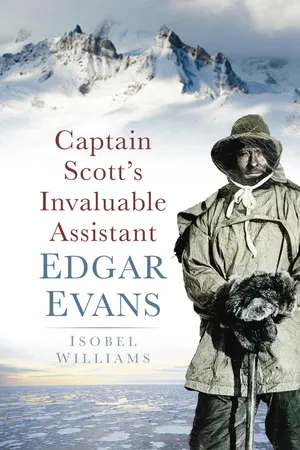
Petty Officer Edgar Evans was Captain's Scott's 'giant worker' and his 'invaluable assistant'. He went with Scott on both the British Antarctic Expeditions of the early 1900s – the 'Discovery' expedition of 1901 and the 'Terra Nova' expedition in 1910 – distinguishing himself on both. In 1903, with Scott, Edgar made the first long and arduous sortie onto the Plateau of Victoria Land. The journey highlighted Edgar's common sense, strength, courage, wit and unflappability. Thus it came as no surprise when, in 1911, Edgar was chosen by Scott to be one of the five men to go on the final attempt at the South Pole. Tragically the 'Welsh Giant' was the first to die on the ill-fated return, and posthumously Edgar was blamed in some quarters for causing the deaths of the whole party. It was suggested that his failure was due to his relative lack of education, which made him less able to endure the conditions than his well-educated companions. Isobel Williams repudiates this shameful suggestion and redresses the balance of attention paid to the upper and lower-deck members of Scott's famous expeditions.
- 128 pages
- English
- ePUB (mobile friendly)
- Available on iOS & Android
eBook - ePub
About this book
Trusted by 375,005 students
Access to over 1.5 million titles for a fair monthly price.
Study more efficiently using our study tools.
Information
1
The Gower Peninsula: Early Life
Edgar Evans came from the Gower Peninsula in South Wales. Jutting into the Bristol Channel and open to the Atlantic gales, Gower is a place of outstanding natural beauty, a location that attracts visitors to its shores year after year. It boasts other famous attractions: in one of its coastal caves, the Paviland Cave, the oldest human skeleton in the British Isles was discovered – the ‘Red Lady of Paviland’1 (actually male remains) is tens of thousands of years old.
It would have been a remarkable astrologer who foretold fame for Edgar Evans when he was born on 7 March 1876 in Middleton Hall Cottage, Middleton – a village in Rhossili and one of the remote parishes on the peninsula. Edgar’s mother, Sarah, had moved to Middleton Cottage, her sister’s home, for her confinement.
This was a modest family. Their roots were firmly in Gower. Evans’ paternal grandfather, Thomas, and three previous generations of his family, came from the peninsula. Thomas was employed in a local limestone quarry (limestone was shipped across the Bristol Channel to fertilise the fields of north Devon). Thomas’ son, Charles (1839–1907), the father of Edgar Evans, was one of the famous ‘Cape Horners’, hardy seamen who sailed from Europe around Cape Horn to the west coast of America, a journey that could last six months.
The ‘Cape Horn’ trade grew because Swansea was then the world centre for smelting copper, essential in industry, construction and ship-building (the copper covering on ships’ hulls prevented the wood from rotting and made the vessels faster).
There were copper works in Swansea from as early as 1717. Approximately 2 tons of coal was necessary to smelt 1 ton of copper, and since South Wales was rich in coal, copper was brought to Swansea rather than coal being taken to the copper sources. When British ore was worked out, copper mines further afield were sought and Cuba and South American countries, particularly Chile, were used. These voyages to South America, in coal-carrying sailing ships, were hazardous undertakings. Life at sea was brutal and unforgiving. Off the Horn, with ‘winds at full-gale strength, waves as high as the maintops, sometimes hail and then snow coming down thick, clouds so low they enfold the mastheads, spume and sky indistinguishable’,2 forward progress was often impossible, some days the ship was set back by miles. Sometimes the voyage lasted four months, often much longer and many men died on the ‘widow-making’ passage. Added to the physical horrors of the crossing was the ever-lurking possibility of spontaneous combustion of the coal, likely to be disastrous in wooden ships and more probable if the coal was damp. After managing to survive the voyage, the sailors still had to contend with the perils of disease in South American ports. And then, having endured all that, the sailors faced the daunting prospect of the return journey. Years later, one of Edgar’s companions in the Antarctic wrote that only those who had had the experience could realise what it meant: handling frozen sails in the dark, short handed … and ‘so cold that the chocks (fittings for securing the ropes) have to be thawed with hot water before a rope will run through them’.3
But Charles Evans pursued this trade until he was in his mid-30s, well after the time he married and had children. In 1862, when he was 23, Charles, described as ‘Mariner, son of Thomas Evans, Quarryman’, married Sarah Beynon in St Mary’s church, in the village of Rhossili. Rhossili is one of the many villages dotted over Gower. It had 294 residents4 and was connected to its closest neighbour by just a muddy lane. Sarah was a local girl, the daughter of William Beynon, the licensee of the Ship Inn in Middleton, and his wife, Ann. She was 22 at the time of her marriage and her family had held the licence for the Ship Inn for most of the nineteenth century.
The ceremony was performed by the Reverend John Ponsonby Lucas BA, MA, an Oxford graduate, who ministered to several of the local villages. St Mary’s, with its beautiful Norman doorway, remains an active, functioning church. For many years a plaque in the aisle wall has proudly commemorated the life of Charles and Sarah’s famous son, Edgar.
As was usual in Victorian households, the couple produced a large family – there were eight known children. Birth control was unknown in working class communities in the late 1800s, and a high birth rate was a type of insurance policy against an unsupported old age. Four of the children are listed in the 1871 census: Charles, 7; John, 4 (both described as scholars); Mary-Ann, 2; and Annie Jane aged 1. The gap of three years between Charles and John suggests an infant death. In 1874, another son, Arthur, was born, followed, in 1876, by Edgar. A seventh child, George, was born in 1878 and a sister, Eliza Jane, in 1879. In fact Sarah Evans gave birth to more than the eight children; in 1913, after Edgar’s death, she was interviewed by a local reporter, and exhibiting stoicism difficult to imagine nowadays, she said that she had buried nine of her twelve children, three having died from consumption.5
Mrs Sarah Evans registered the birth of her fourth son in the sub-district of Gower Western on 13 April 1876. The 7 March was recorded as the birth date and Mrs Evans, unable to write (as was common, even six years after compulsory education was introduced),6 recorded her mark with a cross.
Interestingly, when Edgar entered the navy in April 1891, his Certificate of Service states that his date of birth was 9 March. Probably, once the error was officially recorded, the Boy, 2nd Class, then aged 15 years and 37 (or 39) days, thought it more prudent to go along with the official record than to challenge it, and he never corrected the date, although he is likely to have been aware of his registered birth date. Years later, in 1911, he wrote in his diary on 9 March, when he was on a sortie, that it was the ‘first time he has spent his birthday sledging’.7
Edgar was born into a small, tight-knit community. In the pre-First World War era, many people stayed within a few miles of their birthplace for the whole of their lives, and there was a huge interconnection of families through marriage. Sarah Evans had family links with many people in her village as well as brothers and sisters, some of whom were still living at the Ship Inn. So Edgar was born into a ready-made network of uncles, aunts, grandparents and cousins, as well as the immediate family crowded into his family’s cottage, which housed up to four of his older brothers and sisters as well as the babies, George and Eliza Jane. In addition, his father added to the crush on his intermittent visits home.
He learnt to speak in English as Welsh was hardly ever heard on that part of the peninsula. There must have been some incomers in Gower over the years because the villagers spoke in the ‘Gower Dialect’. This dialect, now virtually forgotten, had evolved through the influence of settlers from south-west England.
As a little lad he kept well out of the way of the local dignitaries; when the doctor visited on horseback or, occasionally, driving his horse and trap which carried the brightly coloured bottles of medicine that could be prescribed for virtually every ailment (since many of the residents could not read they were thought to be particularly impressed by the colours), Edgar took care to avoid him. Likewise, the Rector was an important local man. The Evans family were definitely ‘Church’ rather than ‘Chapel’ (the place of worship for the local Methodists). It is surprising nowadays to read of the chasm that existed between the two in some parts of the country (reminiscent of the Catholic/Protestant divide in Northern Ireland), but in Gower the division was only a pale and peaceful reflection of those clashes. When the Reverend John Ponsonby Lucas had married Edgar’s parents, he gave a girl a lift in his pony and trap, a journey of about an hour, but he was forbidden to speak to her because he was of the established Church whilst she was a Nonconformist.
By the 1881 census the family had moved to Pitton, the next small hamlet east of Rhossili. As was usual, only the people actually in the house on the day the census was recorded were counted, and Mrs Evans, ‘Mariners Wife’, registered her four younger children, now including Edgar, aged 5, as ‘scholar’ at the village school at Middleton. Forster’s Elementary Education Act of 1870 had stipulated that all children between the ages of 5 and 12 were obliged to attend school. The thrust behind this act was the fear that Britain’s status in the world could be threatened by the lack of an efficient national education system. It was a move by no means universally welcomed; there were fears that education would make members of the labouring classes, such as the Evans family, ‘think’ and so become dissatisfied with their lot. The Church also had doubts; its support for the biblical story of creation (which implies, amongst other things, that we are born to the station that we are meant to remain in) resulted in reservations. Also, the Church was already the recipient of state money for educating the poor and was reluctant to relinquish this. But once the Act was law, children were educated perforce. Edgar would be at Standard 1. He learnt his letters from an elementary reading book by copying a line of writing, in ‘good, round, upward writing’, and later wrote a few common words from dictation. He did simple addition and subtraction (of not more than four figures), as well as learning his multiplication tables (up to 6). Strict instruction was given on how to hold a pen – in the right hand with the thumb nearly underneath and three fingers flat out on the top; if his teacher saw him with one of his fingers bent he would have been rewarded by a rap on the knuckles.8 Edgar certainly benefited from the education he was given before he left school at the age of 12. His writing in later years was clear and his prose concise. The only thing that seems to have escaped his attention is punctuation; sentences flow effortlessly and sometimes confusingly, one into another.
In 1883, when his father Charles was 44, the family moved their home again. By now Charles had left long-haul shipping and was employed on a boat The Sunlight, which was involved in local coastal work based in Swansea, so the Evans family moved to the town. Swansea was important; it was part of the nation’s ‘workshop of the world’ and also known as ‘Copperopolis’ because of the prominence of the copper trade. The family moved to Hoskin’s Place, Swansea. They would have lived in one of the thousands of identical ‘two up, two down’ little terraced houses, with a communal back yard and ‘privy’. It is not clear just how many of the family made the move to Swansea; only the four youngest are recorded as being in the house on the 1881 census, but it is unlikely that Edgar’s 13-year-old sister Mary Anne or 11-year-old Annie would have left home by 1883, so it is probable that seven or eight Evans members (at least) shared the overcrowded facilities. Life was not easy. When coal could be afforded, the downstairs room was warmed by a coal fire, which was an integral part of an iron oven. Food was scarce: homemade bread and pies, meat once a week if possible, and potatoes. Water was heated by the stove and a...
Table of contents
- Cover
- Title Page
- Dedication
- Contents
- Acknowledgements
- Introduction
- 1 The Gower Peninsula: Early Life
- 2 The Boy Sailor: Naval Training
- 3 The Discovery Expedition
- 4 From England to South Africa
- 5 The Southern Ocean to Antarctica
- 6 Early Months in Antarctica: February to September 1902
- 7 The Antarctic Spring: September to October 1902
- 8 The Antarctic Summer: October 1902 to January 1903
- 9 The End of the Discovery Expedition, 1903–04
- 10 Return from Antarctica, then Home Again, 1904–10
- 11 Terra Nova
- 12 The First Western Party
- 13 The Winter Months, 1911
- 14 The Polar Assault
- 15 The Aftermath
- 16 Why Did Edgar Die First?
- Epilogue
- Plate Section
- Copyright
Frequently asked questions
Yes, you can cancel anytime from the Subscription tab in your account settings on the Perlego website. Your subscription will stay active until the end of your current billing period. Learn how to cancel your subscription
No, books cannot be downloaded as external files, such as PDFs, for use outside of Perlego. However, you can download books within the Perlego app for offline reading on mobile or tablet. Learn how to download books offline
Perlego offers two plans: Essential and Complete
- Essential is ideal for learners and professionals who enjoy exploring a wide range of subjects. Access the Essential Library with 800,000+ trusted titles and best-sellers across business, personal growth, and the humanities. Includes unlimited reading time and Standard Read Aloud voice.
- Complete: Perfect for advanced learners and researchers needing full, unrestricted access. Unlock 1.5M+ books across hundreds of subjects, including academic and specialized titles. The Complete Plan also includes advanced features like Premium Read Aloud and Research Assistant.
We are an online textbook subscription service, where you can get access to an entire online library for less than the price of a single book per month. With over 1.5 million books across 990+ topics, we’ve got you covered! Learn about our mission
Look out for the read-aloud symbol on your next book to see if you can listen to it. The read-aloud tool reads text aloud for you, highlighting the text as it is being read. You can pause it, speed it up and slow it down. Learn more about Read Aloud
Yes! You can use the Perlego app on both iOS and Android devices to read anytime, anywhere — even offline. Perfect for commutes or when you’re on the go.
Please note we cannot support devices running on iOS 13 and Android 7 or earlier. Learn more about using the app
Please note we cannot support devices running on iOS 13 and Android 7 or earlier. Learn more about using the app
Yes, you can access Captain Scott's Invaluable Assistant: Edgar Evans by Isobel Williams in PDF and/or ePUB format, as well as other popular books in History & Historical Biographies. We have over 1.5 million books available in our catalogue for you to explore.