The book uncovers the involvement of the Secret Service and how Maundy Gregory exploited sensitive information that enabled him to gain access and influence to pillars of the establishment. It reveals for the first time the contents of the recently de-classified secret file held on Gregory and his activities by the Vatican and exposes the circumstances surrounding Gregory's 1933 arrest for selling honours and the deal he was offered by Cabinet Ministers to quit the country in return for a light sentence and a pension for life.
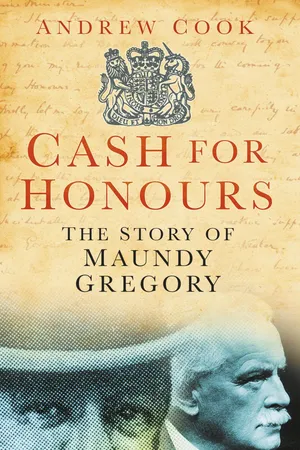
- 352 pages
- English
- ePUB (mobile friendly)
- Available on iOS & Android
eBook - ePub
About this book
Information
CHAPTER ONE
The Visitors
A wealthy provincial supplicant – an elderly, complacent, white-haired, wing-collared manufacturer, say, of socks or sewer pipes – visiting the tall, narrow, old house that was 38 Parliament Street in the 1920s, might find it a discomfiting experience. Power was implicit in the very location, within yards of the Houses of Parliament, Scotland Yard and the Home Office. Westminster Abbey, whose Archbishop still mattered, was across the Square. This was the political hub of an Empire which still covered a third of the world’s inhabited land.1
Inside No. 38, respectful attendants wore uniform which identified them as messengers from the House of Commons.2 The visitor was escorted up to the first floor, where he would sit in an ante-room, a sombre and claustrophobic chamber with a gothic stained-glass window, reading back numbers of the Whitehall Gazette and awaiting his audience with the great eminence.
A soft voice.
‘Mr Maundy Gregory is ready to see you now.’
Maundy Gregory, whose name was so often whispered between very rich men, proved to be not particularly tall and rather chubby, with a beaming smile. He wore an expensive suit, a tie which signalled quiet affluence, and brilliantly polished shoes. He would take his place behind a large desk with three telephones and a bewildering bank of switches and tiny lights, and gaze benignly down upon his seated guest; there was something of the bishop in his demeanour, something that inspired respect, and wonder too, as the gold and pearl cufflinks flashed and Mr Maundy Gregory, his eyes knowing but sympathetic as the guest spoke, would remove a rose diamond the size of a pebble from his inner pocket and turn it thoughtfully between his plump, beringed fingers. He listened; he returned a few confidences, he hinted at social opportunities as yet undreamed of – perhaps an invitation to luncheon with a Lord, or a King – and the interview would be interrupted by a call from the Palace, or Number 10. The guest’s uncomfortably intimidated feeling turned slowly to awe; then, to trust and growing confidence. At last he had found the captain who could navigate him through unfamiliar social waters. And when the visitor was visibly puffed up with his own good judgement, Mr Gregory would broach a proposition.
The mise en scène was everything. Long ago, before the Great War, Maundy Gregory had been a theatrical producer. He understood that first impressions mattered; that opulent packaging inspires confidence. The buyer must have faith that Maundy Gregory alone could deliver the goods.
Hence the telephone calls from Number 10. Few people knew Gregory well; one who did was Mr Pengelly, his accountant, and years later he would say that the Chief had looked all over London for a house called Number 10 so that he could dupe his clients into thinking that these calls came not from his home, but from the Prime Minister, across the road in Downing Street.
Maybe the house came first, and the number was a bonus. For Maundy Gregory would never look ‘all over London’ for a house; he was truly at ease only in Mayfair, St James’s and Soho (and he certainly never wanted to see Southampton again). But 10 Hyde Park Terrace, which fell just a quarter of a mile north-west of his golden triangle, was Maundy Gregory’s perfect bolt-hole. It was a pale stucco mansion on the Bayswater Road, set behind area railings, with bay windows overlooking Hyde Park. It stood just a few minutes’ walk from Marble Arch. From a wide entrance hall, stairs ascended to a dog-leg turn at a half-landing, and upwards to grand reception rooms. Beyond the windows facing the park, a pretty iron balcony ran across the entire width of the first floor. More stairs rose to a second halflanding and a second floor, where Maundy Gregory had his private quarters. Above this were separate stairs to third and fourth floors, originally intended for children and servants but now unoccupied.3
On the ground floor, enjoying views across the road to the leafy Park at the front, and from another tall bay window giving onto the lawn at the back, lived Mrs Edith Marion Rosse, now in her fifties. She had been Gregory’s closest friend since his days in the theatre.
Although it stood on the less fashionable north side of the Park, their neighbours at Hyde Park Terrace included a Member of Parliament, one of the Harmsworth dynasty, and several people of title. Snobbery and late-Georgian charm were not, however, the main attraction.
Maundy Gregory must have private access. He kept a personal taxi, with a driver who worked only for him. Secrecy befitted the man who was said to have run Britain’s spy network during the Great War, who used black blotting paper lest his jottings should be read, who was said to own a West End club and to be a millionaire, and to have covert political interests which might yet change the course of European history. Later he would be accused of murder; later still, of two murders, and the framing of a man hanged for treason.
The house next door to the east was on the corner of Albion Street. A short walk up Albion Street, on the left, was Albion Mews West. The Mews extended behind 10 Hyde Park Terrace. Maundy Gregory could emerge from his cab in the Mews, quietly cross his own garden, and climb the back stairs of the two-storey extension and the last short flight to his private apartments without being noticed either inside or outside the building.
On a Friday evening early in February 1933, Chief Inspector Arthur Askew, of the detective branch at Scotland Yard, had almost certainly spotted Mr Gregory’s taxi turning into the Mews. He and a police sergeant strolled around to the front portico.
The door-knocker boomed throughout the house. No-one inside would be in any doubt about the portent of this visit. Only policemen and bailiffs can convey their intentions so clearly from the other side of a door.
The summons that Askew intended to issue to Mr Maundy Gregory was even more significant than he knew. On the face of it, it was the result of a complaint to the police by a member of the public. Chief Inspector Askew had no reason to suspect that for MI5 and the Chairman of the Conservative Party, this knock on the door would represent the outcome of four years’ work, a couple of aborted attempts to remove Maundy Gregory from his post as Purveyor of Honours to the rich, and the final defeat of high-level opposition. People in high places had been trying to get rid of Mr Gregory for a long time. They had tried, they had failed, and they had watched in frustration as Mr Gregory’s activities became more dubious with every passing year.
For others in positions of power, though, Askew’s rap on the door would represent a threat. If Maundy Gregory talked, and if Maundy Gregory came to grief, so would they. He had always, until now, received protection; but the system seemed about to fail them. Anything might happen.
Nearly eighty years later, a serving Prime Minister has been asked to help the police with their enquiries. At 10 Downing Street the repercussions of Maundy Gregory’s predicament may seem only too familiar. For Maundy Gregory was an honours tout; and Tony Blair’s Government is also suspected of having offered peerages in return for hard cash.
One cannot emphasise too much the huge cultural differences between 1933 and 2007. The British today are cynical. We are not surprised. We expect scandal; and the protagonists survive. In 1933 the pyramid of society was even more bottom-heavy than it is now, and circumstances and attitudes were very different. The powerful political, financial and social élite had been badly shaken by what could happen to élites, as in Russia in 1917. The economy depended on protecting capital, the generation of which depended in great measure on willing labour. The political system was protected by discretion, which was protected by mass deference, which depended on respect. Socially, that respect depended in large part on maintaining the ignorance of the masses.
Millions had gone to war because they believed what their ‘betters’ told them. When the soldiers came back, the social order did change – but slowly. The rich were not as rich as before, yet they were still rich enough to expect deference. Politicians were protected by a huge mandarin class. In all but a very few cases, their background and education set them apart from the man on the Clapham omnibus. Journalists did not snoop into their affairs; ordinary people would have been shocked. The growing middle class employed obedient servants just as the landed gentry did; and the peerage and the politicians and the mandarins were so distant as to seem almost superhuman. The millions at the bottom of the heap still stood up respectfully when the National Anthem was played at the end of every cinema performance. Children in the 1920s waved flags and had a holiday on Empire Day.
Scandal must not be allowed to approach the ruling class. And if it did, the rulers would find someone to sacrifice.
CHAPTER TWO
A False Start
Half a century before, Arthur John Maundy Gregory – this man of mystery and insidious power by 1933 – had possessed neither wealth nor influence. He was the second son of an impoverished High Anglican vicar and his well-born wife. Handsome but stern, old Reverend Gregory wore a biretta, a soutane and a heavy beard. When he first arrived at St Michael’s, Southampton, the whiff of incense about the new vicar had been as the whiff of sulphur to the scandalised congregation. They never did become entirely reconciled to his theatrical, crypto-Catholic style.1 But like his better-known son, the vicar proved thick-skinned, and stayed.
The family remained poor, by Mrs Ursula Gregory’s standards: she had to manage with only a maid, a cook and a nurse when the boys were small. Michael arrived in 1873, Edward in 1875 and two more sons, Arthur and Stephen, followed at two-year intervals.2 For a late-Victorian family, this was not a large brood, and there was enough money for their education.
Michael Gregory, his oldest brother, died in March, 1882 at the age of nine.3 He had been attending a prep school at 9 Hereford Square, South Kensington, just around the corner from their uncle, Arthur Wynell-Mayow, who lived in the Cromwell Road. Their uncle was there when little Michael died of ‘acute bronchitis’ after a ten-day illness. Arthur would have been only seven and may have been at the same school. His feelings are unknown, although he was cruelly teased at his next school as a cry-baby.
When he was about ten, Arthur was sent to board at Banister Court, a school which had been installed in a mansion outside Southampton to educate the sons of officers on P&O ships. There he met a contemporary of his older brother Edward, a boy called Harold Davidson whose father was also a local parson.4
Gregory, the stronger of the two characters, loved to produce and write plays; Harold Davidson, the cleverer, loved to take part. Sadly, every other aspect of young Harold’s time at Banister Court was unhappy. He was small (boys called him Jumbo) and weak, and too kind-hearted to endure what was quite a tough school, and was removed to the Whitgift School when he was thirteen. Arthur learned to survive. He and Harold would meet again later.
He left Banister Court at eighteen having passed Oxford Entrance,5 and enrolled as a non-collegiate student at the university in order to study for Holy Orders. Extra-collegiate and studying theology, he was not in the vanguard of social or intellectual life. He boarded with a Mrs Johnson at 81 Iffley Road and passed unnoticed.6
Quite what he – or his father – thought he could do for religion was unclear. What religion could do for him would not become apparent until thirty-five years later. In the meantime, he developed his superstitious side. These were the late 1890s, when occultism, Spiritualism, table-tapping, Theosophy, Rosicrucianism and The Order of the Golden Dawn were in vogue and Aleister (‘do what thou wilt shall be the whole of the law’) Crowley was about to publish Arcadia. There was much whispering of shamanism, ancient truths hidden in long-forgotten languages, secret brotherhoods, and so on.
Uneducated in science, and haunting second-hand bookshops in search of mystery and conspiracy, Arthur came to reject his father’s beliefs in the most public way possible. In 1898 back in Southampton he wrote and produced a successful play called Self-Condemned whose hero, a sometime priest, rejects High Anglican ways and all the Church stands for. He rejects the theatricality of the service and the hypocrisy of the vows, knowing that behind the religious façade humanity is forever fallible.
His father, by now a sick man, was hurt; the more so since at the first performance he saw priceless mediaeval artefacts from the parish church used as props, without so much as a by-your-leave.
Gregory ignored these protests. He was twenty-one and his play was much admired, for genteel Southampton audiences in those days cared about the issues it raised. He took Self-Condemned on tour. In the less rarefied atmosphere of the industrial north, it was a flop. It folded suddenly. Those who had depended on him for a living did not get paid; penniless actresses had to make their way home somehow.
There was nothing for it. A.J. Gregory must face reality. He was unqualified to make a living in the theatre and without even meagre parental support, he would be destitute. In despair, he returned to Oxford for his final year of theological study.
He was struggling through his penultimate term when the Reverend Gregory died, on 1 March 1899. The obstacle to Gregory’s ambition was now removed. There was a little money as a buffer against rejection, but not enough to launch him or his two surviving brothers in life. Edward began work as a junior accountant. Stephen, two years younger than Arthur, left for the South African War.
Arthur Gregory did not return to the university. His pitch for stardom was reinstated and with it, the possibility of freedom. He could now aim at a career on the stage, with its atmosphere free of moral censure. At first he earned a paltry living as a drawingroom entertainer, playing the piano and relating amusing stories at gatherings in private homes, while he sought work in the theatre. By this time – it was around 1900 – he was friendly with a family called Loraine who lived in Lyndhurst, in the New Forest not far from Southampton. The young sisters were as stage-struck as Gregory was, perhaps because of a family connection to Harry and Richard Loraine. Harry Loraine was an actor-manager, and Richard, his son, had been a popular young leading man with Ben Greet’s Woodland Players and a big West End hit before leaving to fight in the Boer War. He returned to the stage later before becoming even more famous as an aviator.
Gregory was twenty-three, smartly dressed, charming and babyfaced, with a strong sense of the effect he could make if he tried. The Loraines enjoyed his company and he theirs; he had the actor’s gift for anecdote; and the Loraines eventually lost him to a Ben Greet touring company.7
Greet, then in his forties, had been running theatre companies for over twenty years and would go on to found the Shakespeare Company at the Old Vic. Gregory now knew that a solid training in repertory theatre was necessary for his credibility. He set out as a very junior touring actor, spear-carrying and understudying, sewing on buttons and taking the ticket money, and increasingly being given small parts to play in provincial towns.
Romantic leads were ten a penny, but young Gregory was well organised, determined, endlessly resourceful, good-humoured and didn’t panic. He was ambitious and he could persuade temperamental people to carry out instructions. All these qualities got him a permanent job as manager of a burlesque theatre in Southampton. At the same time, he advertised himself as an agent for playwrights. Whether he discovered any new talent seems doubtful. In any case he was soon on the move again. He went to work for a cynical Irish-American showman called Kelly, who taught him to sell himself, rather than his professional talents; this is what people would buy.
After still more jobs for more impresarios, getting better parts all the time, he landed permanent work as a stage manager with a Frank Benson company in the north of England. His keenness and efficiency impressed everyone. He was earning £5 a week – a decent sum, in those days – and it was enough to bring out the showman in him. He acted the part of company manager, with a fresh flower in his buttonhole every day, a dapper suit and starched collar.
He had been in the job for about three years when it dawned on Benson, or his accountants, that Gregory’s much-praised ingenuity and industriousness were devoted largely to his own ends. As the underlings in the company already knew, he was skimming off some of the profits for himself. He left Benson under a cloud.
It was now 1906; h...
Table of contents
- Cover
- Half Title
- Title
- Copyright
- Contents
- Acknowledgements
- Preface
- 1 The Visitors
- 2 A False Start
- 3 The Phoenix Rising
- 4 Not a ‘Sahib’
- 5 Breakthrough
- 6 A Vanishing
- 7 Ups and Downs
- 8 Gathering Storm
- 9 New Opportunities
- 10 The Rot Sets in
- 11 The Dangerous Mr K
- 12 Keeping up Appearances
- 13 Uncle Jim
- 14 Acting Fast
- 15 Downfall
- 16 Nemesis
- 17 Open Verdict
- 18 Sanctuary
- Appendix 1: Enquiry Agent
- Appendix 2: A Brief History of the Honours System 1905–2007
- Appendix 3: The Asquith Peerage List 1911
- Appendix 4: Lloyd George Peerages
- Appendix 5: Baronetcies
- Appendix 6: Fees on Account
- Notes
- Bibliography
Trusted by 375,005 students
Access to over 1.5 million titles for a fair monthly price.
Study more efficiently using our study tools.
Frequently asked questions
Yes, you can cancel anytime from the Subscription tab in your account settings on the Perlego website. Your subscription will stay active until the end of your current billing period. Learn how to cancel your subscription
No, books cannot be downloaded as external files, such as PDFs, for use outside of Perlego. However, you can download books within the Perlego app for offline reading on mobile or tablet. Learn how to download books offline
Perlego offers two plans: Essential and Complete
- Essential is ideal for learners and professionals who enjoy exploring a wide range of subjects. Access the Essential Library with 800,000+ trusted titles and best-sellers across business, personal growth, and the humanities. Includes unlimited reading time and Standard Read Aloud voice.
- Complete: Perfect for advanced learners and researchers needing full, unrestricted access. Unlock 1.5M+ books across hundreds of subjects, including academic and specialized titles. The Complete Plan also includes advanced features like Premium Read Aloud and Research Assistant.
We are an online textbook subscription service, where you can get access to an entire online library for less than the price of a single book per month. With over 1.5 million books across 990+ topics, we’ve got you covered! Learn about our mission
Look out for the read-aloud symbol on your next book to see if you can listen to it. The read-aloud tool reads text aloud for you, highlighting the text as it is being read. You can pause it, speed it up and slow it down. Learn more about Read Aloud
Yes! You can use the Perlego app on both iOS and Android devices to read anytime, anywhere — even offline. Perfect for commutes or when you’re on the go.
Please note we cannot support devices running on iOS 13 and Android 7 or earlier. Learn more about using the app
Please note we cannot support devices running on iOS 13 and Android 7 or earlier. Learn more about using the app
Yes, you can access Cash for Honours by Andrew Cook in PDF and/or ePUB format, as well as other popular books in History & Historical Biographies. We have over 1.5 million books available in our catalogue for you to explore.