The Conservative Party is Britain's most successful political party. For large parts of modern British history it has been the dominant party, though it has always suffered from internal division and periods of defeat. This colourful account of the Party's history since the late 18th century takes the reader on a voyage of discovery.
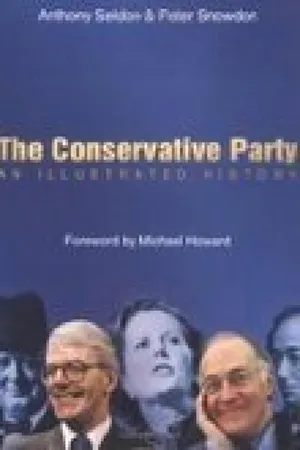
- 256 pages
- English
- ePUB (mobile friendly)
- Available on iOS & Android
eBook - ePub
About this book
Information
ONE
EARLY BEGINNINGS TO THE PARTY OF PEEL: 1640–1867
There has never been one Conservative Party. Rather, throughout the last three and a half centuries, under a variety of names and with different purposes and fluctuating beliefs, there has been a grouping that has formed and reformed itself, but which is recognisably the same entity. Its nature at any given moment has been defined largely by the character and views of the dominant leader of the day, by the political system in which it operated and by the nature of the Opposition that it confronted. Generations of historians have argued over exactly when the party was born. While the earliest roots lie with the Royalist cause in the English Civil War, contemporary historians such as John Barnes refer to the 140 years between the beheading of Charles I in 1649 and that of Louis XVI in 1789 as the party’s ‘pre-history’. Pitt the Younger’s eighteen and a half years in office is often cited as the party’s true starting point, while others insist Peel’s leadership in the 1830s marked the birth of the modern party. Ultimately, looking for evidence of a coherent Conservative Party through the centuries is a mistake. It is better to see each of the phases in the party’s existence since the Civil War in terms of a family tree with each generation less and less like its ancestors. Michael Howard might look at Edward Hyde in the 1640s and see some similarities, but the grouping they head is radically different.
TORY ANCESTORS: 1640–1714
In his seminal work The History of the Tory Party 1640–1714 (1924), the historian Keith Feiling traces the origins of the Conservative Party to the Royalists who backed Charles I in the civil wars of the 1640s. The Royalists sought to maintain the authority of the Crown in the face of the puritan challenge that led ultimately to the beheading of Charles I in January 1649. More subtly, the origins of Toryism can be traced to the moderate royalists like Sir Edward Hyde and Lord Falkland, who tried to find a ‘middle way’ between the intransigence of the monarchy and the increasing radicalism of the parliamentary and extra-parliamentary forces ranged against it.
No middle way could be found and the Royalists went into exile or underground until the monarchy was restored in 1660. The financial situation in which the restored monarch, Charles II, found himself meant that he could not do without Parliament. He had to look to his ministers, principally Hyde (now Earl of Clarendon) and subsequently the Earl of Danby to organise a ‘Court’ party, which would back him in the House of Commons. Part of the difficulty in tracing the ancestry of the Tory party springs from the fact that as long as the Crown was an active player in the political game, groups that supported the royal prerogative found it hard to distinguish themselves as entities in their own right. The next phase in party development came when the legitimacy of the monarch was called into question during the Exclusion Crisis of 1679–81. As Charles had no children, his brother James, the Duke of York, was next in line for the throne. Yet because James was a Catholic, a group of parliamentarians, known as the ‘Whigs’, tried to pass a law barring him from the succession. Those who stood against the Whigs and supported the Crown were dubbed ‘Tories’, initially a gibe which implied Catholic brigands from Ireland, but soon, as a result of Royalist propaganda, a label worn with pride. While the Tories disliked Catholicism just as much as the Whigs, they viewed the attempt to interfere in the succession as unconstitutional and thought it threatened England with a return to the horrors of the 1640s.
With the Tories on side, Charles II saw off the Whig challenge and James II came to the throne in 1685. But many of those who had supported the Crown were soon alienated by the way in which James advanced Catholics and sought to recast the monarchy along the absolutist model of his French contemporary, Louis XIV. Torn between their support for the Crown and their deep attachment to the Church of England, which they saw to be threatened by James II, many Tories chose the latter and secretly invited William of Orange to intervene. The Glorious Revolution, though largely bloodless, still remained of considerable embarrassment to the Tories, who although pleased that James had fled the country, remained instinctively hostile to William assuming the title of king. The emergence of a dual monarchy, James’s daughter Mary sharing the throne with her husband William, did much to reconcile them to what had happened, but they felt considerably happier once William was dead and James’s younger daughter Anne succeeded to the throne in 1702.
Initially, however, Anne’s accession did not bring about the boon in influence that many Tories had hoped for. While the Queen’s principal allies, Godolphin and Marlborough, were Tory in sympathy, they were determined to maintain a cross-party administration. Yet as the character of the administration began to tilt towards the Whigs, Anne, a staunch Anglican, grew increasingly resentful. In the end she turned to Harley and a predominantly Tory administration, and Harley’s younger ally, the mercurial Lord Bolingbroke, worked to deliver the Tories a monopoly of power.
Queen Anne’s death in 1714 changed everything. Her successor, George of Hanover, Anne’s second cousin once removed, had been selected by Parliament over James II’s Catholic descendants on the grounds that he was Protestant. Feiling argues that the ‘first’ Tory party came to an end with Queen Anne’s death. It would be more correct to say that the Tory administration was bitterly divided between the supporters of the incoming Hanoverian monarch, and a significant minority who looked to a King ‘over the water’, James II’s son, as the rightful heir. The Whigs exploited the frustrations of this minority, claiming that the Tories had tried to engineer the succession of a Catholic to the throne. An abortive invasion by the ‘Old Pretender’ (James II’s son) in 1715 served to confirm that the threat was real. In the next twenty-five years, the Whig Robert Walpole was to make good use of the ‘Jacobite taint’ to keep the Tories out of power.
OUT IN THE COLD: 1714–83
Few anticipated the swiftness of the Tory party’s decline. A critical mistake was the refusal of the entire ‘Hanoverian’ faction, Nottingham apart, to take office, but they had no reason to anticipate the disastrous defeat the party suffered in the January 1715 election. By then the Whigs had conducted a ferocious purge of the royal household, lord lieutenancies, revenue departments, military posts, legal offices and magistracies. The votes cast for the two parties were roughly equal, but Whig success in edging home in the smaller boroughs gave them a crucial victory, 341 Whigs being returned against 217 Tories. In September, Scottish Tories joined in the unsuccessful ‘Jacobite’ uprising against the new King, which further reinforced the identity of purpose between King George and his Whig ministers.
Despite long years in the cold, the Tory grouping did not lose its cohesion, and successive splits in the governing Whigs seemed to afford them a chance to return to office. On every occasion, however, temporary allies betrayed them. Their strength diminished: in 1715 they still commanded almost a third of MPs, but by 1742 that proportion had fallen to a quarter. Yet support also fell for Walpole. A key contributing factor was the return of Bolingbroke from exile and his co-founding of The Craftsman with the most brilliant of the Whig dissidents, Pulteney. The journal lambasted Walpole’s corrupt practices and, more constructively, preached the virtues of a national administration that would bury forever the names of Whig and Tory. Later generations of Tories have looked back to Bolingbroke for eternal truths about Toryism, but his purpose was more pragmatic and short term. He and Pulteney wanted Walpole out. Although it took time for the dissident Whigs to join in a broad-bottomed opposition to Walpole, the Tories already enjoyed their co-operation at constituency level. The 1741 election destroyed Walpole’s majority and brought about his fall within months, but the Tories gained little because the Whig Duke of Newcastle engineered a pact with Pulteney that ensured that the new administration remained almost entirely Whig.
The Tories now placed their hopes in the future, or more precisely, in the next king, George II’s grandson. Under the tutelage of Lord Bute, the future George III became convinced that, when he came to the throne, he should appoint politicians on their personal strengths, not their party affiliation: the Whig hegemony looked set to end. Sure enough, when George III succeeded his grandfather in 1760, he brought Tories back to court and installed Bute as a Secretary of State. The Tories supported Bute in his desire for peace with France, which came to fruition with the Treaty of Paris in 1763. Bute then stood down and Grenville emerged as his successor, heading what William Pitt immediately dubbed ‘a Tory administration’. Considered an insult at that time, Pitt’s claim was that the new ministry supported ‘royal’ government along pre-1688 lines. Yet this was only partially true. Many of Grenville’s ministers were Whigs and while a majority of Tories were ready to give their support to the King, the party was now split and a considerable number sided with the Opposition.
Gradually, a new party alignment began to take shape as George III manoeuvred to secure a ministry more to his liking. Although at one on policy, Grenville and the King were at odds on patronage and the continued influence of Bute, and in 1765, George dismissed him as Prime Minister. His replacement, the Marquess of Rockingham, adopted a conciliatory tone towards the increasingly rebellious American colonies. He even succeeded in repealing Grenville’s Stamp Act, which had placed new duties on the American colonialists, despite vociferous opposition from within his administration, most notably from the self-styled ‘King’s Friends’, backed by the monarch. In 1766, the divided government finally collapsed and the King charged Pitt with forming a new ministry. By now the Tory party was hopelessly divided, one group working closely with the King’s Friends, while those who had followed Rockingham or Grenville into opposition remained loyal to their new leaders.
Under Pitt’s ministry from 1766, the King’s Friends became increasingly prominent. The press and opposition parties branded the government as ‘Tory’, to the fury of Pitt’s supporters. After just two years, mounting protests from the American colonies about duties on trade and Pitt’s increasingly poor health precipitated his departure, making way for the Duke of Grafton. Grafton too found his time dominated by the American colonies and proved no more able than Pitt to hold a government together. In 1770, he resigned. His successor, Lord North, described himself as a Whig, but came from a Tory family that had come to terms with the Whig ascendancy. His command of parliamentary debate and his skill at managing the country’s finances were the major reasons for his twelve-year tenure of power. A successful minister while peace lasted, North’s reputation was destroyed by the loss of the American colonies and his refusal to embrace calls for government reform. The Crown’s defeat at Yorktown in November 1781 left North in no doubt that he must make peace with the colonialists. George III would not let him do so but neither would he let North resign. When defeat became inevitable, the King finally let him go and turned to the Opposition.
There followed considerable government instability, with three different prime ministers serving between 1782 and 1783, until in December 1873, George asked the 24-year-old William Pitt (‘the Younger’) to form a ministry. Pitt could count on the support from the Court and Treasury element in the Commons and also had the support of avowed King’s men. But what mattered more was his public reputation as the champion of reform and retrenchment. That brought him support from the independents, who had brought down North in 1782. Consequently, even before the election in 1784, Pitt was well on the way to achieving a majority in the Commons.
THE PITT PARTY: 1783–1806
There followed a 23-year period of Tory dominance. Except it was not really a period of ‘Tory’ hegemony at all, with Pitt terming himself an ‘independent Whig’, and ‘Tory’ remaining a term of abuse. Not until the early nineteenth century did MPs generally describe themselves as ‘Tories’, while the label ‘Tory’, applying to newspapers and journals, the principal media forms of the day, was not in general use until after 1820. More confusingly still, Pitt (like his father, William Pitt ‘the Elder’) was identified originally not with Anglicanism, one of the Tories’ core beliefs, but with the Dissenters. Nor could one say that Pitt was ‘right-wing’ in contrast to the ‘left-wing’ Whigs, as the terms right-wing and left-wing did not exist before they were coined based on the seating plan of the pro- and anti-reform groupings in the French Assembly in 1789.
In what sense, then, can one label the period from 1783 to 1806 (under Pitt until 1801, then Addington until 1804 and under Pitt again until 1806) one of Tory hegemony? Until 1788–9, it made no real sense to label Pitt’s administration ‘Tory’. He saw his primary duty more as providing stable and efficient government than following any particular set of principles. But Pitt’s own independence and position was greatly enhanced following George’s first period of incapacity through mental illness from 1788, which accelerated the long-term shift in power from the monarchy to government ministers. Some historians have seen George’s madness as the moment when a ‘Tory’ government came into existence (in place of the ‘King’s government’). A further boost to the Tory cause came from the French Revolution in 1789. Although the events were welcomed in some quarters as a just fate for Louis XVI as head of England’s old enemy, it soon became alarmingly clear that if not only the monarchy but also landed interests were to be terminated in France, they could be in Britain also. After war was begun in 1793 against Revolutionary France, the status quo in Britain bound ever more tightly together in a common cause against the republicans and radicals across the English Channel. The following year, the Whigs split, and a faction led by Rockingham came over to join Pitt’s government, establishing an alliance between monarchists and the landed interests, and leaving just a small rump of the more radical Whigs on the outside. The identification of a common enemy produced a popular upsurge of Toryism, spawning across the country ‘King’ and ‘Constitution’ clubs, ‘Pitt’ clubs and ‘Constitutional Associations’.
One of the Whigs to join Pitt in 1794 was Edmund Burke, regarded as the profoundest thinker on the evolution of Conservatism in Britain. Burke’s fundamental insight was that society is organic, and that change must be evolutionary, not revolutionary, and in line with social and national traditions. Authority, hallowed over the ages, had an automatic entitlement to be respected, but change was inevitable and desirable; as he wrote, a ‘state without the means of some change is without the means of its conservation’. This thinking explained and justified the conservative preference for gradual reform as opposed to reactionary obstruction of change at all costs, which ran the risk of a build-up of pressure to the point that it became unmanageable. But lest one overestimate Burke’s significance for the Conservative Party, it is worth remembering that his key positions, including support for the landed interest, property, the hereditary principle, the Church of England, order and moderate reform, and constitutional rather than radical change, had been part of the conservative tradition long before Burke joined its ranks. One must thus treat with some scepticism assertions by those like John Gray who see Burke as ‘the founder of British Conservatism’. British Conservatism has always been much more about what British conservatives have done and thought than what philosophers have written.
THE LIVERPOOL PARTY: 1812–27
The general election in 1807, which followed Pitt’s death in 1806, saw the Whigs again branding government supporters ‘Tories’. The dividing line between both groups began to become clearer, although the number of independent MPs in the Commons remained high. Events in France continued to polarise opinion in Britain between supporters of the King and Church of England, the Tories, and those who favoured reform, the Whigs. Supporters of the Tory leader Lord Liverpool were also united in their belief in strict law and order, a rejection of anything that smacked of radicalism, and their dislike of the Foxite Whigs. The distinct identity of the emerging Tories under Liverpool was given a boost by their unbroken period of domination of government, under the Duke of Portland until 1809, then under Spencer Percival until his assassination in May 1812, and then under Liverpool himself until 1827. During these years, far more than under Pitt, a recognisably ‘Tory’ government could be said to be in power, even though Liverpool and his ministerial colleagues saw themselves as Pitt’s successors, and barely thought of themselves as a distinctive ‘party’ at all. Developments were occurring, however, which encouraged the emergence of a more clear-cut Tory party. Prime Minister Liverpool did a great deal to boost collective responsibility among his ministers. Whips in the House of Commons began to advise MPs on how to vote (although this advice stopped short of coercion), the number of ‘independent’ MPs began to fall, and the fashionable St James’s clubs, Brook’s and White’s, emerged as the social settings for rival parliamentary teams. Party organisation at Westminster may still have been only skeletal, and in the country non-existent, but it was a start. It would be wrong, however, to see the labels ‘Whig’ and ‘Tory’ as relating to much more than a series of social networks and to a type or temperament. We are not yet speaking of a defined or disciplined group of politicians, although the Foxite Whigs, who were in permanent opposition after 1807, exhibited some traits of what later came to be understood as a political party.
Liverpool has not always been regarded kindly by posterity. Disraeli later dismissed him as an ‘arch mediocrity’. The historian Norman Gash, however, sees Liverpool as ‘the first great Conservative Prime Minister’. He had a difficult hand to play. Abroad, the Napoleonic war was still raging, which he brought to a successful conclusion in 1814–15. At home, he had to face industrial unrest, including Luddism, as a response to rapid industrialisation, disagreements with George IV (who finally succeeded George III in 1820) over his wish to divorce Queen Caroline, and struggles with Parliament to find the money to pay off war debts. As the 1820s wore on, Liverpool’s problems eased, and a new era of ‘Liberal Toryism’ was popularly seen as beginning in 1822, following a repressive period of ‘High Toryism’ during the unstable war and immediate postwar years. Historians now generally deny that Liverpool’s premiership saw such a conscious shift in emphasis in 1822, and stress instead the eased economic position which allowed Liverpool to adopt a more liberal regime. An influx of talented new ministers (notably Canning at the Foreign Office, ‘Prosperity’ Robinson at the Treasury, William Huskisson – one of the first fatalities of the new steam locomotives – at the Board of Trade and Robert Peel at the Home Office) also provided the government with new life. By 1827, when Liverpool retired after a stroke, he had achieved a record many later prime ministers would have been pleased to emulate, including a reduction of tax, stimulating commerce and achieving peace at home and abroad.
Two great issues of the day, however, had not been tackled. The first, the status of Catholics in Ireland, was deliberately avoided by Liverpool, who knew that it would generate great tensions within the party. Pitt had negotiated the Act of Union with Ireland in 1801 to ward off the risk of a French invasion using that country as a base. Pitt’s promise was that civil discrimination against Irish Catholics would be terminated in return for the Irish Parliament agreeing to the Act. But George III refused to agree, which presented a dilemma for the Tories: the desire to preserve the Union with Ireland suggested giving Catholics their civil rights rather than attempting to govern Ireland through an unrepresentative Protestant elite; but granting them civil rights went against their visceral support for the King and Church of England. In 1812 the issue was temporarily put on ice by agreement to the ‘neutrality principle’ on Catholic Emancipation, though Liverpool realised that such procrastination was only storing up problems for the future. The other issue dodged by Liverpool was parliamentary reform. The need to address ‘rotten boroughs’ – districts that elected MPs but which lacked voters – and to reallocate p...
Table of contents
- Cover
- Title
- Dedication
- Copyright
- Contents
- Foreword by Michael Howard
- The Argument
- 1. Early Beginnings to the Party of Peel
- 2. The Parties of Disraeli and Salisbury
- 3. The Baldwin Party
- 4. The Churchill and Macmillan Parties
- 5. The Thatcher Party
- 6. The Tory Body Politic
- 7. The Great and the Good
- 8. Wreckers, Rebels, Rogues and Eccentrics
- 9. Party and Country
- 10. The Election Machine
- Acknowledgements
- Bibliography
Trusted by 375,005 students
Access to over 1.5 million titles for a fair monthly price.
Study more efficiently using our study tools.
Frequently asked questions
Yes, you can cancel anytime from the Subscription tab in your account settings on the Perlego website. Your subscription will stay active until the end of your current billing period. Learn how to cancel your subscription
No, books cannot be downloaded as external files, such as PDFs, for use outside of Perlego. However, you can download books within the Perlego app for offline reading on mobile or tablet. Learn how to download books offline
Perlego offers two plans: Essential and Complete
- Essential is ideal for learners and professionals who enjoy exploring a wide range of subjects. Access the Essential Library with 800,000+ trusted titles and best-sellers across business, personal growth, and the humanities. Includes unlimited reading time and Standard Read Aloud voice.
- Complete: Perfect for advanced learners and researchers needing full, unrestricted access. Unlock 1.5M+ books across hundreds of subjects, including academic and specialized titles. The Complete Plan also includes advanced features like Premium Read Aloud and Research Assistant.
We are an online textbook subscription service, where you can get access to an entire online library for less than the price of a single book per month. With over 1.5 million books across 990+ topics, we’ve got you covered! Learn about our mission
Look out for the read-aloud symbol on your next book to see if you can listen to it. The read-aloud tool reads text aloud for you, highlighting the text as it is being read. You can pause it, speed it up and slow it down. Learn more about Read Aloud
Yes! You can use the Perlego app on both iOS and Android devices to read anytime, anywhere — even offline. Perfect for commutes or when you’re on the go.
Please note we cannot support devices running on iOS 13 and Android 7 or earlier. Learn more about using the app
Please note we cannot support devices running on iOS 13 and Android 7 or earlier. Learn more about using the app
Yes, you can access The Conservative Party by Anthony Seldon,Peter Snowdon in PDF and/or ePUB format, as well as other popular books in Politics & International Relations & World History. We have over 1.5 million books available in our catalogue for you to explore.