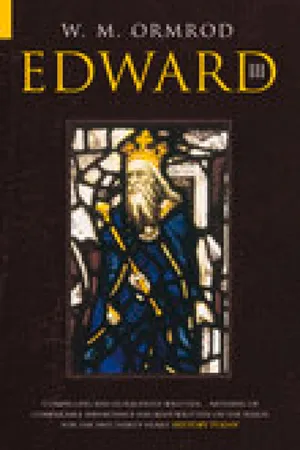
The fifty-year reign of one of England's most charismatic leaders is assessed in this lucid and incisive work. W.M. Ormrod traces Edward's life from his birth, when the very future of the monarchy in England was under threat, to his death when he was regarded throughout Europe as the very model of an ideal monarch.
eBook - ePub
Edward III
About this book
Information
- 1 -
The Early Years
1327–41
The forcible removal of Edward II made an inauspicious start to the new reign. Edward III was a boy of fourteen when he was set prematurely on the throne of England. At his coronation, which took place just a few days after the publication of his succession, he was asked whether he would take the additional oath made by his father in 1308 to observe the just laws chosen by the community of the realm. He was reputedly told that if he did not so swear, he would not be crowned.1 Those who took part in the coronation, however, were well aware that the real political problem lay not with the young king but with Queen Isabella and Roger Mortimer. They had put Edward on the throne, and they clearly intended to control his government.2 In their rush to establish some form of legitimate and workable regime, the queen and her lover won the initiative. The parliament of February-March 1327 was preoccupied with efforts to undo the evils of the previous reign, securing the posthumous rehabilitation of Thomas of Lancaster, acknowledging the succession of Thomas’s brother Henry to most of the family titles, and guaranteeing an amnesty for those of Lancaster’s followers victimized by the Despensers.3 The assembly lacked the authority and missed the opportunity to dictate the form of a regency government, and merely asked that suitable wise men be chosen by the magnates to advise the king.4 A council of sorts was set up, led by Henry of Lancaster, and including some of the leading opponents of the Despenser regime such as the old king’s brothers, the Earls of Norfolk and Kent, and Bishops Stratford of Winchester and Orleton of Hereford.5 This was in no sense a regency council, however, for it enjoyed no executive power. It was Mortimer, through his intimacy with the queen and his influence over the boy king, who actually held the reins of government.
For a while, popular measures helped to disguise the self-seeking ambitions of Isabella and her paramour. The popular cult of Thomas of Lancaster, which had been repressed by Edward II, now received some degree of official support. In 1327 the commons actually demanded that the Ordinances of 1311, for which Lancaster had fought and lost his life, should be added to the list of great and solemn charters observed by the crown.6 Although the government balked at this idea, it did take up the commons’ proposals for the canonization of Lancaster and began to negotiate with the Curia for the making of a new St Thomas.7 The liberality of the new regime also won the queen some powerful allies. Sympathies for Edward II remained, especially in the Welsh Marches, where the Despenser stronghold of Caerphilly held out well into 1327. Even those who had welcomed the queen’s invasion in 1326 might be ambivalent unless rewarded for their support. Erstwhile servants of the Despensers were therefore left at their government posts; and important figures such as the new king’s uncles, who might have expected a greater share of power, were bought off with large grants of money and land. None the less, it was soon obvious who were the real beneficiaries of the coup. The queen and Mortimer helped themselves greedily to the large financial resources left by Edward II, and made free with the possessions of his followers. The Despenser estates in South Wales and the lands of Edward II’s partisan the Earl of Arundel in the northern march now fell under Mortimer’s control. Despite his formal acceptance of the revived Lancastrian inheritance, Mortimer also insisted on seizing Thomas of Lancaster’s former lordship of Denbigh. By snatching marcher lands from Edward II’s supporters and opponents alike, Mortimer consolidated an enormous block of territories on the Welsh borders.8 Before long, he was king in all but name. He held ostentatious tournaments, and married his daughters off to the heirs of the great earldoms of Norfolk and Pembroke. The climax came late in 1328 at the parliament of Salisbury, when Mortimer assumed the title of Earl of March. Within two years of the collapse of the Despensers, an overmighty marcher principality was once again threatening to upset the political balance. The political community braced itself for another confrontation.
The first opportunity for criticism came with the failure of Mortimer’s foreign policy. Edward II had been humiliated by the Scottish leader Robert Bruce at Bannockburn in 1314 and defeated by the French in Gascony during the war of St Sardos of 1323–5. Military or diplomatic victories were much needed in order to re-establish the political credibility of the crown. But Queen Isabella had already tarnished her reputation by working out a humiliating truce with her brother, Charles IV, in 1325. This had required the English king to pay £60,000 as a relief for his duchy of Gascony, and an additional 50,000 marks (£33,333 6s 8d) by way of a war indemnity. Moreover, in 1326 the French and Scottish kings had made a treaty at Corbeil, guaranteeing the integrity of their alliance irrespective of any English approaches to either side. The diplomatic and military situation was therefore unpromising in 1327. On the very night of Edward III’s coronation, a Scottish force crossed the northern border and laid siege to Norham Castle. When news reached the court of Bruce’s plan to launch a combined Irish, Welsh and Scottish attack against Edward, preparations for a campaign were immediately put in hand. But Mortimer proved less than adequate as a war leader. When the two armies eventually drew up at Stanhope Park near Durham in early August, the Scots were able to launch a surprise night attack on Edward III’s quarters and then withdrew before battle could be joined. The whole affair proved a fiasco, and an expensive one at that. All that was left of Edward II’s considerable financial reserve was now used up, and the government had to pawn the crown jewels to pay for the campaign. There was no alternative but to sue for peace. By the treaty of Northampton of 1328 the English renounced all claims to feudal suzerainty and to lands in Scotland. The queen and her lover salvaged some personal satisfaction from the treaty by securing the promise of £20,000 from the Scots, most of which found its way into their own treasuries. But for the young king, and for many of his subjects, the terms were an unmitigated disaster.
It was in the wake of the treaty of Northampton that the first signs of active opposition to Mortimer began to emerge.9 Although the treaty was presented to parliament in 1328 for ratification, a number of the barons, including the Earl of Lancaster, declined to give their assent. In the summer, Lancaster refused to support a projected campaign in Gascony; and later in the year he absented himself from the parliament of Salisbury, returning to his estates in the midlands with the intention of raising rebellion. He was joined by the Earls of Norfolk and Kent and by his son-in-law Sir Thomas Wake. In the event, the uprising was short-lived. The king’s uncles rapidly made peace with the court, and in January 1329 Lancaster was forced to surrender. He and most of his followers were treated leniently: their forfeited estates were restored and the fines imposed on them were pardoned. But Lancaster was now permanently alienated from the court. Others soon followed. Bishop Orleton, who had acted as treasurer for a short while after the deposition, had already fallen out with the queen and her lover by the end of 1328; and Bishop Stratford gave public support to Lancaster in 1328–9, firmly establishing himself as one of Mortimer’s bitterest enemies.10 Several of those implicated in Lancaster’s rebellion, including Henry Beaumont and Thomas Wake, were excepted from the general pardon and forced into exile on the continent, where they plotted Mortimer’s downfall. Those who remained in favour at court hoped that Mortimer’s magnanimous treatment of the rebels would revive public respect for the regime. But such expectations were dashed early in 1330, when the Earl of Kent was arrested and executed. There were rumours that Edward II was still alive, and Kent was charged with the highly unlikely crime of conspiring to put his brother back on the throne.11 The accusation of treason conjured up memories of the very worst moments of Despenser rule. The government’s arbitrary methods now made it plain that the whole revolution of 1326–7 had been redundant.
Mortimer’s influence in government depended entirely on his ability to dominate a puppet king, and for three years he did not miss a single opportunity to humiliate his young charge. Edward III’s father had intended that he should marry a French or Aragonese princess, but his mother had forced him into a hasty marriage with the young Philippa of Hainault in order to secure military backing for the invasion of 1326. Edward and his bride then found their precedence flouted by Isabella and her lover, who blocked Philippa’s coronation until February 1330 and consistently kept the king’s household short of cash. Mortimer quite obviously distrusted Edward from the very start, and set spies in the royal household to track his every move.12 By the summer of 1330 the king was seventeen years old and had just become a father to a healthy boy child. But his efforts to involve himself in government were getting nowhere. A letter to the Pope revealed that he was unable even to secure patronage for his clerical servants and followers.13 He could however depend on two close associates: Master Richard Bury, the keeper of the privy seal, who had served Edward since his earliest years; and William Montagu, the son of one of Edward II’s personal favourites, who had ingratiated himself with the new regime and won the confidence of the young king. With their connivance, Edward managed to inform the Pope that the only royal letters sent to Avignon which really reflected his personal wishes would be those bearing the words pater sancte (holy father) written in the king’s own hand. By such clandestine means did Edward serve out his apprenticeship as king and count the days to Mortimer’s downfall.
His chance finally came late in 1330. Mortimer was increasingly suspicious of Edward’s actions, and insisted on interrogating him and his followers before a great council at Nottingham in October. The king was infuriated at this insult to his title. In the company of Montagu and a small band of young men, he entered Nottingham Castle secretly on the night of 19 October, took the Earl of March unawares, and dragged him off to London to face trial and execution. The enormous earldom which Mortimer had created fell forfeit to the crown, and Edward eagerly carved it up to reward his own supporters. The events at Nottingham confirmed the popular opinion of the Earl of March as an unscrupulous usurper of the king’s rightful power. Few had mourned for Edward II; and although Queen Isabella probably shed more tears for her lover than for her husband, fewer still can have regretted the passing of Roger Mortimer.
On the morrow of the Nottingham coup Edward III issued a proclamation to be read by the sheriffs in public places throughout his realm.
. . . the king’s affairs and the affairs of his realm have been directed until now to the damage and dishonour of him and his realm and to the impoverishment of his people. . ., wherefore he has, of his own knowledge and will, caused certain persons to be arrested, to wit the earl of March [etc.], and he wills that all men shall know that he will henceforth govern his people according to right and reason, as befits his royal dignity, and that the affairs that concern him and the estate of his realm shall be directed by the common counsel of the magnates of his realm and in no other wise. . .14
These were fine words, by which Edward was able to deflect criticism from himself and lay the blame for the misrule of the previous three years firmly on the shoulders of his enemy, Mortimer. It was less easy to live up to such pious declarations of good intent. Historians have tended to see the assumption of personal rule by Edward III as the start of a new period in English politics, when the disagreements and factions of the previous twenty years gradually broke down. But the ineptitude of Edward II and the discord within the ruling elite had left a deep and lasting impression on political society. The fiscal demands of the government, combined with the famines of the early 1320s, had also left the economy, and especially the lower levels of the population, materially weakened.15 The king’s laws were flouted as bands of thugs set up local protection rackets and terrorized their neighbours with complete impunity.16 Edward III therefore had to do much more than win a few noble allies. He had to re-establish some respect for himself and some sense of order in the society over which he theoretically ruled. In the long term, he achieved these ends by diverting the latent hostilities within his realm towards a common external enemy. The wars against Scotland and France helped to unite the realm in a series of national military adventures. But this political transformation did not come about quickly or easily. The campaigns of the 1330s were costly and unproductive, and only temporarily disguised the serious divisions still remaining in political society – divisions which appeared again, and as wide as ever, in the crisis of 1340–I.
The single most important reason for the outbreak of the Hundred Years War was the long-standing dispute over the feudal status of Gascony. Since the treaty of Paris of 1259, the kings of England had been forced to acknowledge that they held this duchy as a fief of the French crown. The reluctance of both Edward I and Edward II to accept this personal and political subjugation had already provoked seizures of their French lands in I294 and I324. So from his earliest years, Edward III was conditioned to the idea of an Anglo-French struggle. He was also well aware of the many reasons for holding on to the English possessions in Gascony. The duchy was the last remnant of the once enormous Plantagenet empire that had sprawled across western France from the Channel to the Pyrenees. To withdraw without a fight would be to betray those Gascon lords such as the Captal de Buch and the Sire d’Albret whose families had given long and honourable service to their English rulers. Gascony was also rich: in 1324 it was said to yield £13,000 a year for the crown,17 and it was the source of most of the wine consumed in fourteenth-century England. Finally, any losses on the continent would inevitably produce criticism at home. Edward II’s failure to defend his possessions in France, Scotland and Ireland was cited as one of the principal reasons for his deposition in 1327.18 The interplay of long-standing points of feudal principle with more pragmatic concerns made it inevitable that Edward III would one day have to defend his titles and lands in France by force of arms.
In the early I330s, however, the king could hardly afford to take an aggressive stance towards the French. It was Scotland which occupied most of his energy and time during these years. Robert Bruce had died in 1329, leaving the throne to his infant son, David II. This inevitably reopened the longstanding dispute over the Scottish succession, and encouraged the English king to give public support to his own preferred candidate, Edward Balliol. It also offered an opportunity to placate a group of powerful English lords, led by Henry Beaumont, who had been deprived of their possessions in the Lowlands in I328 and been alienated from the regime of Mortimer and Isabella. 19 When these northern magnates defeated the Scots at Dupplin Moor in 1332, Edward III agreed to give his official backing to the new Scottish pretender. He moved his administrative resources to York, won control of Berwick, and launched a long campaign which culminated in a battle at Halidon Hill on I9 July I333 . Employing the mixed formation of archers and dismounted men-at-arms later to be used to such good effect against the French, Edward won a great victory. David Bruce was forced into exile, and Balliol seized his throne. Edward pushed a hard bargain with his new royal ally, gaining full sovereign control over eight Lowland shires and securing the homage of Balliol at Newcastle upon Tyne in June I334.
The English king therefore had every reason to consider his first Scottish adventure a resounding success. Unfortunately, he had reckoned without the strength of the Franco-Scottish alliance. He had already been forced to make diplomatic compromises with the new French king, Philip VI. Indeed, in I33I he had actually declared himself willing to perform liege homage for the duchy of Gascony and had made an incognito trip across the Channel to discuss his continental possessions and a possible marriage alliance with France. 20 But the deposition of David II inevitably changed the situation. In the spring of I334 Philip VI took David into his protection and announced that the Scottish succession must be included on the agenda in any future Anglo-French talks. Every warlike move made by Edward III towards Scotland now brought his country one step closer to open hostility with France. The king and his advisers were acutely aware of this danger, and were anxious not to go to war until they were adequately prepared. Wiser and more modest men might indeed have left Scotland to its own devices. But the English intervention there had become a matter of personal pride for Edward III. For a brief while an enormous show of military strength in the summer of 1335 gave Balliol some semblance of authority and allowed the English king to hold control of the Lowland shires. But from 1334 there were frequent threats of French reprisals, and in August and September I335 it was rumoured that a great armada amassed by Philip VI was about to attack the south coast of England. Edward was forced to deflect attention and resources away from the north, and the Scottish war rapidly settled into an uneasy series of border raids from which neither side secured much advantage.
Philip VI’s public support for the Bruce family partly reflected his growing frustration over the question of Gascony. Despite their overtures of peace in 1331, the English showed no sign of capitulating in the protracted talks over the Agenais, the land between the Dordogne and the Garonne which had been ceded to the French after the war of St Sardos of 1323–5 but was now being claimed as a part of the duchy of Gascony by Edward’s negotiators.21 By the end of 1335, with things going badly in the north, Edward was briefly prepared to respond to papal requests for an Anglo-French settlement, and later in 1338 he patched up a truce with Scotland. But in 1336 the signs of impending war with France were plain enough. When Philip VI moved his fleet from the Mediterranean to the Norman ports in the summer of that year, he was not only abandoning the crusading project to which both he and Edward had earlier given dilatory support,22 but was also making a clear declaration of hostile intent. Both the Scottish war and the French negotiations had foundered. It was time for a larger and more decisive confrontation between Edward and the Valois king.
On 24 May 1337 Philip VI formally confiscated the duchy of Aquitaine and the county of Ponthieu. It was claimed that Edward III, who owed liege homage for those lands, had broken his feudal bond by giving sanctuary and aid to Robert of Artois, the cousin, brother-in-law and mortal enemy of the French king. In the normal course of events, this would have been followed by a brief show of English military strength in northern France and Gascony and a diplomatic compromise allowing Edward to repossess his lands on condition that he acknowledge the suzerainty of Philip VI. What made the dispute so different after I337 was the decision of Edward III to break free of the subordinate status imposed on him by the treaty of Paris. Through his mother, Edward was the grandson of Philip IV of France and the nephew of the last Capetian king, Charles IV. When Charles had died without a direct male heir in I328, some attempt had been made to forward Edward’s claim to the French throne. But the comparative weakness of his case, depending on descent through the female line, and the acute problems of his own kingdom meant that the claim had been ignored, and the crown had passed to Charles IV’s cousin, Philip VI. It was almost inevitable, then, that Edward would respond to his opponent’s hostility by reasserting his own title to the French throne. He came very close to making a public declaration of that claim in 1337, and in 1340 he formally assumed the title ‘King of England and France’.23 The dual monarchy which was to cause so many diplomatic and military problems for Edward’s successors had thus come into being.
Whether Edward III had any intention of making this title a reality is, of course, quite another matter. The claim was useful primarily because it allowed him to escape his feudal obligations and assert full sovereign control over the English lands in France. It was also a clever publicity stunt designed to attract allies. In the initial stages of the war Edward relied much on promises of assistance from the princes of the Netherlands. Flanders also fell under his influence when the pro-French count was forced into exile and the cloth-producing towns sought to maintain their trade links with England. He even won the support of the Emperor Louis IV, who in I338 created Edward his imperial vicar-general and gave him extensive authority over Germany and the Low Countries. For a while, indeed, it seemed that most of north-western Europe was falling within Edward’s grasp. His formal assumption of the French royal title in I340, representing a characteristic mixture of personal vanity and political opportunism, was the inevitable climax to this diplomatic success story. But the inconsistencies and inadequacies of military policy in I337–40 speak more of Edward’s aims than do any empty tit...
Table of contents
- Cover
- Title
- Copyright
- Contents
- About the Author
- Preface
- Introduction
- 1. The Early Years: 1327–41
- 2. The Middle Years: 1341–60
- 3. The Later Years: 1360–77
- 4. The King
- 5. The Ministers
- 6. The Magnates
- 7. The Clergy
- 8. Provincial Society and the Gentry
- 9. Urban Society and the Merchants
- Conclusion
- Appendix 1
- Appendix 2
- Appendix 3
- Appendix 4
- Appendix 5
- Notes for Further Reading
- Abbreviations
- Notes
- Select Bibliography
Trusted by 375,005 students
Access to over 1.5 million titles for a fair monthly price.
Study more efficiently using our study tools.
Frequently asked questions
Yes, you can cancel anytime from the Subscription tab in your account settings on the Perlego website. Your subscription will stay active until the end of your current billing period. Learn how to cancel your subscription
No, books cannot be downloaded as external files, such as PDFs, for use outside of Perlego. However, you can download books within the Perlego app for offline reading on mobile or tablet. Learn how to download books offline
Perlego offers two plans: Essential and Complete
- Essential is ideal for learners and professionals who enjoy exploring a wide range of subjects. Access the Essential Library with 800,000+ trusted titles and best-sellers across business, personal growth, and the humanities. Includes unlimited reading time and Standard Read Aloud voice.
- Complete: Perfect for advanced learners and researchers needing full, unrestricted access. Unlock 1.5M+ books across hundreds of subjects, including academic and specialized titles. The Complete Plan also includes advanced features like Premium Read Aloud and Research Assistant.
We are an online textbook subscription service, where you can get access to an entire online library for less than the price of a single book per month. With over 1.5 million books across 990+ topics, we’ve got you covered! Learn about our mission
Look out for the read-aloud symbol on your next book to see if you can listen to it. The read-aloud tool reads text aloud for you, highlighting the text as it is being read. You can pause it, speed it up and slow it down. Learn more about Read Aloud
Yes! You can use the Perlego app on both iOS and Android devices to read anytime, anywhere — even offline. Perfect for commutes or when you’re on the go.
Please note we cannot support devices running on iOS 13 and Android 7 or earlier. Learn more about using the app
Please note we cannot support devices running on iOS 13 and Android 7 or earlier. Learn more about using the app
Yes, you can access Edward III by W M Ormrod in PDF and/or ePUB format, as well as other popular books in History & European Medieval History. We have over 1.5 million books available in our catalogue for you to explore.