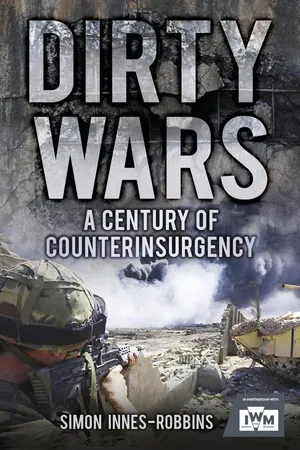
'Who is the enemy?' This is the question most asked in modern warfare; gone are the set-piece conventional battles of the past. Once seen as secondary to more traditional conflicts, irregular warfare (as modified and refashioned since the 1990s) now presents a major challenge to the state and the bureaucratic institutions which have dominated the twentieth century, and to the politicians and civil servants who formulate policy. Twenty-first-century conflict is dominated by counterinsurgency operations, where the enemy is almost indistinguishable from innocent civilians. Battles are gunfights in jungles, deserts and streets; winning 'hearts and minds' is as important as holding territory. From struggles in South Africa, the Philippines and Ireland to operations in Iraq, Afghanistan and Chechnya, this book covers the strategy and doctrine of counterinsurgency, and the factors which ensure whether such operations are successful or not. Recent ignorance of central principles and the emergence of social media, which has shifted the odds in favour of the insurgent, have too often resulted in failure, leaving governments and their security forces embedded in a hostile population, immersed in costly and dangerous nation-building.
eBook - ePub
Dirty Wars
A Century of Counterinsurgency
- 192 pages
- English
- ePUB (mobile friendly)
- Available on iOS & Android
eBook - ePub
About this book
1
TERRORISM AND BRUTALITY
THE GERMAN COUNTERINSURGENCY EXPERIENCE, 1900–45
Introduction
The German Army has the reputation of being probably the most professional, disciplined and efficient organisation to take the field of battle during the late nineteenth and early twentieth centuries. It has often been admired for its military competence, effectiveness, and obduracy, which underpinned many astonishing victories against numerically superior but less skilful adversaries during the two world wars. This assessment tends to neglect the German approach to counterinsurgency – the other side of the coin to the conventional warfare that dominated the country’s military culture and thinking during the twentieth century. Germany’s response to the problem of defeating insurgents during various campaigns reveal a specific ‘German way of war’. German military culture responded to civilian or colonial resistance with much greater brutality than any other European power, displaying a phobia towards guerrilla warfare and an obsession with annihilating, rather than merely defeating, insurgencies. Germans instituted the use of terror on the grounds of ‘military necessity’. This institutional antipathy to guerrilla warfare originated with the Prussian officer corps, a conservative elite, who viewed with repugnance the ‘un-Prussian’ concept of citizens in arms, recognising that it posed a revolutionary challenge to the established order. This aversion manifested itself as early as 1806 following the Prussian defeats at Jena and Auerstädt and during Prussia’s nationalist War of Liberation against Napoleon of 1813–14 when the mass levy of the Landsturm (People’s Army) was supervised closely by the Prussian officer corps and disbanded as soon as national liberation had been achieved.1
While the abhorrence towards irregular warfare, which formed the long-standing institutional mindset of the Prussian Army (and later the German Army), was not unique, it was certainly more pronounced within the German officer corps when combined with the right-wing ideology of the totalitarian regimes ruling Germany. This fear of an unseen enemy who avoided battle, was indistinguishable from the civilian population and employed indirect and unconventional tactics against the occupying forces, brought out the worst in the German Army as an institution that historically regarded terror rather than the use of ‘minimal force’ and the winning of hearts and minds as the most effective way of pacifying a defeated population. This modus operandi would coincide with Nazi ideological doctrine during the Second World War, sanctioning a security policy based on terror and genocide. Irregular warfare, which was perceived to be unclean, indecent and illegal, challenged German mastery of conventional warfare in which superior tactics and technology employed by well-co-ordinated, conventional armies overwhelmed inferior, inefficient and poorly co-ordinated opponents in battles that were viewed as clean, decent and fought according to well-defined rules. Of course, Germany’s opponents, as those of the United States later, soon learned to ignore the rules and to fight in an unconventional manner as the only means of overturning German conventional superiority. The German officer corps regarded guerrilla warfare ‘as the appalling antithesis of its own doctrine’.2
France 1870–71
When the Prussians defeated the armies of Emperor Napoleon III in the summer of 1870, and occupied most of France, the French Republican government refused to admit defeat. Instead it opted for guerrilla warfare, urging its citizens to form irregular forces to ‘cut off convoys, harass the enemy and hang from trees all the enemies they can take’.3 German troops were ambushed and sniped at by the guerrillas, known as francs-tireurs, and telegraph wires cut. The destruction of the railway bridge at Fontenay was one of the most dramatic achievements of the guerrillas, who employed small units instead of conventional forces to harass the invading forces besieging Paris. This unexpected French tactic came as a nasty surprise to the meticulous planners of the Prussian General Staff. The German armies in France, consisting of some 500,000 men, were operating in a hostile country populated by 36 million people, and were at the end of lengthy lines of communication, supplied by railways that were particularly vulnerable. Around 120,000 men, nearly a quarter of the German force, were pinned down guarding lines of communication, and the Germans suffered some 1,000 casualties to the guerrillas, whose significance tended to be exaggerated.4
Rather naively, the Germans hoped that the French population would support them against the ‘illegitimate’ insurgents, issuing proclamations that ordered the surrender of all arms and proscribed demonstrations. Seeing the francs-tireurs as criminals rather than soldiers, the Prussians reacted harshly. Crown Prince Frederick reported that ‘single shots are fired, generally in a cunning, cowardly fashion, on patrols, so that nothing is left for us to do but to adopt retaliatory measures by burning down the house from which the shots came or else by the help of the lash and forced contributions’. Bismarck noted that the francs-tireurs were ‘not soldiers’ and were being treated as ‘murderers’.5 Collective punishments such as fines were the response to guerrilla attacks and many towns and villages suspected of hiding guerrillas were burnt. Francs-tireurs themselves (and inevitably some innocent peasants) were summarily executed, prisoners mistreated and hostages taken. In October 1870 in retaliation for an attack by francs-tireurs, the town of Ablis was razed and its male inhabitants killed, while in January 1871 the Prussian 57th Regiment burned the village of Fontenoy-sur-Moselle and bayoneted the villagers in reprisal for an attack on an outpost by francs-tireurs.6 Apart from such horrific and exceptional brutality, the Prussians more typically employed fines and imprisonment rather than fire and sword in tackling the guerrillas. Moreover, despite the revolutionary traditions of the National Guards and the precedent of resistance to the First Republic by monarchists in the Vendée, the guerrillas never represented a serious threat, being poorly equipped and led and lacking mass support – only 57,000 men joined them – and had waned by early 1871.7
Nevertheless, although the impact of the francs-tireurs upon their communications, supplies, and manpower was not decisive, the psychological shock for the Prussians was immense, notably on the sense of security among their troops serving in France. Attitudes, which formed the core of the army’s institutional mindset, were reinforced and, following the foundation of the German Empire in 1871, the officer corps remained opposed to the concept of a nation in arms, which they maintained was ‘illegal’ under international law. In future wars the German Army would again deal harshly and brutally with any civilian interference with their plans, resorting to terror to subdue an occupied country that continued to resist a ‘lawful’ invader. The German use of reprisals was condemned by the military commentators of other nations, who believed that they were carrying out a new ‘horrible’ form of warfare. Edward Hamley, Commandant of the British Staff College between 1870 and 1877, observing the Prussian experience of 1870–71, noted prophetically that the ‘grand mistake of the Germans is that, while ascribing great influence to fear, they ignore the counter influence of desperation’.8
The Boxer Rebellion
The employment of fear and terror was exemplified by the methods employed by German soldiers who volunteered to fight in the Boxer Rebellion (a traditional peasant uprising that was fuelled by resentment of foreigners and Christians) in China (1900–01), and campaigns against the Herero and Nama in German South-West Africa (now Namibia, 1904–08), and in German East Africa (now Tanzania, 1905–07). Indeed, General Lothar von Trotha, who was chosen personally by Kaiser Wilhelm II to lead German troops in South-West Africa, and the German soldiers deployed there had already been ‘thoroughly brutalised’ by their previous service in German East Africa and China.9 The Kaiser’s infamous Hunnenrede (Hun Speech), made in July 1900 to the 10,000 German soldiers who were about to sail from Bremerhaven to suppress the Boxer Rebellion and avenge the death of the German minister Klemens von Ketteler set the tone for the rest of the twentieth century. The Kaiser demanded that no mercy should be shown and no prisoners taken.10
On arrival in China in September 1900, after peace negotiations had already started and a month after Peking had been taken, German forces participated in no fewer than fifty punitive expeditions to ‘mop up’ the Boxers. While British and French troops were also involved in the destruction and massacre of villages, the German troops were known for their brutality even in friendly settlements. In these ‘cleansing’ or pacification operations, Peking and other cities were ransacked and plundered, women raped and suspected Boxers executed. As it was difficult to identify the Boxers among the civilian population, the German troops acted on mere suspicion. Suspected Boxers and local officials accused of aiding the insurgents were executed. ‘Boxer villages’ were burnt down and all inhabitants killed. Huge numbers of civilians were made homeless. Others were merely robbed or forced to pay fines. The brutality of ‘punitive actions’ led by Field Marshal Alfred Graf von Waldersee, commander-in-chief of the eight nations international force, increased as the Boxers continued to launch guerrilla attacks on the foreign troops. The respected German weekly newspaper Die Zeit detailed the mass murder of the Chinese civilian population by soldiers, some of whom wrote letters home graphically recording their atrocities. Large numbers of these letters were published in German newspapers, where they became known as Hunnenbriefe (Hun Letters).11 One of these letters noted that ‘everything that came across our way, be it man, woman or child, everything was slaughtered’.12
Encouraged by the Kaiser, the commander of the German troops in China, Trotha, behaved harshly. This left behind a legacy of hatred for Germany and provided a precedent for German colonial campaigns that was adversely commented upon by other nations. This brutalisation of warfare during the Boxer expedition foreshadowed the atrocities committed by German forces later in the twentieth century. The German Army displayed a ferocity in its campaigns against indigenous uprisings in Africa and Asia that surpassed that of its imperialist peers. It is clear that terror, which was also an integral part of American, British, French and Portuguese colonial military thought, was employed much more ruthlessly by the Germans. They crossed the boundaries of what was deemed to be correct behaviour in China, and again when dealing with the major counterinsurgencies that developed within their African colonies prior to 1914.13
German East Africa
In East Africa the Hehe, a highly organised military power in the south, offered the longest resistance to the Germans between 1891 and 1898, routing a column under Emil von Zelewski in August 1891. This was the commencement of a long German campaign to destroy the Hehe and its leader, Mkwawa. In October 1894 forces under the command of Colonel von Schele attacked, overran, and sacked Kulenga, Mkwawa’s main fortress, capturing 1,500 women and children, 30,000lb of gunpowder, hundreds of rifles and guns, and livestock. But Mkwawa escaped and for four years between 1894 and 1898, German forces pursued him and his followers who, supplied and supported by the local population, proved very elusive. The Hehe were finally beaten by the Schutztruppe (Defence Force or ‘protection troops’) under Tom von Prince and Lothar von Trotha. Harried by the Germans and without food or supporters, Mkwawa eventually committed suicide in July 1898 and his skull was displayed as a trophy before being sent to Germany.14
Between 1891, when Zelewski was killed, and 1898, when Mkwawa died, German counterinsurgency strategies and tactics were transformed to provide success in African conditions. Unable to match the guerrilla tactics and staying power of their indigenous foe, the Germans resorted to a ‘scorched earth’ strategy to destroy the population’s means of subsistence by burning villages and seizing cattle and supplies. The Schutztruppen operated by sector, moving systematically and relentlessly from valley to valley in turn, destroying all food and water sources, killing the elders and men, and taking prisoner the young women and children, who would be forced to work. This policy resulted in the depopulation of the land, which was then unable to support the enemy forces. The local population was expected to give unconditional allegiance to and support for the German forces. Failure to do so resulted in death. Zelewski, commander of the Schutztruppen, prior to his death and Tom von Prince, commander of the Iringa District, were particularly brutal. The insurrection was eventually suppressed by systematic starvation, which was directed at the civilian population rather than against the rebels.15
This methodical use of scorched earth and famine was also applied in German East Africa against the Maji-Maji insurrection during 1905–07, which was one of the greatest anti-colonial uprisings in Africa prior to the First World War, with similar results for the indigenous population. The enemy was worn down by starvation. The main cause of the revolt was the coercive recruitment of labour to work on the plantations, which grew cash crops, such as cotton, to ensure colonial profitability. This aroused even stronger African opposition than the brutal collection of hut taxes since it threatened the very foundation of African societies. It resulted in July 1905 in an African rebellion much greater than any previously experienced by a modern colonial power. The rebellion spread quickly, with killings of Europeans throughout the south. The Schutztruppe, supported by white volunteers, were hard pressed, and the colonial government was compelled to request army and marine infantry reinforcements from as far away as New Guinea. In September 1905 a Catholic bishop was killed and a number of missions, one near to Dar-es-Salaam, were burnt down. By late autumn in 1905 the rebels, joined by the Ngoni Tribe, were in control of the southern fifth of the country.16
The arrival of German reinforcements, however, turned the tide against the rebels, who lacked modern weapons and co-ordination. The rebels regrouped and, avoiding large-scale confrontations, reverted to classic guerrilla tactics, such as ambushes and hit-and-run attacks by small, highly mobile groups of warriors. By April 1906 the war was effectively over, although the Ngoni were not defeated until 1907. Having a unified command, highly disciplined troops, a good logistics system, the use of African allies and mercenaries, and superior weapons, the Germans did not attempt to gain the support of the population but instead laid waste to vast areas of the south in a step-by-step reconquest employing a brutal famine strategy of destroying settlements, crops and stores, which provided the infrastructure for the rebels. Implementing orders from Gustav von Götzen, the governor, to execute a ‘scorched earth’ strategy, which gave no clemency to the population, Major Kurt Johannes’ ruthless counterinsurgency campaign in Ungoni was an extreme example of colonial violence. He eliminated the entire Ngoni elite by executing some 100 elders in the spring of 1906. He also pursued their warriors and supporters without mercy, killed their leaders, employed captured warriors as forced labour, and took women and children as hostages to prevent supplies reaching the warr...
Table of contents
- Cover
- Title
- Copyright
- Contents
- Acknowledgements
- Preface: The Guerilla Threat
- Introduction The Changing Nature of Counterinsurgency since 1899
- 1 Terrorism and Brutality: The German Counterinsurgency Experience, 1900–45
- 2 The Last to Leave: The Portuguese Experience, 1961–74
- 3 State Terrorism: The Russian Experience, 1919–2011
- 4 A Slow, lingering Death: The French Counterinsurgency Experience, 1947–62
- 5 Banana Wars and Other Small Wars: The American Counterinsurgency Experience, 1898–1975
- 6 The Empire Strikes Back: The British Counterinsurgency Experience, 1900–94
- 7 Dirty Wars: Afghanistan and Iraq, 2003–12
- Conclusion Dirty Wars: The Future
- Notes
- Select Bibliography
- Picture Section
Trusted by 375,005 students
Access to over 1.5 million titles for a fair monthly price.
Study more efficiently using our study tools.
Information
Publisher
The History PressYear
2016Topic
HistoryPrint ISBN
9780752464114
Subtopic
Military & Maritime HistoryeBook ISBN
9780752479019
Index
HistoryFrequently asked questions
Yes, you can cancel anytime from the Subscription tab in your account settings on the Perlego website. Your subscription will stay active until the end of your current billing period. Learn how to cancel your subscription
No, books cannot be downloaded as external files, such as PDFs, for use outside of Perlego. However, you can download books within the Perlego app for offline reading on mobile or tablet. Learn how to download books offline
We are an online textbook subscription service, where you can get access to an entire online library for less than the price of a single book per month. With over 1.5 million books across 990+ topics, we’ve got you covered! Learn about our mission
Look out for the read-aloud symbol on your next book to see if you can listen to it. The read-aloud tool reads text aloud for you, highlighting the text as it is being read. You can pause it, speed it up and slow it down. Learn more about Read Aloud
Yes! You can use the Perlego app on both iOS and Android devices to read anytime, anywhere — even offline. Perfect for commutes or when you’re on the go.
Please note we cannot support devices running on iOS 13 and Android 7 or earlier. Learn more about using the app
Please note we cannot support devices running on iOS 13 and Android 7 or earlier. Learn more about using the app
Yes, you can access Dirty Wars by Dr Simon Innes-Robbins,Simon Robbins,Simon Innes-Robbins in PDF and/or ePUB format, as well as other popular books in History & Military & Maritime History. We have over 1.5 million books available in our catalogue for you to explore.