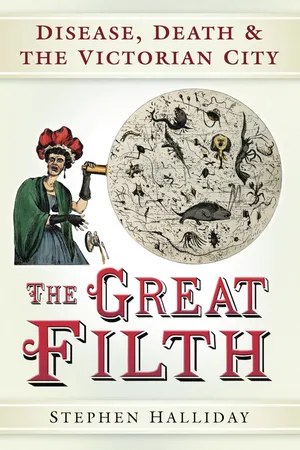
Victorian Britain was the world's industrial powerhouse. Its factories, mills and foundries supplied a global demand for manufactured goods. As Britain changed from an agricultural to an industrial ecomony, people swarmed into the towns and cities where the work was; by the end of Queen Victoria's reign, almost 80 per cent of the population was urban. Overcrowding and filthy living conditions, though, were a recipe for disaster, and diseases such as cholera, typhoid, scarlet fever, smallpox and puerperal (childbed) fever were a part of everyday life for (usually poor) town-and city-dwellers. However, thanks to a dedicated band of doctors, nurses, midwives, scientists, engineers and social reformers, by the time the Victorian era became the Edwardian, they were almost eradicated, and no longer a constant source of fear. Stephen Halliday tells the fascinating story of how these individuals fought opposition from politicians, taxpayers and often their own colleagues to overcome these diseases and make the country a safer place for everyone to live.
- 256 pages
- English
- ePUB (mobile friendly)
- Available on iOS & Android
eBook - ePub
About this book
Information
Notes
Chapter One
1. W. Bonser, ‘Epidemics during the Anglo-Saxon Period’, Journal of the British Archaeological Association, 3rd series, 9 (1944), 48–71.
2. Bede, de Natura Rerum, ch. 37, ‘de pestilentia’.
3. Isidore of Seville, Etymologiae, bk 14, ch. 6.
4. Voltaire, On Inoculation: Letters concerning the English Nation, trans. J. Lockman (London, 1804), letter 11, gives a rather acerbic account of his views on inoculation, which was then becoming commonplace.
5. S. Halliday, Newgate: A Prototype of Hell (Sutton, Stroud, 2006), pp. 40–1, describes the incident.
6. L. Picard, Dr Johnson’s London (Phoenix, London, 2001), p. 79.
7. Voltaire, On Inoculation, letter 11.
8. Edinburgh Review, 9 (1806), 322–51, contains an account of the early opposition to vaccination.
9. Journal of Medical Biography, vol. 8/2 (May 2000), p. 84.
10. The Times, 14 November 1871.
11. John Simon, Papers on the History and Practice of Vaccination (Parliamentary Papers, 1857), vol. 25, p. 225.
12. A. Hardy, ‘Smallpox in London: Factors in the Decline of the Disease in the Nineteenth Century’, Medical History, 27 (1983), 111–38.
Chapter Two
1. C.M. Law, ‘The Growth of the Urban Population of England and Wales, 1801–1911’, Transactions of the Institute of British Geographers, 41 (1967), 142.
2. B.R. Mitchell and P. Deane, Abstract of British Historical Statistics (Cambridge University Press, Cambridge, 1971), pp. 24 ff.
3. A.N. Wilson, After the Victorians (Hutchinson, London, 2005), p. 42.
4. G.M. Trevelyan, English Social History (Longman, London, 1942), p. 463.
5. W. Cobbett, Rural Ride (Dent, London, 1973), pp. 17, 18.
6. G. Rosen, ‘Disease, Debility and Death’, in H.J. Dyos and M. Wolff (eds), The Victorian City: Image and Realities (Routledge & Kegan Paul, London, 1973), vol. 2, p. 626.
7. See Chapter 5.
8. Registrar-General’s Second Annual Report (1839), app., p. xi.
9. N. Humphreys (ed.), Vital Statistics: A Memorial Volume to William Farr (Sanitary Institute, London, 1885), p. 150.
10. B.R. Mitchell and P. Deane, Abstract of British Historical Statistics (Cambridge University Press, Cambridge, 1971), pp. 36–7.
11. Humphreys (ed.), Vital Statistics, p. 203.
12. See Chapter 6 for an account of the struggle to gain professional status for midwives.
13. Lancet, 5 August 1843, p. 661.
14. N. Williams and G. Mooney, ‘Infant Mortality in an Age of Great Cities, c. 1840–1910’, in Continuity and Change, 9/2 (1994), 191 ff.; also Registrar-General’s Fifth Annual Report (1841). The figures refer to women; men live on average two years less than women in each parish.
15. Florence Nightingale, Notes on Hospitals (Longman, London, 1863), p. iii.
16. L. McDonald (ed.), Florence Nightingale on Public Health Care (Wilfred Laurier University Press, Ontario, 2004), p. 608.
17. Selected Writings of Florence Nightingale, ed. L.S. Seymer (Macmillan, London, 1954), pp. 377 ff.
18. Ibid., p. 392.
19. A.S. Wohl, Endangered Lives: Public Health in Victorian Britain (Methuen, London, 1983), p. 12.
20. Lancet, 14 September 1861, p. 256.
21. This is discussed in more detail in Chapter 5.
22. Wohl, Endangered Lives, p. 147.
23. See Chapters 4 and 5 for an account of these two very different personalities, John Simon and Edwin Chadwick
24. Royal Commission on Housing of the Working Classes (Parliamentary Papers, vol. 30, 1884–5), Minutes of Evidence, p. 63.
25. Wohl, Endangered Lives, p. 160.
26. See Chapter 4 for a discussion of their careers.
27. Lancet, 23 December 1899, p. 1760.
28. Wohl, Endang...
Table of contents
- Cover
- Title Page
- Contents
- Introduction
- One The Pioneers
- Two A Nation of City-Dwellers
- Three Science, Scientists and Disease
- Four The Doctors
- Five The Public Servants
- Six The Midwives
- Seven The Engineers
- Conclusion
- Notes
- Bibliography
- Copyright
Trusted by 375,005 students
Access to over 1.5 million titles for a fair monthly price.
Study more efficiently using our study tools.
Frequently asked questions
Yes, you can cancel anytime from the Subscription tab in your account settings on the Perlego website. Your subscription will stay active until the end of your current billing period. Learn how to cancel your subscription
No, books cannot be downloaded as external files, such as PDFs, for use outside of Perlego. However, you can download books within the Perlego app for offline reading on mobile or tablet. Learn how to download books offline
Perlego offers two plans: Essential and Complete
- Essential is ideal for learners and professionals who enjoy exploring a wide range of subjects. Access the Essential Library with 800,000+ trusted titles and best-sellers across business, personal growth, and the humanities. Includes unlimited reading time and Standard Read Aloud voice.
- Complete: Perfect for advanced learners and researchers needing full, unrestricted access. Unlock 1.5M+ books across hundreds of subjects, including academic and specialized titles. The Complete Plan also includes advanced features like Premium Read Aloud and Research Assistant.
We are an online textbook subscription service, where you can get access to an entire online library for less than the price of a single book per month. With over 1.5 million books across 990+ topics, we’ve got you covered! Learn about our mission
Look out for the read-aloud symbol on your next book to see if you can listen to it. The read-aloud tool reads text aloud for you, highlighting the text as it is being read. You can pause it, speed it up and slow it down. Learn more about Read Aloud
Yes! You can use the Perlego app on both iOS and Android devices to read anytime, anywhere — even offline. Perfect for commutes or when you’re on the go.
Please note we cannot support devices running on iOS 13 and Android 7 or earlier. Learn more about using the app
Please note we cannot support devices running on iOS 13 and Android 7 or earlier. Learn more about using the app
Yes, you can access The Great Filth by Stephen Halliday in PDF and/or ePUB format, as well as other popular books in History & British History. We have over 1.5 million books available in our catalogue for you to explore.