- 128 pages
- English
- ePUB (mobile friendly)
- Available on iOS & Android
eBook - ePub
The Great Liners Story
About this book
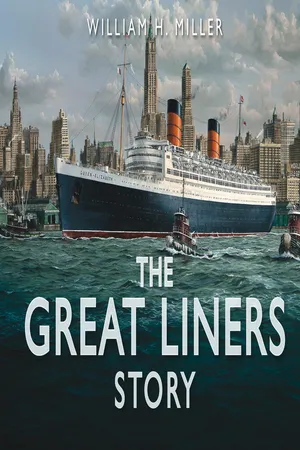
This illustrated and colourful history charts the hey-day of the great liners, those grand and lavish vessels that cruised around the world carrying their glamorous passengers from port to port. Decorated to the highest of finishes, fitted out in the most luxurious of styles, these floating palaces epitomised their opulent age. Their iconic names, from Titanic to Mauretania, from Queen Elizabeth to QE2, conjure up visions of power, grace, elegance and nostalgia for this golden age of travel.
Written by maritime and cruise liner expert William Miller, and accompanied by stunning photographs, artworks, Did You Know facts and quotations, The Great Liners Story is a must-have addition to any maritime library.
Information
1 · THE FIRST SUPER LINERS: GERMAN GREYHOUNDS
The story of the Great Liners begins on the Atlantic route between the Old World and the New, between Europe and the United States. It was the most prestigious, most progressive and certainly most competitive ocean liner run of all time. It was on the North Atlantic that the largest, fastest and indeed grandest passenger ships were created. In this book, I am concentrating for the most part on these Atlantic super liners. It has been a race, sometimes fierce, that has continued for well over a century. Smaller passenger ships, even ones of 30,000 and 40,000 tons, are for the most part left to other books.
Our story begins even earlier, in 1889, when Germany’s Kaiser Wilhelm II visited his grandmother, Queen Victoria, and attended the British Naval Review at Spithead. The British were more than pleased to show off not only the mightiest naval vessels afloat, but the biggest passenger ships then afloat, namely the 10,000-ton Teutonic of the White Star Line. These ships caught the Kaiser’s royal eye. His enthusiasm, his determination and, assuredly, his jealousies were aroused. He returned to his homeland determined that Germany should have bigger and better ships. The world must know, he theorised, that Imperial Germany had reached new and higher technological heights. To the Kaiser and other envious Germans, quite simply, the British had had a monopoly on the biggest ships for long enough. British engineers and even shipyard crews were recruited, teaching German shipbuilders the key components of a new generation of larger ships. Shipyards at Bremen, Hamburg and Stettin were soon ready.
Did you know?
The Kaiser Wilhelm der Grosse of 1897 was the first passenger ship to be called a ‘super liner’ and the first to have four funnels.
It would all take eight years, however, before the first big German liner would be completed. She would be large enough and fast enough to be dubbed the world’s first ‘super liner’. She would not only be the biggest vessel built in Germany, but the biggest afloat. The nation’s most prominent shipowners, the Hamburg America Line and the North German Lloyd, were both deeply interested. It was the Lloyd, however, which rose first to the occasion. Enthusiastically and optimistically, the first ship was the first of a successive quartet. The illustrious Vulkan Shipyard at Stettin was given the prized contract.
Triumph seemed to be in the air! The Kaiser himself went to the launching, on 3 May 1897, of this new Imperial flagship. Designed with four funnels but grouped in pairs, the 655ft-long ship was named Kaiser Wilhelm der Grosse, honouring the Emperor’s grandfather. With the rattle of chains, the release of the building blocks and then the tumultuous roar as the unfinished hull hit the water, this launching was the beginning of the Atlantic race for supremacy, which would last for some seventy years. Only after the first arrival of the transatlantic jet in October 1958 would the race quieten down. The Kaiser Wilhelm der Grosse was the great beginning, the start of a superb fleet of what have been dubbed ‘ocean greyhounds’ and later aptly called the ‘floating palaces’. Worried and cautious, the normally contented British referred to the brand new Kaiser as a ‘German monster’.
It should be mentioned that back in the 1860s, the large, but very eccentric Great Eastern came into service with no fewer than five funnels. Quite unsuccessful, she is usually not considered to be in the ‘Great Liners’ category. Her brief commercial career on the Atlantic ended as an ‘economic folly’ and with her sad demotion as a cablelaying ship.
The Kaiser Wilhelm der Grosse was the first liner with four funnels. They towered above the deck, but even more so above the sea. A trend soon started among passengers, especially those souls in lowerdeck third class and steerage. The number of funnels, although hardly accurate, was soon equated with a ship’s safety, her importance and might. Steamship owners, in Germany and elsewhere, soon noticed that the most popular ships were those with the most ‘stacks’. Three-stackers were popular, but four-stackers even more so.
Did you know?
In 1907, 12,000 immigrants were arriving in New York harbour each day and all of them arrived by ship.
The Kaiser Wilhelm der Grosse was, typically for her time, a three-class ship. There was the marble-clad, gilded, potted palm luxury of upper-deck first class (558 berths in all). Then, slightly less luxurious, was second class (for 338 passengers). But typically, the most profitable was steerage (1,074 berths). Although passengers paid as little as $10 per person for one-way fares from Europe to America, they were ‘squeezed’ aboard and given the least space, amenity, comfort and food. Ironically, while all the early super liners are well remembered for their luxuries, it was their role as immigrant carriers that earned their greatest profits and most likely paid off their construction costs.
The Kaiser Wilhelm der Grosse, which entered service in the autumn of 1897, was praised endlessly. One writer of the day said, ‘She is beyond all magnificence. She is all but top heavy with paintings, wood carvings and stained glass. She brought cathedral-like proportions to the traveling public. Alone, she changed the level of luxury on the high seas.’ On her maiden crossing, she was also a stunning success for speed, crossing in six days and so snatching the much coveted Blue Riband from Britain’s Lucania, a Cunarder. It would take the British a full decade to regain the speed honours on the so-called North Atlantic Ferry. It was a nasty blow to Britain, otherwise contented as a great nation, head of a mighty empire and ruler of the seas. It was also Queen Victoria’s Jubilee – her sixtieth year as queen-empress. There was only one great blemish for the Germans: the new Kaiser Wilhelm der Grosse was soon dubbed ‘the Rolling Billy’.
Meanwhile, the Hamburg America Line wanted its share and soon commissioned a large, fast liner of its own. She was the Deutschland, added in the summer of 1900, weighing in at 16,500 tons and an immediate Blue Riband champion. She held the speed trophy for six years, but at great cost. She proved to be operationally unsound. To maintain her high speed on the Atlantic crossings, she was plagued with vibrations, caused by her high-speed engines, and this was all complicated further by excessive rattling and noise. The peace and tranquillity of her passengers, especially in first class, was greatly disturbed. Passenger numbers fell and she was less than a financial success, in fact the least successful of all Atlantic four-stackers. Hamburg America soon lost interest in high speed and instead thereafter concentrated on high luxury and on even bigger ships.
North German Lloyd remained interested, however, and produced three more super liners, all of which honoured the German Imp...
Table of contents
- Cover
- Title
- Copyright
- Contents
- Introduction
- 1 The First Super Liners: German Greyhounds
- 2 Bigger and Faster Still: Cunard Flagships
- 3 High Luxury: White Star’s Great Trio
- 4 Chateau of the Atlantic: A New French Flagship
- 5 Colossal Proportions: The German Behemoths
- 6 The Third Big Cunarder: The Beautiful Aquitania
- 7 Decorative Divide: The Innovative Ile de France
- 8 Cathedrals of Steel: Two German Giants
- 9 Dual Purpose: An Empress of the Seas
- 10 On the Sunny Southern Route: Italy’s Rivieras Afloat
- 11 Ocean-Going Perfection: The Extraordinary Normandie
- 12 Pride and Profit: Those Glorious Cunard Queens
- 13 Engineering Genius: America’s Speed Champion
- 14 End of the Line: The Last French Supership
- 15 A Long Life: The Ever-Successful QE2
- 16 Biggest Atlantic Liner of All: The Queen Mary 2
- 17 Floating Resorts: The Current Cruise Generation
- Bibliography
Trusted by 375,005 students
Access to over 1.5 million titles for a fair monthly price.
Study more efficiently using our study tools.
Frequently asked questions
Yes, you can cancel anytime from the Subscription tab in your account settings on the Perlego website. Your subscription will stay active until the end of your current billing period. Learn how to cancel your subscription
No, books cannot be downloaded as external files, such as PDFs, for use outside of Perlego. However, you can download books within the Perlego app for offline reading on mobile or tablet. Learn how to download books offline
Perlego offers two plans: Essential and Complete
- Essential is ideal for learners and professionals who enjoy exploring a wide range of subjects. Access the Essential Library with 800,000+ trusted titles and best-sellers across business, personal growth, and the humanities. Includes unlimited reading time and Standard Read Aloud voice.
- Complete: Perfect for advanced learners and researchers needing full, unrestricted access. Unlock 1.5M+ books across hundreds of subjects, including academic and specialized titles. The Complete Plan also includes advanced features like Premium Read Aloud and Research Assistant.
We are an online textbook subscription service, where you can get access to an entire online library for less than the price of a single book per month. With over 1.5 million books across 990+ topics, we’ve got you covered! Learn about our mission
Look out for the read-aloud symbol on your next book to see if you can listen to it. The read-aloud tool reads text aloud for you, highlighting the text as it is being read. You can pause it, speed it up and slow it down. Learn more about Read Aloud
Yes! You can use the Perlego app on both iOS and Android devices to read anytime, anywhere — even offline. Perfect for commutes or when you’re on the go.
Please note we cannot support devices running on iOS 13 and Android 7 or earlier. Learn more about using the app
Please note we cannot support devices running on iOS 13 and Android 7 or earlier. Learn more about using the app
Yes, you can access The Great Liners Story by William H. Miller in PDF and/or ePUB format, as well as other popular books in Technology & Engineering & Marine Transportation. We have over 1.5 million books available in our catalogue for you to explore.