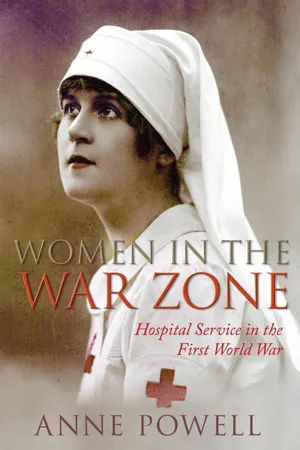
![]()
1915
Russia, Serbia, Egypt and Dardanelles
Miss Florence Farmborough
1st Letuchka (Flying Column)
Red Cross Unit of the 10th Field Surgical Otryad of the Zemstvo of all the Russias
Florence Farmborough was twenty-one when she first went to Russia in 1908. After spending two years in Kiev she moved to Moscow and lived with Dr Pavel Sergeyevich Usov, an eminent heart surgeon, and his family. She taught English to his two daughters, Asya and Nadya.
When Germany declared war on Russia in August 1914 Florence Farmborough and the Usov family were on holiday in their country dacha. A few days later they returned to Moscow.
Dr Usov was appointed to the medical staff of a Red Cross hospital under the patronage of Princess Golitsin and he persuaded the Princess to take Florence, Asya and Nadva as members of the Russian Red Cross Voluntary Aid Detachment. The three young women nursed the wounded in the medical and surgical sections of the hospital and although Florence’s spoken Russian improved during this time she found the theoretical language hard to master. She learnt whole chapters ‘parrot-fashion’ and at the end of six months passed the Red Cross examination.
A special church service was held to celebrate the promotion from VAD to qualified Red Cross nurse.
Before each jewelled icon the lampada glowed with a ruby light. On the altar the high brass candlesticks held steadily-shining candles; near them stood a silver chalice containing holy water, with the Book of Books alongside; a silver plate, heaped with red crosses, had been placed in the centre of the Holy Table. In front of the congregation, standing side by side, were sixteen young women, the first draft of nurses from a class of nearly 200. They were wearing the light grey dress, white apron and long white head-veil of the hospital nurse. A priest, in full canonicals, entered and slowly made his way towards the altar. Soon his rich, resonant voice was heard reciting the beautiful Slavonic prayers of the Greek Orthodox liturgy. Heads were reverently bowed; a murmur of voices rose and fell. The censer was swung lightly to and fro, emitting trembling breaths of fine grey, fragrant smoke.
Finally there was silence. The golden-robed priest rose from his knees and faced the congregation crucifix in hand. At a sign from him, the nurses moved slowly, in relays, to kneel at the altar. The priest then pronounced God’s blessing on the red crosses and on their recipients and, taking the crosses in his hand, moved towards the kneeling nurses. Bending down, he asked each one her name … Over each he intoned a prayer, placed the red cross on her white apron and held his crucifix to her lips …
Now he was standing before me. ‘Your name?’ ‘Florence,’ I answered. The priest paused and whispered to his deacon-acolyte. A book was brought and consulted, then he consulted me: ‘Of the pravoslavny [Orthodox] Church?’ ‘No,’ I whispered, ‘of the Church of England.’ Again the whispered consultation, again the book was referred to. I felt myself growing cold with fear. But he was back again and resumed the prescribed ritual, his tongue slightly twisting at the pronunciation of the foreign name:
To thee, Floronz, child of God, servant of the Most High, is given this token of faith, of hope, of charity. With faith shalt thou follow Christ the Master, with hope shalt thou look towards Christ for thy salvation, with charity shalt thou fulfil thy duties. Thou shalt tend the sick, the wounded, the needy; with words of comfort shalt thou cheer them.
I held the red cross to my breast and pressed my lips to the crucifix with a heart full of gratitude to God, for He had accepted me.
One by one, we moved back to our appointed places. On our breasts the Red Cross gleamed. I looked at my Russian sisters. We exchanged happy, congratulatory smiles. As for me, I stood there with a great contentment in mind and spirit. A dream had been fulfilled: I was now an official member of the great Sisterhood of the Red Cross. What the future held in store I could not say, but, please God, my work must lie among those of our suffering brothers who most needed medical aid and human sympathy – among those who were dying for their country on the battlefields of war-stricken Russia.
Florence was determined to serve on the front and in January 1915 she was enrolled as a surgical nurse in the newly formed front line unit, the 10th Field Surgical Otryad of the Zemstvo of all the Russias. This was divided into three parts: the 1st and 2nd Letuchkas (flying columns), mobile units, each with a staff of forty-four, which could be called at any time to any part of the front. Each Letuchka had twenty-four light, two-wheeled carts, with a large red cross painted on each canvas hood, twenty-four horses, grooms and drivers, two motor cars and several large drays (drawn by two horses). The third unit formed the base, where several supply officers looked after the stores of food and Red Cross material.
At this time the Russians were successfully pushing the Austrians back over the Carpathian mountains. On 11 April Florence Farmborough and members of the 1st Letuchka finally arrived at Gorlitse, East Galicia on the Russo-Austrian front after travelling by train from Moscow for over four weeks. They set up a hospital in a large house. In addition to her nurse’s dresses, aprons and veils, Florence was equipped with a flannel-lined, black leather jacket and a sheepskin waistcoat for the winter months. As the only means of communication in this mountainous region was by riding, high boots and black leather breeches were also added to her wardrobe.
Florence Farmborough’s handwriting was very small and she wrote her pencilled diaries in notebooks and on scraps of paper, intermittently between April 1915 and April 1918.
Wednesday, 22 April. Frishtak
So much has happened. I am dreadfully tired. We are retreating! In that one word lies all the agony of the last few days. We were called from our beds before dawn on Saturday 18th. The Germans had launched their offensive! Explosion after explosion rent the air; shells and shrapnel fell in and around Gorlitse. The roar of the rival cannons grew increasingly intense. Rockets and projectors were at work. Patches of lurid, red light glowed here and there where fires had been kindled by shells. Our house shook to its very foundations, its windows rattling and quivering in their hinges. Death was very busy, his hands full of victims. Then the wounded began to arrive. We started work in acute earnest. At first we could cope; then we were overwhelmed by their numbers. They came in their hundreds, from all directions; some able to walk, others crawling, dragging themselves along the ground. We worked night and day. And still they came! And the thunder of the guns never ceased. Soon their deadly shells were exploding around our Unit; for hours on end, the horror and confusion continued. We had no rest and were worn out with the intensity and immensity of the work. The stream of wounded was endless. Those who could walk were sent on immediately without attention. ‘The Base hospitals will attend to you,’ we told them; ‘Go! Go! Quickly!’ The groans and cries of the wounded were pitiful to hear. We dressed their severe wounds where they lay on the open ground; one by one we tended them, first alleviating their pain by injections. And all the time the bombardment of Gorlitse was continuing with brutal ferocity.
On Sunday, the violence of the thunderous detonations grew in length and strength. Then, suddenly, the terrible word retreat was heard. At first in a whisper; then, in loud, forceful tone: ‘The Russians are retreating!’ And the first-line troops came into sight: a long procession of dirt-bespattered, weary, desperate men – in full retreat! We had received no marching-orders. The thunder of the guns came nearer and nearer. We were frightened and perplexed; they had forgotten us! But they came at last – urgent, decisive orders: we were to start without delay, leaving behind all the wounded and all the equipment that might hinder us. A dreadful feeling of dismay and bewilderment took possession of us; to go away, leaving the wounded and the Unit’s equipment! It was impossible; there must be some mistake! But there was no mistake, we had to obey; we had to go.
Snatching up coats, knapsacks, any of our personal belongings which could be carried – we started off quickly down the rough road. And the wounded? They shouted to us when they saw us leaving; called out to us in piteous language to stop – to take them with us; not to forsake them, for the love of God; not to leave them – our brothers – to the enemy. Those who could walk, got up and followed us; running, hopping, limping, by our sides. The badly crippled crawled after us; all begging, beseeching us not to abandon them in their need. And, on the road, there were others, many others; some of them lying down in the dust, exhausted. They, too, called after us. They held on to us; praying us to stop with them. We had to wrench our skirts from their clinging hands. Then their prayers were intermingled with curses; and, far behind them, we could hear the curses repeated by those of our brothers whom we had left to their fate. The gathering darkness accentuated the panic and misery. To the accompaniment of the thunder of exploding shells, and of the curses and prayers of the wounded men around and behind us, we hurried on into the night.
We had hoped to stop in Biyech, if only for an hour or two, but it was quite impossible. Infantry, cavalry, artillery were pressing forward. This was no place, or time, to think of rest or food. The enemy was close behind; his shells were falling ever nearer and nearer, claiming many victims.
We reached Yaslo on Monday morning, but there, too, were confusion and chaos; and with that huge wave of retreating men and vehicles we were swept forwards, ever eastwards. There was no alternative … Retreat had us in its grip.
We came to a place called Skolychin and, miraculously, an empty house was found to be available.
We were ordered to halt and open a dressing-station immediately. I don’t know where the food came from, but even while we were unpacking some of the bales which contained first aid equipment, a cup of hot tea and a slice of black bread and cheese were put in our hands. Mechanically, we ate and drank, then, refreshed, we prepared to receive our wounded. They were already at our door, clamouring for help and food. Many there were who could no longer walk, and could scarcely speak, their bodies sorely wounded and their minds numbed by the severity of those wounds, yet their strength of will had been such as had enabled them to traverse many painful versts [one verst is a little more than 1 kilometre] in those first tragic hours of retreat.
It is only today that we have heard that the bombardment of Gorlitse was quite unequalled as yet in the present War’s history. But our men have suffered enormous casualties; it is said that our 3rd Army has been cruelly decimated and that the 61st Division, to which we are attached, has lost many thousands of its men.
Monday 20 April. Skolychin
Weary and dust-laden we looked at each other, conscious of the calamity at our Front. There was no time for questions, or for explanations; the sullen and continuous tramping of retreating feet on the roads told it own tale. What is happening there? What will soon happen here? The stricken faces and frightened eyes of the wounded told us. They were exhausted beyond words, too exhausted to groan as their wounds were dressed. Gun-carriages, batteries, motor lorries lumbered in and out of the streams of marching soldiers. Dust hung about the road in a thick grey mist; the sun beat down mercilessly. Now and then ambulance vans would pull up in front of our house and the orderlies would hastily drag the occupants out and deposit them on the ground near the entrance. Cries and groans accompanied this performance, but we were too busy to leave our posts and, beyond a much-needed admonition to the orderlies to use their hands more gently, the newcomers and their sufferings had, for the time being, to be ignored. The wounds were dreadful: bodies and limbs were torn and lacerated beyond repair. Those in a hopeless condition were set apart and not sent on with the more promising cases to the Base. All those who could still walk, unless obviously in need of treatment, were dismissed at once without examination. But there were few of these, for the ‘walkers’ preferred to walk on. Not even a mug of tea could tempt some of them to turn off from the road for a few minutes’ rest. This was no time for resting, with the enemy at one’s heels.
Into our ‘dressing-room’ rushed the tall figure of Alexander Mikhaylovich, one of the divisional surgeons. His usually care-worn face had taken on a more serious expression, but he was silent and we went on working. After a few minutes, he looked up and said: ‘In half an hour’s time, I want two sisters to be ready to return to Biyech. There are many wounded there and we must open a dressing-station at once. Sister Florence and Sister Anna will be ready to leave at 6.30pm, that is in half an hour.’ I could scarcely refrain from crying aloud my thanks to him. Anna seized me and together we rushed off to the wagon on which our stores of material for dressings were packed. Hastily collecting several large drum-shaped, air-tight boxes, which held our sterilised dressings, we placed them, with bundles of wadding, bandages and the like, on two large sheets and tied them all together. We packed, too, the most necessary liquids, instruments, candles, gloves, splints. Our equipment complete, we donned our leather coats and clambered into a huge, dirty-looking lorry which was waiting for us …
Alexander Mikhaylovich came out of the house. His first glance told him that we and our equipment were ready; he nodded approval and carefully, but with some difficulty, because of his stoutness, climbed up and took his seat. The divisional officer suddenly appeared and jumped in, followed by two orderlies. During the journey there was no conversation, only a few instructions given by the divisional surgeon to the chauffeur in an undertone. We were far from comfortable; the straw upon which we were sitting was coarse and scanty. Alexander Mikhaylovich, too, was not happy; every time the car bumped and jolted, which was often, he was tossed up and down like a rubber ball. The evening was growing cool and a keen east wind was rising. We saw innumerable soldiers; their faces all turned in one direction and wearing grim, dogged expressions. Some were hurrying, others stumbling. Many of them looked at us in amazement, wondering what was impelling us to return to the scene of disaster. Small bands of wounded, with blood-stained bandages round head or arm, met us. There were those, too, who were limping painfully, who, noticing the kosinka [head veil] of a Sister, would stop, and with inarticulate sounds point beseechingly to their wounded limbs. But we could not stop and explanations in that continuous din were of no avail; we could but point towards the road we had traversed, trying to make it clear to them that help was at hand if they would only continue their journey. Saddest of all sights was to see wounded men exhausted, lying by the side of the road – unable to drag themselves any further. We saw, too, how more than one soldier would stop to speak, to try to assist them to rise; then, finding that it was useless, would look awhile, sorrowing, and pass on.
Nearing Biyech, we met a hooded van containing wounded and our car drew up for a moment while the divisional doctor interrogated the driver. It seemed that all was quiet in the town save for an occasional shell from the enemy; the inhabitants were sheltering in their cellars, but many badly wounded men were there, unable to leave owing to lack of Red Cross assistance and transport.
At last we pulled up at the gate of a large white monastery. Alexander Mikhaylovich, considerably shaken after his rough ride, hastily got down from the lorry and, passing down the small front garden, disappeared through the white doorway. After a few minutes he beckoned us to follow him. In the doorway stood a black-robed priest; his face was stern and very pale, but so calm and passive was his manner, it was evident that this was not the first time that he had encountered a uniformed contingent. We followed him from room to room as he explained, in broken Russian, that we were at liberty to make what use we pleased of the monastery with its scanty supply of furniture. We told him that only water and basins were necessary and he at once brought in a bucket of water and three small tin pans. The large room, chosen for the dressing-room, was devoid of furniture, but some benches dragged in from an adjoining one were easily transformed into a table, on which we arranged our equipment. All this was done in feverish haste, Alexander Mikhaylovich having impressed upon us the fact that we might have to leave at any minute, and therefore, could not afford to waste a single moment.
Before we had had time to put on our white khalati [overalls], the wounded were in the room – all stretcher cases, all in a terrible state of suffering and exhaustion. To enquire as to when and how the wounds had been inflicted was impossible; in the midst ...