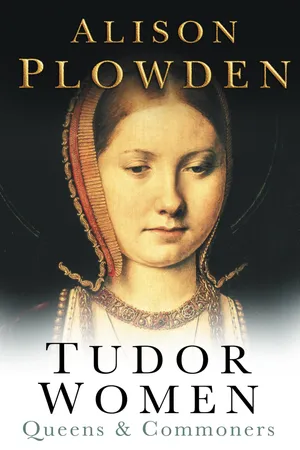
The Tudor era belongs to its women. No other period of English History has produced so many notable and interesting women, and into other period have they so powerfully influenced the course of political events. Mary Tudor, Elizabeth 1 and, at moments of high drama, Mary Queen of Scots dominated the political scene for more than half a century, while in the previous fifty years Henry VIII's marital escapades brought six more women to the centre of attention. In this book the women of the royal family are the central characters; the royal women set the style and between them they provide a dazzling variety of personalities as well as illustrating almost every aspect of life as it affected women in Tudor England. We know what they ate, how they dressed, the books they read and the letters they wrote. Even the greatest of them suffered the universal legal and physiological disabilities of womanhood - some survived them, some went under. Now revised and updated, Alison Plowden's beautifully written account of the women behind the scenes and at the forefront of sixteenth-century English history will be welcomed by anyone interested in exploring this popular period of history from the point of view of the women who made it.
- 174 pages
- English
- ePUB (mobile friendly)
- Available on iOS & Android
eBook - ePub
About this book
Information
CHAPTER ONE
My Lady
the King’s Mother
The royal House of Tudor was to owe a great deal to its womenfolk. Indeed, it owed its very existence to a woman, although when, in 1452, Henry VI was moved to bestow the wardship and marriage of Margaret, the nine-year-old Beaufort heiress, on his half-brothers Edmund and Jasper Tudor, he can have had no notion that he was assisting at the birth of a new dynasty. Henry, a monarch not normally noted for his worldly wisdom, may have been acting out of simple benevolence. He seems to have felt a strong sense of family obligation towards his young relatives, offspring of his widowed mother’s enterprising second marriage to her Welsh Clerk of the Wardrobe, and had already made himself responsible for their education. His more hard-headed advisers, on the other hand, were probably considering how the support of the Tudor brothers, a promising pair of warriors, could best be secured for the Lancastrian cause at a time when the House of Lancaster was clearly going to need all the support it could get in the approaching struggle with its Yorkist rivals. Edmund and Jasper had been created Earls of Richmond and Pembroke respectively but the custody of Margaret Beaufort was an even greater prize. Not merely was she her father’s heir, and the late John Beaufort, Duke of Somerset, had been an extremely rich man; but she was also of the blood royal, a great-granddaughter of John of Gaunt, Duke of Lancaster, third son of the all too prolific King Edward III.
It is not likely that anyone thought of seeking Lady Margaret’s views on these new arrangements for her future. Marriages in royal and noble families were made not in heaven but at the council table, with political or dynastic advantage in mind, and frequently planned when those most closely concerned were still of nursery age. Margaret herself was already contracted to John de la Pole, son of her former guardian the Duke of Suffolk, and being a pious, serious-minded child, the thought of breaking a promise made before God caused her a good deal of heart searching.
According to the story repeated many years later by her close friend John Fisher, Bishop of Rochester, ‘being not yet fully nine years old and doubtful in her mind what she were best to do, she asked counsel of an old gentlewoman whom she much loved and trusted’. This lady advised her to pray for guidance to St Nicholas, the patron and helper of all true maidens, and, says Fisher, a marvellous thing occurred. That same night, as he had often heard Lady Margaret tell, while she lay in prayer, calling on St Nicholas, whether sleeping or waking she could not be sure, ‘about four o’clock in the morning one appeared to her arrayed like a bishop, and naming unto her Edmund Tudor, bade her take him as her husband’.
Margaret’s doubts having thus been resolved by the highest authority and the technical impediment of her prior engagement to John de la Pole dealt with by the canon lawyers, the way was clear for what was to turn out to be one of the most fateful weddings in English history. It took place some time in 1455, as soon as the bride had reached the mature and marriageable age of twelve, but whether or not this unusual pairing was a personally happy one is not recorded. Certainly it was brief, for Edmund Tudor died early in November of the following year. Some three months later, on 28 January 1457, his widow, still not quite fourteen years old, gave birth to a son at Pembroke Castle, stronghold of her brother-in-law Jasper.
The first Henry Tudor, so all the chroniclers agree, was a puny infant, and his earliest biographer, Bernard André, gives much of the credit for his survival to his mother’s devoted care. But although the young Countess of Richmond was not, like so many of her contemporaries, destined to see her baby die in his cradle, the repercussions of that murderous family quarrel, conveniently known to history as the Wars of the Roses, were soon to separate mother and child. Things had begun to go very badly for the House of Lancaster, and by the spring of 1461 there was a Yorkist king on the throne. By the autumn, Pembroke Castle and with it Margaret Beaufort and her son were in Yorkist hands, and not long afterwards the wardship of five-year-old Henry had been sold to the Yorkist Lord Herbert of Raglan.
Although it is unquestionably a hard thing for any mother to be parted from her child, it was not an especially unusual occurrence in Margaret Beaufort’s world, and she would have had no choice but to acquiesce. At least she had the consolation of knowing that her son would be ‘honourably brought-up’, since the Herberts were thinking of him as a possible husband for their daughter Maud, and she no doubt made sure of receiving regular reports of his progress. She herself re-married about this time to Henry Stafford, a son of the Duke of Buckingham and yet another descendant of Edward III. Whether or not there was any element of personal choice in this marriage is something else we don’t know, but obviously it was necessary. A wealthy young woman could not do without male protection, and Jasper Tudor, that loyal and active supporter of the Lancastrian cause, was now a wanted man.
Margaret’s second marriage lasted about ten years, but there were no more children. One chronicler was later to feel that it was ‘as though she had done her part when she had borne a man-child, and the same a kynge of the realms’. Perhaps a more likely explanation may be found in the physical effect of parturition on a pubescent girl. Whatever the reason, Margaret never conceived again, and all her life her precious only son was to fill the centre of her universe; all the force of her strong, vital nature being concentrated single-mindedly on the desire for his ‘glory and well-doing’. But it was to be many years before any of her dreams came true, and at one time it seemed as if the separation of mother and son might well be permanent.
There was a brief resurgence of Lancastrian fortunes at the beginning of the 1470s, but the so-called ‘Readeption’ of Henry VI lasted less than six months, and the battle of Tewkesbury, fought in May 1471, ended in what looked like final disaster for the Red Rose. Almost overnight young Henry Tudor, now in his fifteenth year, had become the sole surviving representative of the House of Lancaster, ‘the only imp now left of Henry VI’s blood’, and therefore liable at any moment to become the object of his Yorkist cousins’ unfriendly interest. Fortunately Jasper, tough, resourceful and apparently bearing a charmed life, was at hand to spirit the boy away. Uncle and nephew sailed from Tenby on 2 June and reached a precarious haven in Brittany.
For Margaret Beaufort, who had seen the extinction of her family in the slaughter at Tewkesbury and was now cut off from all communication with her son, the next twelve years must surely have been the bleakest period of her life. True, Henry had escaped and had found sanctuary of a sort, but even in Brittany he was not necessarily safe from the long arm of the triumphant Yorkists. There was at least one attempt to bribe his Breton hosts to give him up, and any sudden shift in international pressures could easily result in his expulsion and death. If he survived, it seemed as if the best that could be hoped for was that one day the House of York would feel sufficiently secure to allow him to come home and enjoy his father’s confiscated earldom. Time passed and Edward IV proved a popular and successful king, with two young sons to ensure the continuation of his line. For the exile in Brittany there was nothing to do but wait and hope, while at home his mother waited and prayed. Then, suddenly, everything changed.
At Easter 1483 King Edward died, probably as the result of a cerebral haemorrhage, leaving the thirteen-year-old Prince of Wales to succeed him. Within a matter of weeks the King’s brother Richard, Duke of Gloucester, had seized power, declared his two nephews to be illegitimate and confined them both in the Tower for safe-keeping. By June Richard had been crowned and Henry Tudor had become the rival claimant.
We know very little about the ins and outs of the conspiracy woven in favour of the Tudor claim during that summer, but one thing is certain and that is that Margaret Beaufort was one of its instigators. Married now for the third and last time to Thomas, Lord Stanley, head of a powerful Yorkist family and steward of the royal household, she was close to the centre of affairs, and it is tempting to speculate that she may have been among the first to hear the whispers that the princes in the Tower had been murdered by the new king’s hired assassins. Certainly there would have been very little chance for Henry as long as Edward IV’s sons were alive, and whatever the real truth of the matter, it is not disputed that after midsummer no one outside the Tower ever saw either of the children alive again. By the autumn it was being freely rumoured that they were dead, but by that time Margaret’s plans were already in an advanced state of preparation.
Her first step had been to enlist the support of another woman, the widowed queen, Elizabeth Woodville. Edward IV had broken with royal tradition by marrying for love (or, as some said, because the lady was not otherwise available) and socially very much beneath him. The marriage caused considerable ill-feeling at the time and was to give rise to a smouldering resentment among the older nobility and other members of the House of York, who frankly regarded the Queen’s numerous relations as a tribe of rapacious upstarts. Elizabeth herself was never liked. She seems to have had an unhappy talent for making enemies, but her reputation for cold-hearted, calculated greed may not be entirely deserved. In a world where it was every man (and woman) for himself, she can hardly be blamed for taking full advantage of her amazing good luck in catching and holding Edward’s notoriously roving eye.
Now, in the summer of 1483, her luck seemed to have run out. Apart from the tragic loss of her sons, her marriage had been declared invalid and she had been insulted and stripped of her dower rights by the new king. She and her five daughters were holed up in sanctuary at Westminster when Margaret Beaufort opened negotiations, using as emissary a Welsh physician named Lewis who, by a fortunate coincidence, also attended the Queen. The proposition brought by Lewis was for a marriage between one of the Yorkist princesses – preferably the eldest, another Elizabeth – and Henry Tudor. In return, the Queen would promise the support of the Woodville clan in Henry’s bid for power.
The advantages of such a match from the Tudor point of view were obvious. The inclusion of the Yorkist heiress in the new Lancastrian–Tudor claim should go a long way towards satisfying those Yorkists who were already becoming disenchanted with King Richard and alarmed at his ruthlessness. As well as this, any alliance which offered a reasonable prospect of bringing the two factions together and putting an end to the destructive and tedious quarrel which had over-shadowed English political life for so long would be sure of a welcome from the business community, and indeed from all that solid middle section of the population with a vested interest in stability and the maintenance of law and order.
Elizabeth Woodville was ready to co-operate – naturally enough, since Margaret Beaufort’s suggestion brought her not only a glimmer of hope for the future but also a possibility of revenge – but the two mothers could do nothing without money and men. Fortunately Margaret at least was not short of money or of the means of raising it, and she had begun to employ her trusted steward, Reginald Bray, on the delicate task of canvassing support for her project among ‘such noble and worshipful men as were wise, faithful and active’. She’d also been doing a little canvassing of her own. Some time that summer, as the Lady Margaret was travelling from Bridgnorth on a pilgrimage to the shrine of Our Lady of Worcester, she happened to encounter the Duke of Buckingham on his way to Shrewsbury and, so the story goes, at once took the opportunity of begging him to intercede with the King on her son’s behalf, for she earnestly desired that he might be allowed to come home. It’s not likely that Buckingham misunderstood this touching maternal plea, made on the excuse of the close blood tie between them (the Duke had been the nephew of Margaret’s second husband and was a Beaufort on his mother’s side). At any rate according to the traditional account, it was shortly after this convenient wayside meeting that he decided to throw his very considerable weight behind the unknown quantity of Henry Tudor. This was a curious decision for a man who, until very recently, had been one of Richard of Gloucester’s strongest supporters and who could himself have made quite a convincing bid for the throne. But then, if we knew what actually passed between Margaret Beaufort and Henry Stafford on the road from Bridgnorth to Worcester that summer day, we should know a great deal more about the intense personal and political manœuvring which preceded the change of dynasty.
Couriers bearing news, instructions and large sums of cash were now slipping unobtrusively across to Brittany, while Margaret waited for her son to justify her unswerving faith in him. But she was playing a dangerous game. Before the end of September the King had got wind of what was going on, and by the middle of October the coup had collapsed. The Duke of Buckingham was captured and executed, and Margaret might well have suffered a similar fate, had not Richard been reluctant to antagonize the influential Stanley family. This, at least, is the explanation usually given for the fact that the Lady Margaret escaped the normal punishment of those caught plotting against the State. Instead, she forfeited her property, which was transferred to her husband for his lifetime, and Thomas Stanley was ordered to keep his wife under better control in future, removing her servants and making sure that she could not pass any messages to her son or her friends, nor practise against the King. All this, says Polydore Vergil, was done, but although Margaret’s outside activities might have been curtailed, she continued to work on her husband, and when at last Henry landed in South Wales in August 1485, he was pretty well assured of the Stanleys’ support. This was of great importance, as the family owned vast estates in Cheshire and the West Midlands, and while admittedly they waited until the last possible moment before committing themselves, it was the Stanleys’ intervention which turned the scales at the battle of Bosworth.
Unfortunately we have no record of the first meeting between mother and son after the triumph of Bosworth, but it seems reasonable to assume that it was not long delayed. Certainly Henry Tudor showed a very proper recognition of the enormous debt he owed his mother. Thomas Stanley was rewarded with the earldom of Derby, and the first Tudor Parliament restored to Margaret Beaufort, Countess of Richmond and Derby, the estates confiscated two years before. As well as this, she was granted the wardship of young Edward Stafford, son and heir of her late ally the Duke of Buckingham, and a life interest in numerous manors and lordships. The Parliament of 1485 also conferred upon her the rights and privileges of a ‘sole person, not wife nor covert of any husband’, thus giving her control of her huge fortune ‘in as large a form as any woman now may do within the realm’. ‘My lady the King’s mother’, as she was usually styled, had therefore become an extremely rich and important personage, allowed to sign herself Margaret R and, for all practical purposes, honorary Queen Dowager. Bearing in mind the vital biological and political part she had played in establishing the new dynasty, this seems fair enough but, as far as Margaret was concerned, it’s probably safe to say that her real reward had been the moment when she saw ‘her son the King crowned in all that great triumph and glory’. Her friend John Fisher was to recall how she wept copiously throughout the ceremony, explaining that ‘she never was yet in that prosperity, but the greater it was the more she dreaded adversity’. It was a natural reaction after all those years of anxiety, disappointment and fear, but there was to be no more adversity for Margaret Beaufort, and three months later she saw another of her long-cherished plans come to fruition. On 18 January 1486 Henry Tudor fulfilled the pledge he had given in the aftermath of the abortive coup of 1483 and married Elizabeth, King Edward’s daughter – a union which all sensible people devoutly hoped would mark the end of the Wars of the Roses.
Elizabeth of York, another woman to whom the Tudor dynasty owes a large debt of gratitude, was not quite twenty-one at the time of her marriage-an unusually advanced age for a king’s daughter to be still unwed. As a child, Elizabeth had been betrothed to the King of France, but this arrangement had fallen through, and her father’s death, followed by the upheavals of the Gloucester take-over, had drastically affected her prospects.
If it was accepted that a hereditary title could be transmitted through the female line (and Henry Tudor’s hereditary title, such as it was, devolved entirely from his mother), then the Yorkist branch of the Plantagenet tree was the senior and, as Edward IV’s eldest surviving child, Elizabeth’s claim to be queen in her own right was infinitely stronger than Henry’s to be king. There was nothing in English law to prevent a woman from occupying the throne, but in the political climate of the late fifteenth century such an idea would obviously have been unthinkable, and there is no evidence that the Yorkist heiress herself ever resented the subordination of her rights to the Lancastrian claimant. Indeed, according to a contemporary ballad, The Most Pleasant Song of Lady Bessy, Elizabeth, horrified at the thought of being forced into marriage with her uncle Richard, summoned Lord Stanley and begged him to help the exiled Henry to come home and claim his right. When Stanley hesitated-he was afraid of Richard and besides it would be a deadly sin to betray his King – Bessy flung her headdress on the ground and tore her hair ‘that shone as the gold wire’, while ‘tears fell from her eyes apace’. Lord Stanley was touched by her distress, but still he hung back. ‘It is hard to trust women,’ and Bessy might let him down. He also protested, rather feebly, about the difficulties of communicating with Henry. He himself cannot write and dare not confide in a secretary. But dauntless Lady Bessy was ready for him. She can read and write, if necessary in French and Spanish as well as English, and she will act as scrivener. Deeply impressed by the talents of this ‘proper wench’, Stanley gave in and, late that night, alone together in Bessy’s chamber and fortified by wine and spices, they concocted a series of letters to Stanley’s friends and to ‘the Prince of England’ in Brittany. It was Bessy who found a trusty messenger, Humphrey Brereton, and she was presently rewarded by a love letter from Henry, telling her that he will travel over the sea for her sake and make her his queen.
The Song of Lady Bessy, which was probably written by Humphrey Brereton, a squire in the Stanley household, contains a number of authentic touches and a good deal of poetic licence. All the same, it’s quite possible that Elizabeth may have been in touch with Henry at some point in the months before Bosworth and may have sent him a message of encouragement by one of the secret couriers going over to France. Although she had never seen him, she would, of course, have heard glowing reports from Margaret Beaufort, and in any case – whether or not there was ever any truth in the story that King Richard was contemplating marrying his niece – Elizabeth of York seems to have come to the conclusion that a Tudor triumph offered the best hope of a secure and honourable future that she could reasonably expect.
Henry has often in the past been accused of deliberately delaying his wedding in order to forestall any suggestion that he owed the throne to his wife, but although the marriage was certainly of great political importance, the new King’s title could in no way be strengthened by his wife’s. It was the second generation of Tudor monarchs which would benefit from this union of ‘the two bloodes of high renowne’, and Elizabeth’s real usefulness would depend quite simply on her fecundity. The Yorkist princess had been rescued from the power of her wicked uncle, and the reproach of bastardy, laid on her by Richard’s government, had been removed by act of Henry’s first Parliament. She had been raised to the dignity of queen consort. Her mother h...
Table of contents
- Cover
- Title Page
- Contents
- Women in the World
- ONE My Lady the King’s Mother
- TWO By God’s Grace Boys Will Follow
- THREE The King’s Lady
- FOUR Bound to Obey and Serve
- FIVE The Frailness of Young Women
- SIX When Women Become Such Clerks
- SEVEN Long Live Our Good Queen Mary
- EIGHT But One Mistress and No Master
- Elizabethan Women
- Genealogical Table of the Tudor Family
- A Note on Sources
- Copyright
Trusted by 375,005 students
Access to over 1.5 million titles for a fair monthly price.
Study more efficiently using our study tools.
Frequently asked questions
Yes, you can cancel anytime from the Subscription tab in your account settings on the Perlego website. Your subscription will stay active until the end of your current billing period. Learn how to cancel your subscription
No, books cannot be downloaded as external files, such as PDFs, for use outside of Perlego. However, you can download books within the Perlego app for offline reading on mobile or tablet. Learn how to download books offline
Perlego offers two plans: Essential and Complete
- Essential is ideal for learners and professionals who enjoy exploring a wide range of subjects. Access the Essential Library with 800,000+ trusted titles and best-sellers across business, personal growth, and the humanities. Includes unlimited reading time and Standard Read Aloud voice.
- Complete: Perfect for advanced learners and researchers needing full, unrestricted access. Unlock 1.5M+ books across hundreds of subjects, including academic and specialized titles. The Complete Plan also includes advanced features like Premium Read Aloud and Research Assistant.
We are an online textbook subscription service, where you can get access to an entire online library for less than the price of a single book per month. With over 1.5 million books across 990+ topics, we’ve got you covered! Learn about our mission
Look out for the read-aloud symbol on your next book to see if you can listen to it. The read-aloud tool reads text aloud for you, highlighting the text as it is being read. You can pause it, speed it up and slow it down. Learn more about Read Aloud
Yes! You can use the Perlego app on both iOS and Android devices to read anytime, anywhere — even offline. Perfect for commutes or when you’re on the go.
Please note we cannot support devices running on iOS 13 and Android 7 or earlier. Learn more about using the app
Please note we cannot support devices running on iOS 13 and Android 7 or earlier. Learn more about using the app
Yes, you can access Tudor Women by Alison Plowden in PDF and/or ePUB format, as well as other popular books in History & British History. We have over 1.5 million books available in our catalogue for you to explore.