Useful for those interested in Che Guevara and the legacy he left behind, this book includes material which reveals how Ches death and example led to the revolutions of 1968, particularly in France, the UK and the USA. It also includes Fidel Castros speech on Ches death, along with Inti Peredos insistence that the struggle would continue.
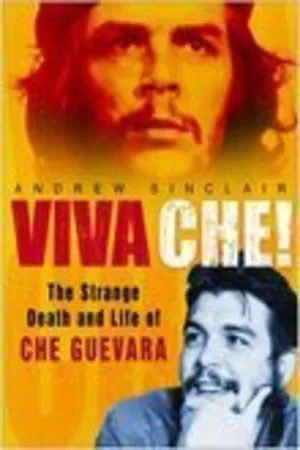
- 192 pages
- English
- ePUB (mobile friendly)
- Available on iOS & Android
eBook - ePub
About this book
Information
Masa
At the end of the battle, when the fighter was dead,
A man came up to him and said:
‘Do not die. I love you so.’
But, alas, the body stayed dead.
Two men came near him and repeated:
‘Don’t leave us. Be brave. Come back.’
But, alas, the body stayed dead.
Then twenty, a hundred, a thousand,
Five hundred thousand came and begged,
‘Can so much love do nothing against death?’
But, alas, the body stayed dead.
Then millions came up; he was surrounded.
And all of them called: ‘Brother, don’t leave us. . . .’
But, alas, the body stayed dead.
Then all the men on earth came round.
The sad body saw them and was moved;
Slowly, he rose and kissed the first one,
And then began to walk. . . .
CÉSAR VALLEJO (Peru)
(1895–1939)
Notes on the Life of
Ernesto ‘Che’ Guevara
Ernesto ‘Che’ Guevara
Ernesto Guevara de la Serna was born in Rosario, Argentina, on 14 June, 1928. His parents were Ernesto Guevara Lynch, civil engineer of Irish descent, and Celia de la Serna, of Spanish descent. This was a middle-class family with strong left-wing and liberal tendencies. The Guevaras were freethinkers, admirers of José Martí, and on the side of the Republicans during the Spanish Civil War.
Ernesto was the eldest of five children; after him came Celia, Roberto, Ana Maria and Juan Martin, in that order.
JOSE AGUILAR: In 1937, my family fled from Spain to Argentina where, at Alta Gracia, a city in the province of Córdoba, we met the Guevaras. All the children became friends and played together every day, really almost living together. The Guevara children were very brave at games and sports, and we were a bit frightened of them. Ernesto like rough games very much; I remember one of his brothers, Roberto, telling me how Ernesto would jump across three feet of space from the third floor of their house to the next, just for kicks, and then make fun of the other chileren because they did not dare do the same thing.
In those days, our favourite writers were Jules Verne and Alexandre Dumas.
Later, when Ernesto started high school in the city of Córdoba, he studied English; but he always liked French better. He studied French with his mother and liked to read French poetry. He was also extremely fond of Pablo Neruda’s poems, and would spend days reciting some of them aloud.
My father, who was a doctor, was upset by the fact that Ernesto read the works of Freud at the age of fourteen and that his parents did not mind.
FERNANDO BARRAL: I met Ernesto in 1940. He was already incredibly sure of himself and totally independent in his opinions. He was very dynamic, restless, and unconventional. I think I secretly envied him for his energy, his self-confidence and his boldness; the most striking thing about him was his absolute fearlessness. The way he played rugby also impressed us, and what made him so different from the rest of us was that he seemed much more ‘tough’.
ALBERTO GRANADOS: I met Ernesto in 1941 when he was at high school with my brother Thomas. I was at University at the time. We Córdoba students, along with students from other universities, had gone on strike against the abuses committed on the university campuses. That was the reason I was arrested and taken to Córdoba central police commissariat. Rather than arrested, I should say kidnapped, for we were not tried. At that time my brother Thomas used to bring me food in jail, as they didn’t feed us. One day, Ernesto, his school friend, came along. I spoke with the two of them and explained that the high school students should demonstrate in the streets so that people would know how we were being treated. What amazed me was young Ernesto Guevara’s reaction to my proposal. He answered, ‘Nothing doing, Alberto. Go out onto the streets so that the police can hit us with their clubs? Nothing doing. I’ll go and demonstrate only if you give me a gun.’
CHE: At fifteen, a man already knows what he wants to die for, and he is not afraid of giving his life, if he has found an ideal which makes this sacrifice easy.
ALBERTO GRANADOS: In spite of the asthma he suffered from all his life, Ernesto was a sports enthusiast, something we had in common; an education which alternated between Baudelaire’s poetry and sports forged him spiritually and made him physically fit. From then on, he became involved with travel and action. He was at high school and I was at university; but as he enjoyed our company and as we were impressed by his intelligence and the depth of his knowledge, we became great friends. I used his father’s library a lot. Ernesto was the main reader, and I came second. Without a doubt, he had an intellectual sense which, from childhood, enabled him to distinguish himself in all aspects of life. He enjoyed going out with us on trips to the country, learning many things that were later useful to us on our motorcycle trip across the continent. Years later, those experiences were necessary to him as a guerrilla. He learned how to set up a tent with few resources. We learned all of those things without ever thinking of future possibilities: it was just a healthy outdoor way of life that allowed us to get away a little from the ordinary routine of the student and city-dweller.
In 1946 Ernesto Guevara finished high school and the Guevara family moved to Buenos Aires. There, Ernesto began his medical studies.
ALBERTO GRANADOS: We all thought that, because of his knowledge of and facility in mathematics, he would study engineering. We were surprised when he told us he had enrolled in medical school. He had a part-time job in the city government and also did some voluntary work in an institute for Allergy Research.
When Ernesto was eighteen years old, he registered for compulsory military service, in accordance with Argentinian law. He was examined by a board of military doctors who, because of his asthma, pronounced him unfit for military service of any sort.
During all his holidays, Ernesto would travel by whatever form of transport was available to him. He sometimes went on foot, and at other times used a bicycle which had a small motor on it. In this manner, he travelled round the various provinces of Argentina: Tucumán, Mendoza, Salta, Jujuy and La Rioja. On another occasion, he signed up as a crew member of a merchant marine ship and went to the Caribbean. It was his first trip abroad.
CHE: I must admit that I have never felt like a foreigner anywhere, neither in Cuba nor in any of the countries I have been to; I felt Guatemalan in Guatemala, Mexican in Mexico, Peruvian in Peru. Just as I feel Cuban in Cuba today and, of course, Argentinian too, here and everywhere else.
ALBERTO GRANADOS: He used to say to his fellow students, ‘While you stay here preparing for three exams, I plan to cover the province of Santa Fé, northern Córdoba, eastern Mendoza, and along the way, study to pass those courses right along with you.’ And, of course, he did just that and maybe more. He covered the route he had planned and passed his courses on top of it. He wasn’t concerned about his grades, he was more interested in studying what would be useful to him and not what was good for getting high marks. . . .
Touring Latin America, becoming acquainted with its beautiful sights and the misery in which its inhabitants lived, was a long cherished dream. On those nights that I spent in the company of Guevara and my brothers in some mountain zone on a weekend or an excursion, our conversation was full of our future trip.
On 29 December, 1951, Ernesto set off with Alberto Granados for a long trip across Latin America by motorcycle. They planned to visit the whole length of the Pacific coast.
ALBERTO GRANADOS: If the motorcycle had held up, the trip would certainly not have turned out to be such a valuable and rewarding personal experience as it did. But the risky motorcycle didn’t make it. Shortly before we got to Santiago, Chile, when we still had not covered even an eighth part of our projected journey, the vehicle simply refused to go any further, and we mournfully wrapped it up in our pup-tent and left it in an out-of-the-way spot while we continued our voyage on foot. This change gave us an opportunity to know the people. We had to get various odd jobs to earn enough money to continue on our trip. We worked as truck drivers, porters, seamen, cops and doctors and dishwashers. Trudging along without a cent in our pockets, we arrived at the gates of the ‘Braden Company’ mine at Chuquicamata, Chile. Certainly, Braden and his cohorts never dreamed that in early 1952 the guard who was then sleeping in their sentry box with his feet resting on a pair of military boots was none other than the man who was later to make Yankee imperialism shiver in its boots: Major Ernesto Che Guevara.
The two young men reached Peru. They were appalled by the condition of the Indians, now totally degraded by hunger, exploitation and addiction to coca.
ALBERTO GRANADOS: I remember one day at Macchu Pichu where we stayed for several days. I was reclining on the ‘sacrificial stone’ among the ruins; Che was sitting next to me, preparing a hot drink. I was speaking about creating a workers’ community in the Andes and then winning over the government to make a revolution for these poor people who receive so few of the benefits of civilization. Ernesto smiled and said, ‘Make the revolution without firing a shot? Are you crazy?’
Guevara and Granados travelled by boat from the port of Pucalpa along the Ucayali River, which is a tributary of the Amazon. After a stay at Iquitos, they travelled on to San Pablo where they stayed at a leprosarium, working in the laboratory and living with the lepers, playing basketball with the patients, taking them on excursions and doing all they could to help.
When the time came to leave, Guevara and Granados decided to cross the Amazon and reach Leticia in Colombia, where the Amazon arrives at the intersection of three countries, Brazil, Peru and Colombia. The lepers built them a raft called the ‘Mambo-Tango’ and organised a going-away party for the two young doctors.
ALBERTO GRANADOS: There, despite a heavy drizzle, was a boat packed with patients: men, women and children. When we arrived they cheered us and immediately began to sing. Everyone else had already gathered there and the band was naturally there too, saxophone in the lead, carrying on a musical dialogue with the patients. Then came the speeches. First three of the patients spoke, simply, awkwardly, but affectionately, expressing admiration for our voyage. When the third patient finished, it was my turn to speak. I was very moved, so my speech was not very good. . . . When the applause ended, they sang a farewell song and began to leave slowly and silently. The most moving part of the ceremony was to see the white boat slowly slipping away in the mist and the rain while the song of the chorus still reached us. It seemed dreamlike; everything was embellished by the affection and sense of brotherhood that we all felt in that moment.
They had many adventures and difficulties, for they missed Leticia and drifted further down river. When they made their way back to Leticia, they worked as soccer coaches, then got arrested in Bogotá. Finally, they reached Venezuela. Granados decided to stay and work at a leprosarium in Caracas and Ernesto met a family friend who owned a plane for transporting race-horses. This plane was returning to Buenos Aires via Miami; so Ernesto set off for Miami.
ALBERTO GRANADOS: Che told us that he had a hard time in Miami, that he went a lot to the library, that at first he had only a cup of coffee and milk during the day, that he became friendly with the owner of a cafeteria who gave him some food - until one day a Puerto Rican came in and began talking against the Truman administration. He was overheard by an FBI agent, and it was the same old story. Che had to make himself scarce.
Ernesto finally got back to Buenos Aires and continued his studies. He received his MD in March, 1953.
JOSE AGUILAR: He finished his student’s career in a meteoric fashion, not terribly well, without getting brilliant marks, but extremely fast.
CHE: When I began my medical studies, most of my ideals as a revolutionary did not exist. Like most other people, I longed for success. I dreamed of being a famous researcher and achieving something which might ultimately be of use to humanity. But due to a series of circumstances and also partly due to inclination, I began to travel all over America and got to know it well. Because of the conditions in which I travelled, I came into close contact with poverty and hunger and disease. Through lack of means, I discovered I was unable to cure sick children, and I saw the degradation of undernourishment and constant repression. In this way, I began to realise that there was another thing which was as important as being a famous researcher or making a great contribution to medical science: and that was to help those people.
JOSE AGUILAR: I noticed when he returned from that trip that he was much more interested in political issues. I heard him reading out a passage from his diary about Macchu Pichu. It was about the Spanish colonial domination which had taken over the Indian culture; he described the Catholic churches he had seen which had been built over and had incorporated Inca remains.
After his graduation, Ernesto set out for Venezuela to visit Granados. With two or three companions he took a milk train that went from Buenos Aires to La Paz, a six-thousand mile trip. The train stopped at every city, large or small. He then crossed Lake Titicaca and went down to the coast to get to Venezuela. When he reached Guayaquil in Ecuador, he met Ricardo Rojo, an Argentinian lawyer in exile who had made a spectacular escape from prison, seeking asylum at the Guatemalan embassy in Buenos Aires. When Ernesto told Rojo that he was on his way to Caracas, Rojo replied: ‘But Guevara, why do you want to go to Venezuela, a country that’s good only for making money? Come with me to Guatemala where there’s a real social revolution taking place.’
Granados received a note from Ernesto a few days later. It said, ‘Petiso, I’m going to Guatemala. I’ll write to you later.’
Ernesto Guevar...
Table of contents
- Cover
- Half Title
- Title
- Copyright
- Contents
- Acknowledgements
- 1 Masa
- 2 Notes on the Life of Ernesto ‘Che’ Guevara
- 3 Contributions in Tribute to Ernesto ‘Che’ Guevara
- 4 How Che Died
- 5 Régis Debray
- 6 The Cry of the Survivor
- 7 The Death and Life of Che Guevara
Trusted by 375,005 students
Access to over 1.5 million titles for a fair monthly price.
Study more efficiently using our study tools.
Frequently asked questions
Yes, you can cancel anytime from the Subscription tab in your account settings on the Perlego website. Your subscription will stay active until the end of your current billing period. Learn how to cancel your subscription
No, books cannot be downloaded as external files, such as PDFs, for use outside of Perlego. However, you can download books within the Perlego app for offline reading on mobile or tablet. Learn how to download books offline
Perlego offers two plans: Essential and Complete
- Essential is ideal for learners and professionals who enjoy exploring a wide range of subjects. Access the Essential Library with 800,000+ trusted titles and best-sellers across business, personal growth, and the humanities. Includes unlimited reading time and Standard Read Aloud voice.
- Complete: Perfect for advanced learners and researchers needing full, unrestricted access. Unlock 1.5M+ books across hundreds of subjects, including academic and specialized titles. The Complete Plan also includes advanced features like Premium Read Aloud and Research Assistant.
We are an online textbook subscription service, where you can get access to an entire online library for less than the price of a single book per month. With over 1.5 million books across 990+ topics, we’ve got you covered! Learn about our mission
Look out for the read-aloud symbol on your next book to see if you can listen to it. The read-aloud tool reads text aloud for you, highlighting the text as it is being read. You can pause it, speed it up and slow it down. Learn more about Read Aloud
Yes! You can use the Perlego app on both iOS and Android devices to read anytime, anywhere — even offline. Perfect for commutes or when you’re on the go.
Please note we cannot support devices running on iOS 13 and Android 7 or earlier. Learn more about using the app
Please note we cannot support devices running on iOS 13 and Android 7 or earlier. Learn more about using the app
Yes, you can access Viva Che! by Andrew Sinclair in PDF and/or ePUB format, as well as other popular books in History & Historical Biographies. We have over 1.5 million books available in our catalogue for you to explore.