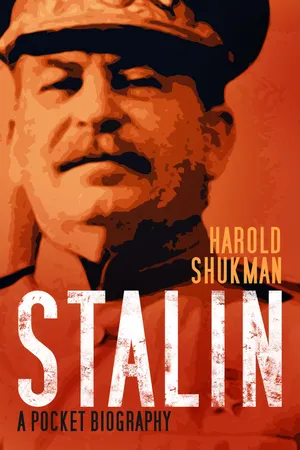
Joseph Stalin was one of the most ruthless and authoritarian dictators in world history, who plunged Russia into a barbarous nightmare, leaving behind a damaged nation and a legacy of grief.
This concise biography presents Lenin's heir from his humble and troubled beginnings to the highest rank of all: General Secretary of the Communist Party.
Stalin: A Pocket Biography is an accessible account of a complex tyrant, perfect for students or anyone taking a first look into modern Russian history.
- 128 pages
- English
- ePUB (mobile friendly)
- Available on iOS & Android
eBook - ePub
About this book
Information
One
INTRODUCTION
‘I kiss you on the nose, Eskimo-fashion. Dammit! I miss you something awful. I miss you like hell, I swear. I have no one, not a soul to have a proper talk with, damn you. Is there really no way for you to come to Cracow?’1 In December 1912, Stalin wrote to his party comrade Lev Kamenev, then in Geneva, in this jocular tone, very much as one Russian intellectual might write to another. Twenty-four years later, he would stage-manage Kamenev’s trial as a ‘Fascist spy’ and have him shot like a dog.
In 1912, Stalin was regarded by his comrades as an audacious revolutionary and an affable comrade – indeed, Lenin described him as a ‘wonderful Georgian’. By the 1930s, he had become a homicidal monster whose thirst for their blood seemed insatiable. When, in the late 1940s, for his own twisted purposes, he masterminded the arrest and in some cases the execution of the wives of some of his closest and longest-serving accomplices, the omnipotent dictator would sadistically respond to their pleas for mercy: ‘It doesn’t depend on me. I can do nothing. Only the NKVD [secret police] can sort it out.’2
What had wrought this transformation? How had a provincial, comparatively insignificant member of a small, unsuccessful group of journalists and persecuted political conspirators – which the Bolsheviks mostly were before the First World War – become one of the most powerful and merciless dictators in history, a dictator whose name and image would saturate every field of Soviet endeavour? How did that image evolve from the ‘grey blur’ depicted by one of the closest observers of 1917, and the ‘outstanding mediocrity’, as the revolution’s most vivid personality called him, into a demigod, an icon worshipped by his own subjects, as well as by an international movement that included many educated and thoughtful people abroad?
Under Stalin’s rule, what had been the Russian Empire was transformed no less spectacularly. When Lenin died in 1924 and Stalin took over the reins of power, the Soviet Union had barely begun to recover from the successive ravages of the First World War, the Civil War and the economic failures of the new regime. Both the industry and the agriculture of this predominantly agrarian country had been reduced to a shadow of their former scale. Yet by 1939 the Soviet Union was an industrial and military power of formidable strength. Driven in 1941 by Hitler’s armies into its own heartland, by 1943 the Red Army turned the war around and by the spring of 1945 was sharing Europe with its Western Allies. Under Stalin’s rule the USSR, a pre-war pariah among nations, took its place on the United Nations Security Council as the leader of the ‘socialist camp’ in a world that was soon to be divided by the Cold War.
As a member of the Politburo from 1917 and as its head from 1924, Stalin can be said to have been in power for thirty-six years, from the time of the revolution until his death in 1953. And since he left no personal diary – that we know of – the story of his life is inevitably and inextricably linked to the history of the period. It is the purpose of this brief account to examine these parallel transformations – Stalin’s and the Soviet Union’s – and to see how they are interrelated.
Two
BEGINNINGS
The Early Years
Stalin’s birthday has always been given as 9/21 December 1879. The local archives now reveal that he was in fact born on 6/18 December 1878, a year earlier. There is no explanation for this discrepancy. His birthplace was Gori, a small town of some 12,000 inhabitants of mixed Caucasian origin, in the Georgian province of Tiflis (Tblisi), and close to the Borzhom source of mineral water that would remain Stalin’s digestive of choice until the end of his life. Named Iosif (Joseph) and known by the Georgian diminutive of Soso, he was the third son of Vissarion (Beso) Dzhugashvili and Yekaterina (Keke), née Geladze. Two infant children had died before Soso arrived.
His father, Beso, was one of the small town’s ninety-two cobblers, among the lowest ranking trades in the hierarchy of artisanry, the topmost being that of watchmaker. His brutishness, poverty and frustration made Beso a violent, drunken husband and father; his wife, a pious Christian, was a hard-working laundry-woman and seamstress. She was dedicated to her only child and determined that he should rise above his origins and, ideally, become a priest in the Orthodox Church. Violence and discord in the family home eventually led to the parents’ separation and Beso ended up dying either in a Tiflis doss-house or after being knifed in a brawl. He was buried as a pauper.
A Georgian-speaker until the age of eleven – he would never lose the distinctive accent – thanks to his mother’s efforts and the help of a sympathetic patron Soso entered the church school in Gori in 1888. In 1894, having graduated with top marks, he was admitted to the Tiflis Seminary to train as a priest. Here he showed talent and a phenomenal memory for Biblical texts. Here also it was that, like so many other young people throughout the empire, he was swept up by the tide of discontent and rebellion that characterized Russia at the turn of the century. Peasants were rioting for more land; workers were striking for better conditions; students were demonstrating for their curricula to be liberalized; intellectuals were demanding political reform that would give society a voice in government; senior officials were being assassinated; anarchists were throwing bombs; Social Democrats were setting up clandestine organizations to bring the message of socialist revolution to the proletariat.
Soso and his fellow seminarists were ripe for conversion to the new political creed. The lack of intellectual stimulation in their studies and the drab harshness of seminary life made them vulnerable to the political ferment that was stirring in Russia, let alone the excitement of the colourful Georgian capital. While still playing the diligent theological student in class, Soso was reading Marx and Darwin. He became an atheist and began associating with underground, i.e. clandestine, revolutionary circles.
By 1899, the seminary and everything it stood for was insufferable to him. After ten years of religious education, at the age of twenty-one and no longer manageable in the seminary, he was expelled for indiscipline. As a fellow seminarist and revolutionary of the time wrote, the young Stalin took with him from the seminary ‘a vicious, ferocious enmity against the school administration, against the bourgeoisie, against everything that existed in the country and embodied Tsarism. Hatred against all authority.’1 Soso abandoned theology and entered the underground world of the Marxist organization in Tiflis where he became a professional revolutionary.
Revolutionary Youth
‘Professional revolutionary’: the term came into use around this time, as Vladimir Lenin was promulgating his ideas about the kind of revolutionary party he wanted to build, and the nature of the people he believed should constitute that party. They must be so dedicated to the cause that no personal or other goals would dilute their zeal or their submission to the ‘Centre’. The Centre would be run by a small, self-appointed group of intellectuals who were themselves guided by the Leader, i.e. Lenin. ‘The cause’ was to overthrow tsarism and promote socialist revolution. Many of Lenin’s recruits were qualified for a professional occupation – economist, physician, lawyer, scientist, some of them potentially distinguished – but most had either dropped out or been expelled from university or high school precisely because they had become actively involved in the revolutionary movement.
Apart from the priesthood, Soso was not a candidate for any other profession. Like many revolutionaries, his abilities as a political writer would find expression only in the party press: poems he wrote as a teenager offered little prospect of a successful literary career. But he was effective as a Marxist teacher of illiterate workers, his seminary education having provided him with an ability to convey complex ideas about the relationship between the economic and political system and the lives of ordinary people in a way they could understand. His simple style would become his hallmark, as both speaker and writer, in later life.
Along with the rewriting of history in general, Stalin’s biography, especially the section covering the years leading up to and including the revolution of 1917, became an object of distortion and invention when he reached the pinnacle of power in the 1920s, and even more so in the 1930s when his status as Leader was elevated into near-deity. In all respects, his image was ruthlessly transformed. What is plain, however, is that in the early years of his revolutionary career in the Caucasus he was an audacious conspirator with a taste for the more nefarious and criminal aspects of revolutionary craft.
In April 1902 he was arrested in the Black Sea oil port of Batum and imprisoned. He was now a registered revolutionary with his mug shot and personal characteristics recorded by the local branch of the Okhrana, or secret police. No stranger to physical hardship and deprivation, he quickly adapted to prison life, but after eighteen months was deported to Novaya Uda, a village in the eastern Siberian province of Irkutsk. While he was there the Russian Social Democratic Party split, although it is unlikely that he heard about it until later.
For nearly three years, Lenin and his comrade, Yuli Martov, had worked from outside Russia to establish a network of committees inside the empire which would follow their ideological guidance. Their ideas were promulgated in a newspaper, called Iskra (The Spark), which was smuggled into Russia and distributed by agents. Gradually, by a mixture of persuasive argument, material inducement and even physical intimidation, Iskra’s agents gathered a substantial amount of support among local committees for their masters in Western Europe. The First Congress of the Russian Social Democratic Workers’ Party had taken place in Russia in March 1898, but within two weeks eight of the nine founding members had been arrested. By the summer of 1903, Lenin and Martov were ready to convene the Second Congress in Brussels and then London with more than fifty delegates from revolutionary bodies inside and outside Russia.
Their hopes for a united party, however, were dashed. First, a small number of significant organizations refused to accept Iskra’s leadership, and their recalcitrance caused cracks to appear elsewhere. Specifically, the Jewish Social Democrats, or Bund, claimed sole representation of Jewish workers in the party and this caused uproar among other delegates of Jewish origin – half of the entire attendance, according to Lenin’s calculation. The Bund eventually left the Congress and the party when its demands were overwhelmingly rejected. (It was during these debates that Trotsky made his name, speaking up so frequently for Lenin’s line that he was dubbed ‘Lenin’s cudgel’, though he would soon move away and adopt an independent position.)
Secondly, Martov was affronted by the discovery that among Iskra’s delegates were a number who were obeying Lenin’s orders blindly, as if he had created a separate following. Along this main fault line other issues, particularly affecting the personnel of the central bodies, e.g. the editorial board of Iskra, led to further differences. As a result of the disarray, the Congress split into two wings. Lenin led a temporary majority and called them Majorityites, or Bolsheviks, while Martov rallied the non-Leninist elements, dubbed by Lenin the Minorityites, or Mensheviks.
Many of the delegates and the leaders themselves were disappointed by their failure to create a united party. Inside Russia activists and workers were disheartened by the split, finding the intellectuals’ squabbles exasperating, and many continued to maintain non-sectarian, united organizations.
Winter in Siberia tested even the tough young Dzhugashvili’s powers of endurance, and in January 1904 he escaped and made his way back to Tiflis. The Transcaucasian Social Democrats were already a mass movement, a feature they shared with other emerging socialist movements in the Russian borderlands, whether Polish, Ukrainian or Jewish, where the issue of social emancipation was linked to that of national liberation. Led by Noah Zhordania, the Caucasians resisted attempts to split their party into Bolsheviks and Mensheviks, and, at least until 1912, remained a unified movement of undifferentiated Social Democrats. Indeed, even the clandestine press in Baku, on which Iskra and dozens of other banned publications were produced in large print runs from 1901, was run jointly by Bolsheviks and Mensheviks without friction until 1905, when it became exclusively Bolshevik.
When Soso arrived in Tiflis he may already have been an admirer of Lenin. In any case, his role as a party worker in the Caucasus grew rapidly and acquired significance.
To evade police detection it was common for revolutionaries to adopt an alias: Lenin had been born Vladimir Ulyanov, Martov’s real name was Julius Tsederbaum, and Trotsky had been Leon Bronstein, to name only three. In 1904 Iosif Dzhugashvili to...
Table of contents
- Cover
- Title
- Copyright
- Contents
- Chronology
- 1 Introduction
- 2 Beginnings
- 3 Party Worker
- 4 Power
- 5 Lenin’s Heir
- 6 The Great Turn
- 7 Stalin the Executioner
- 8 The Nation Revived
- Conclusion
- Notes
- Bibliography
Trusted by 375,005 students
Access to over 1.5 million titles for a fair monthly price.
Study more efficiently using our study tools.
Frequently asked questions
Yes, you can cancel anytime from the Subscription tab in your account settings on the Perlego website. Your subscription will stay active until the end of your current billing period. Learn how to cancel your subscription
No, books cannot be downloaded as external files, such as PDFs, for use outside of Perlego. However, you can download books within the Perlego app for offline reading on mobile or tablet. Learn how to download books offline
Perlego offers two plans: Essential and Complete
- Essential is ideal for learners and professionals who enjoy exploring a wide range of subjects. Access the Essential Library with 800,000+ trusted titles and best-sellers across business, personal growth, and the humanities. Includes unlimited reading time and Standard Read Aloud voice.
- Complete: Perfect for advanced learners and researchers needing full, unrestricted access. Unlock 1.5M+ books across hundreds of subjects, including academic and specialized titles. The Complete Plan also includes advanced features like Premium Read Aloud and Research Assistant.
We are an online textbook subscription service, where you can get access to an entire online library for less than the price of a single book per month. With over 1.5 million books across 990+ topics, we’ve got you covered! Learn about our mission
Look out for the read-aloud symbol on your next book to see if you can listen to it. The read-aloud tool reads text aloud for you, highlighting the text as it is being read. You can pause it, speed it up and slow it down. Learn more about Read Aloud
Yes! You can use the Perlego app on both iOS and Android devices to read anytime, anywhere — even offline. Perfect for commutes or when you’re on the go.
Please note we cannot support devices running on iOS 13 and Android 7 or earlier. Learn more about using the app
Please note we cannot support devices running on iOS 13 and Android 7 or earlier. Learn more about using the app
Yes, you can access Stalin by Harold Shukman in PDF and/or ePUB format, as well as other popular books in Politics & International Relations & Historical Biographies. We have over 1.5 million books available in our catalogue for you to explore.