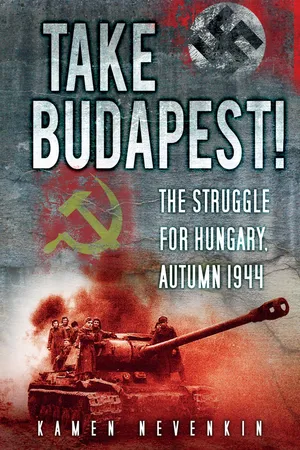
October 1944: Soviet troops launched a powerful attack on Budapest from the south, the culmination of a series of military, political, diplomatic and underground moves undertaken by Hitler, Stalin and Churchill since the collapse of the Axis front in the Balkans two months earlier. However, what had been planned as a bold stroke to knock Hungary out of the war and bring the Red Army as far as Munich quickly became a stalemate. The end result was that Stalin's forces failed to reach Bavaria, but the dictator was not disappointed: Soviet pressure against the German southern flank forced Hitler to transfer a considerable number of his armoured reserves to Hungary and thus largely facilitated Zhukov's drive on to Berlin. Here, Kamen Nevenkin tells the fascinating story of this 'Market Garden'-like operation using a number of never before published German and Russian archival documents, including German papers exclusively held in the Russian military archive. The text is dynamic, easy to read and accompanied by previously unpublished photographs. A detailed tactical narrative, Nevenkin also uses first-person accounts to render a human tale of war to create an ultimately fascinating read.
- 192 pages
- English
- ePUB (mobile friendly)
- Available on iOS & Android
eBook - ePub
About this book
Information
1
LIKE CLAUSEWITZ; ALMOST
1
Hitler had always shared the view of Clausewitz that ‘war is a continuation of politics by different means.’ During the war he repeatedly maintained the primacy of political over military considerations in the formulation of his strategic plans. This became especially evident in the last year of the war when the Führer began increasingly to concentrate his armoured reserves in certain regions in order to achieve given political objectives. In late 1944 there were two such areas: Hungary and the Ardennes. Even though these battlefields were geographically distant, in Hitler’s mind they were tightly bounded to each other by one thing: oil.
Hitler still believed that his forces might be able to stand fast for a long time if they could deliver a heavy blow in the West before the end of the year. One such successful offensive, he hoped, would cause a split among the Allies and force London and Washington to seek a separate peace with Germany. In turn, this would allow the Third Reich to concentrate its efforts exclusively on the Eastern Front. The Führer also hoped that a successful outcome of the attack in the Ardennes would buy more time for the armament industry to produce enough of the new advanced weapons – heavy tanks, jet aircraft, diesel-electric submarines, V2 ballistic missiles – and to complete the development programs of other ‘wonder weapons’, such as the nuclear bomb.
That autumn the bad weather was producing rain, fog and low-lying clouds that grounded the mighty Allied Air Force and caused supply problems for Eisenhower’s forces. The front line, which now was running along the prewar German border, was far shorter than it had been on the eve of the Normandy landing. This was advantageous for the Germans: it eased supply difficulties, increased manoeuvrability, made them less vulnerable to enemy air attacks and less dependent on radio communications (and therefore decreased the impact of Ultra interceptions). It seemed to Hitler that fate itself had sent him this grey autumn and that a favourable opportunity had come at last to realise his plans for a major offensive.
The planning began in mid-September and on 8 October Colonel-General Jodl, the Chief of Staff of the High Command of the Armed Forces (OKW), presented a draft plan for the attack to be mounted in the end of November.1 A mighty force of 32 divisions (including 12 panzer and panzer-grenadier) would strike through the Ardennes towards Antwerp, capturing Brussels in the process. The effect of this would be to entrap and destroy all of the Allied forces operating in the Low Countries. It was clear that the American lines would be breached, but the rapid exploitation of the initial success depended heavily on the available fuel stocks.2 And they were scarce. So scarce that the German commanders had to rely on captured fuel dumps to fulfil the planned objectives.
The Third Reich was fuel starved and the signs were everywhere. In the West the daily allowance of gasoline dropped to about 5 tons per division; in the Balkans the retreating Army Groups F and E could hardly count on any deliveries of fuel for the first fortnight of November and drastic economy measures were imposed; in Italy some panzer units were getting 7 per cent or less of their authorised gasoline allocation; on the Eastern Front the stocks of aviation spirit were at so low a level that the Luftwaffe could no longer provide adequate air support to the ground forces; the Kriegsmarine could maintain the U-Boat warfare at its present level only at the expense of the allocations of diesel fuel to the surface warships.3
The training of the reserves was also deeply affected. The practical exercises in the SS-panzer divisions of Oberstgruppenführer Sepp Dietrich’s 6 Panzer-Army, which was destined to be the principal strike force for the impending offensive in the West, were severely hampered by the fuel shortages; there was virtually no fuel for tactical training or for the training of the drivers.4 The same applied to the Luftwaffe and Kriegsmarine, where the training hours of the pilots and crews were reduced.5 The lack of fuel could be sensed even more tangibly in the everyday life of Nazi Germany: road and water transport almost ceased, the production of war material, industrial and agricultural goods declined and even paramilitary organisations, such as Organisation Todt and Reichsarbeitsdienst (RAD), functioned with great difficulty. Still worse, although fighter aircraft production had reached its climax in September 1944 (3031 single-engine fighters were delivered),6 the Air Fleet ‘Reich’ was less and less capable of defending the towns and factories, because there wasn’t enough fuel. The pilots showed courage and self-sacrifice, but were unable to appear in any significant strength to cause any serious damage to the Allied bomber armadas.
2
Only a few months earlier the fuel situation had been quite comfortable for the Germans. Then the oil supplies of the Third Reich had been coming from two different sources: imports and crude or/and finished petroleum products and gasoline produced by the powerful German chemical industry through synthesis of coal, air and water as raw materials. The natural oil obtained from the oilfields in Romania (Ploiesti), Hungary (Nagykanizsa), Austria (Zisterdorf), Lower Saxony (Harz region) and Galicia (Drogobycz), together with production from the synthetic oil industry, guaranteed that the Wehrmacht could still operate efficiently despite the increasing pressure on all fronts. Everything changed in the spring of 1944 when the Axis chemical and oil industries were selected as a top priority target by the Allied Bomber Command and from the beginning of April 1944 were hit hard. During the summer the production of the chemical works decreased considerably, while the normal functioning of the Ploiesti installations literally ceased and by the time the Soviets seized the area at the end of August, the Romanian oilfields had only a symbolic significance and were making little practical contribution to the Nazi war effort.
The effect of the bombing raids was cumulative. During an interrogation held shortly after the war, Albert Speer, the Hitler’s Minister of armaments, confessed:
The shortage of liquid fuel first made itself felt in the aviation categories. The stocks of Romanian natural oil in Germany enabled the manufacture of both motor spirit and diesel fuels to be continued for several months further.
In considering this question account must be taken of the OKW reserve and at the same time of the reduction in the quantities in circulation.
In the Luftwaffe the shortage of liquid fuel became insupportable from September 1944 onwards, as from that date the allocation was cut down to 30,000 tons a month, whereas the monthly requirements amounted to between 160,000 and 180,000 tons. So far as the Army was concerned, the shortage of liquid fuel, which in this case was also due to supply difficulties, first became catastrophic at the time of the winter offensive of 16 December 1944…7
Speer did his best to show the Führer the implications of the catastrophe. On 30 August he sent the following top-secret report to Hitler:
My Führer,
The last air attacks have again hit the most important chemical works heavily. Thereby the three hydrogenation plants, Leuna, Breux and Poelitz, although only recently in commission again, have been brought to a complete standstill for some weeks.
As the home defence against enemy air attacks promises no appreciably greater results in September as against August, chemical (oil) production in September must now be considerably decreased.
Nevertheless, no effort will be spared to restore the hydrogenation plants so that past production, at least, can be made possible in a short time.
The effect of these new raids on the entire chemical industry are extraordinary, as severe shortages will occur not only in liquid fuels but also in various other important fields of chemistry …
With these results the enemy has hit the chemical industry so heavily that only by abnormal changes in the conditions is there any hope for the retention of the bases for powder and explosives (Methanol), Buna (Methanol and nitrogen for explosives and agriculture). At the same time the loss in carburettor and diesel fuels is so widespread that even the severest measures will not be able to prevent bad effects on the mobility of the troops at the fr...
Table of contents
- Cover
- Title
- Acknowledgements
- Contents
- Foreword by David Glantz
- 1 Like Clausewitz; Almost
- 2 An Exemplary Arrangement of Large Issues
- 3 The Return of the Boomerang
- 4 The Complexity of the Soviet Military Plans
- 5 ‘Take Budapest as Quickly as Possible!’
- 6 ‘Wet, Cold and Totally Depressing’
- 7 Mind Games
- 8 The Race
- 9 Stalin ad Portas!
- 10 Crisis Management
- 11 The Aftermath
- Appendix 1 Command Positions
- Appendix 2 Orders of Battle
- Appendix 3 Troop Strengths
- Appendix 4 Armour Strengths
- Appendix 5 Losses
- Appendix 6 Claims
- Appendix 7 Air War
- Appendix 8 War Crimes
- Appendix 9 Documents
- Bibliography
- Copyright
Trusted by 375,005 students
Access to over 1.5 million titles for a fair monthly price.
Study more efficiently using our study tools.
Frequently asked questions
Yes, you can cancel anytime from the Subscription tab in your account settings on the Perlego website. Your subscription will stay active until the end of your current billing period. Learn how to cancel your subscription
No, books cannot be downloaded as external files, such as PDFs, for use outside of Perlego. However, you can download books within the Perlego app for offline reading on mobile or tablet. Learn how to download books offline
Perlego offers two plans: Essential and Complete
- Essential is ideal for learners and professionals who enjoy exploring a wide range of subjects. Access the Essential Library with 800,000+ trusted titles and best-sellers across business, personal growth, and the humanities. Includes unlimited reading time and Standard Read Aloud voice.
- Complete: Perfect for advanced learners and researchers needing full, unrestricted access. Unlock 1.5M+ books across hundreds of subjects, including academic and specialized titles. The Complete Plan also includes advanced features like Premium Read Aloud and Research Assistant.
We are an online textbook subscription service, where you can get access to an entire online library for less than the price of a single book per month. With over 1.5 million books across 990+ topics, we’ve got you covered! Learn about our mission
Look out for the read-aloud symbol on your next book to see if you can listen to it. The read-aloud tool reads text aloud for you, highlighting the text as it is being read. You can pause it, speed it up and slow it down. Learn more about Read Aloud
Yes! You can use the Perlego app on both iOS and Android devices to read anytime, anywhere — even offline. Perfect for commutes or when you’re on the go.
Please note we cannot support devices running on iOS 13 and Android 7 or earlier. Learn more about using the app
Please note we cannot support devices running on iOS 13 and Android 7 or earlier. Learn more about using the app
Yes, you can access Take Budapest! by Kamen Nevenkin in PDF and/or ePUB format, as well as other popular books in History & Military & Maritime History. We have over 1.5 million books available in our catalogue for you to explore.