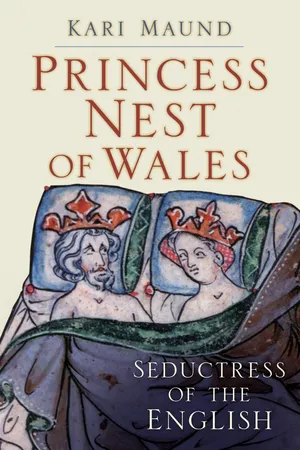
The daughter of one king and the lover of another; matriarch of a powerful dynasty and the cause of conflict and war: Nest, princess of Dyfed, became a legend. This biography reveals Nest's role in one of the most exciting and dynamic periods of Welsh, Irish and English history.
- 160 pages
- English
- ePUB (mobile friendly)
- Available on iOS & Android
eBook - ePub
About this book
Information
Topic
HistoriaSubtopic
Biografías históricas1
NEST’S WALES
Nest of Deheubarth was born at a crossroads in the history of Wales. Had her birth occurred as little as twenty years earlier, it is likely that her name would be no more to us now than a brief note in an old genealogical manuscript – someone’s mother, someone’s wife. But she was born in a time and place where everything was changing in Wales for men and women alike, and those changes were to bring her to the attention of an English king, an influential nobleman, a swashbuckling Welsh rebel, and to lead to at least some aspects of her life being recorded for posterity.
Early medieval Wales was in many aspects conservative, and, although its internal politics were dynamic and often dramatic, Welsh events had, up until the middle of the eleventh century, only intermittently drawn the attention or interest of their English neighbours. Although the country was much the same shape, geographically, at that time as it is now, its political map was considerably different. It was divided into several fiercely independent kingdoms, each with their own native ruling house. The number of these varied from period-to-period, as kings warred with one another, annexed or lost territories, allied, intermarried and schemed, but by Nest’s time the major units were Gwynedd, in the north-west; Powys, in the north-east; Deheubarth, in the south-west; and Morgannwg, in the south-east. Nest’s father, Rhys ap Tewdwr, was king of Deheubarth, then a land of good arable and grazing, forests and notable fishing resources. Its core land was the ancient kingdom of Dyfed, to which earlier kings had annexed the neighbouring territories of Ystrad Twyi, and, intermittently, Gower and Ceredigion. Nest’s grandson, the writer and clergyman Gerald of Wales, was born and brought up in southern Deheubarth, in what is now Pembrokeshire, and retained a life-long love of the land. Writing in the last decades of the twelfth century, he described it as, ‘…a region rich in wheat, with fish from the sea and plenty of wine for sale… Of all the different parts of Wales, Dyfed with its seven cantrefs is at once the most beautiful and the most productive.’1 In terms of the internal politics of Wales, the king of Deheubarth was one of the most powerful figures. Indeed, for much of the tenth century Wales had been dominated by a succession of effective kings from that kingdom.2 They were Nest’s ancestors, and from what we can tell, she was proud of them and their history.
What was the nature of the culture in which she spent her childhood? Society was hierarchical and heavily male dominated.3 Our extant historical sources concentrate on the deeds of kings and their teulu (warbands), and upon the upper clergy; the bulk of the population – and nearly all the women – go unrecorded, outside the descriptions given in law codes, the occasional reference in a land grant or Life of a saint. Status was largely a matter of birth – born into a royal line, Nest herself was a member of a privileged group. Welsh kings were expected to be effective military leaders, generous patrons and upholders of the law. They seem to have been semi-nomadic, travelling about their kingdoms, visiting both their own estates and those of their aristocracy and clergy. They were accompanied in this by their warband, which was made up of young noblemen and royal kinsmen, as well as by their immediate family and the royal household of servants and officials. This peripatetic lifestyle allowed them to monitor continuously the mood of their country, and to keep a close eye on their people. Also, it served another purpose: Wales at this time was largely a non-monetary economy, but kings nevertheless were due renders from their people. These could take a variety of forms –consumables, such as bread, dairy products, beer, mead and honey; grain for sowing or milling; animal skins and livestock including pigs, cattle and sheep; services such as building work or military support; and, in some instances, precious metals, either by weight or in the form of coins of Anglo-Saxon or Anglo-Norman origin.4 Moving from place to place allowed the kings both to collect and consume these renders efficiently, without placing too great a burden upon any one area for too long, or risking that perishable goods might rot before they could be used. While kings may have stayed as guests with members of their nobility from time to time, it is likely that in many cases, the places in which they stayed were their property – royal estates seem to have been scattered throughout each kingdom. This in itself was practical: it helped to maintain the distance between king and subject – wherever he was, he was usually on his own territory, which gave him both practical and psychological advantages. He would be employing his familiar warband as his defenders, rather than leaving his security in the hands of outsiders.
The king’s court was known as the llys. According to the extant Welsh law codes, this consisted of a number of buildings, including a hall, a sleeping chamber for the royal family, buildings to house domestic activities like cooking and baking, storehouses, shelter for livestock and sleeping quarters for the teulu and other members of the household. These would have been fortified in some fashion, presumably by some combination of gates, ditches and palisades. In addition to tax renders, the llys was supported by a nearby royal estate, or maerdref, worked on behalf of the king by tenants or bondsmen. No certain royal building complexes survive in Wales from the late eleventh century, but we have archaeological evidence of royal strongholds from both earlier and later periods. The hill-forts which may have characterised the royal, aristocratic and other elite inhabitations of the very early medieval period (fifth to seventh centuries) had fallen out of use long before Nest’s birth – before, indeed, the rise to power of the royal house of which she was a member.5 These ancient strongholds bear witness to a relatively wealthy lifestyle. At Dinas Powys, near Cardiff, for instance, archaeological finds included pottery from south-west France and the Mediterranean, suggesting participation in European trade; alongside evidence for metalworking and jewellery making.6 Its inhabitants, whether royal or aristocratic, lived a comfortable lifestyle, produced surpluses for trade, and were able to support specialised craftsmen. By Nest’s time, royal life seems to have been more mobile – and there is less evidence for craft specialisation, perhaps due to the lack of a settled royal centre. We know that a contemporary of her father, Gruffudd ap Llywelyn, king of Gwynedd 1039−1063/4, had a defended stronghold at Rhuddlan,7 and that one of the latter’s successors, Gruffudd ap Cynan, had several major courts within that kingdom.8 By the mid to later twelfth century, one main hall complex of the kings of Deheubarth lay at Dinefwr, near Llandeilo in Dyfed. Gerald of Wales believed that this had been their main royal seat since ancient times.9 The castle which now stands there belongs to a later period than that of Nest, but there is some evidence to suggest that Gerald was correct in his belief that a royal centre had existed there before the coming of the Normans to Wales.10 Another llys of the kings of Deheubarth possibly lay at Carreg Cennen.11 In the Mabinogion, Pwyll, the king of Dyfed, has a court at Arberth, and his son and successor Pryderi has another further north at Rhuddlan Teivi in Ceredigion.12
What might these llysoedd have looked like? A list of buildings as described by the Welsh law codes has been given above. Archaeological excavation in north Wales has revealed the remains of several llysoedd in Gwynedd. These date from the thirteenth century, and may thus have been influenced by Anglo-Norman and Angevin styles of building. Nevertheless, at Aber, the foundations of a large stone hall made up of three chambers have been uncovered, which may represent one of the dwellings of the princes of Gwynedd. At Rhosyr, rather more substantial remains have been uncovered, possibly representing the remains of a hall and a separate chamber, while early documentary evidence mentions the presence at the same site also of a chapel and a stable.13 The hall at Rhosyr may have been mainly constructed of timber, despite its stone foundations,14 and such a method was probably more common in eleventh-century Deheubarth. While references to royal llysoedd occur in Welsh medieval poetry and prose tales, there are no descriptions of the physical appearance of these halls. While Norman stone castles served as a potent symbol of the physical presence – and permanence – of the Norman invaders, the llys of the Welsh king seems to have had a more social function. It is mentioned in prose and poem as the location for rich feast and celebrations, presided over by an open-handed king. Hence in the prose tale Pwyll Pendeuic Dyuet (Pwyll, Lord of Dyfed), when the hero Pwyll comes to the court of Heveydd the Old, whose daughter Rhiannon he seeks to wed:
There was great joy at their arrival: a huge assembly rejoicing to see them and a great feast set out and all the resources of the court placed at their disposal. The hall was made ready and they entered and sat down: Heveydd sat on one side of Pwyll and Rhiannon on the other, and everyone else according to rank. They ate and caroused and conversed …15
Hospitality seems to have been prized not only in a king but in all householders. Gerald of Wales noted of the Welsh that, ‘Everyone’s house is open to all … When you travel there is no question of your asking for accommodation or of their offering it: you simply march into a house and hand over your weapons to the person in charge.’16 The guest thus arriving could expect food, bed and entertainment, and element is again echoed in the prose tales. When in Culhwch ac Olwen the young warrior Culhwch arrives at King Arthur’s court, he is welcomed, well fed and granted the aid of king and court, even though he has ignored proper custom by riding armed into the midst of the hall. When Kei questions Arthur’s reception of this young upstart, Arthur replies, ‘We are noble men so long as others come to us, and the more gifts we distribute, the greater will be our reputation and fame and glory.’17 Generosity was a valued attribute not only of kings but also of their wives. The Welsh law codes lay out at least some of the gift-giving obligations of queens,18 while after Pwyll has married Rhiannon and she has come to his court no visitor leaves without receiving a valuable gift from her.19 Care must be observed in applying the testimony of prose tales and law codes. The latter as extant date probably to the later twelfth and thirteenth centuries, and, as far as the king’s wife is concerned, may have been influenced by Norman and Angevin practice; in particular to the circumstances attendant upon the intermarriages of the later princes of Gwynedd with illegitimate daughters of Angevin kings.20 Both law codes and prose tales, moreover, present us with ideal versions of a given situation: the actions of kings and queens are presented in terms of best practice, and this does not necessarily reflect everyday behaviour. Additionally, characters like Arthur or Pwyll or Rhiannon are almost by definition anomalous in terms of daily life. They are not realistic representations of people; they are heroes, whose demeanour and behaviour is expected to differ – sometimes immensely – from the norm. They possess unusual powers or attractions or resources, and they live in courts of unusual richness. Pwyll travels between his own, apparently mundane kingdom, and the supernatural realms both of Rhiannon’s father Heveydd and of the underworld king Arawn. Rhiannon possesses almost magical knowledge and powers, and exemplary beauty. Arthur’s court is the home of heroes and the fountain of legends. It is unlikely that Rhys ap Tewdwr and his court operated on the scale of opulence imagined in these stories, nor can we be certain that he possessed a formal queen. It is likely, however, that in her father’s various houses Nest will have witnessed feasts and gatherings of the leading men of the kingdom, and seen her father (and perhaps her mother) reward favoured or valued supporters with gifts of food, clothing, livestock or ornamentation.
Royal places seem also to have been centres for trade and perhaps craft activity, although this is harder to trace after the early period. As has been mentioned, the elite complex at Dinas Powys was home to metalworkers and jewellers, presumably under the patronage of the lord. T...
Table of contents
- Cover
- Title
- Contents
- Introduction
- 1 Nest’s Wales
- 2 Nest’s Girlhood
- 3 Nest and the Normans
- 4 Nest and the Rebels
- Select Bibliography
- Genealogical Tables and Maps
- About the Author
- Copyright
Trusted by 375,005 students
Access to over 1.5 million titles for a fair monthly price.
Study more efficiently using our study tools.
Frequently asked questions
Yes, you can cancel anytime from the Subscription tab in your account settings on the Perlego website. Your subscription will stay active until the end of your current billing period. Learn how to cancel your subscription
No, books cannot be downloaded as external files, such as PDFs, for use outside of Perlego. However, you can download books within the Perlego app for offline reading on mobile or tablet. Learn how to download books offline
Perlego offers two plans: Essential and Complete
- Essential is ideal for learners and professionals who enjoy exploring a wide range of subjects. Access the Essential Library with 800,000+ trusted titles and best-sellers across business, personal growth, and the humanities. Includes unlimited reading time and Standard Read Aloud voice.
- Complete: Perfect for advanced learners and researchers needing full, unrestricted access. Unlock 1.5M+ books across hundreds of subjects, including academic and specialized titles. The Complete Plan also includes advanced features like Premium Read Aloud and Research Assistant.
We are an online textbook subscription service, where you can get access to an entire online library for less than the price of a single book per month. With over 1.5 million books across 990+ topics, we’ve got you covered! Learn about our mission
Look out for the read-aloud symbol on your next book to see if you can listen to it. The read-aloud tool reads text aloud for you, highlighting the text as it is being read. You can pause it, speed it up and slow it down. Learn more about Read Aloud
Yes! You can use the Perlego app on both iOS and Android devices to read anytime, anywhere — even offline. Perfect for commutes or when you’re on the go.
Please note we cannot support devices running on iOS 13 and Android 7 or earlier. Learn more about using the app
Please note we cannot support devices running on iOS 13 and Android 7 or earlier. Learn more about using the app
Yes, you can access Princess Nest of Wales by Kari Maund in PDF and/or ePUB format, as well as other popular books in Historia & Biografías históricas. We have over 1.5 million books available in our catalogue for you to explore.