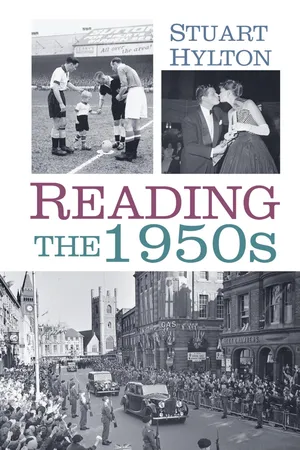
In Reading in the 1950s Stuart Hylton gives a fascinating account of the town and its people during a decade of rapid and memorable change. The story begins in the drab atmosphere of the early postwar years, with their austerity, sense of shrinking empire and declining national prestige. It ends with the brash new world of the swinging sixties, which brought The Beatles, the miniskirt and the Mini car. From television and labour-saving appliances which revolutionised the home, to the motor car which began to dominate travel and to alter the character of the town, the author also records aspects of Reading that stayed much the same – the courage and humour of the townspeople in sometimes trying circumstances, the ingenuity and incompetence of the criminal classes, the absurdities of officialdom, and the sheer diversity of local life as it emerges from reports in the press. Capturing the spirit of the population during an era of bewildering development and change, this is a must-have for locals and anybody with an interest in the history of the town.
- 128 pages
- English
- ePUB (mobile friendly)
- Available on iOS & Android
eBook - ePub
About this book
Information
ONE
1950: Out of Austerity
Reading was still struggling with the aftermath of war as the second half of the twentieth century dawned. The damage caused by bombing in the very heart of the town centre was yet to be repaired. Power cuts brought all-too-frequent reminders of the blackout and many goods were still on ration.
Reading people marked the arrival of the 1950s in all sorts of ways. The dance halls and churches were equally full. Railwaymen saw in the New Year by sounding their locomotive whistles. In the week between Christmas and New Year, one of their passengers, a drunken reveller on the London to Penzance train, chose to step out at Reading for a spot of fresh air to clear his head. Unfortunately for him, the train did not stop at Reading and he did not survive to see the 1950s. At the other end of the mortal coil, Mrs Annie Gains of Whitley saw in the new decade by giving birth to a son in the back seat of a taxi, en route to the Grove Maternity Home in Emmer Green.
Although the nation was still living in the shadow of the war, signs of a new way of life were beginning to emerge. Helicopters, the newspapers announced, were going to be the transport of the future and they demanded to know what the town was doing to prepare for this. Rooftop landing pads were urgently needed. Car ownership was spreading, though new cars were still often difficult to obtain. In the second-hand market, £99 would buy a 1933 Morris Minor two-seater saloon, while a brand new Humber Pullman limousine (the stretched limo of its day) cost £1,350 plus purchase tax (or roughly twice the cost of a two-bedroom cottage in Caversham).
Perhaps even more significantly, a new form of home entertainment was starting to come into its own. The advertisements spoke very highly of it:
Whatever the family choice of entertainment, you will find it in TELEVISION. It has brought a new meaning into home life and thousands who used to seek their entertainment outside, now find their television set a source of untold pleasures at home. Why not learn more about it?
Home trials were available, before you decided to make the sizeable investment of £54 or more in a set of your own. A major irritation was cars without suppressors, which affected reception. As the television-viewing public grew in number, there was hope that the fitting of suppressors to cars would be made compulsory.
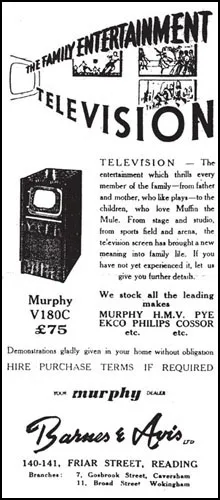
Television arrives to take over our lives.
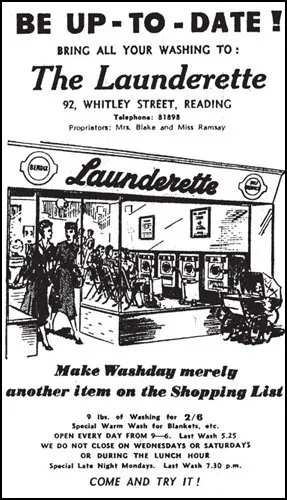
All the glamour of washday!
For those who could not afford a television, there was something else to watch – a self-service launderette.
It is the first in Berkshire and follows a pattern which has made launderettes top favourites for household washing in America and with British housewives in many towns. Standing in the garden of an eighteenth-century cottage, Reading’s most original laundry is light, airy and decorated throughout in blue and white.… Customers bring all their family wash, from blankets to handkerchiefs, receive a cupful of special soap powder and are allotted to a machine. Mrs M. Jones, the trained attendant, shows newcomers how to pack the soiled clothes into the electric washing machine. The glass door is closed; a small dial is set and the customer sits back to watch operations.… even men can manage their own washing under this system, which has clear advantages in hygiene – each person’s laundry is washed separately under their own supervision.
For most people, the radio and the cinema remained the main sources of entertainment. Radio stars were household names and a variety bill made up of ‘Stars of Radio’ appeared at the Palace Theatre in the spring of 1950. It was headed by a ventriloquist, Peter Brough (and his better-known dummy, Archie Andrews). In case anyone else finds it odd that a ventriloquist should make his name on the radio, the bill also included a troupe of dancers and a duo mysteriously described as ‘Thrills on wheels’, neither of which sound like an obvious act for that medium. It seems only the radio juggler was missing.
At the cinema, the Central and Granby cinemas experimented with midnight matinées, and many people queued in the rain to see Little Women or the Alfred Hitchcock film Under Capricorn. The bus company laid on special late-night buses for the filmgoers. They bought a combined cinema and bus ticket on the way in and, while they watched the film, the bus company worked out how many buses would be needed afterwards and called them up. The British film, The Blue Lamp, which gave birth to the character of Dixon of Dock Green, was attracting a great deal of interest in 1950. A special showing was organised at the Odeon for the Chief Constable and many of his staff. Chief Constable Lawrence said afterwards, ‘It is an extremely important film, from the official police point-of-view.’
The first postwar Labour Government was coming towards its end and the hostility between Reading’s Labour MP, Ian Mikardo, and the local press was growing more fierce by the week. This editorial from January 1950 is typical:
The Socialist party knows that, in the coming General Election, whatever the hoardings may flaunt, they are on trial, and have to face a barrage of unpleasant facts which, over the past five years, have proved how much easier it is to promise than to perform. In 1945 they were suddenly and unexpectedly called upon to translate into reality the blueprints of the dreamers and the pseudo-philosophers who, for half a century, had asked only to be allowed to put their theories to the test. And what a dismal failure this translation has been! Instead of devoting their energies to restoring the war-wracked nation to at least some of its former prosperity, the Government at once plunged into the task of implementing their ideals in the face of every economic warning from more sober and expert guides; proceeded to placate by class legislation those who had put them into power; and to pass over the real government of the country into other hands.
Mikardo, for his part, took the paper to task for sending their fashion, rather than their political, correspondent to one of his speeches, since he spent all his time reporting what Mikardo was wearing and nothing about what he had said – and even managed to get the details of his attire wrong! Maybe it was this that led the paper to involve its ultimate weapon – the Women’s Page – in the election. They sent their reporter to spend an afternoon canvassing with the wife of one of the candidates (the Conservative, naturally).
As the elections approached, the paper campaigned furiously for a change of MP. For this election, Reading had been split into two seats and Mikardo was standing for Reading South. In their pen portraits of the rival candidates, the paper made not the slightest pretence at impartiality. Of Mikardo, they said, ‘No other candidate arouses more feeling among friend or foe’ and, referring to his previous career in the private sector, suggested that ‘It is typical of Mikardo that, while he condemns capitalism and free enterprise, he is quite prepared to make a good living helping capitalism and free enterprise.’ By contrast, his Conservative opponent, David Rissik, was portrayed in near-saintly terms. He was a war hero who ‘didn’t just fight in the jungle; he knew what he was fighting for’.
The campaign drew a variety of well-known speakers to the town. Herbert Morrison put the Labour case at a public meeting, while Quentin Hogg came to Reading for the Conservatives and threatened to slap a writ on a man who was heckling him! The Liberals were also campaigning, though one gets the impression that their hearts were not really in it. They were being criticised in the press for splitting the anti-Labour vote and their electoral slogan ‘For a liberal government vote Liberal’ did not immediately seize the public imagination for some reason. Their candidate for Reading North, Michael Derrick, addressed what was not surprisingly described as ‘a small audience’ at Kendrick School on the uplifting theme of ‘If we fail, we shall try again’. Small wonder, perhaps, that they only got just over 3,000 votes in each of the Reading constituencies.
The country returned the Labour government for a second term, but with the slimmest of majorities, and Reading elected two Labour MPs, Mikardo and Kim Mackay (‘a disastrous choice’ the paper called it). Characteristically, Mikardo could not resist a piece of sarcasm at the Chronicle’s expense in the light of his victory:
I am thankful for the service they have rendered to the Labour cause during the election campaign. People are not dumb and they are not taken in by such vituperation and, far from supporting the cause they are urged to, they oppose it. There were hundreds of ‘floating voters’ who voted for us on the basis of what the senile old gentleman who writes the leaders for the Berkshire Chronicle said. I do sincerely want to thank him for putting some doubtful voters into our camp which we should not otherwise have had.
When, later that year, Mikardo was rushed to hospital with a gall bladder problem, the editorial columns were strangely silent in their wishes for a speedy recovery.
One of the commonest criticisms of the government was that it was imposing its ideology on aspects of life where it was not needed. There were editorial calls for housing to be removed from the realm of party politics (that is, Labour party politics) so that free enterprise could rapidly reduce waiting lists, and the prospective Conservative candidate for Reading South made the following attack at a local by-election meeting:
National policies have been forced into local government. That has been the work of the Socialists. In our view, local government must be 100% local, and one of our first objectives when we are returned will be to see that our local councils get back the powers that have been stripped from them.
Local councils in the 1990s are still waiting for a government of any persuasion that will do this.
Housing remained a major problem for many people in Reading. In July 1950 the 1,000th postwar house was handed over to its new tenants at Halls Road in Tilehurst. Mr and Mrs Slater, the happy occupants, had been waiting five years for it and there were still more than 4,000 families like them on the town’s waiting lists. Many solutions (other than private enterprise) were offered to the housing problem. Some saw industrialised building methods as the answer and 128 concrete houses were built in Whitley at a cost of £158,544 5s 8d. These, the public were told, kept the costs down without spoiling the beauty of the surrounding area (in this case, Whitley Wood Road). Wokingham Rural District Council believed terraced houses were one possible answer. As one of the councillors noted, during a fact-finding mission to look at this form of building:
They can be things of beauty and frightfully economical as well. In the past, we have made the mistake of putting people into houses they cannot afford. We do not want any more of this nonsense of two lavatories, one upstairs and one downstairs. I hope this council is going to turn its back on semi-detached houses with rents of 30s a week.
The courts continued to offer up their selection of life’s rich tapestry. A man was arrested under a 600-year-old piece of legislation for masquerading as a woman at the Rex cinema ‘in a manner likely to cause a breach of the peace’ (presumably as opposed to masquerading as a woman in any other way). No details were given to an eager public, except that he was bound over to keep the peace in the sum of £100. In another case, an 81-year-old man who had spent a total of fifty-six years in prison had another four added to his total, for a case of housebreaking.
The motoring offences at one quarter sessions were of more than usual interest, as the defendant in a case of driving without due care and attention was a 20-year-old racing motorist named Stirling Moss. It was alleged that he took a corner at excess speed, with his tyres squealing. At his appeal, his defence counsel described the £10 fine, the endorsement of his licence and a month’s suspension as ‘a slur on a racing motorist’, but the appeal was unsuccessful. (We will never know whether the arresting officer was the first to ask the immortal question ‘And who do you think you are, then, Stirling Moss?’)
One of the oddest cases of the year involved a motorist charged with two counts of dangerous driving. Despite narrowly missing a man in an invalid chair, hitting a car and a motor-cycle and turning his car on its side, his plea that he was suffering from the effects of sunstroke at the time was enough to get him acquitted.
One important question settled by the courts was the value of a wife. A man from Ringwood Road made a claim for £50 against the co-respondent in his divorce case for the loss of his wife. The learned judge’s summing up included the following remarks:
It is all too common for a co-respondent who has broken up a man’s home to evade the consequences of his wrongdoing by what some people might call a mean trick, saying ‘The woman I took away from you was not worth very much anyway, and you are not entitled to anything for having lost her.’
The judge took the view that £50 damages was very reasonable, and threw in the custody of their child for good measure.
Two men engaged in a potentially hazardous form of theft, appearing before the courts for stealing a quantity of lead from the Atomic Energy Establishment at Harwell. Anyone seeking to copy their crime in future would have less travelling to do, as it was announced early in 1950 that Reading was to get its own Atomic Energy Establishment, on the former wartime bomber airfield at Aldermaston. The government took pains to ensure the public that ‘precautions will be taken to ensure that no harmful effect to the neighbourhood will arise from the works to be carried out at this new establishment’. Then as now, the authorities were not forthcoming when asked to be more specific about security.
Opinion was sharply divided between those who wanted to keep the picturesque village as it was and those who saw jobs and business opportunities. Plans were subsequently announced to build 500 homes to house the workers at the Establishment, in Newbury and Basingstoke, as well as in Aldermaston itself. The authorities in Reading were afraid that all this building would draw essential ...
Table of contents
- Cover
- Title Page
- Contents
- Introduction and Acknowledgements
- 1. 1950: Out of Austerity
- 2. 1951: Festival Time
- 3. 1952: The King Dies
- 4. 1953: Coronation
- 5. 1954: Teddy Boys and Tragedy
- 6. 1955: Smog and ITV
- 7. 1956: Rock Around the Clock
- 8. 1957: Space, and Room to Live
- 9. 1958: Banning the Bomb, and the Smoke
- 10. 1959: Minis and Mikardo
- Copyright
Trusted by 375,005 students
Access to over 1.5 million titles for a fair monthly price.
Study more efficiently using our study tools.
Frequently asked questions
Yes, you can cancel anytime from the Subscription tab in your account settings on the Perlego website. Your subscription will stay active until the end of your current billing period. Learn how to cancel your subscription
No, books cannot be downloaded as external files, such as PDFs, for use outside of Perlego. However, you can download books within the Perlego app for offline reading on mobile or tablet. Learn how to download books offline
Perlego offers two plans: Essential and Complete
- Essential is ideal for learners and professionals who enjoy exploring a wide range of subjects. Access the Essential Library with 800,000+ trusted titles and best-sellers across business, personal growth, and the humanities. Includes unlimited reading time and Standard Read Aloud voice.
- Complete: Perfect for advanced learners and researchers needing full, unrestricted access. Unlock 1.5M+ books across hundreds of subjects, including academic and specialized titles. The Complete Plan also includes advanced features like Premium Read Aloud and Research Assistant.
We are an online textbook subscription service, where you can get access to an entire online library for less than the price of a single book per month. With over 1.5 million books across 990+ topics, we’ve got you covered! Learn about our mission
Look out for the read-aloud symbol on your next book to see if you can listen to it. The read-aloud tool reads text aloud for you, highlighting the text as it is being read. You can pause it, speed it up and slow it down. Learn more about Read Aloud
Yes! You can use the Perlego app on both iOS and Android devices to read anytime, anywhere — even offline. Perfect for commutes or when you’re on the go.
Please note we cannot support devices running on iOS 13 and Android 7 or earlier. Learn more about using the app
Please note we cannot support devices running on iOS 13 and Android 7 or earlier. Learn more about using the app
Yes, you can access Reading in the 1950s by Stuart Hylton in PDF and/or ePUB format, as well as other popular books in History & British History. We have over 1.5 million books available in our catalogue for you to explore.