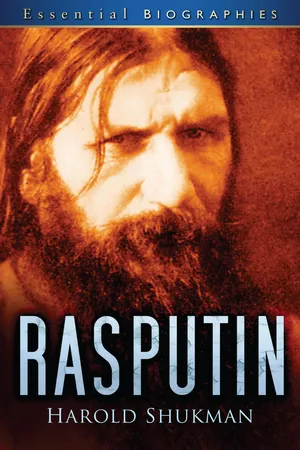
Gregory Rasputin features in Russian history as a malign and destructive force, a man with an unhealthy influence on the Empress Alexandra and undue power in Russian politics. Yet his purposes were ostensibly beneficent. An uneducated peasant, he left Siberia to become a wandering 'holy man' and soon acquired a reputation as a healer. The empress was desperate to find a cure for haemophilia from which her son Alexei suffered, and in 1905 Rasputin was presented at court. His positive effect on the heir's health made him indispensible. But his religious teachings were unorthodox, and his charismatic presence aroused in many ladies of the St Petersburg aristocracy an exalted response, which he exploited sexually. Shady financial dealings added to the atmosphere of debauchery and scandal, and he was also seen as a political threat. He was assassinated in 1916.
- 128 pages
- English
- ePUB (mobile friendly)
- Available on iOS & Android
eBook - ePub
Rasputin: Essential Biographies
About this book
Information
ONE
EARLY DAYS
The fall of an empire demands explanation in terms of historical forces that one expects to match the scale of the events themselves – major war, economic collapse, social revolution. But individuals also have their place. It is, for instance, impossible to think of the Russian revolution without mentioning Nicholas II, Kerensky, Lenin or Trotsky. Yet among these names we also invariably encounter that of Gregory Rasputin, usually described as a drunken, lecherous pseudo-holy man, a debauched peasant whose baneful influence over the Empress Alexandra was to prove fatal to the Romanov dynasty. A small private museum has been opened in his birthplace which aims to show that his reputation as an utterly amoral and mercenary reprobate is based mostly on myth. He has featured in novels and films – even in a pop song that opened with ‘Ra, Ra, Rasputin/Lover of the Russian queen/Russia’s greatest love machine’.
The purpose of this book is to identify the qualities that enabled Rasputin to enter Russian history, and that lent themselves to this sort of treatment, to ask what made the Romanov dynasty susceptible to his influence, and to explain why the relationship was ultimately disastrous.
We shall examine a number of related areas: the condition of Russia from the turn of the century to the First World War; the relationship between the tsar and society; religious attitudes among peasants and aristocrats. The activities of Rasputin can only be properly understood in the context of these settings.
Russia at the Turn of the Century
The vast multi-national empire was struggling to modernize: to continue the economic upsurge begun in the 1880s; to tackle peasant land-hunger by major reform; to enable popular participation in the political process by the introduction of a parliament, called the State Duma; and to raise public awareness by a huge expansion of the press and a reduction in state censorship.
In every area of state and public activity, the tension between past practice and new initiative gave rise to conflicting political programmes. The central question was: how should Russia be governed? On becoming tsar Nicholas II swore to uphold the legacy of his father, Alexander III, who had been a committed autocrat, and who had espoused economic reform expressly in order to strengthen the autocracy. The autocracy – that is, the traditional Russian form of monarchy – was widely supported by the aristocracy and large sections of the gentry. Many, however, also believed that a form of constitutional monarchy, or shared power, was the way ahead. The peasants were piously loyal to the person of the tsar, but also longed for land reform that would give them greater autonomy and less control by the state, of which the tsar was the executive head.
The mentality of the fast-growing working class – mostly ex-peasants and poor town dwellers – was changing rapidly under the impact of harsh industrial working conditions and socialist propaganda, and it was becoming republican, if not outright revolutionary.
Standing outside this structure were the intelligentsia. They included politicians and journalists, writers and poets, composers and musicians, artists and critics, teachers, doctors and lawyers, scientists and engineers. Their ideas varied widely, but they shared a critical attitude towards the state and its effects on social development. Part of the intelligentsia plotted to overthrow the existing state, and the most extreme of them were organized by Vladimir Lenin into a party of ‘professional revolutionaries’, known as the Bolsheviks.
Nicholas ascended the throne in 1894, the year of his marriage to Princess Alix of Hesse-Darmstadt, a granddaughter of Queen Victoria, German by title but English by upbringing. On becoming a Romanov, Alix adopted Orthodox Christianity and changed her name to Alexandra, adopting the patronymic Fedorovna required of Russian empresses.
Nicholas’s father, Alexander III, had ruled since 1881, applying economic policies designed to stimulate industry, business and commerce, and with dramatic success. By the end of the century Russia had been transformed into a major player in the world league of oil, steel, coal and wheat producers. But economic success brought with it industrial unrest, the organization of workers in illegal trade unions and their political agitation by Marxist revolutionaries. Equally, the export of grain had been achieved at the cost of depressed peasant consumption and low domestic prices. Workers and peasants reached a climax of discontent, with strikes and peasant revolts sweeping large areas of the country in the first years of the century.
Russia’s small student population had been the seedbed of revolution since the middle of the nineteenth century, and in 1902 it, too, erupted in demonstrations, calling for intellectual freedom and democratic liberties. The unrest culminated in January 1905. A procession of 100,000 workers and their families, led by a priest and bearing icons and portraits of the tsar, marched towards the Winter Palace in St Petersburg with demands for economic and political improvements. The troops fired warning shots, and then opened fire on the crowd. Several hundred were killed and injured, and Nicholas II was cursed as Nicholas the Bloody.
Terrorism mounted, claiming senior government figures, including a close relative of the tsar. The turmoil peaked in October with a general strike that affected every aspect of public activity. Russia was challenging the tsar to compromise and allow society a voice in government.
The task facing Nicholas was enormous. Unprepared and untrained for his role as emperor, he lived with the memory of a father who had despised him. A muscular bully of a man, who lifted weights for exercise and played the trombone for cultural diversion, Alexander had dismissed Nicholas as a weak and indecisive failure, and Nicholas had accepted his father’s judgement of him. He detested his state responsibilities and was happiest in the bosom of his adoring family, a country squire by nature with no stomach for confrontation with ‘historic forces’.
The events of 1905 were complicated by war with Japan for possession of Manchuria. The Trans-Siberian Railway from European Russia to the Pacific was not complete when hundreds of thousands of troops had to be transported 10,000 kilometres to fight an unknown enemy, who had only to cross 300 kilometres of sea to put his forces on the mainland. While the civilian population was in revolt, the army was fighting – and mostly losing – battles in the Far East. Virtually the entire Russian fleet was sunk by the Japanese in the Tsushima Straits on a single afternoon in May. In August 1905 the United States brokered a peace treaty that was less punitive for Russia than anticipated.
The tsar had sanctioned the war in the misguided belief that the empire’s economic interests in the Far East could be secured by an easy victory over the forces of an ‘inferior’ Asiatic country. Now, faced by universal unrest at home and humiliation abroad, he was compelled at the end of October 1905 to succumb to the popular demand for representation. He issued a manifesto promising civil rights, including freedom of speech, conscience, assembly and association, and inviolability of the person; a broad franchise for elections to a national assembly (the State Duma); and representative government.
This surrender came to be known as the 1905 Revolution. But, as Leon Trotsky told a huge crowd at St Petersburg University, holding a copy of the manifesto aloft: ‘The Tsar’s Manifesto is nothing but a piece of paper. Today they give it to you, tomorrow they will tear it into bits, as I do now!’1 And indeed, after violently suppressing the revolt, and with the state’s coffers replenished by a huge foreign loan, the tsar watered down the concessions. The Duma was not elected by universal suffrage, but by an electoral system weighted in favour of (supposed) conservative forces. By the time the Duma convened in May 1906, it was clear that the tsar had no intention of allowing it to encroach on his God-given right to rule the empire as he saw fit. Confrontation and worsening relations between the monarch and his subjects was to be the order of the day.
The Romanov Tragedy
In the midst of internal and international strife, Nicholas II and his wife were facing yet another crisis, but it was one they dared not make public, fearing the damage it could do to the dynasty. They decided instead to keep it within the confines of their private family life.
By 1900 the empress had had three daughters in succession, and both she and her husband wanted a son to continue the Romanov dynasty. During a trip to France in 1901, the tsar’s sister-in-law, Grand Duchess Militsa, persuaded the royal couple to consult a faith healer, Philippe Nizier-Vachod, who was reputed to be able to determine the sex of an unborn child. He was taken back to Russia with Nicholas and Alexandra, but the next child, her fourth, was also a girl, and when Vachod told the empress in 1903 that she was pregnant and she turned out not to be, he was sent packing. The next year, however, she did indeed give birth to a son, Alexei, the tsarevich or crown prince.
Romanov delight was dashed when it was found that Alexei was a haemophiliac. Like other descendants of Queen Victoria, Alexandra had already lost four male relatives, including a brother, to this blood disease. In haemophilia, prolonged bleeding occurs if the sufferer experiences even slight physical injury. Lacking the clotting agent without which the bleeding cannot stop spontaneously, the haemophiliac of ninety years ago, before the advent of blood transfusion and additives, had little choice but to endure the pain of the swelling, to lie quietly and wait, either for the gradual recovery of the blood vessels, which could take many weeks, or death itself.
The distraught parents of the tsarevich searched everywhere for a cure or at least some palliative treatment, but in vain. Medical science of the time could offer no comfort, still less a solution. They were therefore open to suggestions of alternative medicine, whether homeopathic, herbalist or spiritual. It was into this scene of family distress, overshadowed by national turmoil and political uncertainty, that a peasant from Siberia was introduced, in the hope that he possessed some magic power that would save Alexei’s life.
The Formation of a Holy Man
Most of what is known about Rasputin has been the subject of mythology and is open to correction. He has often been called a mad monk, but he was neither mad nor a monk. Thought to have been born in 1872, in fact he was born on 10 January 1869. Said to have been nicknamed Rasputin because the Russian word rasputnik suited his reputation as a libertine, in fact his name was that of his forebears, who took their name from the word rasputie, which simply means a fork in the highway.
Gregory Rasputin was born in the village of Pokrovskoe, in the province of Tobolsk in Western Siberia. His father, Yefim, was a poor peasant who eked out a living on his smallholding, supplemented by a small carrier business. As a boy, Gregory helped his father in the fields and then gradually took over the transport trade. He was described as a well-built child who soon became the most daring of a gang of toughs. The priest of Pokrovskoe used to give him ten kopeks a week to stay away from church on Sundays. He became a well-known horse-thief and drunken hooligan, a wild boy with no respect for people or property, foul-mouthed and violent, and sexually precocious.
His confidence in handling women, which in Siberian culture was akin to a man’s skill in mastering a horse, was perhaps one of the most reliable facts in his biography. Women of all classes responded to his domineering manner, submitting to his crude advances in sufficient number to gratify his reputedly gargantuan appetite. In due course, however, Rasputin’s sexual powers were augmented by power of a different sort, and one that explains why his lustful exploits succeeded with such a wide variety of women, from peasant girls to the womenfolk of the highest in the land.
The young Gregory was not entirely given over to the life of a materialistic sensualist, however. The first indication that he might possess special qualities occurred when he was only a small boy. He was lying sick in bed when the villagers gathered in his father’s house to discuss what to do about the theft of one of their horses, no small matter amid such poverty. The young Gregory suddenly sat up in bed and pointed to a man at the back of the room, declaring that he was the thief. As this turned out to be tr...
Table of contents
- Cover
- Title
- Copyright
- Contents
- Chronology
- 1. Early Days
- 2. Religion and High Society
- 3. Growing Fame
- 4. Trial and Tribulation
- 5. War and Spy Mania
- 6. Friends and Enemies
- 7. The End
- 8. Postscript
- Notes
- Bibliography
Trusted by 375,005 students
Access to over 1.5 million titles for a fair monthly price.
Study more efficiently using our study tools.
Frequently asked questions
Yes, you can cancel anytime from the Subscription tab in your account settings on the Perlego website. Your subscription will stay active until the end of your current billing period. Learn how to cancel your subscription
No, books cannot be downloaded as external files, such as PDFs, for use outside of Perlego. However, you can download books within the Perlego app for offline reading on mobile or tablet. Learn how to download books offline
Perlego offers two plans: Essential and Complete
- Essential is ideal for learners and professionals who enjoy exploring a wide range of subjects. Access the Essential Library with 800,000+ trusted titles and best-sellers across business, personal growth, and the humanities. Includes unlimited reading time and Standard Read Aloud voice.
- Complete: Perfect for advanced learners and researchers needing full, unrestricted access. Unlock 1.5M+ books across hundreds of subjects, including academic and specialized titles. The Complete Plan also includes advanced features like Premium Read Aloud and Research Assistant.
We are an online textbook subscription service, where you can get access to an entire online library for less than the price of a single book per month. With over 1.5 million books across 990+ topics, we’ve got you covered! Learn about our mission
Look out for the read-aloud symbol on your next book to see if you can listen to it. The read-aloud tool reads text aloud for you, highlighting the text as it is being read. You can pause it, speed it up and slow it down. Learn more about Read Aloud
Yes! You can use the Perlego app on both iOS and Android devices to read anytime, anywhere — even offline. Perfect for commutes or when you’re on the go.
Please note we cannot support devices running on iOS 13 and Android 7 or earlier. Learn more about using the app
Please note we cannot support devices running on iOS 13 and Android 7 or earlier. Learn more about using the app
Yes, you can access Rasputin: Essential Biographies by Harold Shukman in PDF and/or ePUB format, as well as other popular books in History & Historical Biographies. We have over 1.5 million books available in our catalogue for you to explore.