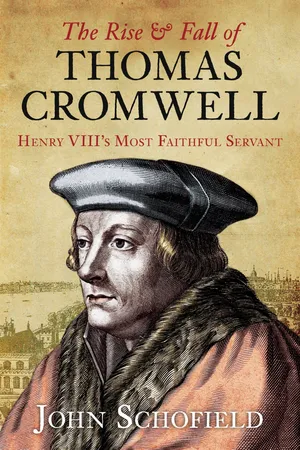
Thomas Cromwell was a man of humble origins and outstanding intellect who rose up to become Henry VIII's chief minister and right-hand man during the English Reformation. He wielded enormous power while he retained the king's favour, but the failure of Henry's marriage to Anne of Cleves, which Cromwell had arranged, led to his swift downfall and execution. In this biography, John Schofield reveals that the popular image of Cromwell as a blood-stained henchman is largely fictional. Detailed research into contemporary sources illuminates his brilliant mind and his love for and patronage of the arts and humanities, while short case studies shed new light on his relations with, and his reputation among, Henry VIII's subjects. In his conclusion, Schofield narrates the drama of Cromwell's downfall and highlights the king's posthumous exoneration of the 'most faithful servant he ever had'.
- 379 pages
- English
- ePUB (mobile friendly)
- Available on iOS & Android
eBook - ePub
About this book
Information
PART I
Rise to Power
1
In My Lord the Cardinal’s Service
Well might many a famous individual from the past, were he able to read history’s verdict on him, echo the cry of Shakespeare’s Cassio: ‘Reputation, reputation, reputation! I have lost my reputation’.1
In our times – despite the sterling labours of the late Professor G.R. Elton – the very mention of Thomas Cromwell’s name is likely to conjure up a baleful spectre in the minds of many. He was, we are repeatedly informed, the chief destroyer of a vibrant, idyllic English medieval church, the man who plundered the monasteries and consigned to oblivion centuries of pious, devotional tradition, imposing in its place an alien creed of justification by faith alone; the prime instigator and enforcer of harsh Tudor treason laws; a ruthless, sinister, unsmiling Machiavellian who cynically cut down Anne Boleyn and all others who dared oppose him, before finally receiving his much deserved deserts when he overreached himself and lured King Henry into an disastrously unsuitable marriage with Anne of Cleves.
I do not remember for sure what made me first begin to wonder whether all of this might be largely fanciful, and whether the real Thomas Cromwell, if only we could meet him and become better acquainted, might take on a less fearsome and altogether more agreeable aspect. It was not a craving to be novel just for the sake of it, but what began as no more than a hunch quickly developed into a conviction. Readers will be able to decide for themselves if they care to go down the same route.
Like many substantial and controversial men in history, only patchy details about Cromwell’s early life are known. The main sources are Eustace Chapuys, imperial ambassador to England during much of the 1530s; Reginald, later Cardinal Pole; Matteo Bandello, the Italian writer who became bishop of Agen in France; and John Foxe, the Elizabethan historian and martryologist. Of these four Chapuys knew Cromwell best, but even he is frustratingly brief. Cromwell, says Chapuys, was the ‘son of a poor blacksmith who lived and is buried at a small village’ near London. His uncle was cook to Archbishop Warham. In his youth Cromwell was somewhat ‘ill conditioned and wild’ (mal conditionné), and he spent some time in prison before travelling in Flanders, Rome and throughout Italy. The reason for the imprisonment is not stated.2
Reginald Pole also knew Cromwell personally, though not as well as Chapuys did. Pole confirms Cromwell’s birth near London, but calls his father a cloth shearer. Cromwell, Pole continues, then became a private soldier in Italy before pursuing a more secure, if less adventurous, way of life as an accountant in the service of a Venetian merchant.3
The Italian connection is taken up by Bandello, with his engaging story of the wealthy Florentine merchant, Francesco Frescobaldi, chancing one day to meet ‘a poor youth’ (un povero giovane) in the streets begging alms ‘for the love of God’. Seeing him ‘in a bad condition though gentle in appearance’ (mal in arnese e che in viso mostrava aver del gentile), Frescobaldi was moved to pity, especially when he learned that the youth hailed from England, a country he knew and loved. He asked him his name. ‘My name is Thomas Cromwell’, he replied, ‘the son of a poor cloth shearer’ (d’un povero cimatore di panni). He had escaped from the battle of Garigliano in Italy where he served as a page or servant to an infantryman, carrying his pike. Frescobaldi invited Master Cromwell into his house as his guest and offered him shelter, food and clothing. After a short stay he gave him money and a new horse. Thus refreshed and replenished, the grateful youth set out to return to England.4
These accounts complement rather than contradict each other, though with one interesting exception. Cromwell’s father was a ‘smith’ (Chapuys) but a ‘cloth shearer’ (Pole, Bandello). Foxe clarifies the matter with the information that Cromwell ‘was born in Putney or thereabouts, being a smith’s son, whose mother married afterwards to a shearman’. So the smith was Cromwell’s natural father and the shearman (or shearer) the step-father. Foxe gives no reason why his mother married again, but the only obvious one, unless the second marriage was illegal, is that his father, the smith, died shortly after Thomas was born. So it is not certain whether Cromwell was the name of the father or step-father.
Foxe also disagrees with Chapuys and Bandello on Cromwell’s youth. Bandello has Cromwell arriving in Italy after ‘fleeing from my father’ (che fuggendo da mio padre), which Foxe, in a curiously slanted translation, renders as ‘straying from my country’. Elsewhere Foxe, still on the subject of the young Cromwell, tells us that ‘a great delight came into his mind to stray into foreign countries, to see the world abroad and to learn experience’ – quite a different reason for leaving England than the one given by either Chapuys or Bandello. At first it seems that Foxe might have wanted to cover up the youthful waywardness of one of his greatest heroes. However, this explanation will not do, because later it is Foxe who tells us that Cromwell, as Wolsey’s agent, long before he became a Lutheran, was very active in procuring bulls and pardons from Rome. Foxe also quotes Cromwell telling Cranmer that he had been a bit of a ‘ruffian’ in his younger days, though Foxe includes this in his discussion of Cromwell’s pre-Protestant years, not his actual youth.5
Fortunately these small variations are not very important. They can easily be explained by the fact that none of these witnesses knew all the details of Cromwell’s birth and youth at first hand. Besides, no comprehensive records of births, marriages and deaths were kept until an act of parliament prepared by the adult Cromwell in 1538 required them.
According to Merriman, a certain Walter Cromwell was Thomas’s father. As Merriman notes, however, this name appears in records of antiquity from 1475 right up to 1514, so he could not have been the natural father, who, unless Foxe is greatly mistaken, must have died sometime before 1500. It is just as unlikely that Walter was the step-father, because he is described in the Close Rolls as a brewer of beer (‘berebruer’), not a shearer. He was also a man of some means. As well as his beer business he kept sheep and cattle, he became Constable of Putney in 1495, and he owned lands and property in Wimbledon. This information fits neither the description of Thomas’s father as a poor smith, nor his step-father as a poor shearer. Walter and Thomas Cromwell may have been related, but it is difficult to see how they could have been father and son.6
Cromwell’s mother came from Derbyshire or Staffordshire. Her maiden name may have been ‘Meverell’. According to Cromwell himself, in a conversation with Chapuys, she was fifty-two years old when he was born. The mother’s age suggests that Thomas was the youngest child and perhaps an unexpected one. If, therefore, the father died soon after the birth, and the mother married again to a shearer, as Foxe says, it is quite plausible that tensions soon arose between the poor shearer and his energetic and perhaps unruly stepson. A troubled and unhappy childhood, therefore, provided the impulse for the young Thomas to seek his fortune abroad.7
A sort of reverse reasoning dates Cromwell’s birth to around 1485. Time is needed for him to become old enough to do a spell in prison, as Chapuys says, before venturing out on his own. The battle of Garigliano was fought in late December 1503, so it would have been sometime the following year, maybe spring, before he could have reached Florence and met Frescobaldi. That would put him in his eighteenth year, still young enough to be called a ‘youth’.
The matter is, however, somewhat complicated by Stephen Vaughan, a close friend of the adult Cromwell, who knew him better than any of the witnesses named so far. In the middle of a long letter on various points, Vaughan urged Cromwell not to wear himself out through overwork, warning enigmatically that ‘half your years be spent’. This letter is dated December 1534. It is not clear how long Vaughan expected Cromwell to live. If he meant the biblical ‘three score years and ten … or four score years’ for those who have the strength (Psalm 90:10), then Cromwell would have been thirty-five or forty at the time. This gives two alternative dates for his birth – 1499 and 1494. The first is far too early for Garigliano in 1503, and even the second would make Cromwell only eight or nine when he fled from England and joined the French army. Vaughan may have meant Cromwell’s years of discretion, normally regarded as beginning at around the age of twelve, which would take us back to approximately 1485. However, it may well be that Vaughan was simply using a figure of speech, never imagining that anyone would try and calculate the time of Cromwell’s birth from it. As Vaughan merely blurs an already indistinct picture, the traditional date of 1485 should suffice until or unless some more positive evidence turns up.8
Nothing is known about Cromwell for some years after his meeting with Frescobaldi. However, despite the lack of a formal education, the adult Cromwell was a proficient linguist – he was fluent in French, Italian, Spanish, Latin and Greek – so it is likely that he travelled extensively across southern Europe. His adventures there remain a mystery.
Around 1510 it so happened that the town of Boston in England needed to renew two papal pardons, and one Geoffrey Chambers and a companion were sent as messengers to Rome with provisions and money. Chambers met Cromwell in Antwerp, and because Cromwell could speak Italian, he was persuaded to accompany the two Englishmen to the eternal city. At that time Cromwell had ‘no sound taste or judgement of religion’, sighed Foxe, the source for this story. Cromwell showed an inventive streak, however, in his plan to persuade Pope Julius to grant Boston’s requests speedily. Cromwell prepared ‘some fine dishes of jelly … made after our country manner here in England’; he then waited patiently until Julius returned from a hunting expedition before approaching him with presents and a ‘three man’s song’, again in the ‘English fashion’. The dainty jelly dishes so delighted the Vicar of Christ that he authorised the pardons with little more ado.9
By 1512 Thomas Cromwell, with mind broadened and horizons widened by his foreign travels, had settled in England. In November that year, in his new career as a lawyer, he endorsed a legal document entitling one Thomas Empson to lands. He had not given up his interest in commerce, however, and two years later he again paid a visit to the great trading city of Antwerp. Around this time he married Elizabeth Wykys, the daughter of a shearman, and apparently a fairly well-to-do shearman for she descended from an ancient family, one of whom had served as gentleman-usher to King Henry VII. Practically nothing is known about Cromwell’s marriage except that at least two daughters and one son survived infancy. Merriman’s idea that Cromwell married mainly for money is no more than an uncharitable guess, and there is no reason to doubt that Thomas and Elizabeth Cromwell were a happy couple.10
Possibly in 1514, definitely by 1516, Cromwell became part of Cardinal Wolsey’s household. He went to Rome a second time in 1517–18, again for rea...
Table of contents
- Cover
- Title
- Dedication
- Contents
- Preface
- Part I Rise to Power
- 1 In My Lord the Cardinal’s Service
- 2 To Make or Mar
- 3 The Lutheran
- 4 The King’s Councillor
- 5 Principal Secretary
- 6 Vicegerent
- Part II Cromwell and the Royal Ladies
- 7 Her Special Friend
- 8 In the Line of Duty
- 9 Around the Throne the Thunder Rolls
- 10 A New Queen of the Old Faith
- Part III The King’s Chief Minister
- 11 The Administrator
- 12 The Widows’ Helper
- 13 Patron and Persona
- Part IV How Have the Mighty Fallen
- 14 The Vicegerency in Eclipse
- 15 The Affairs of Kings
- 16 A Treacherous Place
- 17 The Pillar is Perished
- Epilogue
- Abbreviations
- List of Illustrations
- Bibliography
- Acknowledgements
- Plates
- Copyright
Trusted by 375,005 students
Access to over 1.5 million titles for a fair monthly price.
Study more efficiently using our study tools.
Frequently asked questions
Yes, you can cancel anytime from the Subscription tab in your account settings on the Perlego website. Your subscription will stay active until the end of your current billing period. Learn how to cancel your subscription
No, books cannot be downloaded as external files, such as PDFs, for use outside of Perlego. However, you can download books within the Perlego app for offline reading on mobile or tablet. Learn how to download books offline
Perlego offers two plans: Essential and Complete
- Essential is ideal for learners and professionals who enjoy exploring a wide range of subjects. Access the Essential Library with 800,000+ trusted titles and best-sellers across business, personal growth, and the humanities. Includes unlimited reading time and Standard Read Aloud voice.
- Complete: Perfect for advanced learners and researchers needing full, unrestricted access. Unlock 1.5M+ books across hundreds of subjects, including academic and specialized titles. The Complete Plan also includes advanced features like Premium Read Aloud and Research Assistant.
We are an online textbook subscription service, where you can get access to an entire online library for less than the price of a single book per month. With over 1.5 million books across 990+ topics, we’ve got you covered! Learn about our mission
Look out for the read-aloud symbol on your next book to see if you can listen to it. The read-aloud tool reads text aloud for you, highlighting the text as it is being read. You can pause it, speed it up and slow it down. Learn more about Read Aloud
Yes! You can use the Perlego app on both iOS and Android devices to read anytime, anywhere — even offline. Perfect for commutes or when you’re on the go.
Please note we cannot support devices running on iOS 13 and Android 7 or earlier. Learn more about using the app
Please note we cannot support devices running on iOS 13 and Android 7 or earlier. Learn more about using the app
Yes, you can access The Rise and Fall of Thomas Cromwell by John Schofield in PDF and/or ePUB format, as well as other popular books in History & Historical Biographies. We have over 1.5 million books available in our catalogue for you to explore.