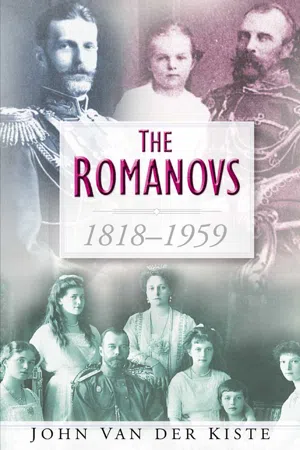
This work examines Alexander II's life and reign, and the lives of his children, including his successor Tsar Alexander III, whose determination to purge the empire of all terrorism and protect the autocracy brought more violence in its wake. It also recounts the lives of the Tsar's children.
- 288 pages
- English
- ePUB (mobile friendly)
- Available on iOS & Android
eBook - ePub
The Romanovs
About this book
Trusted by 375,005 students
Access to over 1.5 million titles for a fair monthly price.
Study more efficiently using our study tools.
Information
Tsar Alexander II,
1818–81
1
‘A naturalness which charms’
In June 1796 Grand Duke Nicholas Paulovich of Russia was born, the third son of Grand Duke Paul and his wife Grand Duchess Maria Feodorovna. The baby’s first few months coincided with the twilight era of his grandmother Empress Catherine II (‘Catherine the Great’), whose reign of forty-four years was drawing to a close. She died in November and was succeeded on the throne by Paul, her mentally unstable son, whose five years as Tsar ended with a palace revolution during which he was strangled. His successor was the eldest of his four sons, who reigned for twenty-four years as Alexander I. His marriage to Princess Elizabeth of Baden gave them no sons, and their daughters died in infancy. The second son, Constantine, had divorced his first wife and his second, morganatic, marriage was childless, while the youngest son, Michael, married in 1824 but his wife produced only two daughters.
On Nicholas, therefore, depended the survival of the Romanov dynasty. With two elder brothers he had never expected to succeed to the throne, and he grew up imagining that his role would be the traditional Grand Duke’s life of a soldier. In 1814 Nicholas and Michael passed through Berlin to join the Tsar’s military staff. En route they met the widower King Frederick William III of Prussia, and Nicholas was captivated by his hostess, the King’s daughter Charlotte; within a few months they were betrothed. When he returned to the Prussian capital for the engagement ceremony, she told him that he had come just in time to settle a most important question. The clocks of St Petersburg, she said, were three-quarters of an hour ahead of those of Berlin. Did the time go more quickly there? Gallantly he assured her ‘that time passes nowhere as fast as with you’. In July 1817 they were married at the Winter Palace, St Petersburg. The groom was aged twenty-one, while his bride celebrated her nineteenth birthday that same day.
Within weeks of their marriage Charlotte, now received into the Orthodox Church and given the names Alexandra Feodorovna, was expecting their first child. A son and heir was born to them in the Kremlin on 17/29 April 1818, during Holy Week. While noting in her journal that their happiness knew no bounds, the Grand Duchess could not but feel ‘slightly melancholy at the thought that the tiny helpless thing would one day have to ascend the throne’.1
Church bells throughout Moscow were ringing to celebrate Easter, and legend has it that as the child was born, a flock of white doves circled over the roof of the Chudov Monastery where imperial infants were traditionally christened, and where he was baptized a week later with the names Alexander Nicolaievitch. Even more poetically, observers spoke of seeing a rose-tinted cloud in the sky shaped like a diadem, similar to but richer than that of the imperial crown. Though there was surely some invention in these descriptions, to the superstitious they were good omens that the newly born Grand Duke would not merely ascend the imperial throne, but prove to be one of the most enlightened Russian monarchs of all.
The child destined to become Tsar, known by the family as ‘le petit Sasha’, spent his summers at Pavlovsk, a pleasant leafy suburb west of the capital, and winters at Anichkov Palace, St Petersburg. The parents were wise, affectionate and strict, bringing him up in spartan surroundings and a few austerely furnished rooms, with no public appearances. His grandmother the Dowager Empress was devoted to him, and for his first six years he was entrusted to the care of governesses. In 1824 a tutor, Colonel Karl Merder, took charge of his education. Merder’s first report to the parents found much to praise in his pupil, but also room for improvement. His Imperial Highness was ‘extremely well-mannered, thoughtful about the comfort of others, and deeply affectionate’. While quick at his lessons, he was ‘rather prone to tears and reluctant to struggle with the least difficulty’.2
In August 1819 the couple’s eldest daughter Marie was born. Their next child, a stillborn daughter, followed eleven months later. Four more Grand Duchesses followed at regular intervals: Olga, born in September 1822; another in November 1823 who only survived a few hours; Alexandra in June 1825; and Elizabeth in June 1826. By this time Tsar Alexander I had passed away. On his death on 19 November/1 December 1825, the correspondent of The Times observed that the Russian empire was in the strange position of having two self-denying Emperors and no active ruler.3 Constantine was officially Tsarevich, though he was content with his post as viceroy of Poland; he had long since made it clear that he had no desire to reign, and accordingly renounced his rights to the throne. Nicholas had sworn allegiance to Constantine as Tsar, and unlike their mother he seemed unaware or reluctant to believe his brother’s renunciation.
When news of Tsar Alexander I’s death reached Warsaw Constantine swore allegiance to Nicholas, while the latter led the imperial guard in taking an oath of loyalty to his brother. Only when he learned of a conspiracy in the army would he accept that Constantine’s renunciation was irrevocable, and that for the sake of the empire he must accept the crown. Groups of soldiers on the streets were calling for Constantine as Tsar, and though the rebellion had no proper leadership, Nicholas was aware of the risk of anarchy.
Early next morning troops and soldiers gathered at Senate Square. While disconcerted to learn that the senate had already sworn an oath of loyalty to Nicholas, they continued to demand Constantine as their Tsar. When Count Miloradovich, governor of St Petersburg, rode towards them to explain that Constantine had renounced the throne, and that he himself had seen the document of abdication, one of the ringleaders, Colonel Kakhovsky, who had sworn to kill Nicholas, shot the Count dead. Nicholas determined to meet the rebels face to face, and when officials nervously told him that several hundred officers were involved in the mutiny he brushed their protests aside, insisting that even if he was only to be Emperor for a day, he would show the world that he was worthy of the title. Riding into the square, he offered the rebels an amnesty if they promised to disperse. He did not wish to begin his reign with bloodshed, but the conspirators were in no mood for compromise. As dusk was falling, he realized that there was no alternative but to accept the advice of a general who told him to ‘sweep the square with gunfire or abdicate’. The guards fired, over sixty people were killed and several hundreds injured, and with that the Decembrist conspiracy was over. Kakhovsky and four other ringleaders were sentenced to death, and around three hundred were exiled to Siberia.
At the age of seven Grand Duke Alexander Nicolaievitch became Tsarevich. A second tutor, Vasili Zhukovsky, was chosen to assist Merder in sharing the responsibility of educating the heir. Zhukovsky, the illegitimate son of a landowner from the provinces and a teenage captive taken to Russia after one of the wars with Turkey, had become one of Russia’s leading poets, and was an imaginative, even radical choice. That his young charge grew up to be an enlightened monarch by Russian standards says much for the wisdom of his appointment.
Even before taking up the reins of office, he had not hesitated to risk imperial wrath by making plain his opinions of what he saw as the Tsarevich’s premature first taste of pomp and splendour. In accordance with imperial tradition he was appointed colonel-in-chief to some of his father’s guards regiments, although it was a token gesture and he did not appear in public with them. However he had been allowed to ride in his father’s coronation parade, much to the enthusiasm of the crowds, and the Tsar’s joy. Merder noticed that for some time afterwards Alexander was too excited to concentrate properly on his lessons. Bravely Zhukovsky warned the Empress that ‘an over-developed passion for the art of war – even if indulged in on parade ground, would cripple the soul and the mind’. It would never do for him to end up by ‘seeing his people as an immense regiment and his country as a barracks’.4 The Tsar was angry at first, but gave way when Zhukovsky threatened to resign.
Tsar Nicholas I was always a strict father, but when the cares of state permitted he enjoyed playing with the children in the privacy of their own home; and a regular routine enabled him to spend at least two hours with them every day. He rose early, worked on various tasks, and at 10 a.m. came to the Tsarina’s apartments, where he spent an hour breakfasting with his family and holding what he called ‘la revue de la famille’, at which he asked each of his children to present him with a report on how the previous day had been spent, and what progress they had made with their studies and other tasks. He examined their study books himself so he could watch their progress and comment on their shortcomings as necessary, often awarding punishments and rarely giving rewards. It was his responsibility, he considered, to be stern with them as he was founding a new dynasty and thus training a new generation of Russian leaders. However any demands imposed by duty were tempered by parental warmth. He dined daily at 4 p.m. with his wife, children, and a few close friends or counsellors. The meal lasted forty-five minutes, until he left to return to his work. In the evening they might gather again for readings or informal concerts, at which the Tsar sometimes played the cornet.
The Tsarevich spent winters at the grand forbidding Winter Palace, and summers at the more homely Tsarskoe-Selo. His leisure hours were spent playing with his sisters and some of the children of commoners approved by the Empress and invited by Merder. He had no separate household; four footmen performed all domestic duties, but there were no butlers or maids. His rooms were spartan, and the classrooms in both palaces had bare floorboards and no curtains; they were merely furnished with desks, benches and bookshelves. The less forbidding playroom had a carpet, curtains and a few upholstered chairs, but no sofa or armchairs. He slept on a narrow camp bed without a pillow. Food was very plain, comprising beetroot or cabbage soup, meat cooked without relishes, boiled fish, and fruit, with special delicacies only provided at birthdays, holidays and other celebrations. Discipline at table was strictly observed; he was expected to eat everything put in front of him, and requests for a second helping were discouraged. Guests were forbidden to address the heir to the throne as ‘Highness’ or anything of the kind, while servants must always be treated with courtesy, and footmen were not to obey his commands or orders unless they were prefaced with ‘please’.
This spartan upbringing often surprised foreign observers. When the French ambassador, le Duc de Dagouse, expected to be presented automatically to the heir after a formal audience with the Tsar in the throne room of the Winter Palace, no ceremony was suggested. He decided to ask the Tsar, who replied he would meet all the children later, probably in the park at Tsarskoe-Selo. A formal presentation would never do, as the heir would get a swollen head if an experienced and famous general was to pay him homage; ‘Before everything else I am determined to have him brought up as a man.’5 In time the Duke met Alexander and his little sisters in the park at Tsarskoe-Selo, and they invited him to cross to the children’s island where they had planted all the trees and shrubs. He was enchanted by the simplicity of their miniature world and playground with its brightly painted seesaw, miniature kitchen garden, and the meal they served him of wild strawberries, lettuce and young carrots with wheat rusks served on limewood platters, with milk served in thick earthenware mugs.
From his mother, who maintained close ties with her family in Berlin, the Tsarevich inherited and retained a strong affection for Prussian ways. At the age of eleven he paid his first visit to the capital, which he enjoyed despite confessing to Merder that he often felt homesick. His maternal grandfather, King Frederick William III, had appointed him colonel-in-chief of the Third Prussian Uhlan Regiment, and until the end of his visit he refused to appear in anything except the regimental uniform. From that year he attended the annual cadet camps organized under his father’s personal supervision. Every Christmas his presents were of a suitably warlike nature; in 1831 they included a bust of Peter the Great, a rifle, sword, box of pistols, parade uniform, and a set of china cups and saucers showing Russian soldiers with different arms.
While Tsar Nicholas I was very much the model of a nineteenth-century autocrat, he was prepared – if not without persuasion, sometimes against his better judgment – to allow his eldest son a relatively liberal education. Zhukovsky devised a curriculum for him whereby two young companions would share a structured school environment. They were kept away from court life and pageantry, and brought up very simply. Competition between the boys was frowned on, they were encouraged to discuss their reading and learning together, and to keep private journals. History and languages formed the core of their early studies, followed later by science, law and philosophy. As a prize for good behaviour they were allowed to put money in the poor box. The military aspect was not dispensed with entirely, but kept in perspective, with occasional drill. Sport was represented by fencing, gymnastics and riding, and every Sunday they had outings or took up handicrafts instead of formal lessons.
From boyhood Alexander was unfailingly polite, honest, keen to learn though only of average ability, sensitive and often dreamy, with a tendency to be mischievous and mentally lazy. His tutors found him emotional, erratic in his attention to studies, and often vague or hesitant when faced with difficulties; he would make an inordinate fuss about trifling problems, or cry for no obvious reason. They suspected that the unsettling circumstances of his father’s accession had left him with a lasting dread of his future inheritance. When at last a brother Constantine was born in September 1827 he was relieved, as ‘Papa will be able to choose him as the Heir’.6
Like most small boys, he preferred outdoor life to lessons. While he was fond of parades, reviews and uniforms, the more serious military aspects aroused no interest in him. When he went to camp at Krasnoe and took part in army manoeuvres for the first time in the summer of 1829, his father was concerned at an evident lack of enthusiasm, and angry with the tutors when they defended what he regarded as an imbalance in his education; he wanted more emphasis placed on military sciences. Merder was left in no doubt that Grand Dukes were meant to be soldiers first and foremost. The next Emperor, in particular, must be raised as a potential war leader, and His Majesty had no wish to see him brought up in a civilian atmosphere as if he was only fit for a professor’s chair. Ironically all his younger sons showed a taste for the services; Constantine joined the Russian navy, Nicholas (born 1831) the military engineers, and Michael (born 1832) the artillery regiment. Merder knew better than to argue with his master, but as a born soldier himself with a better appreciation of human character, he saw that Grand Duke Alexander found the whole idea of war evil and abhorrent, and such a conviction formed in boyhood could not be eradicated by anything the tutors might say or do.
Little acts of kindness testified to his endearingly selfless character. On a walk with Merder along the St Petersburg canal one afternoon, the boy looked at one of the barges moored to the quay and saw an old workman on a filthy mat, groaning and shaking. He rushed across a plank, went to talk to the man, and by the time Merder caught up with them he saw his charge wiping away the old man’s tears with a handkerchief. Touched by this solicitude, Merder handed the Tsarevich a gold coin from his purse, and without hesitation the boy gave it to the old man.
In the autumn of 1829 ‘the little school’ was resumed at the Winter Palace in St Petersburg. Alexander spent Sunday afternoons and evenings with his sisters in their mother’s private apartments, and Zhukovsky and Merder were asked to join them ‘for a little music and tea’ in the evenings. These invitations became less frequent and gradually ceased, and at Christmas presents were given with icy formality. Zhukovsky sensed that he was out of favour, and the household thought he would soon be dismissed. By March 1830 he could bear the tension no longer, and unburdened himself in a lengthy heartfelt letter to the Tsar. He could not afford to be kept in suspense any longer, he said, but felt that he was being accused of ‘unworthy and interested interference in literary quarrels now going on in St Petersburg’, and he could not continue in his post as tutor unless ‘reassured of your Majesty’s trust in my fitness to educate your son’.7 What had happened was that a third-rate novelist, Bulgarin, liked by the Tsar as he never gave the censors any trouble, had many friends at the court of St Petersburg. One of his novels had been mocked in an epigram by the radical poet Pushkin, a close friend of Zhukovsky, and subsequent gossip led to unsubstantiated allegations of disloyalty against Zhukovsky. However his letter cleared the air and the Tsar readily forgave him, telling him that the incident should be forgotten.
It was not the last time that there would be disagreement between the Tsar and his son’s tutors. Two years later Zhukovsky left for Baden to undergo a cure for his bronchial trouble. Before doing so he recommended two further tutors for the Tsarevich, Peter Pletnev for Russian literature, and Professor Constantine Arseniev for history. The former was readily accepted, but not so Arseniev, who had been dismissed from his chair at the university a few years earlier for speaking against corruption in the judicial system and on behalf of free labour. Zhukovsky stood his ground against the Tsar’s wrath, emphasizing the professor’s merits as a historian and tutor, and insisting that nobody else in Russia was more suited to give His Imperial Highness a thorough course in the science of government. As for his rebellious past, Zhukovsky answered that loyalty and flattery were not synonymous; there were countless grave defects in their judicial system, and the Grand Duke was reaching an age when the truth could no longer be concealed from him. The Tsar gave in, but made his point after Zhukovsky had gone abroad by dismissing Father Pavsky, a favourite religious teacher known for his outspoken liberal beliefs, for an isolated comment of sympathy with Russian dissenters. Merder interceded on Pavsky’s behalf, to be told by the Tsar that he found the dismissal necessary; his son showed too little interest in military matters, and he was still determined that the boy should be a soldier at heart. Yet the Tsarevich took it badly, misbehaving in class, quarrelling and disobeying his tutors, fighting with his companions, and showing a tendency to arrogance.
When Merder suffered a mild heart attack in the summer of 1832 after a particularly trying week in which Alexander had been more unruly than ever, Arseniev unkindly told him that he was responsible. He promptly broke down in tears, promising to behave better in future, and kept his word. When Merder was better the Tsarevich visited him regularly at home, and when he went abroad on medical advice, wrote to him once a week.
In 1834 the Tsarevich celebrated his sixteenth birthday, and the coming of age ceremonies included taking an oath of allegiance and solemn obedience to his father and to the laws of the empire. The ceremony took place in the Winter Palace before a congregation of court...
Table of contents
- Cover
- Half Title
- Dedication
- Title
- Copyright
- Contents
- Preface
- Part I: Tsar Alexander II, 1818–81
- Part II: Tsar Alexander III, 1881–94
- Part III: Tsar Nicholas 11 and after, 1849–1959
- Postscript
- Tsar Alexander II’s Children and Grandchildren
- Reference Notes
- Bibliography
Frequently asked questions
Yes, you can cancel anytime from the Subscription tab in your account settings on the Perlego website. Your subscription will stay active until the end of your current billing period. Learn how to cancel your subscription
No, books cannot be downloaded as external files, such as PDFs, for use outside of Perlego. However, you can download books within the Perlego app for offline reading on mobile or tablet. Learn how to download books offline
Perlego offers two plans: Essential and Complete
- Essential is ideal for learners and professionals who enjoy exploring a wide range of subjects. Access the Essential Library with 800,000+ trusted titles and best-sellers across business, personal growth, and the humanities. Includes unlimited reading time and Standard Read Aloud voice.
- Complete: Perfect for advanced learners and researchers needing full, unrestricted access. Unlock 1.5M+ books across hundreds of subjects, including academic and specialized titles. The Complete Plan also includes advanced features like Premium Read Aloud and Research Assistant.
We are an online textbook subscription service, where you can get access to an entire online library for less than the price of a single book per month. With over 1.5 million books across 990+ topics, we’ve got you covered! Learn about our mission
Look out for the read-aloud symbol on your next book to see if you can listen to it. The read-aloud tool reads text aloud for you, highlighting the text as it is being read. You can pause it, speed it up and slow it down. Learn more about Read Aloud
Yes! You can use the Perlego app on both iOS and Android devices to read anytime, anywhere — even offline. Perfect for commutes or when you’re on the go.
Please note we cannot support devices running on iOS 13 and Android 7 or earlier. Learn more about using the app
Please note we cannot support devices running on iOS 13 and Android 7 or earlier. Learn more about using the app
Yes, you can access The Romanovs by John van der Kiste,John Van der Kiste in PDF and/or ePUB format, as well as other popular books in History & Historical Biographies. We have over 1.5 million books available in our catalogue for you to explore.