- 128 pages
- English
- ePUB (mobile friendly)
- Available on iOS & Android
eBook - ePub
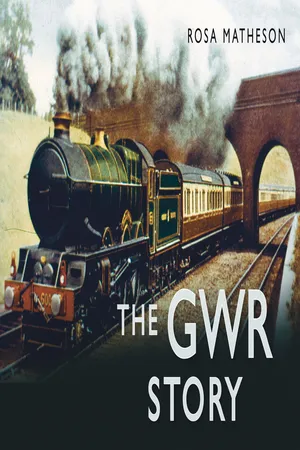
The GWR Story
About this book
The Great Western Railway – quickly coming to be known as 'God's Wonderful Railway' – was once regarded as the most advanced in the world. Engineered by Isambard Kingdom Brunel it was initially designed to connect Bristol to London and came to develop a distinct character all of its own, one of the many reasons why it remains a much-loved and popular area of interest.
This book traces its history covering topics such as the company, its engines and carriages, its engineers – including Gooch, Dean, Armstrong, Collett, Churchward and of course Brunel – as well as the battle of the gauges. Full of little-known facts and figures and with numerous photographs and memorabilia as well as a timeline, it is a tale full of record breakers and mighty achievements waiting to be retold to a modern age.
Information
Subtopic
EisenbahnverkehrTIMELINE AND MILESTONES
1833
(21 January) Business men of Bristol meet to discuss possibility of a Bristol to London Railroad
(7 March) Isambard Kingdom Brunel appointed as engineer to survey the route.
(19 August) First joint meeting of Bristol and London Committees. Title ‘Great Western Railway’ adopted.
1834
(25 July) GWR Bill rejected on grounds of ‘insufficient means’. New prospectus issued to raise more funds.
1835
(31 August) Great Western Railway Act passed by Parliament. This does not stipulate the gauge width!
(29 October) Birth of the broad gauge. Directors resolved that ‘the embankments, bridges and other works to be constructed of such dimensions as to admit rails being laid to the extreme width proposed by Mr Brunel, viz., 7ft’ (¼ inch added for expansion).
1836
Work commenced.
1837
(18 August) Daniel Gooch appointed Locomotive Superintendent.
1838
First GWR train ran as a ‘Director’s Special’, hauled by the engine North Star.
1839
(1 July) Maidenhead–Twyford section opened.
1840
Much of the line completed, only Swindon–Bath section remaining.
(16 December) line reached Swindon.
1841
(30 June) London-Bristol line fully opened. First train ran from Paddington to Bristol in 4 hours. Network had 170 miles of broad gauge track.
1843
(2 January) Swindon Works opened for business.
Brunel’s great iron ship SS Great Britain launched in Bristol.
1845
‘Break of Gauge’ controversy instigates Gauge Commission.
1846
(February) First complete engine to be built by the company – Great Western – completed.
Gauge Commission finds in favour of the ‘narrow’ gauge 4ft 8 ½ins. This becomes the ‘standard’ gauge for all new railways.
1847
GWR Medical Fund Society started in Swindon.
1848
(14 June) Swindon Works ‘Trip’ commenced.
1854
GWR absorb the Shrewsbury & Chester Railway, acquiring standard gauge locomotives and rolling stock.
1855
First ‘narrow’ gauge locomotive built at Swindon.
First ‘Special Postal’ train run by GWR.
1859
(2 May) Royal Albert Bridge at Saltash, designed by Brunel, is opened.
1866
(November) Daniel Gooch becomes Chairman of the Board.
1871
Powers granted by Parliament for GWR to operate ships.
1874
Work begins on the Severn Tunnel
1875
The vacuum brake employed on passenger rolling stock. This was a safety system that applied a train’s brakes if it passed a danger signal.
1877
Last broad gauge branch line opened to St Ives.
1886
The Severn Tunnel opens – Britain’s longest underwater mainline tunnel.
1892
First corridor train with toilet facilities runs.
(21–22 May) Last of the broad gauge changed to standard gauge.
1895
Compulsory ten-minute stop at Swindon Station ended when GWR bought back the catering concession.
1903
(10 March) First non-stop run between Paddington and Plymouth via Bristol with the Royal Special.
(17 August) Start of GWR's own road motor services.
1904
City of Truro becomes first locomotive in the world to reach 100mph.
1906
First use of ‘Automatic Train Control’ (ATC) during trials on the Henley branch line. Further trials carried out in 1908 (Paddington–Reading) and in 1909, after satisfactory trials on Lambourn section the GWR gave the go-ahead to introduce it throughout the system.
(17 March) Old Oak Common locomotive shed opened.
1914
(4 August) War declared. Government takes control of the railways.
1923
(1 January) All the railways are grouped into the ‘Big Four’. The GWR was the only company to keep its own name and structure.
1933
(12 April) Introduction of air services from Cardiff to Torquay and Plymouth.
(4 December) GWR pioneered the use of diesel traction in the UK and introduced it in their fast railcars.
1934
(July) Introduction of the new GWR roundel.
1935
(31 August) GWR Centenary.
Introduction of ‘The Bristolian’.
1939
The Second World War begins – Government takes control of railways again.
1946
The first oil-fired GWR locomotive appears and trials begin on gas-turbine propulsion.
1948
(1 January) Nationalisation of British railways.
(5 March) Last Board meeting of the Great Western Railway Company.
Table of contents
- Cover
- Title
- Copyright
- Contents
- Acknowledgements and Introduction
- The Company
- The ‘Battle of the Gauges’
- Great Western Railwaymen
- ‘7 Wonders’ of the Great Western Railway
- ‘Firsts’ and ‘Record Breakers’
- Shipping Services
- Timeline and Milestones
- Sources
Trusted by 375,005 students
Access to over 1.5 million titles for a fair monthly price.
Study more efficiently using our study tools.
Frequently asked questions
Yes, you can cancel anytime from the Subscription tab in your account settings on the Perlego website. Your subscription will stay active until the end of your current billing period. Learn how to cancel your subscription
No, books cannot be downloaded as external files, such as PDFs, for use outside of Perlego. However, you can download books within the Perlego app for offline reading on mobile or tablet. Learn how to download books offline
Perlego offers two plans: Essential and Complete
- Essential is ideal for learners and professionals who enjoy exploring a wide range of subjects. Access the Essential Library with 800,000+ trusted titles and best-sellers across business, personal growth, and the humanities. Includes unlimited reading time and Standard Read Aloud voice.
- Complete: Perfect for advanced learners and researchers needing full, unrestricted access. Unlock 1.5M+ books across hundreds of subjects, including academic and specialized titles. The Complete Plan also includes advanced features like Premium Read Aloud and Research Assistant.
We are an online textbook subscription service, where you can get access to an entire online library for less than the price of a single book per month. With over 1.5 million books across 990+ topics, we’ve got you covered! Learn about our mission
Look out for the read-aloud symbol on your next book to see if you can listen to it. The read-aloud tool reads text aloud for you, highlighting the text as it is being read. You can pause it, speed it up and slow it down. Learn more about Read Aloud
Yes! You can use the Perlego app on both iOS and Android devices to read anytime, anywhere — even offline. Perfect for commutes or when you’re on the go.
Please note we cannot support devices running on iOS 13 and Android 7 or earlier. Learn more about using the app
Please note we cannot support devices running on iOS 13 and Android 7 or earlier. Learn more about using the app
Yes, you can access The GWR Story by Rosa Matheson in PDF and/or ePUB format, as well as other popular books in Technik & Maschinenbau & Eisenbahnverkehr. We have over 1.5 million books available in our catalogue for you to explore.