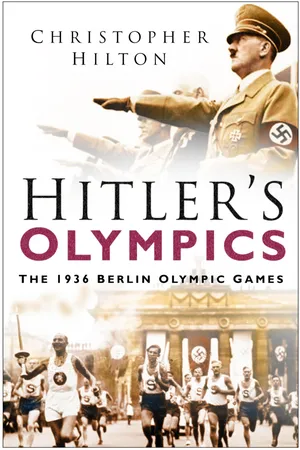
The Berlin Olympic Games, more than 70 years on, remain the most controversial ever held. This book creates a vivid account of the disputes, the personalities, and the events which made these Games so memorable. Ironically, the choice of Germany as the host nation for the 1936 Olympics was intended to signal its return to the world community after defeat in World War I. In actuality, Hitler intended the Berlin Games to be an advertisement for Germany as he was creating it, and they became one of the largest propaganda exercises in history. Two Germans Jews competed in the Games while the most memorable achievement was that of black American Jesse Owens, who won four gold medals. Ultimately, however, Germany was the overall biggest medal winner. The popular success of Owens allowed the Nazis to claim that their policies had no racial element and charges of antisemitism that did arise were levelled at the Americans.
- 336 pages
- English
- ePUB (mobile friendly)
- Available on iOS & Android
eBook - ePub
About this book
Information
Topic
HistoireSubtopic
Histoire du mondeChapter 1
MAN AT THE CENTRE OF THE WORLD
The German nation … provided the world with … its willingness to co-operate in large international projects designed to further universal peace.
Josef Goebbels1
That August day the city of heavy stone, the city with its new god, waited. A million people, held back by 40,000 storm troopers,2 stood twenty and thirty deep all along the 3-mile route. Each of them knew he would be coming in a moment from the enclosed Chancellory courtyard.
At the far end of that courtyard two statues of heroic naked men, one symbolising the Party and the other the armed forces, guarded shallow steps up to the Chancellory entrance. An open-topped Mercedes waited there. Two bodyguards in dark uniforms sat on the rear seat, motionless.
He wore military uniform, knee-length leather boots and the peaked cap designed for him. He wore a golden Party badge and his prized military medal, an Iron Cross.3 As he moved briskly down the steps, the Mercedes door swung open and he stepped in. He stood and remained standing. He knew the power of his physical presence over the millions and as he passed they would all see him, feel that power. The Mercedes moved off towards the courtyard’s double doors at the instant the timetable decreed it should: 3.18 p.m.
A little drizzle had fallen from an overcast sky and, as the Mercedes emerged and turned into Wilhelmstrasse, the road glistened. Four similar Mercedes with more bodyguards followed, making a convoy with a symmetry and a power of its own. The timetable decreed that the journey from here to the great amphitheatre last 32 minutes.
At the intersection with Unter den Linden, a wide thoroughfare whose buildings were draped with flags, the convoy turned left. The lime trees populating the central area between two carriageways had been replaced by swastikas 45 feet high. The crowd began cheering and, in great ripples, gave the stiff-arm Nazi salute. Along the 3 miles a voice echoed from loud speakers set at regular intervals ‘He is coming, He is coming’.
The convoy glided through the Brandenburg Gate, with its statue of a horseman on top, and was out onto the long avenue which stretched – rigid as a backbone, straight as a rod – away through wooded parkland. The avenue was so long it changed names several times, but people called it collectively the Via Triumphalis. It continued to the suburb of Charlottenburg and the amphitheatre.
Every moment brought him closer, every moment the ripple of cheering and saluting travelled with him, and from above the voice echoed ‘He is coming now, He is coming now’.
At 3.45 p.m. the amphitheatre gates closed; there were 100,000 inside.
At Charlottenburg the convoy turned off the avenue, moved towards a platz – deep crowds circling it – and the entrance. The convoy halted, he stepped down at 3.50 p.m. and passed through the entrance: an opened gate. He inspected a battalion of honour, walked briskly under a tall bell tower, passed four field guns ready to fire a salute and onto a vast field of manicured grass. The amphitheatre loomed at the far side of the field.
Two rows of dignitaries and officials waited for him and as he reached them a fanfare sounded in the distance. Now he faced a multicoloured panorama of some four thousand people arranged by nationality, half to one side of the field, half to the other. Some had spent weeks travelling half the world to be here. Some had come an exhausting journey by train, others caught trains quite normally. Some were in large groups, some came as individuals. Some brought pageantry with them: straw hats, naval caps, turbans, blue berets.
At 3.56 p.m. he walked briskly between them. He had 4 minutes to reach the amphitheatre. As he went, the dignitaries – military officers among them – fell in behind him, were towed along in his wake.
Two heroic statues of men holding horses guarded the amphitheatre entrance. Nearby young people in shorts, perhaps a thousand of them, jostled for their glimpse and raised their arms stiff in the salute.
He walked past a stone buttress with a huge iron tripod and crucible on it that would receive the sacred flame. As he descended stone steps, tier after tier of the 100,000 were on their feet raising a forest of arms in another ripple.
He crossed the reddish running track onto the circular grass of the infield. A tiny girl in white proferred a bouquet of flowers. He patted her, accepted it and reflexively she stepped back, gave the salute. He recrossed the track and at 4.05 p.m., as the timetable decreed, ascended to his private box cut into one of the tiers.
He had come.
The rest would be anthems and triumphal music, the hoisting of flags, the tolling of the bell, the march past of the nations who’d waited outside – programmed to last 46 minutes – and speeches.
Then he stood at the centre of the world for the first time in his life.
He held himself erect and said ‘I hereby proclaim open the Olympic Games of Berlin celebrating the Eleventh Olympiad of the modern era’.
The field guns fired, a great host of pigeons representing doves of peace swarmed into the overcast sky and at 5.20 p.m. a runner bearing a torch with the sacred flame entered the amphitheatre, padded towards the stone buttress and the crucible.
The runner lit it.
The most controversial sporting event in history had begun.
Notes
1. The XIth Olympic Games, Berlin, 1936 Official Report.
2. Hitler had his own army, Sturmabteilung (Storm Section). They were also known as the storm troopers and Brown Shirts.
3. Paul Yogi Mayer, Jews and the Olympic Games (London, Vallentine Mitchell, 2004), p. 102. Hitler won the Iron Cross, Germany’s highest award for bravery, during the First World War.
Chapter 2
POISONED CHALICE
The German sports authorities have declared their intention of promoting the racial and anti-Semitic, the pagan and anti-Christian and other political policies of the German Government and the Nazi party … in the selection of the German Olympic team.
American Athletic Union resolution, 1935
In May 1930 people could still speak the language of reason and normality. Adolf Hitler was nowhere near power and nobody except perhaps the man himself could imagine what he would really do if he got it. That month, to emphasise the normality, his autobiography Mein Kampf came out in a new English edition with all the profits going to the British Red Cross Society. That month, too, one of the regular Olympic Congresses met in the principal auditorium of Berlin University, giving the city a chance to lobby for the 1936 Games – the 1932 Games were already allocated to Los Angeles. The Congress comprised a wide group invited by the International Olympic Committee (IOC), the movement’s governing body, and played a consultative role.
The city hosted a banquet in the town hall for Congress members and, there, the Municipal Corporation joined the application, as required by the Olympic Statutes.
The whole impetus created a favourable impression, enhanced by a glimpse of scale and efficiency: 2,000 rowing boats formed a procession on the proposed Olympic course. When the IOC met next, in April 1931 in Barcelona, the application would almost certainly be a formality and the Berlin bidders felt so confident they began to draw up plans to remodel the stadium they already had. They appointed an architect, Werner March, to work on it.
Far from being a controversial choice Berlin seemed a normal continuation of the great tradition stretching back into the very mists of time. Some historians dated the ancient Games to 900 BC, others claimed evidence taking it back several centuries further. Everybody agreed they lasted until AD 393 when the Roman emperor Theodosius banned them because winning had become paramount, inviting professionalism and corruption.
The Olympic idea did not die but remained dormant. In the nineteenth century various sports festivals around Europe included one at Much Wenlock, the scenic town in the English county of Shropshire. There a Dr William Penney Brookes founded an Olympic society in 1850 and campaigned for the Games to be reinstated.
In 1889 the French government wanted to study physical culture, and an all-round sportsman called Pierre Frédy, titled baron de Coubertin, became actively involved. He was already engaged on reforming the French educational system and believed passionately in the virtues of fitness and sport. De Coubertin went on a world tour to see what was happening elsewhere and, towards the end of it, met Brookes. The meeting seems to have been genuinely inspirational.
In 1892, during a lecture at the Sorbonne in Paris, de Coubertin put forward the idea of reinstating the Games and two years later he founded the IOC. He would be its president for four decades. The first Games of the modern era were held in 1896, appropriately at Athens, and thirteen countries sent 311 competitors.
Obeying the original four-year cycle, the next Games went to Paris in 1900 (twenty-two countries, 1,330 competitors) and women competed for the first time, in tennis and golf. St Louis, Missouri proved too far for many to travel (back to thirteen countries and 625 competitors), but the movement grew via Athens in 1906 (breaking and reinvigorating the cycle), London in 1908 and Stockholm in 1912. The 1916 Games were to have been in Berlin but the long shadows of the First World War crept across the Continent. De Coubertin and the IOC harboured the notion that having the Games might persuade the German people towards peace rather than alienate them: Germany, an Olympic stalwart, had sent teams to every Games from their reinstatement. Even when the First World War broke out in 1914, planning continued, no ...
Table of contents
- Cover
- Title
- Acknowledgements
- Maps
- Contents
- Chapter 1 Man at the Centre of the World
- Chapter 2 Poisoned Chalice
- Chapter 3 No Jews or Dogs Allowed
- Chapter 4 Stormy Waters
- Chapter 5 Light My Fire
- Chapter 6 War Games
- Chapter 7 The Führer and the Runner
- Chapter 8 Bitter Taste
- Chapter 9 Last Shot Fired
- Chapter 10 Village People
- Statistics
- Bibliography
- About the Author
- Copyright
Trusted by 375,005 students
Access to over 1.5 million titles for a fair monthly price.
Study more efficiently using our study tools.
Frequently asked questions
Yes, you can cancel anytime from the Subscription tab in your account settings on the Perlego website. Your subscription will stay active until the end of your current billing period. Learn how to cancel your subscription
No, books cannot be downloaded as external files, such as PDFs, for use outside of Perlego. However, you can download books within the Perlego app for offline reading on mobile or tablet. Learn how to download books offline
Perlego offers two plans: Essential and Complete
- Essential is ideal for learners and professionals who enjoy exploring a wide range of subjects. Access the Essential Library with 800,000+ trusted titles and best-sellers across business, personal growth, and the humanities. Includes unlimited reading time and Standard Read Aloud voice.
- Complete: Perfect for advanced learners and researchers needing full, unrestricted access. Unlock 1.5M+ books across hundreds of subjects, including academic and specialized titles. The Complete Plan also includes advanced features like Premium Read Aloud and Research Assistant.
We are an online textbook subscription service, where you can get access to an entire online library for less than the price of a single book per month. With over 1.5 million books across 990+ topics, we’ve got you covered! Learn about our mission
Look out for the read-aloud symbol on your next book to see if you can listen to it. The read-aloud tool reads text aloud for you, highlighting the text as it is being read. You can pause it, speed it up and slow it down. Learn more about Read Aloud
Yes! You can use the Perlego app on both iOS and Android devices to read anytime, anywhere — even offline. Perfect for commutes or when you’re on the go.
Please note we cannot support devices running on iOS 13 and Android 7 or earlier. Learn more about using the app
Please note we cannot support devices running on iOS 13 and Android 7 or earlier. Learn more about using the app
Yes, you can access Hitler's Olympics by Christopher Hilton in PDF and/or ePUB format, as well as other popular books in Histoire & Histoire du monde. We have over 1.5 million books available in our catalogue for you to explore.