History of the Kitchen.
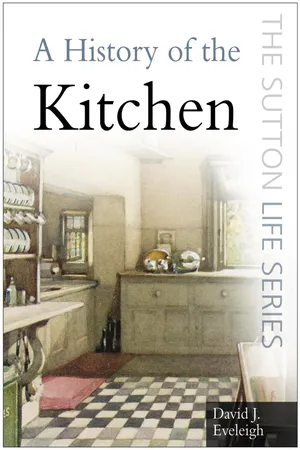
- 96 pages
- English
- ePUB (mobile friendly)
- Available on iOS & Android
eBook - ePub
A History of the Kitchen
About this book
Trusted by 375,005 students
Access to over 1.5 million titles for a fair monthly price.
Study more efficiently using our study tools.
Information
CHAPTER 1
Farmhouse and Cottage Kitchens, 1600 to the present day
The farmhouse kitchen has long held a fascination for those searching for traditional values and ways of life. In 1792, Arthur Young (1741-1820), agriculturalist, traveller and writer, wrote with affection of the kitchens of substantial farmers in Suffolk and the ‘central counties’. ‘A large, roomy clean kitchen’, he wrote, ‘with a rouzing wood fire on the hearth and the ceiling well hung with smoaked bacon and hams’. Young’s ideal conveyed a way of living untouched by pretension and modern fads - of rustic simplicity – plain manners and plain but wholesome food. Farmhouse kitchens were cosy, comfortable and convivial. They inspired writers such as Gertrude Jekyll (1843-1932) and artists like Frederick Daniel Hardy (1826-1911) and Helen Allingham (1848-1926) who found in their interiors much which was picturesque - and without artifice - in good taste. For these and other admirers, the same timeless atmosphere could be found in the cottages of the better-off sort of rural labourer and the kitchens of old country inns.
In remote rural locations, farmhouse, cottage and country inn kitchens maintained and preserved traditional ways of doing things. Some proved remarkably resistant to change: as recently as the 1950s, it was possible to enter the kitchens of some farmhouses in Devon and, in effect, step back two or three hundred years. Their large open fireplaces with pots hanging over an open fire would have been familiar to a seventeenth century Devon farmer and his family. As early as the 1780s, rural kitchens could appear decidedly old fashioned. Staying overnight in the ‘Red Lion’ in Bodiam on 17 August 1788, John Byng (1743-1813) observed that the inns of rural Kent still cooked over wood fires, noting in his diary that, ‘a common cook here would not know how to manage a coal fire’. Inevitably, farmhouse and cottage kitchens were subject to change, however subtle and gradual. When Arthur Young was writing in the 1790s, his ideal farm kitchen was already under siege, at least in those prosperous southern and midland counties. He and other rural commentators like William Cobbett (1762-1835), the son of a Surrey farmer, wanted to see farmers and their families living in the kitchen and rubbing shoulders with their farm servants and outdoor workers. But the prosperous farmer – socially aware and ambitious – was turning his back on the kitchen and retiring to a more private parlour or drawing room furnished like any of a well-to-do town dweller with upholstered furniture, carpets and worst of all, a piano!
As Arthur Young had observed, farmhouse kitchens were generally spacious. The kitchen at Unstead Farm, Godalming, Surrey, described by Gertrude Jekyll in 1940, was thirty feet long and twenty feet wide, with a low ceiling and paved with stone slabs. One was deeply cut with a large ‘W’ and marked the position of the well ten feet deep. A water supply, of course, was vital to the running of any kitchen but the sink and pump, which drew water from a shallow well, was more usually found located in a back kitchen or scullery.
The kitchen was the hub of the farmhouse: here the preparation and cooking of meals went on side by side with every day family life. Drawing on her late Victorian childhood in Castle Top Farm near Cromford, Derbyshire, Alison Uttley (1884-1976) wrote in ‘The Country Child’ of the farm kitchen as, ‘the heart of the house…full of doors and windows and old oak and people going to and fro’. Essential kitchen equipment and furniture was frequently jumbled up with working tools from the farm. A valuation of the furniture at Hallen Farm, near Henbury, Gloucestershire, made in March 1870, records such a seemingly random assortment. It included two ‘elbow wood seat chairs’, a dining table, a mahogany bureau, an oak oval table, a weather glass, a settle, coal box, paraffin lamp, two saws, a steel yard and pestle and mortar. There were also two clotheshorses and a ‘wash trough’. By this date much country and kitchen furniture was made of deal, replacing the native hardwoods – oak, elm, ash and beech - traditionally favoured by the village joiner.
At Unstead Farm in 1904, a long table of deal, eleven feet five inches long and two and a half feet wide, ran down the middle of the room. Dressers were found in farmhouses from the seventeenth century and made of oak or elm although nineteenth century examples were more likely to be made of deal or pine and painted or grained. Some dressers were built in as fixtures but many were moveable pieces of furniture. Alison Uttley’s were of oak and consisted of ‘shining brasses and beeswaxed sides and drawers with their own distinctive names’. The shelves above were filled with a dinner service, jugs of various kinds and a set of graduated dish covers. Other typical pieces of furniture included corner cupboards and bread creels or bacon racks suspended from the ceiling.
Most farmhouse and cottage kitchens were furnished with a clock. When the stock and effects of Mr Cripp’s farm at Bierton, near Aylesbury, was sold by auction in August 1796, the kitchen furniture included a thirty hour clock in a ‘wainscot case’ whilst the kitchen at Hallen Farm in 1870 contained an eight day clock. At the ‘Bell Inn’, in Aldworth on the Berkshire Downs, a long case clock with a brass dial and a ‘bull’s eye’ glass showing the pendulum is fixed between two settles beside the large kitchen fireplace. The clock was made by a Reading maker, Ian Hocker, about 1760 and has quietly ticked away in the corner of this public house ever since.
Standing in front of the hearth, the settle served as a seat, a draught screen and store; many settles had cupboards in the back in which hams were hung and lockers under the seats for keeping hand tools. Settles gradually appear in household inventories from the 1620s when they were also found in town houses; however, by the eighteenth century, the settle was established as the archetypal piece of country furniture: eminently functional, locally made and untouched by fashion. Many curved round from the side of the fireplace to face the hearth, creating a cosy, warm and intimate environment protecting its occupants from the strong draughts pulled through the kitchen by the large chimney. Thomas Hardy (1840-1928) described the benefits of the settle in ‘The Return of the Native’, first published in 1878. ‘Outside the settle candles gutter, locks of hair wave, young women shiver, and old men sneeze. Inside is paradise. Not a symptom of a draught disturbs the air; the sitters’ backs are as warm as their faces and old tales are drawn from the occupant by the comfortable heat…’.

The focal point of the kitchen, of course, was the large open fireplace. They ranged in width from about five to nine feet, some three or four feet deep with an opening supported by a low brick or masonry arch or an oak beam about five feet from the floor. A shelf above the fireplace provided space for miscellaneous kitchen utensils and ornaments. A farmhouse kitchen scene by W.H. Pyne (1769-1843) of about 1790 shows the mantle shelf filled with an hour glass, a mole trap, a chamber candlestick, two coffee pots, a cream skimmer, meat chopper, a candlestick, candle snuffer and a tinder box. Tinder boxes were essential kitchen articles for making a light until the widespread introduction of friction matches in the 1830s when they quickly fell from use. A wooden rack was sometimes fixed above the chimney opening. Known as a ‘clavy’ in Dorset, it was chiefly for storing roasting spits and occasionally, an old musket or blunderbuss. Made of steel, spits were liable to rust so it made sense to keep them close to the fireplace – not only the warmest part of the house - but also the driest. For the same reason, salt was stored close to the fireplace. Amongst the kitchen hearth equipment in Mr Cripp’s farmhouse at Bierton in 1796, lot forty two included: ‘a fireshovel, bellows and salt box’. They were knocked down for just two shillings.
The chimney fireplace had become an essential architectural and structural component of farmhouses and cottages across much of Britain in the sixteenth and seventeenth centuries. Its introduction was gradual. Starting around 1500 in the south-east, the chimney had reached the north by 1700 but as late as 1900, the central hearth occupying the middle of the floor lingered on in crofters’ cottages in the Orkneys. Nevertheless, in some localities the adoption of the chimney occurred quickly enough to be worthy of notice. In 1577, William Harrison, rector of Radwinter in Essex, wrote that old men in his village had seen many changes in their lifetime, including ‘the multitude of chimneys lately erected’.
Burning wood, turf or peat, the fireplace was usually large enough for people to sitwithin the recess on low stools or benches. Here they could look up the wide flue and on a cold, frosty night see the stars or when the weather was wet, hit by a sooty splash of rain. A cavity in the wall – or ‘loft’ - for smoking bacon and hams was a common feature at roughly first floor level. Fallen branches, roots and hedge cuttings were bu...
Table of contents
- Cover
- Title
- Copyright
- Contents
- Introduction
- 1. Farmhouse and Cottage Kitchens, 1600 to the Present Day
- 2. The Kitchens of Mansions and Other Large Establishments, 1700-1939
- 3. Kitchens in Town and Suburbia, 1850-1939
Frequently asked questions
Yes, you can cancel anytime from the Subscription tab in your account settings on the Perlego website. Your subscription will stay active until the end of your current billing period. Learn how to cancel your subscription
No, books cannot be downloaded as external files, such as PDFs, for use outside of Perlego. However, you can download books within the Perlego app for offline reading on mobile or tablet. Learn how to download books offline
Perlego offers two plans: Essential and Complete
- Essential is ideal for learners and professionals who enjoy exploring a wide range of subjects. Access the Essential Library with 800,000+ trusted titles and best-sellers across business, personal growth, and the humanities. Includes unlimited reading time and Standard Read Aloud voice.
- Complete: Perfect for advanced learners and researchers needing full, unrestricted access. Unlock 1.5M+ books across hundreds of subjects, including academic and specialized titles. The Complete Plan also includes advanced features like Premium Read Aloud and Research Assistant.
We are an online textbook subscription service, where you can get access to an entire online library for less than the price of a single book per month. With over 1.5 million books across 990+ topics, we’ve got you covered! Learn about our mission
Look out for the read-aloud symbol on your next book to see if you can listen to it. The read-aloud tool reads text aloud for you, highlighting the text as it is being read. You can pause it, speed it up and slow it down. Learn more about Read Aloud
Yes! You can use the Perlego app on both iOS and Android devices to read anytime, anywhere — even offline. Perfect for commutes or when you’re on the go.
Please note we cannot support devices running on iOS 13 and Android 7 or earlier. Learn more about using the app
Please note we cannot support devices running on iOS 13 and Android 7 or earlier. Learn more about using the app
Yes, you can access A History of the Kitchen by David Eveleigh in PDF and/or ePUB format, as well as other popular books in History & World History. We have over 1.5 million books available in our catalogue for you to explore.