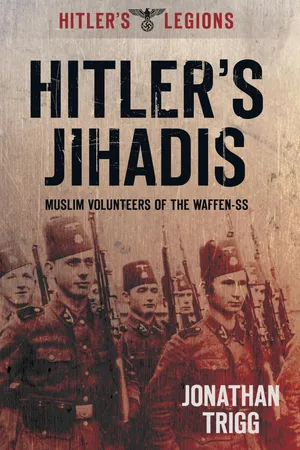
As the West finds itself embroiled in conflict with radical Islam at home and abroad it is fascinating to hear the echoes of militant Islam from the Second World War, and the Nazis attempt to preach 'Jihad' against the British Empire and Stalin.Hitler's Jihadis tells the story of the tens of thousands of Muslims, from as far away as India who volunteered to wear the SS double lightning flashes and serve alongside their erstwhile conquerors. Jonathan Trigg gives insight into the pre-war politics that inspired these Islamic volunteers, who for the most part did not survive. Those who did survive the war and the bloody retribution that followed saw the reputation of the units in which they served in berated as militarily inept and castigated for atrocities against unarmed civilians. Using first hand accounts and official records Hitler's Jihadis peels away the propaganda to reveal the complexity that lies at the heart of the story of Hitler's most unlikely 'Aryans'.
- 128 pages
- English
- ePUB (mobile friendly)
- Available on iOS & Android
eBook - ePub
About this book
Information
IV
The 1st East Mussulman SS-Regiment – Himmler’s first Muslim SS (Ostmuselmannisches SS-Regiment 1)
The 1943 Waffen-SS expansion
Himmler had been working assiduously since the outbreak of the War in 1939 to expand the armed, Waffen-SS wing of his empire. The advent of Barbarossa in all its vast scale had speeded up this process and 1943 was a watershed year in the growth of the Black Guard. Previous recruitment and formational strictures, imposed by the Wehrmacht high command, which had hitherto acted as a brake on growth, were either greatly relaxed or dispensed with. The result was an explosion in the overall number of Waffen-SS personnel and type of units. This was especially true of foreign recruitment, which prior to 1943 had primarily been focused on either providing small-scale battle casualty replacements to the existing SS field divisions, or more importantly in setting up and manning the various Waffen-SS national volunteer legions. These SS legions; the Norwegian Legion Norwegen, the Danish Freikorps Danmark, the Dutch Legion Niederlande and the Flemish Legion Flandern, were all recruited for an initial two-year engagement and in 1943 this was ending.
The performance of the legions had been mixed, with issues around training and treatment of volunteers damaging performance. But the Russian Front was a formidable school for a soldier to learn his trade and two years on from their inception there were enough signs of optimism from the legions to convince the SS authorities that the foreign volunteer experiment should be continued. What was also clear, was that a complete restructuring was needed. The legions themselves were too small as units to maintain viability at the front. Casualties in Russia were so high that anything less than brigade or regimental size was quickly worn down to nothing and became combat ineffective. Consequently, the conclusion was not that fewer foreign volunteers were needed, but more. The aim now then was to use the surviving veterans as cadres to expand the old legions into much larger SS regiments or full blown SS-Sturmbrigades (assault brigades), such as the French SS-Frankreich, Belgian Walloon SS-Wallonien and the Belgian Flemish SS-Langemarck. These units would then be used to form either new divisions in their own right, or to act as significant reinforcements for the existing premier SS formations, thus the Wallonien fought with the SS-Wiking and the Langemarck with the SS-Das Reich.
Himmler takes a hand
But even this major expansion was not enough for the Reichsführer-SS Heinrich Himmler, and he cast his acquisitive eye still further afield to fill the Waffen-SS order of battle. Himmler, just like his master in the Reich Chancellory, was rabidly anti-Slav and still could not bring himself to agree with the playwrite Schiller’s view on Russia; ‘Russland nur durch Russland überwunden’ (roughly translated, ‘Only Russia can overcome Russia’). This was still a step too far for the bespectacled Bavarian bureaucrat, but the host of Muslims already serving in the German Army at the front were a different ball game as far as he was concerned.
For Himmler, the bravery of the Muslim soldiery in von Kleist’s Caucasus invasion had been encouraging, especially their performance during the winter retreat when they had fought doggedly as part of the rearguard of Army Group A. This positive impression was reinforced during Manstein and Hausser’s crucial check to the charging Red Army at the battle of Kharkov. When the city was initially abandoned, contrary to Hitler’s latest ’hold to the last man’ order and prior to the counter-attack led by the SS panzer corps, a Turkmen battalion had lost its beloved German commander killed in action and had actually voluntarily re-entered the doomed city to retrieve his body for an honourable burial. This was the kind of act that Himmler could appreciate and firmly planted in his mind the potential for an SS Turkic Muslim division. As so often when Himmler had an idea that needed action to become reality, he turned to his arch-fixer and close confidant, the seemingly tireless Swabian SS-Gruppenführer Gottlob Berger and the recruiting machinery of his SS-Hauptamt (SS Main office responsible for all foreign volunteer recruitment).
Berger had been Himmler’s main ally in building the Waffen-SS since before the War and for him this was another opportunity to dutifully answer his master’s call. After putting out some feelers and speaking to various members of his own staff and that of OKH, Berger began to look closely at an existing German Army unit; the verstärkt Turkestanisches Infanterie-Bataillon 450 (reinforced Turkistani Infantry Battalion 450).
Colonel Reinhard Gehlen and Major Andreas Meyer-Mader
On the whole, the Wehrmacht juggernaut that thundered across the border into the Soviet Union on 22 June 1941 was anti-Slav in outlook and thinking. This was especially pronounced of course in the Waffen-SS formations. This antipathy, prevalent though it was, was not universal. From the beginning there were members of the Army officer corps who agreed fundamentally with Schiller’s comment above on how to defeat Russia. Many of them had initimate knowledge of Russia, having either served there in the past, being Russian-born or of Baltic German parentage like Reichsminister Rosenberg himself. This admittedly small group of enlightened junior officers (none was above the rank of Colonel) found a spiritual home in Oberst (Colonel) Reinhard Gehlen’s Fremde Heere Ost Abteilung (Enemy Armies East Section) in the Abwehr intelligence service. Here they expounded their belief that the best, and indeed only, way of winning the war in Russia was to turn the seething discontent of the Soviet masses against their own communist government. For Gehlen and his compatriots the Slavs were not enemies but potential allies in crushing Stalin.
One officer with such an outlook, although not a member of Gehlen’s staff, was the Austrian Major (Major) Andreas Meyer-Mader. Meyer-Mader had had an interesting career to date, having already commanded foreign troops when he was posted as a liaison officer before the War to the Chinese Nationalist Generalissimo Chiang Kai-Shek. Initially intended to carry out a purely technical advisory role in Chiang Kai-Shek’s long running war with Mao Tse-Tung’s Communists, Meyer-Mader had ended up commanding Nationalist troops in the field during Mao’s now-famous Long March.
Meyer-Mader’s experiences in China would probably have been nothing more than a fascinating interlude in his military career, except that he went on to serve with the Seventeenth Army in southern Russia during the early winter of 1941. He was there when the decision was taken by General Russwurm (at the same time as von Bock was making the same decision to the north with Army Broup B) to raise two battalions of local Hiwis to supplement the strength of his 444th Sicherungs Divison (Security Division) made up of older men and tasked with combating partisans in the rear areas. One battalion was Christian and the other was Muslim, the latter being designated the 444th Turkmen Battalion. Casting around for a suitable commander, Russwurm alighted on Meyer-Mader as an officer with just the right experience to lead foreign troops and he was duly appointed. The Battalion was immediately thrown into the ruthless barbarity of the Russian Bandenkrieg (guerrilla war) and under Meyer-Mader’s command soon earned an unenviable reputation for horrendous behaviour over the winter of 1941–1942. Despite this, the experiment was judged enough of a success to separate out the Turkmen and expand the size of the unit. The result was the creation of the verstärkt Turkestanisches Infanterie-Bataillon 450 (reinforced Turkistani Infantry Battalion 450).
The verstärkt Turkestanisches Infanterie-Bataillon 450
Withdrawn from the front in southern Russia at the beginning of January 1942 the Turkmen were sent by train over a thousand miles north to the old Polish fortress town of Modlin in the General Gouvernement fur die besetzten Polnischen Gebiete (General Government for the Occupied Polish Region), more commonly known simply as the General Government. For the Turkmen it was the first time that any of them had been outside the Soviet Union; equally, the local Poles were extremely curious about the new arrivals, but there was no time for pleasantries, as no sooner had they arrived in Modlin than they were sent on to the small town of Legionowo some thirteen miles to the east. It was here that the Turkmen were officially designated the verstärkt Turkestanisches Infanterie-Bataillon 450 on 13 January 1942. Still under Meyer-Mader’s command the new unit was built up with fresh drafts of volunteers, many of them ex-POWs desperate to escape the horrors of German captivity, and put through its paces on the training grounds with stocks of captured Soviet weaponry. Within a few weeks the unit boasted a strength of 822, comprising a German cadre of 10 officers, 52 NCOs and 31 other ranks (filling specialist and support roles), with a mainstay of 620 Turkmen other ranks, 102 NCOs and also seven officers. To have so many command appointments filled by Turkmen was truly remarkable. By comparison the Flemish SS-Legion Flandern, comprising some thousand men of all ranks, went into combat the previous November with only a solitary Flemish NCO, the rest being German. To have almost as many Turkmen officers as Germans was also worthy of note, this was clearly not to be a unit of cannon-fodder Turkmen commanded solely by Germans. The new unit was established with three battalions; Companies 1–4 in I Battalion, Companies 5–8 in II Battalion and Companies 9–12 in III Battalion.
Following its training period in Poland the new unit was again dispatched to southern Russia, this time to reinforce the German Army’s largest field formation, Friedrich von Paulus’s massively powerful Sixth Army. As the Sixth Army thrust eastwards in the Wehrmacht’s renewed summer offensive of 1942 the Turkmen followed in its wake acting as rear area security, although in the huge expanses of the southern steppes and in the chaos of cut-off Soviet formations this often meant in effect frontline combat against Red Army men as well as partisans. When the Sixth Army finally arrived at the gates of Stalingrad in late autumn Meyer-Mader’s men were one of several units tasked with keeping open the vital rail link back west to the logistics and communications centre of Kharkov in the Ukraine. This was a thankless job but not as hard as the death struggle von Paulus’s men were engaged in on the banks of the Volga, but even so Meyer-Mader seemed incapable of maintaining basic discipline in the unit and their behaviour deterioriated until atrocities against local civilians were commonplace.
The Soviet counter-offensive that saw Sixth Army encircled, pushed the Turkmen and their German allies back westwards and ended Heeresgruppe Süd’s (Army Group South’s) patience with the Austrian major and his men. Meyer-Mader himself was relieved of command for incompetence and the battalion was withdrawn from service until further notice. Unlike many other units of Muslim volunteers fighting in the same theatre with both von Paulus’s men and von Kleist in the Caucasus, this particular unit was a disaster. In truth, German commanders did not know what to do with it and were unwilling to waste either precious trained German cadre personnel or modern weaponry on it. For the moment they would let it kick its heels in the rear.
SS-Obersturmbannführer Meyer-Mader and the 94th SS Regiment
It was at this time that Gottlob Berger began to express an interest in the Turkmen and one can only guess at the feelings of relief that this investigation evinced in the harried staff officers of Army Group South. As a result, it was made known to Berger that there would be no Army opposition to recruiting the Turkmen into the Waffen-SS. Berger was also interested in the Turkmen’s former commander and set up a meeting in November 1943 between his boss the Reichsführer, Meyer-Mader and the Mufti of Jerusalem (more information on the Mufti is included in the next chapter).
The agenda was the ability to raise, train and lead a combat division of Turkic Muslim SS. The Mufti’s role was to give the proposed formation his blessing and spiritual guidance, and for him to lend practical recruitment support to Meyer-Mader who was to be induced to transfer to the Waffen-SS and lead the new unit. The first meeting went well and was followed up on 14 December 1943 by a second where Meyer-Mader was promised a promotion, a free hand in recruiting and an increase in pay, rations and equipment scales for his new troops. The Austrian officer agreed and overnight became SS-Obersturmbannführer Andreas Meyer-Mader, regimental commander of the 94th SS Regiment formally established on 18 December 1943.
Based in the Poniatowa/Kaposvar area the new regiment was made up of recruits lured over by Meyer-Mader from the now-defunct and disgraced verstärkt Turkestanisches Infanterie-Bataillon 450 (a transfer the Army were only too pleased to see). Meyer-Mader also recruited men from existing Turkic Osttruppen units such as the 480th, 782nd, 786th and 791st Turkestanische Battalions, as well as the Azeri 818th and Volga Tartar 831st. POW camps were trawled as well as the teeming ranks of Hiwis and soon there were some 3,000 men in training in the unit. Redesignated the 450th Eastern Regiment, with a complement of three infantry battalions of three strong companies each, the formation continued its work-up training in spring 1944 but was hampered by lack of equipment. Although some first-class German arms were forthcoming as promised, the supply situation in the Third Reich was such that it was difficult to see how the unit was ever going to receive anything other than the scraps from a pretty meagre table. Even uniforms were scarce and many men had no boots. In an attempt to remedy the situation the Regiment was transferred to the Trawniki base area near Lublin, which had been used for some time as the training centre for non-German concentration camp personnel. The move did mean that some of the worst deficiencies of kit were made up, but it did not bode well for how the Turkmen were viewed by the SS authorities, or how they were to be trained. This was an establishment that oversaw the arming and preparation of some of Nazi Germany’s most brutal and barbarous thugs.
Combat in Belarus – the Ostmuselmannisches SS-Regiment 1 (the 1st East Mussulman SS-Regiment)
Alongside this less than helpful geographic move, and as ever on the merry-go-round of Waffen-SS nomenclature, the Turkmen then underwent another name change at the beginning of March 1944 when they were officially re-titled the Ostmuselmannisches SS-Regiment 1 (the 1st East Mussulman SS-Regiment). This was intended as a precursor to their envisaged expansion into a full Turkic SS division. It was also decided that some of them at least were ready to take part in an upcoming anti-partisan offensive in Belorussia. Shipped to the town of Yuratishki near Minsk the Turkic SS men were supplied some weaponry and uniforms from the SS logistics depot at Bobruisk and prepared for combat, although it seems only the relatively small number of 550 men were considered fit for action at the time and the majority of the Regiment did not move out to take part in the fighting.
Belorussia itself had the dubious distinction of suffering the highest per capita casualty rate of any country in Hitler’s war, higher even than Poland, the Ukraine and Yugoslavia. Fought over by local nationalists, separatist Poles and Ukrainians, as well as the invading Nazis and liberating Soviets, the fertile land and thriving cities of Belorussia were reduced to bloody ruin in more than three years of total war. By the spring of 1944, unrest in the country was endemic due to the savagery of German oppression and STAVKA’s (the Soviet Supreme Command) policy of stirring up resistance in the Wehrmacht’s backyard to disrupt German effectiveness at the front. The terrain, with its almost limitless forests and swamps, made it relatively easy for large numbers of partisans to operate and unbelievably some 150,000 were estimated to be doing so according to the German OKH by early 1944. They were organized into approximately 150 brigades and 49 separate detachments. The result for the Germans was chaos and real concern about the vital rail and road links to the frontline in the east. For example, the main Lida to Minsk rail line was attacked an average of 40 times a month. Something had to be done, and that something was planned to be a co-ordinated offensive between elements of Third Panzer Army and the rear area security formations of Belorussia’ s Higher SS and Police Leader SS-Gruppenführer Curt von Gottberg’s Kampfgruppe von Gottberg.
Dirlewanger, Kaminski and the death of SS-Obersturmbannführer Meyer-Mader
The proposed offensive was targeted at the ...
Table of contents
- Contents
- Map
- Acknowledgements
- Notes on the Text
- Introduction
- I
- II
- III
- IV
- V
- VI
- VII
- VIII
- IX
- X
- XI
- APPENDIX A
- APPENDIX B
- APPENDIX C
- APPENDIX D
- BIBLIOGRAPHY
- Plate Section
- Copyright
Trusted by 375,005 students
Access to over 1.5 million titles for a fair monthly price.
Study more efficiently using our study tools.
Frequently asked questions
Yes, you can cancel anytime from the Subscription tab in your account settings on the Perlego website. Your subscription will stay active until the end of your current billing period. Learn how to cancel your subscription
No, books cannot be downloaded as external files, such as PDFs, for use outside of Perlego. However, you can download books within the Perlego app for offline reading on mobile or tablet. Learn how to download books offline
Perlego offers two plans: Essential and Complete
- Essential is ideal for learners and professionals who enjoy exploring a wide range of subjects. Access the Essential Library with 800,000+ trusted titles and best-sellers across business, personal growth, and the humanities. Includes unlimited reading time and Standard Read Aloud voice.
- Complete: Perfect for advanced learners and researchers needing full, unrestricted access. Unlock 1.5M+ books across hundreds of subjects, including academic and specialized titles. The Complete Plan also includes advanced features like Premium Read Aloud and Research Assistant.
We are an online textbook subscription service, where you can get access to an entire online library for less than the price of a single book per month. With over 1.5 million books across 990+ topics, we’ve got you covered! Learn about our mission
Look out for the read-aloud symbol on your next book to see if you can listen to it. The read-aloud tool reads text aloud for you, highlighting the text as it is being read. You can pause it, speed it up and slow it down. Learn more about Read Aloud
Yes! You can use the Perlego app on both iOS and Android devices to read anytime, anywhere — even offline. Perfect for commutes or when you’re on the go.
Please note we cannot support devices running on iOS 13 and Android 7 or earlier. Learn more about using the app
Please note we cannot support devices running on iOS 13 and Android 7 or earlier. Learn more about using the app
Yes, you can access Hitler's Jihadis by Jonathan Trigg in PDF and/or ePUB format, as well as other popular books in History & Military & Maritime History. We have over 1.5 million books available in our catalogue for you to explore.