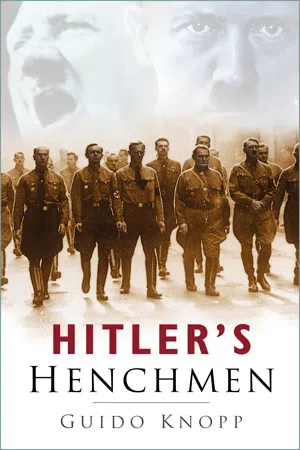
Josef Goebbels, Hermann Goring, Heinrich Himmler, Rudolph Hess, Albert Speer and Karl Donitz. These were the men who smoothed Adolf Hitler's path to power and became the perpetrators of a reign of terror unparalleled in history. They were the supporters and executives at Hitler's regime, carrying out his orders with deadly efficiency. This radical new assessment of power under the swastika reveals many unknown facts and gives a unique but disturbing glimpse behind the scenes of the Nazi state.an TV journalist and presenter Guido Knopp has unearthed a wealth of new material about the Third Reich. Based on meticulous research and countless interviews, this is essential reading for anyone interested in Hitler and the Second World War.
- 288 pages
- English
- ePUB (mobile friendly)
- Available on iOS & Android
eBook - ePub
Hitler's Henchmen
About this book
Information
CHAPTER ONE
THE FIREBRAND: JOSEPH GOEBBELS
KNOPP/HARTL
I have now learnt abstinence. And a boundless contempt for the common herd.
There is a curse hanging over me and women.
Here is a man who knows the way. I want to be worthy of him.
Hitler talks to me in a very friendly, confidential way. How fond he is of me as a person, too . . .
I suppose it will always be one of the biggest jokes about democracy that it has itself presented its deadliest enemies with the very means by which to destroy it.
The Bolshevists can teach us a lot, especially about propaganda.
It was rather a good thing and helpful to us that at least some of the Jews thought: Oh well, it won’t really be as bad as all that.
This plague of Jews must be wiped out. Completely and utterly. Nothing must be left of them.
Now, let the nation arise, let the storm break!
We will go down in history as the greatest statesmen of all time.
Or else the greatest criminals.
Goebbels
You know of course that I am not very keen on this exaggerated anti-semitism. But nor can I really say that the Jews are particular friends of mine. However, I don’t think they can be got rid of by insults and polemics or even by pogroms, and even if this were possible, it would be most ignoble and inhuman to do so.
Goebbels to Anka Stalherm, 1919
He has taught us again the old German virtue of loyalty; we are going to stand by him until victory or defeat. Let us thank Destiny for having given us this man, the helmsman in our hour of peril, the apostle of truth, the leader into freedom, the confessor, the zealot, the voice calling us to arms, the steadfast hero, the emblem of Germany’s conscience.
Goebbels on Hitler, 1924
Germany longs for this one man, as the earth thirsts for rain in summer. O Lord, show the German people a miracle! A miracle!! A man!!!
Goebbels, 1924
Soon he will listen only to his generals, and things will get tough for me.
Goebbels, 1938
Why can’t women be our equal in every way? Can they be educated to it? Or are they simply inferior? Only in rare cases can women become heroines!
Goebbels, 1925
Men of Dr Goebbels’ type have always been alien to me, though I have refrained from passing judgement. But today he is the most hated man in Germany. At one time we used to complain about Jewish managing directors sexually harassing their female employees. Now Dr Goebbels is doing it.
Himmler, 1939
We Germans may not know much about living, but when it comes to dying – we’re fabulous!
Goebbels, 1932
If I’d told those people to jump from the third floor – they’d’ve done it!
Goebbels after his ‘Total War’ speech at the Sportpalast, 1943
This is the secret of propaganda: those whom the propaganda is aimed at must become completely saturated with the ideas it contains, without ever realising that they are being saturated. Obviously the propaganda has a purpose, but this purpose must be so cleverly and innocently disguised that the people we intend to influence simply do not notice it is happening.
Goebbels addressing senior radio executives, 1933
The rhetorical gifts and organisational talents this man displayed were unique. There was nothing he did not seem capable of. The party members were absolutely devoted to him and the SA would willingly have been cut to pieces for him. Goebbels, well, he was just our Goebbels.
Horst Wessel, 1926
To hell with this loud-mouthed propaganda boss, Goebbels by name. The man who, crippled in body and soul, deliberately and with inhuman malice strives to elevate the lie to godlike status, the sole master of the world!
Thomas Mann, 1933
The press today is no longer the enemy but is working alongside government. Today press and government are in fact pulling in the same direction.
Goebbels, 1934
He was without doubt the most intelligent of them all. He was an academic, as you could clearly tell from his choice of words and way of speaking. Unlike Göring, Himmler and Bormann, he possessed the ability to distance himself to some extent from day-to-day events. He wasn’t self-centred and he was no coward. He told Hitler what he thought, even when he believed the war was over – and Hitler always listened to him. To me, Goebbels was a propaganda genius and I believe it can equally well be said that he made Hitler as that Hitler made him. He was a very complex personality – completely cold. Where National Socialism was at its worst – in its anti-Jewish measures in Germany – he was the driving force.
Speer, 1979
* * *
As Paul Joseph Goebbels, the undersized 29-year-old philology graduate, stepped out into the forecourt of Munich’s massive central station on 8 April 1926, a chauffeur was already waiting for him in a supercharged Mercedes with gleaming chrome. Thanks to the ‘gigantic’ roadside posters advertising the appearance of ‘Dr Goebbels’ in the Bürgerbräu beer hall the following day, the drive to the hotel turned into a triumphal procession for the newcomer.
‘What a splendid reception!’ he enthused in his diary. Then, in the evening, when his fatherly host appeared in person to pay his respects to the visitor, Goebbels finally achieved a state of bliss: ‘Hitler telephoned. Wants to welcome us in person.’ He exulted in his diary: ‘He arrives in a quarter of an hour. Tall, healthy, full of vitality. I like him so much. He is embarrassingly kind to us.’
Hitler generously put his limousine at the guest speaker’s disposal for a spin around Lake Starnberg before the initiation began the following evening in the Bürgerbräukeller: ‘I give it everything I’ve got. They cheer, they roar. At the end Hitler embraces me. There are tears in my eyes. I’m in a kind of heaven.’ A wave of ecstasy floods through Goebbels’ diary: ‘I bow down before the greater man, the political genius!’ Later he adds another verse to the hymn of praise:
He is a genius. The unquestioned creative instrument of a divine destiny. I stand before him in a state of shock. But he is like a child; kind, good, compassionate. Yet catlike, cunning, clever, agile; and like a lion, huge and roaring. What a chap, what a man!
To the young admirer, Hitler was more than a father-figure or exemplar. Fired with zeal, Goebbels elevated the backroom demagogue into the Messiah and Redeemer in human form. In Hitler his ill-defined search for religious faith had found an icon. ‘What one believes in is immaterial; the important thing is believing.’ These were the words Goebbels put into the mouth of Michael Voormann, the hero of his bombastic attempt at novel-writing. Having abandoned both Catholic piety and left-wing revolutionary exuberance, he now worshipped with glowing faith an earthly deity who would become the leitmotiv of his existence and was already filling his failed career with a new purpose.
‘I am gladly departing this life, which has been nothing but hell for me,’ Goebbels had cried out in his testament to posterity at the age of only twenty-two. Yet this theatrical exit was postponed to a later date and he was forced to continue his meagre existence as a student. A small bursary from the Catholic Albertus Magnus Society, occasional earnings as a tutor, endless loans from friends, visits to the pawnbroker, and most of all the money which his father donated from his meagre income, all helped to keep the literature student’s head more or less above water. When necessary he just went without meals for a few days. Wherever his student wanderings took him – Bonn, Würzburg, Freiburg, Munich and Heidelberg – the spectre of poverty was his constant companion.
His experience of terrible shortages in Germany after the First World War combined with his personal penury to shape his vision of a world in which men of ability became the victims of sinister machinations. ‘Isn’t it monstrous,’ he wrote in frustration to his boyhood sweetheart Anka Stalherm in 1920, ‘that people with the most brilliant intellectual gifts languish in poverty, because the rest are squandering, blowing and wasting the money that could help them?’
In this Goebbels was portraying himself: he felt that he was destined for higher things, was convinced his future was to be a famous writer, an idealist who would change the world. His first steps in life had in fact led him single-mindedly up the social ladder. He was born on 29 October 1897 in the small Lower Rhineland town of Rheydt, the third son of a bookkeeper who had doggedly worked his way up from blue-collar to white-collar status. For this gifted boy, attending the town’s high school meant crossing what was in those days still a very rigid class barrier. He enjoyed the privilege of piano lessons and an education in the humanities. As the brightest pupil in his year the university doors were open to him. For the son of a lower middle-class family this success was both a satisfaction and a compensation. For it was not only his humble origins that permanently labelled him an outsider. ‘Why had God made him in such a way that people mocked and scorned him?’ he made his fictional Michael Voorman complain. ‘Why could he not love himself and love life as others did?’ It was this cry of self-hate and self-pity which would reverberate to the end of his life. From his childhood he was denied access to the world of the carefree and the undamaged; as a sickly four-year-old he contracted osteomyelitis in the right leg. Despite all the efforts of doctors, growth of the limb was stunted. And for the rest of his life he had to drag the affected foot behind him in an unsightly orthopaedic shoe. While others played, danced or enjoyed sport, the crippled boy always remained on the sidelines. In 1914, excited by the general euphoria of war, he presented himself for an army medical check, only to be wearily waved aside by the doctor. ‘When he saw the others running, jumping and romping about,’ Goebbels confessed in Michael, ‘he berated his God for . . . doing this to him; he hated the others for not being like him; he even mocked his mother for being happy to have such a cripple.’
In the solitude of his attic room he learned to hate with a passion: to hate himself in all his ugliness, to hate the others who did not take him seriously, despised him or else smothered him with pity, and lastly to hate the whole of mankind. ‘I have now learnt abstinence,’ he wrote in his journal of the soul, ‘And a boundless contempt for the common herd!’
The malign delight with which he later dissected the weaknesses of others, the vengeance with which he pursued opponents and colleagues alike, the mistrust which led him to suspect treason and plotting all around him, and his incapacity to feel pity – all had their origin in those early days of humiliation. At the same time experience taught him to play down his physical shortcomings by behaving in a particularly assertive way.
He never lost control. He was calculating and cold. Ice-cold and diabolical.
Otto Jacobs, stenographer
It was no coincidence that he cut quite a figure on the stage. With forceful phrases and sweeping gestures he was able to spellbind those around him. He used his repartee and mental acumen to divert attention from his appearance. The success which was denied him on the sportsground and the field of battle, he seized with relentless energy in the classroom and at his desk. In November 1921 Goebbels’ ambition to rise in the world was crowned with success: he graduated in the faculty of philology at Heidelberg and was now ‘Herr Doktor’. For hours he practised a flamboyant signature, now embellished with academic credentials. Never again would he sign his name without adding his full title. In his home town of Rheydt the neighbours greeted him on the street with respect. For the 24-year-old Goebbels, graduation from university brought social recognition and personal triumph. Yet, far from gaining employment and status, he found himself back in the attic of his parents’ house. On its own, his academic title did nothing to free him from material hardship. In the next two and a half years the struggling young man became painfully aware that even ‘Doctors’ have to earn their keep and write job applications. In his little study the obscure writer filled reams of paper with poems, articles and tracts – but the outside world paid him precious little attention. Apart from the reprinting of six of his essays in the Westdeutsche Landeszeitung, the public completely ignored the prolific recluse.
It seemed, therefore, like an admission of total defeat when he was forced to seek gainful employment in a Cologne branch of the Dresdner Bank. Instead of addressing an illustrious audience, his resonant voice was now heard shouting out share-prices on the trading-floor.
His detested duties in the ‘Temple of Materialism’ reinforced his disgust at the ‘hectic dance around the Golden Calf’. ‘You talk of capital investment,’ Goebbels raged in his diary over speculation during the runaway inflation of 1923 ‘but behind these fine words lurks nothing but a bestial hunger for more. I say bestial, but that is an insult to animals, for an animal only eats until it has had its fill.’ The fertile soil of anti-capitalism brought forth the first shoots of anti-Semitism. His latent prejudice, something frowned on by the Catholic lower middle-class, hardened into a sinister conspiracy theory. In ‘the Jews of international finance’ Goebbels discovered the perfect scapegoat, both for his personal penury and for the economic hardships of his time. For him Jewish finagling was not only at the heart of Western materialism – the very ‘spawn of evil’ – but also of international Marxism. The men pulling the strings in both worlds had a common ambition to remove every trace of national autonomy. Fed by the relevant writings of the period, Goebbels distilled from the murky philosophical brew the ‘inexorable logic’ that only a ‘life-or-death struggle’ against ‘international Jewry’ would open the way to a better world.
As yet he apparently found no contradiction between this belief and his acquaintance with actual people of Jewish descent. The Heidelberg literary historian, Friedrich Gundolf, whom Goebbels greatly admired, was Jewish, as was his supervisor, Professor Max von Waldberg, and a close family friend was a Jewish lawyer who gave literary advice to the budding poet. When his fiancée, a teacher named Else Janke, revealed that her mother was Jewish, he was taken aback, but did not end the relationship – at least not immediately. When Goebbels later rose to be a spokesman for the Nazi Party, he threw out his bride-to-be as a tiresome leftover from his youth.
At first, however, it was he who was out on the street. After only nine months his career as a bank employee came to an abrupt end. In order to conceal the disgrace from his family, he continued to commute to Cologne for weeks without a job, until his lack of funds forced him to reveal the truth.
‘As a result of a slight nervous dis...
Table of contents
- Cover
- Title
- Copyright
- Contents
- Picture Credits
- List of Illustrations
- Foreword: Perfectly Ordinary Germans?
- 1 The Firebrand: Joseph Goebbels
- 2 The Number Two: Hermann Göring
- 3 The Enforcer: Heinrich Himmler
- 4 The Deputy: Rudolf Hess
- 5 The Architect: Albert Speer
- 6 The Successor: Karl Dönitz
- Select Bibliography
- Picture Section
Trusted by 375,005 students
Access to over 1.5 million titles for a fair monthly price.
Study more efficiently using our study tools.
Frequently asked questions
Yes, you can cancel anytime from the Subscription tab in your account settings on the Perlego website. Your subscription will stay active until the end of your current billing period. Learn how to cancel your subscription
No, books cannot be downloaded as external files, such as PDFs, for use outside of Perlego. However, you can download books within the Perlego app for offline reading on mobile or tablet. Learn how to download books offline
Perlego offers two plans: Essential and Complete
- Essential is ideal for learners and professionals who enjoy exploring a wide range of subjects. Access the Essential Library with 800,000+ trusted titles and best-sellers across business, personal growth, and the humanities. Includes unlimited reading time and Standard Read Aloud voice.
- Complete: Perfect for advanced learners and researchers needing full, unrestricted access. Unlock 1.5M+ books across hundreds of subjects, including academic and specialized titles. The Complete Plan also includes advanced features like Premium Read Aloud and Research Assistant.
We are an online textbook subscription service, where you can get access to an entire online library for less than the price of a single book per month. With over 1.5 million books across 990+ topics, we’ve got you covered! Learn about our mission
Look out for the read-aloud symbol on your next book to see if you can listen to it. The read-aloud tool reads text aloud for you, highlighting the text as it is being read. You can pause it, speed it up and slow it down. Learn more about Read Aloud
Yes! You can use the Perlego app on both iOS and Android devices to read anytime, anywhere — even offline. Perfect for commutes or when you’re on the go.
Please note we cannot support devices running on iOS 13 and Android 7 or earlier. Learn more about using the app
Please note we cannot support devices running on iOS 13 and Android 7 or earlier. Learn more about using the app
Yes, you can access Hitler's Henchmen by Guido Knopp in PDF and/or ePUB format, as well as other popular books in History & Military & Maritime History. We have over 1.5 million books available in our catalogue for you to explore.