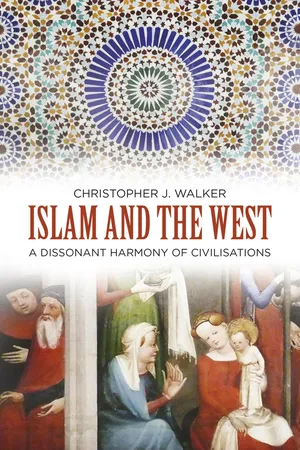
We have rapidly grown used to the idea, particularly since the declaration of a worldwide war on terrorism, that between Islam and the West there exists a deep historical and ideological gulf. Christopher J. Walker turns such accepted views on their head and paints instead a picture of two belief systems that have a long history of toleration and mutual influence. Indeed, Islam has given a great deal to civilisation: essentially modern notions of free enquiry, rational experimentation, rational experimentation and the independence of science from religious authority are legacies of the Islamic world. Islam and the West is a thought-provoking study covering some of the cardinal encounters between Islamic and Western countries.
- 288 pages
- English
- ePUB (mobile friendly)
- Available on iOS & Android
eBook - ePub
About this book
Information
Topic
Theology & ReligionSubtopic
World HistoryCHAPTER ONE
Sophronius and Omar
Helena, the mother of the Emperor Constantine, first accorded Jerusalem a central place within Roman Christianity, by making a pilgrimage there probably in the year 326. According to the pious historians Socrates Scholasticus and Sozomen, she discovered the site of the Holy Sepulchre. At the time of her visit this sacred place was occupied by a temple built by the Emperor Hadrian and dedicated to Astarte. The devout lady pilgrim, granted the title of ‘empress’ by her imperial son, dutifully sought out other sites connected with the life of Jesus, and discovered a holy relic of deep and lasting significance, that of the True Cross. Her devotional travels inaugurated the powerful and lasting tradition of Christian pilgrimage – the process whereby inner spirituality is strengthened and enriched by an outward journey of aspiration, physical hardship, attainment, presence, recollection and meditation.1
Astarte was the local cult-name for Venus, and even in pagan times an aura of sacred suffering and renewal hovered in the darkened grotto. The rites of Syrian Adonis, the annual life-replenishing corn-god, were celebrated here in springtime. A link has been suggested between ‘Adonis’ and ‘Adonai’; the womb which nurtured the fresh-limbed god of springtime became the tomb of the Son of Man. Perhaps we can also find here a continuity of female presence, with Astarte foreshadowing Mary Magdalene and the other women at the empty tomb, who in turn could be linked to the historical figure of Helena. The ambience was in contrast to the robustly male environment of the other great sacred place, the former Jewish Temple, manifestly masculine in its pagan Roman form as the Temple of Jupiter Capitolinus.
Christianity had evolved from being a faith of the oppressed into a triumphant imperial religion. From being a subversive doctrine challenging the divinity of the emperor and waiting expectantly for the end of the world, it was on the verge of granting legitimacy to imperial rule. The faith was now bound up with temporal power; it was about to become a partner to the political order. The emperor came to be seen not only as the commander-in-chief, judge and legislator, but also the living symbol of the Christian empire, with a status as God’s first servant. He became the object of a cult, which was enacted with reverential ceremonial. His person came to be held as sacred. Here was a great change.
There is a paradox in pilgrimage, especially in a journey to sacred sites undertaken by the emperor’s mother. The Roman Empire took on the aspect of a universal empire; the earthly embodiment of the unbounded spiritual realm. Its universality was limited only by its proximity to another empire of equal power and magnificence, that of the Sasanid Persians. Rome implanted within the minds of the people of the Mediterranean seaboard, of Anatolia and of some of Europe, a notion of world citizenship. Here the idea of Christianity as a universal religion found fertile soil. A universal empire, where the universal gospel could be preached to every creature without distinction, was a harmonious pairing. God could proclaim his universality, his non-totemic lack of a specific locality, by his reflection in universal empire. Yet now Helena, at the moment that Christianity was affirming its universality, was by her pilgrimage subtly undermining the idea of universal empire and faith. Her devotion emphasised the individual localities of the origins of Christian faith. Undoubtedly a pilgrim’s journey can refresh and renew faith. But pilgrimage may also lead to a privatisation of piety. The notion of the universality of Jesus may shade into his being a local sacred figure of Palestine. Pilgrimage can make the inner lamp of the soul shine more brightly; but it can also fetishise a land mass, and imbue a locality with a specific devotion which may diminish the aspects of faith that aspire to worldwide validity. Helena’s own intention would have been sacred recollection, not local idolatry; but for lesser persons than herself, it was a short journey from the pilgrimage of the soul to a cultic reverence for relics of saints, the sacrality of remains, and other totemic detritus of regional superstition. Erasmus would later remind us that, by the sixteenth century, a merchant ship could be built from the fragments of wood said to be relics of the True Cross.2
Jerusalem, like other cities in Asia, passed in and out of the control of the later Roman, or Byzantine, Empire. When the Persian Sasanids, in one of their almost annual campaigns, stormed out of their capital Ctesiphon in the year 615, they conquered Anatolia and Syria – the whole of eastern Byzantium.3 They seized the alleged relic of the True Cross, and carried it home in triumph. Palestine was wrecked, and thereafter Jerusalem never regained the opulence it had known during Constantine’s reign. The Persian rage for conquest was said to have resembled that of ‘infuriated beasts and irritated dragons’.4 Two years later the same unappeased invaders hungrily eyed the great city of Constantinople from the Asiatic shore of the Bosporus. But the Emperor Heraclius gave them no quarter, and after campaigns lasting more than ten years drove them from his lands and regained possession of the ‘True Cross’. In the struggle the empires of both Byzantium and Persia drew their inspiration from sword-driven faith. In 629 Heraclius finally earned the laurel wreath of victory. The war had been in part a typical war of imperial rivalry for territories and access; but it also drew some of its force from the urge to regain totems of faith. It showed aspects of holy war. The court poet saw it more in intellectual and metaphysical terms. Celebrating a triumph, George Pisidis wrote an ode to Heraclius: ‘O capable intelligence and most acute nature! Fire of analysis energetically pursuing profundity!’5 Heraclius’ victory was so monumental that it found echo far away, with a report of the sacred struggle reaching Arabia, where it is mentioned in the Koran.6
Few victories have been more filled with irony. For the struggle of empires, the cataclysmic duel between Rome and Persia, the battles fought amid the turbulent rivers, harsh deserts, trackless plains and distant snowy mountains of Asia had exhausted both sides. Winning and losing their empires by the sword had left them prostrate. The future of Syria and Mesopotamia lay neither with east nor west, but with the south. In Edward Gibbon’s words, ‘The rival monarchies at the same instant became the prey of an enemy whom they had been so long accustomed to despise.’7
Islam had been born a few years before Heraclius’ victory, in AD 622. On that date the dedicatedly monotheist prophet Muhammad undertook his flight (hijra) from Mecca to Medina. For a decade he built a state there, based on his prophetic messages. Following his death in 632 his mantle fell to his leading followers – although later it was to be contested in a bitter struggle between them and members of his family, which led to the division of Islam into two branches: Sunni, known as orthodox, and Shiite, from the Arabic word for ‘partisan’, since its followers were the partisans of Ali, Muhammad’s son-in-law. The successor to the Prophet, and leader of the community of believers, was known as the caliph (khalifa).
Islam evolved in a milieu which was partly Christian, partly Jewish, partly pagan, but wholly Arab. The Christian influence came, in part, from the southern Syrian hills; here, desert Arabs, traversing great spaces, had been drawn to the play of light radiating from monkish cells. Distant flickering lamps were welcomed as points of illumination amid brooding night; they were visions of hope and longing, starry presences which lifted darkness from the soul.8 The great pre-Islamic poet Imru’ ul Qais, finely combining the sensual with the austere, proclaimed of his beloved that ‘in the evening she brightens the darkness, as if she were the lamp of the cell of a monk devoted to God’.9 We find a similar mixture of hedonism edged with Christian sanctity in the verses of al-A’sha, a contemporary of Muhammad: ‘Many an early cup [glistening] like the eye of a cock have I drunk with trusty youths in its curtained chamber while the church-bells rang – pure wine like saffron and amber, poured in its glass and mixed, spreading a costly perfume in the house, as if the riders had [just] arrived with it from the sea of Darin.’10 (Darin was a port near Bahrain, where musk from India was unloaded.)
The influence of the Christian kingdom of Abyssinia, Ethiopia today, was felt strongly in southern Arabia. At one time part of Arabia was subject to Abyssinia, an event which had occurred in response to the over-ambitious policies of a Jewish king who ruled south Arabia in the sixth century AD. There had been converts to Judaism, and more than one Arabian tribe had embraced Judaism. The Jewish faith, in its sceptical Sadducean form, where observance is minimal and faith is expressed in doing what is naturally good, was also present in Arabia. Its presence promoted the idea that, amidst different faiths vying with each other, an indistinct belief in One God was alone necessary, combined with an aspiration to do what was, on consideration, felt to be right. In the city of Mecca itself the mood was occasionally touched by the monotheistic currents which surrounded it. The rich families of that prosperous trading city remained devoted to pleasure and to polytheism – a polytheism which even here could develop into a kind of quasi-monotheism that has been called henotheism. (Monotheism indicates the idea of God alone, henotheism that of one supreme God among lesser deities, a less rigorous notion.11)
In this ambience the new faith was proclaimed. What Islam uniquely brought was a universal message expressed within the Arab context; that is, it was a profound monotheistic message, using the imagery, social context and above all the rich and resonant language of the Arabs. Islam is not a specifically Arab religion; but its formulation and expression in Arabia gave the faith aspects which only the Arabs could have given it. Islam also unified them at a highly appropriate moment. Its success was due more to practicality than to religious enthusiasm (in the sense of extremism). Muhammad himself was too disciplined to be called a religious enthusiast.12 If read carefully, the Koran reveals not a frenzy of enthusiasm and violence, but gratitude to God for his works and the Prophet’s fondness for his native city of Mecca despite the materialism of its big merchant families.13 The preaching of a new faith gave its propagators a powerful sense of zeal; but it was a zeal circumscribed by the founder’s practicality.
The Koran should properly be known as the Qur’an; the word is cognate with the Syriac qeryana, ‘reading’, ‘declaiming’, and with the Aramaic qeri, ‘to be read’, a marginal indication of textual corruption found in the Hebrew bible. The language of the Koran is of central significance. Its power and beauty can soften the hearts of the most hardbitten sceptics. As Peter Brown has written: ‘For Muhammad’s followers, this was no Syriac religious ode, a human composition offered by man to God. It was an echo of the voice of God himself, of a God who had never ceased, throughout the ages, to “call out” to mankind.’14 The astonishing power of the language made it easy to believe that Arabic was spoken in paradise, and that any translation of the Koran, if not actually blasphemous, violated its essential spirit.
Muhammad had made no conquests beyond the Arabian peninsula. But in the immediate aftermath of his death the Arab horsemen, imbued with the mission to spread the Prophet’s message, stormed out of the peninsula and within a comparatively short time were in control of vast tracts of land. Besides Asia they conquered westwards: Egypt, North Africa, ultimately Spain. The struggle was hard fought: Alexandria had to be conquered twice (in 641 and 645). But the story of the burning of the library of Alexandria is almost certainly a fake, since much of the library had already been destroyed – by Julius Caesar, by turbulent monks raised to wrath by theological niceties, and by an edict of the Emperor Theodosius dating from about AD 389. The story of the conflagration was first related by Abdullatif al-Baghdadi, who died in 1231, and it was copied by Grigor abul-Faraj, whose Arab history was translated in 1663 and became influential in the developing studies of the East.15
Just as the Persians and the Byzantines had fought tenaciously, so now the new invaders staked a claim to the land of west Asia, with the benefit of being more lightly armed. Their subsequent victory broke down the ‘iron curtain’ of antiquity, the Roman–Persian frontier, and united most of east Rome with Persia, fashioning a new realm which recreated the universality of the Roman Empire, but in a more easterly position.16 The first caliph was an elderly, cautious man of integrity, Abu Bakr. His successor, Omar, saw Islam as a world phenomenon. (Some commentators have likened Omar’s position in the faith to that of St Paul within Christianity.)
The campaign to capture Syria concluded with the battle of the Yarmuk in 636, when Arab forces under Khalid ibn al-Walid defeated Byzantine and mercenary forces led by the brother of Emperor Heraclius. Departing, the emperor memorably declared: ‘Farewell, Syria, and what an excellent country this is for the enemy!’17 The conquest of Syria had been made easier for the conquerors for two reasons. In the first place, Islam had the advantage of its simplicity. Christianity, to those who set their minds to work out its theology, had become very complex. The issue of the Trinity was the most perplexing: it was hard to see how one God could be Three, each of whom was fully God in his own right, while yet there were not three gods but One. (The view that the three persons of the Trinity were three differing aspects of the One God is heretical and Sabellian; the Athanasian view of the Trinity is that each of the three persons is fully God.) The puzzles concerning the nature of Christ were equally complex. Serious divisions had arisen, especially in Syria, concerning the connection between his human and divine natures: whether they commingled or remained separate. If they did commingle, then Christ was of a different substance from mortals. If they were separate, which substance died on the Cross? Then might we be not saved? All these issues were of prime importance at the time. The Syrian Christians had reached their own conclusions, but these were opposed as heretical by Constantinople. Islam allowed them to have the beliefs they wished. Those still puzzled by Christian metaphysics were offered a simple and direct formula: ‘There is no god but God, and Muhammad is his prophet.’ The duties of being a Muslim were equally straightforward: belief in God and his prophet, prayer, almsgiving, fasting during Ramadan, and pilgrimage to Mecca at least once in the lifetime.18
In the second place Arabs and Arab kingdoms had had a presence in pre-Islamic Syria. The Nabataeans had enjoyed greatness in the first century AD, and from the sixth century the Ghassanids of the Hawran had acted as Christian auxiliary soldiers to Byzantium, despite their dissident views on the nature of Christ. These kingdoms and linguistic groups felt an affinity with the Arabs of Arabia, a point which was reinforced when the Islamic conquerors allowed the Ghassanids to practise their own beliefs freely. This liberty of belief stood in contrast to the faith forced on them by the heresy-hunters of Byzantium.
Not all of the initial Arab conquests of the extensive lands of Eastern Christianity were straightforward, or occurred in the manner of liberation from theological tyranny. Much of the warfare was violent, harsh and inhumane. In seventh-century Armenia a part of the Christian population which had taken refuge in its churches was burnt alive by forces commanded by Abd ur-Rahman.19 But even here there was only occasional pressure to convert the people to Islam, and Armenians reached high office as Christians.20 As a European Islamicist of the seventeenth century was to write of the Islamic conquests in general, ‘I own that violence had some place here, but persuasion had more.’21
Jerusalem had already established a place within Islam, since Muhammad had initially instructed his followers to pray in its direction, in the years before it became obligatory for them to address their prayers towards Mecca. Jerusalem was also, possibly, the site of the Prophet’s journey into heaven, according to a text in which the term ‘the Further mosque’ appears.22 ‘The Further mosque’ is a translation of ‘al-Aqsa mosque’; however, confusingly, this is not the site of the p...
Table of contents
- Cover
- Half Title
- Title
- Copyright
- Contents
- Preface
- Introduction
- 1 Sophronius and Omar
- 2 The Asperity of Religious War
- 3 Europe’s Loss and Recovery of Knowledge
- 4 ‘Almost Continuall Warres’
- 5 ‘The Magnificence of the Queen his Mistress’
- 6 Shah Abbas and the Sherley Brothers
- 7 Stuart Learning and the Improvement of Human Reason
- 8 Islam and Europe in the Eighteenth Century
- 9 Ottoman Fortunes: Military Debacle, Diplomatic Rescue
- Notes
- Bibliography
Trusted by 375,005 students
Access to over 1.5 million titles for a fair monthly price.
Study more efficiently using our study tools.
Frequently asked questions
Yes, you can cancel anytime from the Subscription tab in your account settings on the Perlego website. Your subscription will stay active until the end of your current billing period. Learn how to cancel your subscription
No, books cannot be downloaded as external files, such as PDFs, for use outside of Perlego. However, you can download books within the Perlego app for offline reading on mobile or tablet. Learn how to download books offline
Perlego offers two plans: Essential and Complete
- Essential is ideal for learners and professionals who enjoy exploring a wide range of subjects. Access the Essential Library with 800,000+ trusted titles and best-sellers across business, personal growth, and the humanities. Includes unlimited reading time and Standard Read Aloud voice.
- Complete: Perfect for advanced learners and researchers needing full, unrestricted access. Unlock 1.5M+ books across hundreds of subjects, including academic and specialized titles. The Complete Plan also includes advanced features like Premium Read Aloud and Research Assistant.
We are an online textbook subscription service, where you can get access to an entire online library for less than the price of a single book per month. With over 1.5 million books across 990+ topics, we’ve got you covered! Learn about our mission
Look out for the read-aloud symbol on your next book to see if you can listen to it. The read-aloud tool reads text aloud for you, highlighting the text as it is being read. You can pause it, speed it up and slow it down. Learn more about Read Aloud
Yes! You can use the Perlego app on both iOS and Android devices to read anytime, anywhere — even offline. Perfect for commutes or when you’re on the go.
Please note we cannot support devices running on iOS 13 and Android 7 or earlier. Learn more about using the app
Please note we cannot support devices running on iOS 13 and Android 7 or earlier. Learn more about using the app
Yes, you can access Islam and the West by Christopher J Walker in PDF and/or ePUB format, as well as other popular books in Theology & Religion & World History. We have over 1.5 million books available in our catalogue for you to explore.