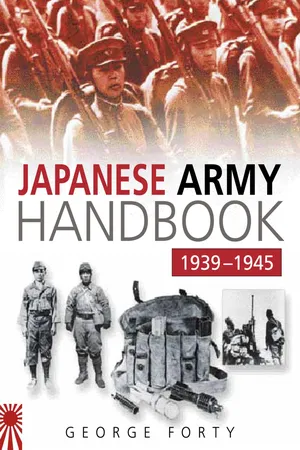
This is an insight into the most feared army of World War II. The Japanese Imperial Army grew from 1.5 million men in 1939 to 5.5 million men by the end of the war. Their highly successful campaigns in the Far East and the Pacific at the beginning of World War II were every bit as spectacular as those of the Germans in Europe, and they earned an enviable reputation as expert jungle fighters which it took some years for the Allies to match. Their code of honour also made them extremely cruel enemies to prisoners and civilians alike, while their Kamikaze suicidal tendencies meant they would automatically fight to the last without any thought of surrender. Fully illustrated with rare archive photographs, this is a comprehensive study of the army. The author describes how they mobilized and trained their soldiers, and looks at their organizational structures, from high command down to divisional level and below. Also included are uniforms, equipment, all kinds of weapons ranging from tanks and artillery, technical equipment, tactics, symbology and vehicle markings.
- 288 pages
- English
- ePUB (mobile friendly)
- Available on iOS & Android
eBook - ePub
Japanese Army Handbook 1939-1945
About this book
Information
Topic
StoriaSubtopic
Storia militare e marittimaCHAPTER 1
HISTORICAL BACKGROUND
From the twelfth to the nineteenth century the Japanese people had a history of being governed by a military caste – the Samurai. They were stoic warriors who held bravery, honour and personal loyalty above life itself, ritual suicide by disembowelment (seppuku) being the respected alternative to dishonour or defeat. The Samurai dominated the Japanese government until the Meiji Restoration of 1868, when Emperor Meiji Tenno launched Japan along western lines. He played an active role in the prosecution of both the Sino-Japanese War (1894–5) and the Russo-Japanese War (1904–5) in which the new ‘European-style’ army showed itself to be every bit as good as its European equivalent. What made this all the more surprising was that the majority of the soldiers were ordinary Japanese peasants, who had always been denied the right to bear arms. They proved themselves to be brave, aggressive, obedient and well able to master modern tactics and weapons. Nevertheless, the Samurai did not entirely lose their influence, the Choshu clan in particular dominating the armed forces until the 1920s. Yamagata Aritomo, who was from a family of the lowest samurai rank in Choshu, is credited as being the creator of the modern Japanese Army. The Imperial Japanese Army of the early 1900s numbered 380,000 active and reserve troops, plus a second reserve of 50,000, together with 220,000 trained men in the National Army; a further 4,250,000 men were available for induction. Sheer numbers were unimportant in the 1904 war with Russia, because the Russians could easily match them in quantity; much more important was their fighting ability. One contemporary historian described them as possessing hereditary bravery, having ‘retained the virtues of the barbarian without the defects of civilization’. The Russians had scant regard for the Japanese soldier at the start of the war, but quickly began to realize their error. The eventual Russian defeat undoubtedly marked the end of the automatic assumption regarding the superiority of European troops, while the bitter fighting and heavy casualties on both sides showed what efficient killing machines were now available on the battlefield.
At the end of the nineteenth century Japan was steadily increasing her trade links with the rest of the world. At the same time she was flexing her military muscles and re-equipping her armed forces with modern weapons. It was not long before her army proved its worth, first against China, then Russia. In the 1894–5 war against China, the IJA had taken Port Arthur from the Chinese, only to see it subsequently acquired by the Russians. From 1900 to 1903 Japan prepared to fight a limited war in Korea and Manchuria, with the aims of curbing growing Russian power and ensuring her own grip upon Korea. The first step would be the capture of Port Arthur (Lushun). Situated on the tip of the Liaotung peninsula in Manchuria, Port Arthur was the Russian Far East Fleet’s base and the only ice-free port on the Pacific coast. On 8 February 1904 the Japanese launched a surprise naval attack on the Russian fleet at Port Arthur; they followed it up by declaring war on 10 February and landing their First Army under Gen Baron Yamemoto Kuroki near the port. At the same time their Second Army under Gen Oku began a northern advance through Korea to the Yalu River, in order to cover the Port Arthur operation. Surrounded, the port was besieged throughout 1904, the Russian garrison fending off many Japanese assaults and being subjected to heavy artillery fire – the Japanese employed nineteen 280mm howitzers firing 500lb projectiles over a range of 10,000yd. Eventually the garrison surrendered the port on 2 January 1905, but by then the Japanese had lost 58,000 killed and wounded, plus a further 30,000 sick. Meanwhile, heavy fighting had been taking place in Manchuria where the Russians lost a series of battles, culminating in defeat at Mukden (21 February–10 March 1905), although the Japanese were unable to take advantage and follow up their victory on the battlefield because they had lost so many men. This was the last major land action of the war which ended on 6 September that year. Japan now controlled Formosa, Kwantung Peninsula (the southern tip of Manchuria) and south Sakhalin Island.
In 1910 the Japanese annexed Korea; they would remain in control there until the end of the Second World War. Japan declared war against Germany on 23 August 1914, but was more interested in its own territorial aspirations in China, Korea and the Pacific than in helping the Allies. The IJA was now organized along European lines, with universal male conscription – initially for two, later three years – for all men up to the age of thirty-seven. They saw little fighting in the First World War, except for occupying the Caroline, Mariana and Marshall Islands, and, with British assistance, besieging and capturing the German fortress-port of Tsingato in the Kiaochow colony on 7 November 1914. The IJA of this period wore European uniforms, dark blue in colour and comprising a single-breasted tunic, trousers and peaked cap in which was worn a brass five-pointed star. The main rifle was the Japanese-produced 6.5mm Arisaka Type 38, a Mauser derivative, which they had first adopted in 1905. There was also a carbine version which differed only in barrel length, being just under a foot shorter.
When Yamagata died in 1922, the power of the Samurai declined significantly and the heirachy of the Army began to change, taking in a growing number of young men from the middle classes who were interested more in self-advancement than in the ascetic way of life of the warrior. This led in the late 1920s to the emergence of a ‘secret society’ of dissident officers who plotted a coup d’etat to sweep away the old order. This came to a head in 1931, when the Kwantung Army,* then in Manchuria, acting on its own initiative and on the orders of a group of junior officers, seized first the city of Mukden on 18 September, and then the entire province. The senior commanders were not entirely averse to this action because they were happy to see the pressure on China increased and, despite continuing adverse world opinion, they reinforced the Kwantung Army, landing fifteen divisions of the First and Second Armies in China (the force now numbered 64,900 plus a small air element). Their action was condemned by the League of Nations, but the League was unable to compel Japan to withdraw. The following year (1932), they renamed Manchuria ‘Manchukuo’ and it became a Japanese puppet state. They also attacked Shanghai on 28 March 1932; they received further censure from the League of Nations and withdrew from the city on 24 February 1933.
The IJA was soon involved in heavy fighting against Gen Chiang Kai-Shek’s 19th Route Army; this lasted for some six weeks until a truce could be arranged. Thereafter, the Japanese campaigns in China were expanded, so that by 1937 they had become a major strategic advance down the Yangtse, resulting in the capture of Chiang Kai-Shek’s capital, Nanking. The IJA was still outnumbered ten to one by the Chinese, but both sides suffered heavy casualties as the fighting continued. The lust for power of a handful of fanatical generals from the early 1930s onwards would lead to their involvement in all-out global war, and the campaigns in China can be considered as part of the global build-up to the Second World War.
While their aggression towards China escalated, the Japanese also launched attacks (always classed as ‘accidents’) against British and American shipping and their property in China. Also in 1939 they made border incursions into the Soviet Union but were swiftly repulsed by the Red Army. Germany was one of her few allies, Japan having signed the Anti-Comintern Pact with Germany in November 1936 (joined by Italy in November 1937), intended to counter the spread of international communism, so the Japanese leaders were very worried by the Russo-German non-aggression pact, but Hitler’s spectacular victories in Europe in 1940 ‘stilled the voice of caution’,* and in September that year they signed a new Tripartite Pact with Italy and Germany. They also prevailed upon both Britain and Vichy France to help them in their war against China, the former closing the Burma Road† for six months, while the latter allowed Japanese military forces into northern Indo-China and later let them establish bases in southern Indo-China. The major threat to their expansionist dreams was, of course, the American Pacific Fleet, hence the unprovoked attack on Pearl Harbor.
At the same time as these external conflicts were taking place there was a series of violent incidents in mainland Japan, not only between the Army and the government but also within the Army itself. These centred around the growing feelings of nationalism and expansionist aggression, not dissimilar to the German desire for Lebensraum (‘living space’) which Hitler used as an excuse for expanding the Third Reich. Two factions emerged within the Army with very different ideas on how this expansion of Japan should be achieved: one group was known as the ‘Control’ (Tosei-ha), the other as the ‘Imperial Way’ (Kodoha). The Tosei-ha believed that the policy should be one of expansion into China only, while the Kodo-ha believed in a more wide-ranging policy encompassing the whole of eastern Asia, whether that meant war with Russia or not. In 1936 the court martial of a member of the ‘Imperial Way’ faction for the murder of Gen Nagata, the head of the department controlling officers’ promotions and postings, and a leading member of the ‘Control’ faction, was the signal for a coup in Tokyo. Nagata had been trying to remove Gen Mazaki, the principal ‘Imperial Way’ leader and generally endeavouring to minimize their activities; his actions provoked the ‘Imperial Way’ into retaliation. In the early hours of 26 February 1936, units of the IJA 1st Division, plus some individual supporters from the Imperial Guards Division, went to the houses of selected senior government members to kill them. The prime minister escaped, but two former prime ministers and Mazaki’s successor were all murdered. The rebels then barricaded off part of central Tokyo and occupied various public buildings. Eventually they gave themselves up, hoping for a ‘show trial’ where they could plead their case and win public support. However, this did not happen and the ringleaders were court-martialled and executed in secret.
This all led to a loss of respect for the Army among the civilian population but there was certainly no loss of military power within the government. For example, no fewer than nine of the eleven prime ministers between May 1932 and August 1945 were either generals or admirals. The senior army leaders were now mainly from the ‘Control’ faction, and would initially follow a policy of expansion within China. At the same time as Japan signed the Anti-Comintern Pact, the military began to rearm and to put the IJA on to a full war footing. The following year the civilian prime minister was removed and replaced with a general, but when he antagonized the rest of the cabinet they agreed for him to be replaced by Prince Konoye, who was confidently expected to support the Army’s nationalist outlook. Konoye, however, tried to moderate the Army’s expansionist policies but with little success and eventually he was replaced by his own war minister, Gen Hideki Tojo, who would remain as both prime minister and army minister until 1944, when the Japanese began to suffer serious military setbacks. In February 1944 Tojo also assumed the office of Army Chief of Staff, but this only infuriated his critics even more. Eventually, in July 1944, he resigned all his offices and withdrew into obscurity.
DAI TOA SEN (GREAT EAST ASIA WAR)
Following ‘the Day of Infamy’, as President Roosevelt described Japan’s pre-emptive strike against the US Pacific Fleet’s base on 7 December 1941, Japan embarked upon a series of wide-ranging operations against American, British and Dutch bases in China, Malaya, Burma, the Philippines and the East Indies. What the Japanese called the ‘Great East Asia War’ – the Japanese term for the Second World War – had thus begun in earnest. In all these campaigns the IJA played a major role, quickly gaining a reputation as a tough, implacable foe, daring in attack and fanatical in defence, invariably showing little inclination to surrender, preferring to die in battle. Most recruits were well suited to army life, being strong, simple and obedient. Those who came from the country – although there were also many from the towns and cities – were also used to a frugal existence and accustomed to carrying heavy loads. They earned a considerable reputation as jungle fighters, which lasted for most of the war. Those from the urban areas were perhaps more bound by their ‘soldier’s code’ of loyalty, valour and the firm belief in the righteousness of their cause, which was the real strength behind their undoubted battlefield prowess. The peacetime standing army had comprised seventeen divisions, plus the Korean, Formosan and Kwantung Armies. By 1941, as will be explained in more detail later, this had grown to thirty-one divisions, mainly created to reinforce those formations fighting in China. By 1945 the IJA comprised some 191 divisions (mainly infantry), totalling over 2.3 million men. In addition they were supported by the Indian Liberation Army (INLA) and the Free Burma Army, both formed in Japan, which fought alongside the IJA.
The Japanese armed forces enjoyed spectacular successes on land, in the air and at sea between December 1941 and May 1942, ranging over a vast area and taking on the supposedly ‘invincible’ forces of the colonial powers. Britain, for example, lost Hong Kong, Singapore, Malaya and Burma in quick succession, and the IJA was at the very gates of India by the end of May 1942. The Dutch East Indies had surrendered by March 1942, and the widespread US possessions in the Pacific fared little better, all being lost by the end of May 1942, although isolated parties of indomitable defenders kept up guerrilla activities on some islands. It is surprising that in the whole of these opening campaigns the Japanese only committed a force of some eleven divisions in total; the army that overran Burma, for example, was actually outnumbered by the British garrison there, yet the Japanese outclassed the British troops. Thus was created the myth that they were ‘born jungle fighters’, mainly through the quality of the troops engaged and the ruthless nature of their operations. After these highly successful opening campaigns, the IJA made no more spectacular advances, needing to keep the main bulk of its forces in China where the Chinese doggedly resisted, gradually wearing down their enemies. However, it was undoubtedly the growing strength of the American and British (including the Commonwealth) armed forces and the massive American industrial potential that would turn Japanese victory into defeat in all areas.
As the war dragged on and defeat began to stare the Japanese in the face, most of the government saw that surrender was the only sensible course, but the generals at the top still thought differently. After the dropping of the atomic bombs and the Russian invasion of Manchuria, the Emperor was now more determined than ever to surrender; this was the last straw for the Minister of War, Gen Korechika Anami, who committed traditional suicide on the night of 13 August 1945. The dissenting generals then surrounded the Emperor’s palace and held the Emperor a virtual prisoner, while trying to find and destroy his surrender speech. They were foiled by the general commanding the local operational headquarters, who spoke to the troops in person and won them over to his side. After the surrender the IJA was disarmed and disbanded. Defeat brought an amazing change of heart within the Japanese people who showed their dislike and distrust for the generals by mounting a massive peace movement and resolving never to fight again. This policy would be maintained for the next five years until the outbreak of the Korean War in 1950, Japan relying on US troops stationed in Japan for their security. The subsequent formation of a 75,000-strong ‘National Police Reserve’, authorized by Gen Douglas MacArthur as head of the occupation forces, led on to the formation of the National Safety Force (NSF) in 1952 and then to the Ground Self-Defence Force (GSDF). The GSDF would quickly learn ‘to walk on eggshells’, as one historian put it, because of the strength of anti-war feelings in the country as a whole. For example, it was not until 1992 that the Army obtained permission to serve overseas, contributing troops for a peace-keeping operation in Cambodia.
ARMS AND SERVICES
The division between Arms and Services in the IJA was as follows:
a. Line Branch (Heika). From 1940 the following arms were grouped together under the generic term ‘Line Branch’: Infantry, Cavalry (including tank), Artillery (light – which included field, mountain and horse; medium; heavy; coastal; anti-aircraft), Transport, Chemical Warfare and Air Service. Although this grouping allowed for personnel to be cross-posted between arms, it did not change the basic functions of the component arms.
b. Services (Kakubu). These included: Medical; Veterinary; Intendance (cf: US Army Quartermaster Branch); Technical; Judicial and Military Bands.
* The Kwantung Army was in Manchuria by agreement with the Chinese government in order to defend the railway network against the activities of dissident Chinese warlords. Its HQ was at Port Arthur and in September 1931 it numbered some 10,400 men. The ‘Manchurian Incident’ that precipitated action against the Chinese was the deliberate blowing up, by the Japanese, of a short section of the South Manchurian Railway, which they then blamed upon the Chinese.
* World Armies, John Keegan. Hitler is also supposed to have secretly told the Japanese that his pact with Russia was a double-bluff and that he would soon invade the Soviet Union.
†The Burma Road was a 350–400-mile-long supply route connecting Burma with China.
CHAPTER 2
MOBILIZATION AND CONSCRIPTION
A NATION OF 100 MILLION
In 1939 there were approximately 100 million Japanese citizens, 70 per cent of whom lived on the four main home islands of Honshu, Hokkaido, Shikkou and Kyushu, or on the 3,900 plus smaller islands, which stretched in an arc of some 2,000 miles in length off the eastern coast of the Asiatic mainland. Before the Second World War, during peacetime all male Japanese between the ages of seventeen and forty were subject to service in the armed forces, apart from the seriously disabled and certain criminals. It was possible to postpone service, for example, for educational reasons. Each year, all twenty-year-olds were medically examined and classified in the following manner:
Class A. Candidates had to be in good physical condition, not less than 5ft (1.52m) in height and were thus classified ‘Available for active service’.
Class B-1. Taller than 4ft 11in (1.5m) but under the standard of Class A. Also classified ‘Available for active service’.
Class B-2. As for B1, but with poorer hearing and eyesight; classified ‘Available for 1st Conscript Reserve’.
Class B-3. As for B2, but with even poorer eyesight and physical condition; classified ‘Available for 2nd Conscript Reserve’.
Class C. Same height as for B3, but in worse physical condition; also, men between 4ft 9in and 4ft 11in and not suffering from any disabling ailment. Classified ‘Assigned to the 2nd National Army’.
Class D. Less than 4ft 9in in height; suffering from certain specific ailments which were not quickly improved by treatment. Classified ‘Rejected – unfit for service’.
Class F. Found to be suffering from some temporary ailment and classified ‘For re-examination next year’.
From those who were fit for active service (Classes A and B-1), the required numbers would be inducted and given two years’ training. The rest of the fit men went into one type of reserve or another, received a limited amount of training and were available as replacements. Those of a lower medical category were not given any training but put into the 2nd National Army where they were liable to be called ...
Table of contents
- Cover
- Title
- Copyright
- Contents
- Acknowledgements
- Introduction
- 1. Historical Background
- 2. Mobilization and Conscription
- 3. Training
- 4. Higher Organizations
- 5. Field Organizations
- 6. The Combat Arms
- 7. The Services
- 8. The Soldier
- 9. Weapons
- 10. Vehicles
- 11. Miscellaneous Equipment
- 12. Tactics
- 13. Personalities
- 14. The Kempeitai
- Annex A: Japanese Military Conventional Signs
- Annex B: Army Abbreviations
- Annex C: Japanese Ground Radio Equipment
- Bibliography
Trusted by 375,005 students
Access to over 1.5 million titles for a fair monthly price.
Study more efficiently using our study tools.
Frequently asked questions
Yes, you can cancel anytime from the Subscription tab in your account settings on the Perlego website. Your subscription will stay active until the end of your current billing period. Learn how to cancel your subscription
No, books cannot be downloaded as external files, such as PDFs, for use outside of Perlego. However, you can download books within the Perlego app for offline reading on mobile or tablet. Learn how to download books offline
We are an online textbook subscription service, where you can get access to an entire online library for less than the price of a single book per month. With over 1.5 million books across 990+ topics, we’ve got you covered! Learn about our mission
Look out for the read-aloud symbol on your next book to see if you can listen to it. The read-aloud tool reads text aloud for you, highlighting the text as it is being read. You can pause it, speed it up and slow it down. Learn more about Read Aloud
Yes! You can use the Perlego app on both iOS and Android devices to read anytime, anywhere — even offline. Perfect for commutes or when you’re on the go.
Please note we cannot support devices running on iOS 13 and Android 7 or earlier. Learn more about using the app
Please note we cannot support devices running on iOS 13 and Android 7 or earlier. Learn more about using the app
Yes, you can access Japanese Army Handbook 1939-1945 by George Forty,Lieutenant Colonel George Forty OBE in PDF and/or ePUB format, as well as other popular books in Storia & Storia militare e marittima. We have over 1.5 million books available in our catalogue for you to explore.