This first entry of a series covers the fascinating and enigmatic world of J.R.R. Tolkien, examining his place in literary history, his books and his iconic characters. The reader can explore facts and trivia from Tolkien's life and works, including his early life in southern Africa and Birmingham, Tolkien on the silver screen, his role in the two world wars and his friendship with C.S. Lewis, as well as the places that inspired his fictional world of Middle-earth. Both light-hearted and highly informative, this book offers an insight for new and old Tolkien fans into one of the great writers of the twentieth century.
eBook - ePub
J.R.R. Tolkien: Inspiring Lives
Inspiring Lives
- 192 pages
- English
- ePUB (mobile friendly)
- Available on iOS & Android
eBook - ePub
About this book
Information
Publisher
The History PressYear
2012Print ISBN
9780750992275
9780752487199
Edition
2eBook ISBN
9780752490977
• 1 •
TOLKIEN AND THE SILVER SCREEN

THE STORY OF TOLKIEN’S works making it from the printed word to the film screen has as many twists and turns as the plots of his books, and the actual sums of money paid for the film rights may well be lost in the mists of time, in a far-off land, a long long time ago …

In 1964 William L. Snyder obtained the rights to The Hobbit and other works by Tolkien; these rights were to last until 30 June 1966 and the sum of money paid was always said to have been peanuts. Snyder got Gene Deitch, the animator behind Tom and Jerry, to work on making a feature-length animated movie of The Hobbit, and Deitch worked with Bill Bernal on the screenplay for the movie. It is said that the screenplay was loosely based on the book but that a female character was created in the form of a princess in order to tone down Bilbo Baggins’ bachelor status!
In early 1966 Deitch went to New York with a much-changed script for The Hobbit, having by this time read The Lord of the Rings. This was to be presented to 20th Century Fox, but Snyder asked for too much money and the deal fell through. But Snyder could see that there was money to be made from the film rights as by this time the Tolkien phenomenon had taken off. He got Deitch to make a 12-minute animated movie of The Hobbit; this was done in Prague and took thirty days to make, with the brilliant Czech illustrator Adolf Born working on the visual effects.
The film arrived in New York on 29 June 1966. Snyder had booked a small projector room in Manhattan and the 12-minute animated film of The Hobbit was shown on 30 June. Deitch literally went and got people off the street to come and see the film, giving them a dime, which they handed back to him to pay to see the film. After the showing, members of the audience were asked to sign a paper to say that they had paid to see the full-colour animated film of The Hobbit on 30 June 1966. Because of this, Snyder retained the film rights to all of Tolkien’s work and sold them back to Tolkien for around $100,000, a very large sum of money at the time. The 12-minute 35mm print of the film was rediscovered in January 2012 and can be seen on the internet (Google ‘Deitch Hobbit’).
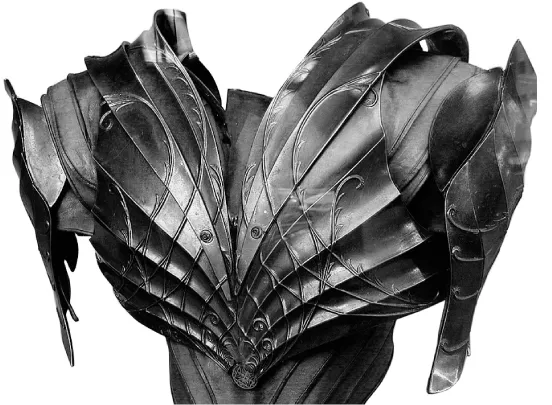
Elven armour from The Lord of the Rings film trilogy. (Vëon Menelion/PKM at the Wikimedia Project/Wikimedia Commons)
Tolkien’s Aunt Grace, his father Arthur’s younger sister, told Tolkien tales of the Tolkien family roots in Europe and how one relation, George von Hohenzollern, had fought with Archduke Ferdinand at the Siege of Vienna in 1529. George had raided the Turkish lines and captured the sultan’s standard and had been give the nickname Tollkubn, which meant ‘foolhardy’, and this nickname persisted. The family had moved to France but in 1794 had fled to England to escape the French Revolution and had started to use the surname Tolkien.
The Tolkiens had blended into English life by the nineteenth century and had become clock, watch and piano makers. Piano making had been Tolkien’s grandfather John Benjamin Tolkien’s business in Birmingham but the business had become bankrupt in 1877.
There are tales that during the Beatles’ flower-power period they looked into making a film of The Lord of the Rings in which Paul McCartney was to play Frodo with John Lennon as Gollum, George Harrison as Gandalf, and Ringo Starr as Sam, however this did not make it to the silver screen.
Tolkien again sold the film rights to The Hobbit and The Lord of the Rings in 1969 to United Artists, reputedly for $250,000 although some sources give a much lower sum of money. The money is believed to have been used to pay off a tax bill. Tolkien, and after his death the Tolkien Estate, retained a 7.5 per cent royalty for any future films made from the two books. United Artists employed John Boorman to produce a screenplay for The Lord of the Rings in 1970 but this never went into production.
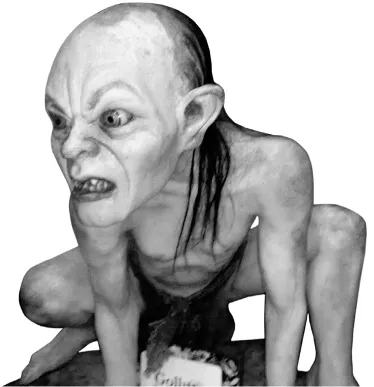
A Gollum sculpture at the Wax Museum, Mexico City. (Vic201401/Wikimedia Commons)
In 1976 United Artists sold the film rights to Tolkien’s works to the Saul Zaentz Company. They, through a company called Middle-earth Enterprises, produced an animated film called The Lord of the Rings, which was released in 1978. The film was directed by Ralph Bakshi and is based on the first half of The Lord of the Rings; the film is made up of live footage and animation. The live footage is rotoscoped – a method where live images are traced on to cels (celluloid transparent sheets) to convert them into animations – giving the film a consistent look. The film received mixed reviews from the critics but was a financial success and in later years influenced Peter Jackson in the making of his The Lord of the Rings films.
But before this, an animated film entitled The Hobbit was released in 1977, produced by Rankin/Bass and directed by Arthur Rankin Jr and Jules Bass. The film ran for 78 minutes and could be said to have been the prequel to The Lord of the Rings. They released an animated movie of the third book of the trilogy, The Return of the King, in 1979; this film ran for 97 minutes, so was a much-compressed version of the book, but held the basic storyline together.
The Hobbit was not what you would call a planned book by Tolkien, but started one day when he was marking examination papers. A student had left a blank page and Tolkien wrote on the page ‘In a hole in the ground there lived a Hobbit’ (H. Carpenter, ‘The Storyteller’, J.R.R. Tolkien: a Biography). Tolkien did not know what a Hobbit was but started writing the story in 1930/1931 and by 1932 he was able to show his friend C.S. Lewis an almost completed manuscript.
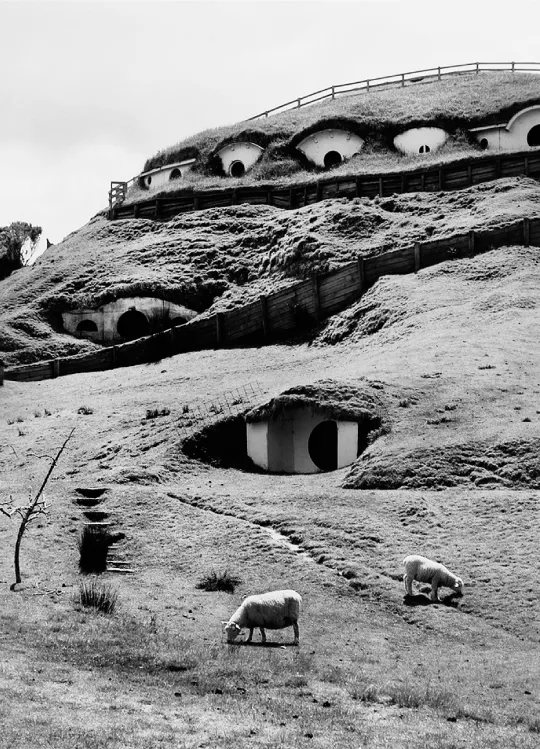
The Lord of the Rings twenty-first-century film trilogy was directed by Peter Jackson; the three-film project took eight years to make and cost $285 million. The films were made in New Zealand and distributed by New Line Cinema. The films take their titles from the three books that make up The Lord of the Rings, being The Fellowship of the Ring (2001), The Two Towers (2002) and The Return of the King (2003). The films follow Tolkien’s basic plot but flow through the storyline in a form that is easy to follow for the filmgoer, although they do leave out some of the plot and some of the characters, notably Tom Bombadil.
In 2002 a 2,000-page yellowing handwritten manuscript written by Tolkien, translating and appraising the epic poem Beowulf, was found in the Bodleian Library. Beowulf became a movie in 2007 and could be viewed in 3D as well as 2D at cinemas worldwide.
The epic tale, set in Tolkien’s fictional world of Middle-earth, is based around the destruction of the One Ring, made and owned by the Dark Lord Sauron. At the start of the first film, the One Ring is in the hands of Bilbo Baggins and is then given to his adopted heir Frodo Baggins, both Hobbits. Frodo is accompanied by the Fellowship of the Ring, made up of the Hobbits Sam, Merry and Pippin; Gandalf the Wizard, Gimli the Dwarf, Legolas the Elf, Boromir the Man from Gondor, and Strider the Ranger. The fellowship is on a quest to destroy the One Ring in the Cracks of Doom, but by the end of the first film the fellowship is broken up.
The next two films follow the adventures of the various surviving members of the fellowship and the other characters, both good and bad – notably the treacherous Gollum, himself once an ‘owner’ of the One Ring. The final film reaches a climax with the destruction of the One Ring and the return of the Hobbits to a much-changed homeland, the Shire. The three films have grossed just under $3 billion worldwide to date.
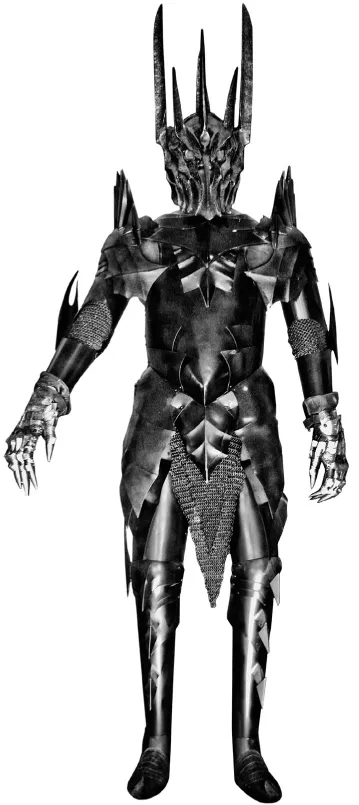
The Lord of the Rings fantasy armour from the Texas Renaissance Festival, 2008. (Jeremy Van Dyke/Magnus Manske/Wikimedia Commons)
Vi...
Table of contents
- Cover
- Title
- Copyright
- Contents
- Introduction
- The Tolkien Society
- Timeline
- 1 Tolkien and the Silver Screen
- 2 Southern Africa
- 3 Pipe Smoking in Fiction and Life
- 4 Birmingham Days
- 5 Ancient Landscapes and Myths
- 6 Love and Marriage
- 7 Clubs and Societies
- 8 Plaques and Memorials
- 9 Religious Faith
- 10 The Real Middle-earth
- 11 The Great Conflict: the First World War
- 12 Principle Inhabitants of Middle-earth
- 13 The Great Conflict: the Second World War
- 14 C.S. Lewis
- 15 Oxford Colleges
- 16 Published Works of J.R.R. Tolkien
- Bibliography
Trusted by 375,005 students
Access to over 1.5 million titles for a fair monthly price.
Study more efficiently using our study tools.
Frequently asked questions
Yes, you can cancel anytime from the Subscription tab in your account settings on the Perlego website. Your subscription will stay active until the end of your current billing period. Learn how to cancel your subscription
No, books cannot be downloaded as external files, such as PDFs, for use outside of Perlego. However, you can download books within the Perlego app for offline reading on mobile or tablet. Learn how to download books offline
Perlego offers two plans: Essential and Complete
- Essential is ideal for learners and professionals who enjoy exploring a wide range of subjects. Access the Essential Library with 800,000+ trusted titles and best-sellers across business, personal growth, and the humanities. Includes unlimited reading time and Standard Read Aloud voice.
- Complete: Perfect for advanced learners and researchers needing full, unrestricted access. Unlock 1.5M+ books across hundreds of subjects, including academic and specialized titles. The Complete Plan also includes advanced features like Premium Read Aloud and Research Assistant.
We are an online textbook subscription service, where you can get access to an entire online library for less than the price of a single book per month. With over 1.5 million books across 990+ topics, we’ve got you covered! Learn about our mission
Look out for the read-aloud symbol on your next book to see if you can listen to it. The read-aloud tool reads text aloud for you, highlighting the text as it is being read. You can pause it, speed it up and slow it down. Learn more about Read Aloud
Yes! You can use the Perlego app on both iOS and Android devices to read anytime, anywhere — even offline. Perfect for commutes or when you’re on the go.
Please note we cannot support devices running on iOS 13 and Android 7 or earlier. Learn more about using the app
Please note we cannot support devices running on iOS 13 and Android 7 or earlier. Learn more about using the app
Yes, you can access J.R.R. Tolkien: Inspiring Lives by Robert S. Blackham,Robert S Blackham,Robert Blackham in PDF and/or ePUB format, as well as other popular books in Literature & Literary Biographies. We have over 1.5 million books available in our catalogue for you to explore.