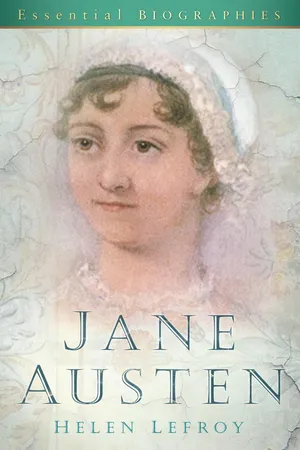
Jane Austen's reputation rests on the six novels she wrote in her short life - enduringly popular novels which have become part of the fabric of English life, and which have reached new audiences through recent dramatisations on screen and stage. This book, which draws on her letters, describes Jane's life in the vicarage at Steventon and later at Bath and Chawton, and her relationships with family and friends - especially her beloved sister, Cassandra, and the engaging Tom Lefroy (who it was rumoured was the love of her life). It also describes the parties and balls in country houses and assembly rooms which she attended and the detail of nineteenth-century life which she so sharply observed and which provided the background to her novels. This book is a pleasure for anyone wanting to understand the life of one of our great novelists.
- 128 pages
- English
- ePUB (mobile friendly)
- Available on iOS & Android
eBook - ePub
Jane Austen: Essential Biographies
About this book
Information
ONE
STEVENTON – THE EARLY YEARS
For generations Austens had lived at Horsmonden in Kent, where they were engaged in the woollen industry. At the end of the seventeenth century John Austen, owner of the family property, married a remarkably strong and determined woman, Elizabeth Weller. Widowed in 1704, and with a string of debts and children, she took on the job of housekeeper at Sevenoaks Grammar School and also lodged the Master. As funds were only available for her eldest son to go to university, the younger boys were obliged to seek apprenticeships. Francis became a prosperous lawyer in Sevenoaks and William a surgeon in Tonbridge. William – Jane’s grandfather – died when his son George (1731–1805) was six years old. From 1741 to 1747 George Austen – Jane’s father – attended Tonbridge School. An equable temperament, firm character and ability to work hard enabled him to take up the scholarship to St John’s College, Oxford, reserved for a boy from Tonbridge School. After taking his degree the Tonbridge connection enabled him to stay on at St John’s for a further seven years, studying divinity.
He was ordained a priest in the Church of England; he returned to Kent to take up the job of second master at his old school, and at the same time to be perpetual curate at Shipbourne, a few miles away. Three years later he went back to his Oxford college as assistant chaplain. As a bachelor he could remain at St John’s indefinitely but with no financial resources of his own, if he wished to marry he must find a benefice rich enough to support a family. A female second cousin had married Thomas Knight, the owner of the estate of Godmersham in Kent, who then had the good fortune to inherit more property and land in Hampshire, at Steventon and Chawton. Thomas Knight was able to offer the benefice of Steventon to George Austen. George’s wealthy uncle Francis purchased two more benefices in parishes near Steventon: George could have whichever became available first. So with the prospect of a tolerable income from two parishes, George set out to woo and to win the heart of Cassandra Leigh, younger daughter of the Revd Thomas Leigh of Harpsden, near Henley-on-Thames.
Cassandra came from the Gloucestershire family of Leigh, who were descended from Sir Thomas Leigh, Lord Mayor of London in the time of Elizabeth I. Wealthy and powerful, he acquired the enormous mansion and surrounding lands of Stoneleigh Abbey. As a reward for welcoming Charles I to the Abbey during the Civil War, Thomas Leigh’s son was given a peerage.
George Austen and Cassandra Leigh were married at Walcot Church, Bath, on 26 April 1764. They set off immediately for Hampshire, but as the rectory at Steventon was in poor condition, they spent the first four years of their married life a couple of miles away at Deane Rectory, where their first three sons were born: James (1765), George (1766) and Edward (1767). George was born handicapped and did not live at home but was cared for in a village in the neighbourhood until his death at the age of seventy-two.
Steventon Rectory stood at the foot of the lane which leads up to the simple medieval church of St Nicholas. There were three main rooms on the ground floor at the front, with George Austen’s study and library at the back; above were seven bedrooms and three attics. The house was demolished in 1826; all that remains is a pump in the corner of a field. Steventon is still a small rural village, surrounded by fields and woods, in a valley between two main roads. The Austens would have walked or ridden a few miles north to Deane Gate to pick up a stage-coach to London, or to Andover, Salisbury and the west. A few miles to the south was the Wheatsheaf Inn, a regular stopping place for coaches from Winchester and Southampton en route to London, where the horses could be changed and passengers given just twenty minutes for breakfast.
At Steventon the Austen family was enlarged: Henry (1771), Cassandra (1773), Frank (1774), Jane (16 December 1775) and finally Charles (1779) were all born there. To supplement his income George Austen decided to take pupils, the sons of the local gentry, who were educated with his own boys and were boarded in the house. With the help of a bailiff George Austen cultivated his three acres of glebe land, and a further 200 acres which he rented.
Jane had the great good fortune to be born into a supremely happy and resourceful family. Her parents were never wealthy but both had aristocratic connections. Parsons on the whole were better educated than squires, and had a recognized and respected place in society. A degree from Oxford or Cambridge University was the only essential requirement for ordination in the Church of England.
Cassandra Austen, a lively, intelligent wife and mother, was a thrifty and sensible manager of her large family. She kept a few cows at Steventon and would certainly have had a well-stocked poultry-yard. To add variety to meals for the family and visitors she and her husband worked hard in the vegetable garden and orchard. She was a great reader of novels, borrowed from a circulating library in Basingstoke, and she had a gift for writing verse and choosing words to rhyme – a gift inherited by several of her children. A grand-daughter later remembered that visitors to Steventon Rectory would usually find her in the front parlour with a needle in her hand, making and mending.
Cassandra Austen’s sister Jane had married the Revd Dr Edward Cooper in 1768. He gave up a fellowship at All Souls College, Oxford, to become the rector of a parish near Bath. Their two children, Edward and Jane, were good friends of the Austen family. When the Austens decided that their elder daughter Cassandra should join her cousin Jane Cooper to be given lessons by Mrs Cawley at Oxford, Jane Austen, then aged seven, insisted on going too. Mrs Cawley, the childless widow of a former head of an Oxford college, was strict and unsympathetic. She took the three girls with her when she moved to Southampton. There the Austen girls caught typhus. Jane was seriously ill and it was only Jane Cooper’s presence of mind in writing to the Austens at Steventon which saved the girls. Mrs Austen and Mrs Cooper rescued their daughters in time, but Mrs Cooper caught typhus and died.
Cassandra and Jane now spent more than a year at home, but by 1785 it was time for Cassandra, the elder girl, to receive more education. In a household of boys and young men it may have been thought she should have the opportunity to acquire the feminine accomplishments of music, dancing and needlework. Again Jane insisted on accompanying her sister, which prompted her mother’s comment that, ‘if Cassandra’s head had been going to be cut off, Jane would have hers cut off too’.1 Now aged twelve and nine, Cassandra and Jane joined Jane Cooper at the Abbey School, Reading. It seems to have been a happy establishment, with lessons in the morning only. But Mr Austen would have to pay fees of £35 per annum for each girl; these may have been more than George Austen could afford. In the following years he would also need to find fees of £25 a year for his son Frank when he entered the Naval Academy at Portsmouth, though extras (the barber, shoemaker, instruments and stationery, for example) brought the total cost of maintaining a boy at the Academy nearer to £50 a year. So after only eighteen months the girls returned home. From then on Jane educated herself from the resources of her father’s extensive library, and certainly with his guidance.
The close friendship between the sisters was remembered many years later by their niece Anna:
Their sisterly affection for each other could hardly be exceeded. . . . This attachment was never interrupted or weakened. They lived in the same home, and shared the same bed-room, till separated by death. . . . Cassandra’s was the colder and calmer disposition; she was always prudent and well judging, but with less outward demonstration of feeling and less sunniness of temper than Jane possessed. . . . Cassandra had the merit of having her temper always under command; Jane had the happiness of a temper that never required to be commanded.2
In 1792 Mr Austen’s niece Eliza de Feuillide wrote of the sisters: ‘Cassandra & Jane are both very much grown (the latter is now taller than myself) and greatly improved as well in Manners as in Person. . . . They are I think equally sensible, and both so to a degree seldom met with, but still My Heart gives the preference to Jane, whose kind partiality to me, indeed requires a return of the same nature.’3
After Jane’s death in 1817 Henry Austen wrote of his sister: ‘Her carriage and deportment were quiet, yet graceful. Her features were separately good. Their assemblage produced an unrivalled expression of that cheerfulness, sensibility, and benevolence, which were her real characteristics. Her complexion was of the finest texture. . . . Her voice was extremely sweet.’4
And in 1870, when he came to write A Memoir of Jane Austen, her nephew Edward said of his aunt: ‘In person she was very attractive; her figure was rather tall and slender, her step light and firm, and her whole appearance expressive of health and animation. In complexion she was a clear brunette with a rich colour; she had full round cheeks, with mouth and nose small and well formed, bright hazel eyes, and brown hair forming natural curls close round her face.’5
Life at Steventon in 1786 was not dull. The good-looking and lively brothers were popular, and always ready to join friends for a day’s hunting or rough shooting. James, the eldest, was especially keen on the craze for amateur theatricals, and for several years would persuade his brothers and their friends to join in performing plays or a pantomime either in the house or the barn. The cast was occasionally joined by George Austen’s niece Eliza de Feuillide. Married to a French army officer (who was later guillotined) she came to England for the birth of their son. Jane was fascinated by this pretty, sophisticated cousin, her sharp eyes missing nothing as Eliza teased and flirted with the susceptible James and Henry Austen.
At the age of about twelve, Jane began to write down some of the stories she had probably told Cassandra in the bedroom they shared. She copied the stories into three manuscript books which she labelled ‘Volume the First’, ‘Volume the Second’ and ‘Volume the Third’. They are known collectively as the Juvenilia. The stories are light-hearted, witty and amusing, and would have been read aloud to the family in the evenings. ‘She also had a high-spirited taste for nonsense. . . . At fifteen her writing is already marked by her characteristic neat stylishness, her crisp irony.’6
The brothers now began to leave home. Edward, after travelling on the Continent, was spending more time with Mr and Mrs Thomas Knight who had chosen him to be their heir. He was the first of the brothers to marry, his bride being Elizabeth Bridges, a beautiful girl from Kent. He was a generous and genial host, always welcoming family and friends to Godmersham Park, the fine country house near Ashford in Kent later bequeathed to him by the Knights. The second house he inherited was at Chawton in Hampshire. Cassandra was frequently called on to run the household, and to amuse the children whenever Elizabeth was lying in, usually for a month, after the birth of another child. She was there when Elizabeth died unexpectedly after the arrival of Brook John in 1808.
Frank had also left the rectory. After two years at the Royal Naval Academy, his first sea-going appointment took him to the East Indies for four years. In 1791 Jane’s youngest brother Charles followed Frank to the Na...
Table of contents
- Cover
- Title
- Copyright
- Dedication
- Contents
- Chronology
- Introduction
- 1. Steventon – The Early Years
- 2. Steventon – The Later Years
- 3. Bath
- 4. Lyme Regis
- 5. Southampton
- 6. Chawton – The Early Years
- 7. Chawton – The Later Years
- 8. The Last Years
- 9. Aunt Jane and her Nieces and Nephews
- 10. Why Did Jane Austen Not Marry?
- 11. After Jane’s Death
- Jane Austen’s Works
- Bibliography
- Notes
Trusted by 375,005 students
Access to over 1.5 million titles for a fair monthly price.
Study more efficiently using our study tools.
Frequently asked questions
Yes, you can cancel anytime from the Subscription tab in your account settings on the Perlego website. Your subscription will stay active until the end of your current billing period. Learn how to cancel your subscription
No, books cannot be downloaded as external files, such as PDFs, for use outside of Perlego. However, you can download books within the Perlego app for offline reading on mobile or tablet. Learn how to download books offline
Perlego offers two plans: Essential and Complete
- Essential is ideal for learners and professionals who enjoy exploring a wide range of subjects. Access the Essential Library with 800,000+ trusted titles and best-sellers across business, personal growth, and the humanities. Includes unlimited reading time and Standard Read Aloud voice.
- Complete: Perfect for advanced learners and researchers needing full, unrestricted access. Unlock 1.5M+ books across hundreds of subjects, including academic and specialized titles. The Complete Plan also includes advanced features like Premium Read Aloud and Research Assistant.
We are an online textbook subscription service, where you can get access to an entire online library for less than the price of a single book per month. With over 1.5 million books across 990+ topics, we’ve got you covered! Learn about our mission
Look out for the read-aloud symbol on your next book to see if you can listen to it. The read-aloud tool reads text aloud for you, highlighting the text as it is being read. You can pause it, speed it up and slow it down. Learn more about Read Aloud
Yes! You can use the Perlego app on both iOS and Android devices to read anytime, anywhere — even offline. Perfect for commutes or when you’re on the go.
Please note we cannot support devices running on iOS 13 and Android 7 or earlier. Learn more about using the app
Please note we cannot support devices running on iOS 13 and Android 7 or earlier. Learn more about using the app
Yes, you can access Jane Austen: Essential Biographies by Helen Lefroy in PDF and/or ePUB format, as well as other popular books in History & Historical Biographies. We have over 1.5 million books available in our catalogue for you to explore.