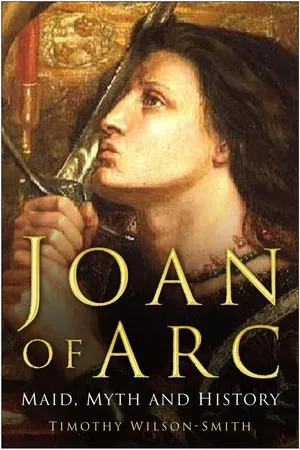
Joan of Arc, born in Domremy in France in 1412, began to hear voices when she was thirteen and, believing they were directives from God, followed them - to the French court, to battle to wrest France from the English in the Hundred Years War, and to defeat and capture. She was put on trial for heresy and, on 30 May 1431, burned at the stake. Even today many people are fascinated by this teenage woman who persuaded her king to believe that she could lead her nation to victory. In the retrial of 1452-6 she was vindicated, but it took almost five hundred years after an English soldier declared 'we have burnt a saint' for the Catholic Church to conclude that she was indeed one. Joan of Arc: Maid, Myth and Mystery is not merely an account of a life that was cut short; its focus is also on Joan's history, which in 1431 had just begun, and which, the author shows, was influenced just as much by the transformation in Anglo-French relations and by internal politics, issues of freedom and republicanism, and by changes in society regarding secularisation and belief, as by our response to the central issue of Joan's voices themselves.
- 256 pages
- English
- ePUB (mobile friendly)
- Available on iOS & Android
eBook - ePub
About this book
Trusted by 375,005 students
Access to over 1.5 million titles for a fair monthly price.
Study more efficiently using our study tools.
Information
PART ONE
The Maid in Life and Death
ONE
A Prophetess to the Rescue
England and France had been rivals for many years when, in Holy Week 1429, Joan of Arc wrote to Henry VI, child king of England and France, informing him that she was sent by God to tell him to leave France and return home. The letter was also sent to William de la Pole, Count of Suffolk, Sir John Talbot and Thomas, Lord Scales, lieutenants of the Duke of Bedford, ‘who calls himself Regent of the King of France for the King of England’ (Bedford, Regent of English France, was Henry’s older uncle). Joan also addressed the soldiers besieging Orléans, among whom she singles out the feared English archers.
As an illiterate girl, Joan dictated her letters. How many letters in all were sent cannot be known, but about twenty are referred to in various documents, of which this letter to the English is the first complete letter to survive. It survived because it must have so incensed the recipients that it was kept and cited as evidence against Joan at her trial in Rouen. Her tone is peremptory and arrogant. The King of England must render account to the King of Heaven and return the keys of the cities he has seized. If he does not, as ‘commander of the military’, she will force his men to flee; and if they do not obey, ‘the Maid’ (Joan) will have them all killed. She is sent by the King of Heaven ‘to take you out of France’. ‘The King of Heaven has sent her so much power that you will not be able to harm her or her brave army.’1
Those before Orléans must go: ‘you have no rights in France from God, the King of Heaven, and the Son of the Virgin Mary’, for God has given France to Charles, the rightful heir; and he will soon enter Paris ‘in a grand company’. Lieutenants of the Duke of Bedford, who ‘calls himself Regent of the King of France for the King of England, make a response, if you wish to make peace over the city of Orléans!’ As for the Duke, ‘the Maid asks you not to make her destroy you’. ‘If you come to terms, you . . . can join her company, in which the French will perform the greatest feat ever done in the name of Christianity.’2
Holy women on a mission are apt to be curt. Fifty years earlier, St Catherine of Siena had bullied Pope Gregory XI into going back to Rome; and when the move led to a schism in the Church, with one pope in Avignon and another in Rome, Catherine did not hesitate to maintain that the true pope was Gregory’s successor in Rome, Urban VI. There were two important differences between Catherine and Joan, however. First, Catherine spoke persuasively in a melodious Tuscan Italian, whereas Joan probably never went beyond the stage of managing to write her own name, Jehanne. Second, Catherine fought for true authority in the Catholic Church, whereas Joan claimed to know the true authority in one Christian state. In 1415, shortly after Joan was born, the schism in the Church was ended at the Council of Constance, but there were doubts about the relative authority of popes and Church councils; and Joan was not sure who was the true pope. What mattered to Joan was her insistence that Henry VI was a usurper, with no rights over the lands God designed for his uncle Charles, whom his enemies had demoted to the King of Bourges; and that she, to whom she referred dispassionately as ‘the Maid’ (in French la pucelle), was to restore to Charles his undivided kingdom.
The writing of the letter was the culminating episode in a story that had begun some ten months earlier. In May 1428 Joan had gone to see Robert de Baudricourt, châtelain, or castellan, of the local castle of Vaucouleurs, to order him to take her to Charles. Twice he demurred, until at last, after her repeated calls that he must do what her voices demanded, he obeyed. But, even though she was admitted to the court at Chinon and she identified Charles when he pretended to hide, Charles asked the theologians of the loyal University of Poitiers to question her, before he trusted her. As the University of Paris, most prestigious of all French universities, was under Anglo-Burgundian control, this was the most prudent act he could perform. After this, her first ‘trial’, Joan sent her letter to the King of England.
No details of the Poitiers conversations are known; and more attention has been given by historians, playwrights and film-makers to her first meeting with Charles in Chinon. How was she able to identify him? What did she say to him in private? This encounter may have given Charles confidence in her, but it seems it was the interrogations at Poitiers that gave her confidence in herself. The university theologians found no wrong in her, but only ‘humility, virginity, devotion, honesty, simplicity’. Everyone she met took an interest in her virginity. It is also obvious that she was direct, but the hectoring manner that suffuses her letter to Henry VI was not evident to the first group of clerics who pressed her closely on her mission. What worried Seguin Seguin, a Dominican friar who was dean of the Faculty of Poitiers, was that there was as yet no sign of her divine calling. ‘God,’ he claimed, ‘did not want her to be believed unless something appeared on account of which it seemed to them that she was to be believed.’3 It was not enough that she asserted that God had sent her nor that soldiers – he could have meant Robert de Baudricourt – believed her assertions.
A contemporary German inquisitor wrote that ‘there was lately in France, within the last ten years, a maid of whom I have already spoken, named Joan, for her prophetic spirit and for the power of her miracles.’4 When she prophesied, Joan emphasised her role as la pucelle, the Maid, as much as on the rights of Charles the Dauphin to be King of France. The word ‘la pucelle’ is hard to translate, for although it means a girl on the threshold of adulthood, it does not have precisely the sense of our word ‘nubile’. Over and over again Joan emphasised that she was a virgin, and every time her virginity was examined she was intact. To some commentators, from Voltaire to the present day, her obsession seems morbid. It places her, however, in a tradition that goes back to the beginnings of Christianity, for what distinguished the Christians from other Jewish sects, including even the Essenes of Qumran, was the value they placed on celibacy. Jesus himself was not married, his mother was said to be a virgin and of the Apostles only St Peter was known to be a married man. Even though most Christians married, even though the unmarried St Paul saw married love as an appropriate image of the love between Christ and his Church, celibacy had from the early days of Christianity a certain prestige among Christians. By Joan’s time, celibacy, long cherished as a monastic ideal, had become a clerical one. While in the Eastern Church only bishops had to be monks, in the West the law prescribed that all priests should be celibate.
From the early thirteenth century, as urban society became more developed, there was a move to carry the faith to lay people in the towns, and this was carried out by the new ‘orders’ of friars, who took vows of chastity as well as of poverty and obedience. In Joan’s day, in addition to the parish clergy there were still monks, but the storm troopers of the Church were the friars. Among their numbers were the best-trained, the most eloquent, the most admired and the most traduced of clerics. Free from working in the government of the Church, they could devote themselves to individualistic projects, such as teaching and writing – they dominated the universities – or to preaching to lay people and giving direction to their spiritual lives.
At this time, male monks or friars far outnumbered women religious, who followed slightly modified versions of male rules, but from 1300 women became more prominent and played an increasingly individualistic role in the spiritual affairs of the Church. At the age of seven St Catherine of Siena consecrated her virginity to Christ; aged sixteen she joined the Dominican third order – friars made up the first order and nuns the second – and thus was attached to a religious order while still a lay person. In her twenties, after receiving a series of visions, she began her spectacular public career. In the Netherlands, lay women lived together in béguinages free of vows, free to keep their property, free to leave and marry, but at least temporarily virginal, while they taught or did light manual labour or devoted themselves to prayer. Slightly further north, in Norwich, a woman who may have been a Benedictine nun, Dame Julian, lived as a recluse in an anchorage, a small house set in a churchyard, devoting herself to prayer and later, after experiencing a number of visions, to dictating her story. She claimed to be illiterate, which probably means that her Latin was not up to much, but she was well read in texts she needed to know, such as some of St Catherine’s letters and some modern English clerical writings.
None of these women was a model for Joan of Arc, but it is beside this group that she belongs, both as a visionary and as a woman of action; and yet her social background was different to theirs, for whereas the others came from cities where international trade flourished, she never forgot that she was a country girl. Like her, some béguines were suspected of heresy; like her, St Catherine of Siena found that her life was threatened by political enemies; all were like her in their devotion to temporary or permanent virginity. Of those who ‘visited’ Joan, Sts Catherine (of Alexandria) and Margaret (of Antioch) reinforced her resolve to remain a virgin, though curiously St Margaret is patron saint of childbirth and as such it is probably her statue that is on the bedstead of Jan van Eyck’s Arnolfini wedding portrait, which dates from 1434. There could have been many other such heavenly visitants, such as St Barbara, along with the tower in which her father had immured her to force her to marry, or the huge company, some 10,000 virgins who traipsed round Europe with St Ursula before suffering martyrdom for the sake of virginity. And besides these there were numerous virgin martyrs, set in serried ranks like those standing with loosened hair and palms in their hands among the heavenly hosts who adore the Lamb in the Ghent altarpiece that Jan van Eyck was in process of finishing while Joan became famous. One female saint, St Uncumber, had a beard to put men off; and it was for similar reasons, not as a transvestite, that Joan wore men’s clothes. To accomplish what she fervently believed she was called to do, she had to neutralise men’s sexual urges. She was strong and fit and became a good horsewoman, but she never struck anyone as unfeminine. To be whole-hearted, however, she had to be a virgin.
Most virgins called themselves virgins for the kingdom of heaven. What marks out Joan is that she was also a virgin for the kingdom of France or, rather, for Charles the Dauphin, whom she was sure was God’s choice as King of France.
Playgoers will be familiar with Shakespeare’s habit of indifferently using the words ‘England’ and ‘France’ (or ‘Worcester’ or ‘York’) for a country, a county, a city and for the person who has authority over the place. The man is identified with his title and the title with his land. In a feudal society, where a lord could expect loyalty from those who held their land from him, tight bonds kept upper-class society together; even when, by Joan’s time, those bonds had been so loosened that lords thought more in terms of retainers and servants than of vassals, there was still a tendency to think of a king as sovereign, suzerain or overlord; he was the linchpin of lay society.
The King of France was also something more. As God’s anointed, he was given divine authority over his people; he had a miraculous power to heal when he touched for the king’s evil or scrofula, a power that his brother of England also exercised. From the 1160s, following the canonisation of Edward the Confessor, the King of England was able to claim a royal saint; a century later Henry III built a great shrine for St Edward in the abbey the Confessor had founded in Westminster and also named his son and heir Edward. It took the French royal family 150 years to catch up, but when Louis IX was declared to be St Louis, at least every King of France since the saint’s death in 1270 could claim a saint as ancestor (Edward the Confessor had died childless). The aura of holiness clung to the kings of both countries.
The lawyers of the French king drew attention to his rights as king. He could tax his subjects, lay down laws, call them to account in his courts. Indeed, in the fifteenth century the distinguished English lawyer Sir John Fortescue noted that the rights of the King of France were far greater than those of his English counterpart. Whereas the English kingdom was a dominium regale et politicum, the kingdom of France was a dominium regale tantum. Fortescue was probably writing while in exile in France in the 1460s, during the period of the dynastic civil wars known as the Wars of the Roses, when a struggle for the throne was symbolised as a contest between the white rose of the Dukes of York and the red rose of the Dukes of Lancaster. In this period English institutions were crumbling, but the point Fortescue made was still a valid one. Kings had the right and the duty to govern in a dominium regale, but while the English king had to consult with his peers and his commoners in parliament, the French king did not have to listen to or even summon the Estates General. In more modern terms, the King of England was a constitutional king, the King of France was an absolute monarch. Fortescue may have been too sanguine about English practice and understandably he overestimated the French king’s actual freedom of action, as he was writing when Joan’s Charles VII had just driven the English from all French soil except that round Calais. Throughout his reign Charles had been only too well aware that his power was restricted by the privileges of many of his subjects, above all those of his dukes, his counts and sometimes even of burgesses or bourgeois in cities. Peasants had almost no rights, but the whole pyramid of society rested on them; and there was nothing more feared than a peasant revolt.
For generations French royal power had been centred on the Île de France, the countryside round Paris, but gradually it had been extended to include neighbouring lands to the north-east, such as Artois, and in the Loire and Seine valleys, where Touraine, Anjou, Maine and Normandy were wrested from John of England. Further gains, in Poitou (also from the English), in Languedoc, in the northeast and the centre of France put most of the land now called France under the control of its king. By 1300 the King of France was the most powerful lay ruler in Latin Christendom, far stronger than the Holy Roman Emperor – whom even a man as intelligent as Dante liked to believe to be still the leading monarch in the West. Even the Church, when Philip IV cajoled the pope to move to Avignon in 1309, appeared to be a spiritual adjunct to the French Crown. A French king and pope should have been an unstoppable combination; and yet the army of Philip IV had been routed by the cities of Flanders at the battle of Courtrai in 1302.
Extensive though the royal demesne had become, four fiefs lay beyond its bounds; and, besides, the Count of Anjou, who was descended from Louis IX’s youngest brother, was semi-independent both as count of Provence, a county outside France, and as sometime King of Naples. Of the four fiefs, Flanders and Brittany scarcely identified with France, as many of their inhabitants did not speak French; Burgundy, closer to the kingdom’s heart, had reverted to the French Crown and would pass to the son of a king; and the English lands in the south-west, making up the duchy of Guyenne, were remote and hard to handle, as its duke was also King of England. From 1258 the English king held these lands from the French king. Philip IV made inroads into Guyenne but failed to conquer it; Philip had, however, prepared the way for France’s acquisition of the duchy by making Edward I agree to the marriage of his son Edward to Philip’s daughter Isabella – on condition that he, Philip, return Gascony, the southern coastal area of the duchy he had seized, to his ‘dearest cousin’. With this marriage in mind, Philip could anticipate the day when his grandchild, as King of England and France, would bring to an end France’s problems with English Guyenne.
It turned out that it was the Crown of France that had the problems. When Philip IV died in 1314, the French dynasty, hitherto so stable, was threatened by an unfamiliar sequence of occurrences. From 987, when Hugh Capet had become king, survival had never been an issue, because in each generation of the royal line of Capet a son had succeeded a father. Now the normal chain of events was broken. Philip’s oldest son Louis X died in 1316, as did Louis’s son, John I, who reigned for only ten days. The infant’s uncles, Philip V and Charles IV, dying in 1322 and 1328 respectively, had no male heirs, leaving as nearest male relative the son of their sister Isabella and her husband Edward II of England. In 1327 this teenager, another Edward, became Duke of Guyenne and King Edward III of England. In Paris, his mother’s representatives argued that there was no good reason why a woman should not inherit a title, but the French assembly ruled out any claim that would involve her. The French had an immediate practical problem: they needed a regent, as the late king’s wife was pregnant. They chose the late king’s adult male cousin, Philip Count of Valois, to take that role; and, when a baby girl was born to the widowed queen, the count quickly became King Philip VI.5 This decision accorded later with a fundamental principle of the French constitution according to Salic Law, not only must the throne of France be inherited by a man, but also through the male line. At the time the choice of Philip VI was wise. Edward III was young, far away and apparently dominated by a mother nobody in Paris liked.
Exactly a century later, Joan too was concerned with rights of inheritance, for she held that Charles the Dauphin was the man God meant to be the king, not Henry VI of England and II of France, who was connected to the French throne by his mother Catherine, Charles’s sister. Joan believed that nothing could set aside God’s intended order of succession. She also valued another Frankish legacy: the work of St Remigius, apostle of the Franks, patron of her parish church in Domremy. St Remigius, in French Rémi, was the man who baptised Clovis, the first King of the Franks to extend his hold over large parts of northern Gaul.
Clovis made his ruthless way as a barbarian and a pagan until in 496, yielding to the arguments of his Christian wife and Remigius, he became a Catholic. Being Catholics did not prevent Clovis or his successors from indulging in the internecine struggles that fill the depressing pages of Bishop Gregory of Tours’s History of Gaul. The Franks, however, were a conduit by which the Catholic faith and so the influence of the Roman Church, flowed over Western Europe. When the line of Clovis died out, it was replaced by the line of Charles Martel, who had stopped the Moors from overrunning Gaul; and his grandson Charlemagne extended Frankish rule beyond Gaul into parts of Germany, Italy and even Spain. The fame of Clovis and Charlemagne was cherished by the western or Salian Franks, whose kingdom became the nucleus of France, so that the two names most common among the kings of France were the Frankish names of Clovis, Clodovicus or Lodovicus in Latin, Louis in French, and of Karl, Karolus or, in French, Charles. Joan’s king was a Charles and his son and heir was a Louis. Both had to play a role uniquely French, for thanks to Clovis France was called the oldest daughter of the Church. But no French king, Joan believed, was truly king until he had been anointed with the oil of St Remigius in Reims Cathedral and crowned.
The legal case for English kings to be also kings of France rested on the assumption that as the late king’s closest relative, Edward III should have inherited the throne of France. The assumption mattered only because some members of the English royal family were formidable generals. It was not until 1340, backdating his claim to 1337, that Edward declared he was the rightful King of France. It was a derisory assertion until first he beat Philip at Crécy and took Calais, and then his heir, Edward the Black Prince, defeated King John II, Philip’s son and successor, at Poitiers. In 1361, by the Treaty of Brétigny, Edward was conceded sovereignty over the whole of Guyenne, one-third of France, in return for renouncing his claim to France. But that claim was revived when most of the duchy was won back by Charles V (1364–80). In 1369, as Charles prepared to invade Gascony, Edward reasserted his claim to France. On his royal banner, alongside the two lions of Normandy and the single lion of Aquitaine, he placed the lilies of France – which remained there until 1802 – long before the three lions had been nationalised as the emblems of England.
By the time the next English king, Richard of Bordeaux, inherited the English throne in 1377, he did not hold much land near his birthp...
Table of contents
- Cover
- Title
- Copyright
- Contents
- Preface
- Acknowledgements
- Chronology
- Prologue: The Limits of History
- Part One: The Maid in Life and Death
- Part Two: The Maid Vindicated
- Part Three: The Cult of the Maid
- Genealogical Tables
- Notes
- Bibliography
Frequently asked questions
Yes, you can cancel anytime from the Subscription tab in your account settings on the Perlego website. Your subscription will stay active until the end of your current billing period. Learn how to cancel your subscription
No, books cannot be downloaded as external files, such as PDFs, for use outside of Perlego. However, you can download books within the Perlego app for offline reading on mobile or tablet. Learn how to download books offline
Perlego offers two plans: Essential and Complete
- Essential is ideal for learners and professionals who enjoy exploring a wide range of subjects. Access the Essential Library with 800,000+ trusted titles and best-sellers across business, personal growth, and the humanities. Includes unlimited reading time and Standard Read Aloud voice.
- Complete: Perfect for advanced learners and researchers needing full, unrestricted access. Unlock 1.5M+ books across hundreds of subjects, including academic and specialized titles. The Complete Plan also includes advanced features like Premium Read Aloud and Research Assistant.
We are an online textbook subscription service, where you can get access to an entire online library for less than the price of a single book per month. With over 1.5 million books across 990+ topics, we’ve got you covered! Learn about our mission
Look out for the read-aloud symbol on your next book to see if you can listen to it. The read-aloud tool reads text aloud for you, highlighting the text as it is being read. You can pause it, speed it up and slow it down. Learn more about Read Aloud
Yes! You can use the Perlego app on both iOS and Android devices to read anytime, anywhere — even offline. Perfect for commutes or when you’re on the go.
Please note we cannot support devices running on iOS 13 and Android 7 or earlier. Learn more about using the app
Please note we cannot support devices running on iOS 13 and Android 7 or earlier. Learn more about using the app
Yes, you can access Joan of Arc: Maid, Myth and History by Timothy Wilson-Smith in PDF and/or ePUB format, as well as other popular books in History & Historical Biographies. We have over 1.5 million books available in our catalogue for you to explore.