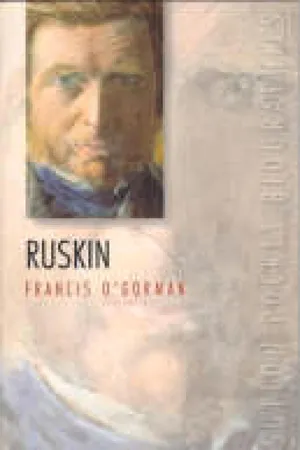
John Ruskin was one of the greatest Victorian critics of art and society, but he was also preoccupied with politics, economics and education. This pocket-sized biography explores his influence on his own age and ours, examining his work, his relationships and his creative life.
eBook - ePub
Ruskin
About this book
Trusted by 375,005 students
Access to over 1.5 million titles for a fair monthly price.
Study more efficiently using our study tools.
Information
ONE
‘THIS BOOK
SEEMS TO GIVE
ME EYES’,
1819–43
John Ruskin is England’s greatest writer on European visual arts and architecture. He writes luminously about paintings and buildings with a power and passion unmatched by any other English author. He is a social critic of seminal importance whose ideas influenced both his own age and ours. Among other things, he is also an educationalist, architect of the welfare state, literary critic, historian, theologian, scientist, student of Greek myth, watercolourist, autobiographer, university professor and a practical builder of roads. His life is closely linked with some of the most stirring and beautiful places in Europe, such as the Alps, the English Lakes and the city Ruskin called the ‘ghost upon the sands of the sea’,1 Venice, though it is also a life, as this book will show, of intense personal anguish and disappointment. What Ruskin so triumphantly accomplished, he achieved often by overcoming pain and disillusionment. He is a great and compelling writer and, though he left no children behind him, he fathered many books, and they continue to live, vividly, and to exert a powerful and enduring influence on those who read them today.
On 8 February 1819, John Ruskin, the only child of Margaret (née Cock) and John James Ruskin, was born at 54 Hunter Street, Brunswick Square, London, a terraced, blank-faced and now demolished house near the present site of St Pancras station. His father, John James (1785–1864), the son of a financially misfortunate Edinburgh merchant, was a highly successful sherry importer (Buckingham Palace would buy directly from him on occasions) whose prudence, enterprise and flair secured a large and increasing income for his wife and son. John James’s death in 1864 would leave his son a very rich man. His wife, Margaret (1781–1871), was a committed Evangelical Christian and she brought her son up to share her strong beliefs. But the household was not a puritan one: how could it have been when it depended on John James’s discriminating palate? Good food and wine were enjoyed there. Ruskin, a child of precocious mental power, learned to read at an early age, and his parents separately provided him with courses of reading which, in their different ways, profoundly influenced his future life.
At about the time that the family moved, in 1823, to Herne Hill, Ruskin’s mother began to make her son read aloud from beginning to end the whole of the Bible, starting all over again at Genesis the day after he had finished the Revelation. This continual reading and rereading was maintained till Ruskin went up to Oxford. It left an indelible impression on his mind and his prose style and, long after he had shed his own Evangelical beliefs, the cadences and vocabulary of the King James Bible permeated his writing. John James Ruskin was more widely read and his enthusiasms – for Shakespeare, Homer and Byron, for instance – also became his child’s. But his chief literary legacy to his son was his passion for Sir Walter Scott, whose novels and poems were to provide Ruskin with a lifetime’s inspiration and pleasure and a powerful ideal of chivalric conduct.
John James’s work necessitated a good deal of cross-country travel in search of business, and he took his son with him as soon as he could. From 1824, they began to visit English country houses in pursuit of custom. In 1825, John James took his child further afield to France and Belgium, where they saw the field of the Battle of Waterloo. Even from the earliest, John could not travel without writing down what he saw and thought, or sketching the views before him. Some of his writing was in verse, and his ‘Derwent Water’ was published in the Spiritual Times in August 1829 when he was only ten; it is his first published work.
The family’s 1830 tour of the Lake District, travelling via Oxford, Birmingham and Matlock, was recorded in a comprehensive diary, as well as, later, in an amusing but rather pompous poem in rhyming couplets, Iteriad or Three Weeks Among the Lakes.2 The diary, published only in 1990, reveals the young Ruskin’s already highly developed facility for close observation and preserving fine details of what he saw. His long account of Gloucester Cathedral, with which he concluded his narration of the family’s travels, was the beginning of a lifetime’s literary labour in fastidiously recording the architecture and monuments of great historical buildings.3
A gift in 1832, for his thirteenth birthday, of a copy of Samuel Rogers’s somewhat mundane poems Italy was a significant event for the young Ruskin, though not because of the poetry. Italy in its 1830 edition contained illustrations by Prout, Stothard and, chiefly, Joseph Mallord William Turner, perhaps the first time Ruskin had seen the work of the artist whose name was to become inseparable from his. (He may have seen a Turner oil at Appuldurcombe when he visited the Isle of Wight in 1828.) Ruskin later met Rogers and embarrassingly praised the quality of the illustrations, omitting to compliment the poet on the poetry. But he knew what he thought more important.
In 1833, the Ruskins were abroad again, this time more ambitiously. They took an extended continental tour into mainland Europe that included Strasburg, Schaffhausen, Milan, Genoa and Turin, and their son began his acquaintance with one of the most influential landscapes of his life, the Alps. ‘How shall I thank you for carrying me again over the summits of the higher Alps[?]’ Ruskin wrote to his father on their return: ‘Mamma says you are spoiling me. I say I am spoiling, despoiling, and taking the spoil of your pocket [. . .] What a dear Papa, I’ve got’.4 Later, in his autobiography, Ruskin said the first sight of the Alps was ‘not only the revelation of the beauty of the earth, but the opening of the first page of its volume’.5 During this tour, Ruskin, while in Paris, met Adèle Domecq, the young daughter of one of his father’s business partners; he later developed a youthful passion for her which lasted some years and caused him to be gravely distressed emotionally. Margaret Ruskin was appalled by her Catholicism.
In 1834, the fifteen-year-old Ruskin published his first work in prose, an essay on the colour of the waters of the Rhine in Loudon’s popular Magazine of Natural History. It revealed further his gift for careful visual study, and was an early sign of his fascination with science which would form another important facet of the adult Ruskin’s interests. It was his greatest ambition as a child, he recalled in Deucalion, not to be a famous artist or a famous writer, but the president of the Geological Society.
Ruskin was initially educated by his mother, although he was also visited by a number of private tutors. From the middle of 1834 to December 1836, he attended a small school run by the progressive, Evangelical clergyman Thomas Dale. ‘Mr Dale crams them [Ruskin’s fellow students] & me/Beyond the bounds of our digestion’,6 Ruskin wrote in verse to his father in February 1835. One of his essays surviving from Dale’s school, solemnly titled ‘Does the Perusal of Works of Fiction Act Favourably or Unfavourably on the Moral Character?’, was a piece about the merits of Sir Walter Scott and it indicated something of the influence that John James had from such an early age on the taste and opinions of his son. Ruskin also took drawing lessons from Charles Runciman, and later from Copley Fielding and James Duffield Harding. Ruskin was highly gifted from the first and well able to imitate the picturesque style demanded of him.
In 1836, Ruskin attended lectures on the new academic subject of English literature at King’s College, London – Robert Browning was also briefly there. In January 1837, a month before his eighteenth birthday, he went up to the aristocratic but run-down Christ Church, Oxford (beer was stored in the chapel which also was, and is, Oxford’s cathedral). His father, always concerned with matters of social status, had ensured his son’s position as a gentleman commoner, a distinction which carried some kudos among the under-graduates. Ruskin’s parents hoped he would impress at Oxford both socially and academically and then take Holy Orders. But the reality of university was duller than Ruskin had expected. The dead hand of the unreformed Oxford syllabus lay heavily on him at Christ Church, though he found one tutor, the Revd Walter Lucas Brown, more interesting than the rest, and kept up a long and querulous correspondence with him for years after they had both left the college. He also met and made friends with the industrious, ambitious Henry Acland, later to become Regius Professor of Medicine at Oxford, a man who would play a significant part in Ruskin’s life.
Fortunately, writing college essays did not take up all of Ruskin’s time, and he managed to publish the articles comprising the Poetry of Architecture in the Architectural Magazine, 1837–8. These were important in setting out early thoughts, to be developed in The Seven Lamps of Architecture and The Stones of Venice, on the relationship between architecture and national character and moral temper. They were also an opportunity for Ruskin to castigate the condition of much English building, ‘disgraced by every variety of abomination’7 he said, and an utter lack of ‘unity of feeling, [which is] the basis of all grace, the essence of all beauty’.8 In due course, he would begin to recommend how this situation could be improved. Ruskin also won the University’s prestigious Newdigate Prize for poetry in 1839 – at his third attempt – with the dutiful offering of Salsette and Elephanta. Arthur Hugh Clough came second. It was the most successful Ruskin’s polished, elegant but conventional poetry was to be.
Illness suddenly intervened in Ruskin’s Oxford career. Perhaps his mother had feared it would, for she stayed in Oxford in lodgings on the High Street throughout her son’s residence there and he took tea with her more or less daily. In April 1840, he coughed blood, a disturbing suggestion of consumption, and was temporarily withdrawn from the University. A long continental tour was suggested as a remedy, and on 25 September the family departed on the journey that would take Ruskin to many of the major centres of Italian art and architecture. Travelling comfortably and in style to Genoa, Lucca, Pisa and Florence, the Ruskins reached Rome at the end of November 1840. The information gathered on this long tour, during which the family also stayed at Naples, Sorrento and Amalfi, was fundamental to the writing of Ruskin’s first major work, Modern Painters I (1843). On 6 May 1841, the family reached Venice (they had visited it for the first time in 1835, when Ruskin wrote mock-Byronic poetry about it). ‘Thank God I am here!’ Ruskin wrote enthusiastically in his diary: ‘it is the Paradise of cities [. . .] I am happier than I have been these five years – so happy – happier than in all probability I ever shall be again in my life’.9 He was often given to such hyperbole, but he was also more seriously convinced that present happiness was always fragile.
Back in England in June 1841, Ruskin was still ill, and he tried the grim salt-water cure of the well-known maverick Dr Henry Jephson of Leamington. It seemed, against the odds, to work. While in Leamington, Ruskin took up his pen to write his only work of fiction. He said in Praeterita that he was utterly ‘incapable of acting a part, or telling a tale’.10 But The King of the Golden River was proof otherwise. A morality tale about justice and generosity in the imaginary land of Stiria, Ruskin wrote it, he said, ‘solely for [the] amusement’ of a ‘very young lady’.11 She was his future wife, Euphemia Chalmers Gray (he sometimes called her Phemy, but she was mostly known as Effie), who had first stayed with the Ruskins on her way to school in August 1840 and then, on her way back in July 1841, had challenged him to write a fairy tale. In 1850, John James arranged for The King of the Golden River to be published, with illustrations by Richard Doyle, and it has remained a popular children’s story.
Ruskin, later in 1841 and feeling stronger, was determined to return to Oxford to finish his degree, though his long absence precluded the possibility of a high class. In April 1842, he duly sat the papers – he came to hate the whole notion of competitive exams and believed their educational value to be nonexistent – and was awarded an honorary double fourth, the highest the examiners could give him under the circumstances. While sitting his exams, his mother wrote to him sternly of his duty: ‘believe me John you never will know permanent happiness in this world ever if you do not seek it in promoting the happiness of others and in Loving and obeying your God’.12 But Ruskin was increasingly sure he would not serve God by entering the Church. A visit to Walter Lucas Brown, by this time rector of the unremarkable village of Wendlebury near Oxford, and living a dull life of sermons and sick visits, cannot have done much to persuade him of the Church’s attractions.
The year 1842 also saw a change in Ruskin’s th...
Table of contents
- Cover
- Title
- Copyright
- Dedication
- Contents
- Acknowledgements
- Chronology
- Map: Ruskin’s Europe
- 1. ‘This book seems to give me eyes’, 1819–43
- 2. ‘The ghost upon the sands of the sea’, 1844–54
- 3. ‘The sum of twenty years of thought’, 1855–9
- 4. ‘Frightfully tormented in various ways’, 1860–8
- 5. ‘I will endure it no longer quietly’, 1869–78
- 6. ‘Rising and falling, mixed with the lightning’, 1879–1900
- Notes
- Bibliography
Frequently asked questions
Yes, you can cancel anytime from the Subscription tab in your account settings on the Perlego website. Your subscription will stay active until the end of your current billing period. Learn how to cancel your subscription
No, books cannot be downloaded as external files, such as PDFs, for use outside of Perlego. However, you can download books within the Perlego app for offline reading on mobile or tablet. Learn how to download books offline
Perlego offers two plans: Essential and Complete
- Essential is ideal for learners and professionals who enjoy exploring a wide range of subjects. Access the Essential Library with 800,000+ trusted titles and best-sellers across business, personal growth, and the humanities. Includes unlimited reading time and Standard Read Aloud voice.
- Complete: Perfect for advanced learners and researchers needing full, unrestricted access. Unlock 1.5M+ books across hundreds of subjects, including academic and specialized titles. The Complete Plan also includes advanced features like Premium Read Aloud and Research Assistant.
We are an online textbook subscription service, where you can get access to an entire online library for less than the price of a single book per month. With over 1.5 million books across 990+ topics, we’ve got you covered! Learn about our mission
Look out for the read-aloud symbol on your next book to see if you can listen to it. The read-aloud tool reads text aloud for you, highlighting the text as it is being read. You can pause it, speed it up and slow it down. Learn more about Read Aloud
Yes! You can use the Perlego app on both iOS and Android devices to read anytime, anywhere — even offline. Perfect for commutes or when you’re on the go.
Please note we cannot support devices running on iOS 13 and Android 7 or earlier. Learn more about using the app
Please note we cannot support devices running on iOS 13 and Android 7 or earlier. Learn more about using the app
Yes, you can access Ruskin by Francis O'Gorman in PDF and/or ePUB format, as well as other popular books in History & World History. We have over 1.5 million books available in our catalogue for you to explore.