![]()
1
‘Verteberries’ and ‘Golden Serpents’
There is no picking up a pebble by the brook-side without finding all nature in connexion with it.
(G. Mantell1)
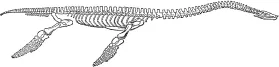
With the sea breaking behind her and the forbidding cliffs looming in front, the young girl knew she had found what she was looking for. Twelve-year-old Mary Anning, with large intelligent eyes, pale skin glowing in the fresh sea breeze and dark hair tangled, had spotted hints of long bones. A year earlier, in 1811,2 her brother Joseph had been the first to notice the head of a ‘crocodile’ in the exposed fallen rocks on the foreshore between Lyme Regis and Charmouth. It would eventually be identified as an Ichthyosaurus (literally ‘fish lizard’). The huge head had a long snout, and its large saucer-shaped eye socket seemed to stare out at them unnervingly.
Now, one year later, Mary had found the rest of the ‘fish lizard’ in the cliff high above where her brother had found the head. The Annings hired men to dig out the complete skeleton, 17 feet long, from the place it had rested in for 175, perhaps 200, million years. It was in ‘a very perfect state’.3
This was the first of these streamlined marine reptiles to receive the full blast of publicity in London. The Lord of the Manor at Lyme Regis, Henry Hoste Henley, bought it from the Annings, and he then passed it on to a museum in London’s Piccadilly. But it was not the first ichthyosaur to be discovered. The Welsh naturalist Llhyd had found a few fragments one hundred years earlier, which he described in his book Lithosphylacii Britannia (1699), and there had been others. But such a hugely important discovery by this young girl and her brother would prove to be the stuff of legend. This extraordinary find and others to follow would help to challenge, then overturn, many long-held ‘truths’ regarding the evolution of life on earth.
* * *
Mary Anning’s birth into a turbulent world was preceded by events of the most dramatic and far-reaching kind: the American Revolution of 1776, the French Revolution of 1789, and the burgeoning Industrial Revolution of 1776–1815, launched in Britain, the first industrialised country. The effects of such world-jarring events even percolated through to life on England’s south coast in remote Dorset, which was isolated by muddy, rutted roads, and further set apart by the local dialect.
The Anning family lived in comely Lyme Regis, a small seaside resort in west Dorset, noted for its fossils. Lyme and the River Lym lie cosily in a little combe, or ‘bottom’, between two steep hills with exceptionally fossiliferous cliffs stretching almost as far as the eye can see in either direction. In a dip to the east snuggles the equally fossil-rich village of Charmouth. Within the crumbling cliffs are strata of Blue Lias, sandwich-like layers of limestone and shale, imprisoning gigantic unknown beasts from other, earlier, worlds. The fossils (mostly skeletal remains, along with wood and trace impressions of prehistoric organisms preserved by natural processes), found almost everywhere around this area of the coast, were millions of years old, dating from periods of ‘deep time’ that are hard to grasp even today. Generally the fossils were unknown at the time of Mary’s discoveries, but some scholars were beginning to understand what they were.
Mary Anning lived out her life against a backdrop of long-recorded history. She was later described as ‘a being of imagination’.4 Did the young Mary gaze out to sea as the mist rolled in, and fancy she had been there at crucial points in Lyme’s history? Near the town, Homo sapiens had left his marks from the distant past, from the Iron Age hillfort on top of Pilsden Pen, at 909 feet the highest hill in Dorset, and the earthworks at Lambert Castle, to Lyme’s very own Cobb, much, much more recent but still hundreds of years old. The Cobb was the central feature of Lyme Regis, and the reason why the little port had survived, even thrived, for centuries.
When searching for fossils, as she walked along under menacing Black Ven cliff to Charmouth, did Mary imagine that she could see the thirty-five fearsome dragon-prowed Viking warships approaching, in ad 831, on one of their frequent raids on that place, ‘where they made cruel ravage and slaughter’?5 Standing on dominant Black Ven cliff, where the warning fire beacon had been lit on 31 July 1588, could she clearly ‘see’ the two Lyme ships heading out into Lyme Bay to join the English fleet commanded by Drake, and view its first skirmish with the Spanish Armada?
History flowed all around her. Did she ever imagine that she had been there in April 1644 during the Civil War, when Prince Maurice and 6,000 over-confident men attacked the ‘little vile fishing village’ intending to make it ‘breakfast work’? For the next eight weeks they unsuccessfully laid siege to the town from the land side. Flights of flaming arrows dipped in tar and hot cannon set ablaze the thatched houses at the west end of the town, as the intrepid women of fiercely Puritan Lyme dressed themselves as men to help confuse and repel the attackers.
When young Mary looked out to sea she might very well have seen French ships hovering – and she would not have been dreaming. For centuries there had been sightings of French vessels, raids and attacks along this coast. And the Francophobia was firmly grounded on reality. In addition to the menace of French privateers, the country was at war with France. When Mary was born in 1799, Britain had already been at war for six years and would continue to be so for the first sixteen years of her life. To a town on the south coast of England, the wars with the French were not remote. By December 1802 anti-French feeling was high, and between 1803 and 1805 an invasion scare reached panic proportions. The Napoleonic Wars resumed in 1805 and only came to an end with the Battle of Waterloo in 1815.
To the west of the Cobb, and taking in the border between Dorset and Devon, the wild, forested Undercliff, formed by countless landslides, stretches for 8 miles between Lyme and Axmouth. With every step Mary could not help but walk over ‘serpent-stones’ (ammonites), some several feet wide, so many that they formed a pavement, and fossils beyond number on Monmouth Beach. This was the place where James Scott, Duke of Monmouth (1649–85), a natural son of Charles II, chose to land in 1685, unfurl the royal standard and proclaim himself king. When his rebellion failed, the local people paid in blood, and ‘Hanging’ Judge Jeffreys ordered that twelve men be hanged, drawn and quartered at this spot on the foreshore.
Did Mary ever sense that her story would become an important part of the history of Lyme Regis, or even the most famous?
* * *
Mary’s parents, Richard Anning (c. 1766–1810) and his wife Mary (‘Molly’) (c. 1764–1842), married at Blandford parish church in August 1793. Richard probably came from Colyton,6 a market town on the River Coly in East Devon (inland from Beer Head), only 9 miles from Lyme Regis, at a time when the fortunes of the latter were known to be improving. Lyme was becoming a summer seaside resort, attracting well-to-do middle-class visitors.
Mary’s mother, Mary (‘Molly’) Moore, after whom she was named, came from Blandford Forum, a handsome Georgian town not far from Lyme. It was also the name given to an older sister, born in about 1794, who had perished in a Christmas-time house fire in 1798 recorded in the Bath Chronicle: ‘A child, four years of age, of Mr R. Anning, a cabinet-maker of Lyme, was left by the mother about five minutes . . . in a room where there were some shavings by the fire . . . The girl’s clothes caught fire and she was so dreadfully burnt as to cause her death.’ Of Molly and Richard’s four female infants, three died: Martha, the first Mary and Elizabeth. Of five male babies, four rapidly departed this life: the first Henry, the second Henry, Percival and Richard.
Joseph and his younger sister Mary were the only two children to survive to adulthood out of a family of at least nine children, perhaps ten. In those days it was not unusual for infants to die. The Annings’ immediate neighbours in unfashionable, unhealthy Cockmoile Square included John Bennett (1762–1852) and his wife Maria (c. 1763–1831), who lost three infants in four years, also at the end of the eighteenth century.7 Infant mortality was still high decades later in the first available census (1851): 123 babies died per 1,000 in West Dorset, but this was better than the national average of 150.
Happily, the year 1799 was a healthy one for the newly born in Cockmoile Square where the Annings lived, because not only did (the second) Mary survive, but so too did Ann, born the same year to the Bennetts next door. The Anning house had a double bow window in front, and comprised three floors and a cellar with windows. In the confined area of the Square, close neighbours would have been very close indeed. The Bennetts would remain in the Square for fifty years.
Oddly shaped Cockmoile Square, with its bizarre arrangement of dwellings, was built out almost over the River Lym, with the backs of the houses sensibly facing the sea, but still dangerously close to the foreshore. It was a place for artisans and their families. By trade a cordwainer or shoemaker, John Bennett was at heart a musician, and also an entrepreneur. In the 1820s he opened his own private baths, constructed between his sizeable leasehold property in the Square and the sea, despite the proximity of Jefferd’s Baths,8 open since 1804. That it was a viable proposition illustrates the increasing popularity of Lyme as a seaside resort for the discerning classes.
Richard Anning was a cabinet-maker or carpenter, but he also collected fossils to sell. Clearly a man of independent mind, and with limited time to hunt for fossils, he made use of Sundays and religious holidays including Good Friday and saints’ days for his rambles. He was a dissenter, a Congregationalist, as were the Bennetts. The dissenters, too, would have disapproved of his working on Sundays.
Occasionally Richard ferreted out fossils even on weekdays, which angered his wife, who ‘was wont to ridicule his pursuit of such things’,9 according to George Roberts, Lyme’s schoolmaster and first historian. Money was always short in the endless struggle to feed, clothe and keep the family warm when sharp and penetrating ocean breezes hit the little town tucked so picturesquely in its combe.
Remnants of stories that have come down to us indicate that Richard Anning had a strong, distinctive character. He was one of the ringleaders of a destructive mob during a bread riot in Lyme in March 1800.10 No one was prosecuted because no one would testify. It was a time, from 1799 to 1801, of bad harvests, when costs spiralled, the price of wheat went up and there were acute local food shortages, especially of the staple bread, since there was no European corn on the market, owing to the war.
The poverty was so widespread in Dorset that people made money any way they could. Even a family’s hair was an asset that could be harvested and sold to make wigs and hairpieces; a family’s crop of tresses might be farmed out at a price. The barber came along and cut off all the hair, then rubbed the numbskull with oil, and returned when the hair had achieved a marketable length once more.11 The Annings were fortunate in that fossils were close to hand to pr...