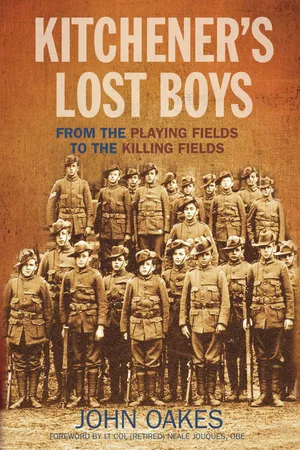
In the early days of the First World War, Lord Kitchener made his famous appeal for volunteers to join the New Army. Men flocked to recruiting offices to enlist, and on some days tens of thousands of potential soldiers responded to his call. Men had to be at least eighteen years old to join up, and nineteen to serve overseas, but in the flurry of activity many younger boys came to enlist: some were only thirteen or fourteen. Many were turned away, but a lot were illegally conscripted, and as many as 250,000 underage boys found themselves fighting for King and Country in the First World War. Over half would never return home. In this groundbreaking new book, John Oakes - whose own father-in-law walked out of the Welsh valleys to join the Royal Navy at the age of fourteen - delves into the complex history of Britain's youngest Great War recruits. Focusing on the recruitment crisis of 1914, he reveals why boys joined up, what their experiences were and how they survived to endure a lifetime of memories. For those who didn't, an unknown grave awaited, and in some cases their mothers never knew what had become of their children.
- 192 pages
- English
- ePUB (mobile friendly)
- Available on iOS & Android
eBook - ePub
About this book
Information
1
THE SACRIFICIAL
SCHOOLBOY
But youth’s fair form, though fallen, is ever fair,
And beautiful in death the boy appears,
The hero boy, that dies in blooming years;
In man’s regrets he lives, and woman’s tears,
More sacred than in life, and lovelier far,
For having perished in the front of war.
Tyrtaeus c. 600 BC.
Translated by Thomas Campbell (1777–1844).
‘Rupert Brooke is dead’ wrote Winston Churchill in a brilliant obituary appearing in The Times on Wednesday 26 April 1915.
A telegram from the Admiral at Lemnos tells us that his life has been closed at the moment when it seemed to have reached its springtime. A voice had become audible, a note had been struck, more true, more thrilling, more able to do justice to the nobility of our youth in arms engaged in the present war than any other – more able to express their thoughts of self surrender, and with a power to carry comfort to those who watch them so intently from afar. The voice has been swiftly stilled. Only the echoes and the memory remain; but they will linger.
During the last few months of his life, months of preparation in gallant comradeship and open air, the poet soldier told with all the simple force of genius, the sorrow of youth about to die, and the sure triumphant consolations of a sincere and valiant spirit. He expected to die: he was willing to die for the dear England whose beauty and majesty he knew; and he advanced towards the brink in perfect serenity, with the absolute conviction of the rightness of his country’s cause and a heart devoid of hate for his fellow men.
The thoughts to which he gave expression in the very few incomparable war sonnets he left behind will be shared by many thousands of young men moving resolutely and blithely forward into this, the hardest, the cruellest, the least-rewarding of all the wars that men have fought.
No doubt Churchill was genuinely saddened by Brooke’s death but there is room to suspect that he had a further motive for writing so movingly about a young officer at the time of the Gallipoli landings. He had led the faction in government which had proposed the attack on the Turks, who had entered the war on the side of Germany and the Central Powers. It was a tremendous gamble. The strategic objective was the Turkish capital of Constantinople, the city which commanded the links between Europe, Asia, the Black Sea and the Mediterranean. The objective was to be achieved by an amphibious landing on the beaches of the Gallipoli Peninsula, which dominated the Dardanelle Straits leading to the Sea of Marmora and the Bosphorus.
Churchill’s eulogy helped to establish the myth of youth, which was growing around Rupert Brooke. It was also, in modern terms, a spin doctor’s coup. It moved the propaganda war forward by glorifying the notion that it was good and right for the young to die for their country. The influence held by novels, boys’ own papers, popular songs, films, posters, cigarette cards, postcards, school books and commercial advertising over adolescent minds in the years preceding the First World War is worth further exploration.
The power of poetry used in the manipulation of public opinion at that time cannot be overlooked. Poetry and fiction had a disproportionate effect, by feeding the imaginative appetites of its readers. It had an emotional and long-lasting impact by becoming incorporated in its reader’s inner personal narrative. It was hard to escape its effect without conscious intellectual effort and most people were not intellectuals and had other things to do anyway. The popular poets and writers of juvenile literature, by validating the imperial warrior hero, helped to mobilise public consent for the declaration of war and for the recruitment of boys into the army.
The government was aware of the power of prominent authors and harnessed it once war had commenced. Kipling was one of several writers who joined the War Propaganda Unit (WPU) set up on 2 September 1914 by the Liberal MP, Charles Masterman, at the behest of David Lloyd George, then chancellor of the exchequer. Kipling wrote a small booklet for the unit entitled The New Army in Training, which will be discussed later. Kipling was just one of a number of prominent authors who lent their services to the war effort. Masterman persuaded Arthur Conan Doyle, John Masefield, G.K. Chesterton, Hilaire Belloc and John Buchan, among others, to write for him. In all, the War Propaganda Unit published 1,160 pamphlets. Though the WPU may have been an effective propaganda arm during the war, no such organisation existed before hostilities commenced. (Many prominent men, not just Kipling and his fellow authors, actively supported the war; they gave money to raise regiments, made speeches at recruiting drives and even gave up their houses as billets.)
Rupert Brooke has been called a war poet. This is a misnomer. He was a before-the-war poet and his influence on the recruitment of public opinion and on the youth culture of the day was significant. His rise to fame is worth charting.
In September 1914 Churchill, then First Lord of the Admiralty, was persuaded to use his influence and obtained a commission for Brooke in the Royal Naval Division, which was to be despatched with the British Expeditionary Force to France. In the event, the RND was diverted to Belgium following an offensive by the Germans, led by General von Bosler, on 28 September 1914. Von Bosler’s force of five divisions, with its 173 guns, began firing upon the outer south-east forts defending the city and port of Antwerp. The British cabinet was greatly concerned; if Antwerp was captured by the Germans, they might be able to take the French channel ports, making it near impossible to land British troops and supplies for the war in France and Belgium. Consequently, the British government decided to send a division of troops to assist in the defence of the city.
On 2 October the Germans penetrated two of Antwerp’s forts, and Churchill was sent to the city to report on the situation in person. Leaving London that night, he spent three days inspecting the fortifications around the city. He reported to Kitchener on 4 October that Belgian resistance was weakening, and Kitchener despatched the British relief force to Belgium. Landing at Ostend on 6 October, it was too late to save Antwerp. The city was evacuated the following day and its Belgian military governor formally surrendered on 10 October. The British intervention prolonged the defence of Antwerp for a few days and Rupert Brooke was a participant in one of the first British engagements of the First World War.
After Antwerp, Brooke wrote of his passion for war in an explicitly youth-oriented sequence of sonnets which he called ‘1914’. They were a call to arms for his generation and they articulated sentiments held by a significant number of young male adolescents. One stanza of his sonnet, ‘The Dead’, glamorised the sacrificial schoolboy and had a disproportionate effect on the mobilisation of consent, a key factor in the manipulation of public opinion:
Blow out, you bugles, over the rich Dead!
There’s none of these so lonely and poor of old,
But, dying, has made us rarer gifts than gold.
These laid the worlds away; poured out the red
Sweet wine of youth; gave up the years to be
Of work and joy, and that unhoped serene,
That man calls age; and those who would have been
Their sons, they gave their immortality.
On St George’s Day, 23 April 1915, Rupert Brooke died of blood poisoning resulting from a mosquito bite while on his way with the Royal Naval Division’s Hood Battalion to take part in the Gallipoli landings. Dean Inge read out one of his sonnets, ‘The Soldier’, from the pulpit of St Paul’s cathedral on Easter Sunday 1915:
If I should die, think only this of me:
That there’s some corner of a foreign field
That is forever England. There shall be
In that rich earth a richer dust concealed;
A dust whom England bore, shaped, made aware,
Gave, once, her flowers of love, her ways to roam,
A body of England’s, breathing English air,
Washed by rivers, blest by suns of home.
And think, this heart, all evil shed away,
A pulse in the eternal mind, no less
Gives somewhere back the thoughts by England given;
Her sights and sounds; dreams happy as her day;
And laughter, learnt of friends; and gentleness,
In hearts at peace, under an English heaven.
This was no new concept arising out of Brooke’s poems and Churchill’s intervention but, like all effective propaganda, it exploited and legitimised a widely-held sentiment. It is easy to find it exhibited in the obituaries of too many boy soldiers. Here are some of those published in the Roll of Honour in The Times.
Second Lieutenant Dudley Hurst-Brown, R.F.A., who died on June 15th from wounds received the same day in Flanders, was 18 years old on June 8, … He was educated at Cardwalles, Maidenhead, and Winchester, where he was in the O.T.C., and it was his intention upon leaving Winchester in the autumn of this year to proceed to Oxford and enter the Army through the University, the same as his elder brother, but, war breaking out, he immediately offered his services and received his commission in the Special Reserve on August 11, 1914. He was at the front for five months, during which time he went through some of the most severe fighting, but escaped injury until receiving his fatal wound. In his letter received the day before his death he stated how glad he was to be at the front, although the fighting was becoming frightful and that he saw little chance as a junior officer of ever getting safely home again, and concluded the letter with the famous Latin epitaph of Horace, ‘Dulce et decorum est pro patria mori’.
Dudley Hurst-Brown had left his schoolroom to fight at the age of seventeen. He knew he would die but was motivated by the prospect of honourable sacrifice.
A further search at random among the obituaries in The Times for July 1916 all too easily reveals boys who went straight from school into the army and thence to the killing fields. In common with Dudley Hurst-Brown, they were often public schoolboys who had been in the Officer Training Corps:
Lieutenant Alexander James Begg, Highland Light Infantry, who died on July 10 of wounds received on July 1 … he was awarded the Military Cross for conspicuous bravery in organising and carrying out a successful raid on the German trenches in April, when he was wounded. Educated at Glasgow Academy and Fettes College, he played in the football team and the fives team, and was a cadet sergeant in the O.T.C. He received his commission on leaving school in September 1915.
Lieutenant James Stanley Lightfoot Welch. Yorkshire Light Infantry … educated at the Preparatory School of Upper Canada College, Toronto and Yardley Court, Tonbridge, and at Rugby where he was a member of the O.T.C., and a scholar. In 1913 he was elected to an open scholarship at King’s College, Cambridge, and would have gone up to Cambridge in October 1914. When war broke out he applied for a commission, and was gazetted in October 1914, being promoted the following May. A letter from his commanding officer says that whilst he was leading his platoon against the enemy he was first wounded by a bullet and fell, but was immediately afterward killed by a shell. His last words to his platoon were Never mind me – carry on.
The Times, 13 July 1916.
A few days later and the following obituary appeared:
Second Lieutenant J. Victor Sinnet-Jones, Royal Welsh Fusiliers, who fell last week in France … was educated at Llandaff Choir School and at King’s School, Worcester, where he was prominent in work and games. He obtained a temporary commission from the School O.T.C. in August last instead of going to Oxford to prepare for holy orders. His elder brother in the same regiment fell earlier in the war.
The Times, 27 July 1916.
That these schoolboy soldiers and many others like them died in July 1916 is no surprise; that was the first month of the deadly Battle of the Somme. An offensive was launched with the aim of making a breakthrough in the German lines for a cavalry attack. The infantry offensive was preceded by a great deal of artillery work. The tasks the gunners undertook were varied. They were required to interrupt the work of the German staff, disrupt their supply lines, knock out their artillery and break their communications systems and, as far as possible, destroy their front line fortifications and make gaps in the barbed wire. They also needed to kill or incapacitate German troops and reduce the morale of the survivors. The Germans were particularly rich in machine guns which they had sited with care and protected well to resist the best efforts of the British artillery. It takes a great deal of time to train gunners properly. That was a luxury the New Army volunteers lacked but, even so, they gave a good account of themselves. At dawn on 1 July 1916, following an intensive ‘shock and awe’ artillery barrage on the German fortifications, the Allies attacked along a twenty-five mile front. The British troops, who were funnelling through gaps in their own wire, were mown down by withering fire from the numerous German machine guns, which were sited to aim at their legs and lower bodies.
On the first day the British lost around 1,000 officers and 19,240 men. The battle continued until 18 November, by which time approximately 95,675 British were dead. These figures must be viewed with some caution, however, because there were not enough clerks in the British Army to compile accurate statistics.
Kitchener’s New Army took the brunt of it all but it must be remembered that it was fighting German veterans who were well protected in cavernous strongholds dug in chalk. Against all precedents and expectations, there were very few British stragglers. Shells and streams of machine-gun bullets made gaps in the lines of khaki figures but the survivors continued to surge forward with dogged determination. Only well-led and well-motivated men could have survived such an ordeal without breaking. The men of the New Army entered the Somme as sporting athletes and emerged as cautious professional soldiers.
The proportion of young subalterns who were killed, wounded or hospitalised with shell-shock was inordinately high. They led their men in battle and that required extraordinary courage, which must have been the fruit of intense indoctrination. In the early years of the war the similarity of their education is striking. They were mostly ex-public schoolboys who had been members of the Officer Training Corps. It is no surprise to find that 516 Old Harrovians were killed in the First World War, approximately one every t...
Table of contents
- Cover
- Title
- Copyright
- Contents
- Acknowledgements
- Foreword
- Introduction
- 1 The Sacrificial Schoolboy
- 2 Why They Chose to Fight
- 3 One Hell of a Lesson
- 4 Recruiting Fever
- 5 Training for Armageddon
- 6 School for Sacrifice
- 7 Outstanding Debts of Courage
- 8 A Land Unfit for Heroes
- Appendix: A Time Line of the Main British Engagements on the Western Front (1914–1918)
- Endnotes
- Select Bibliography
Trusted by 375,005 students
Access to over 1.5 million titles for a fair monthly price.
Study more efficiently using our study tools.
Frequently asked questions
Yes, you can cancel anytime from the Subscription tab in your account settings on the Perlego website. Your subscription will stay active until the end of your current billing period. Learn how to cancel your subscription
No, books cannot be downloaded as external files, such as PDFs, for use outside of Perlego. However, you can download books within the Perlego app for offline reading on mobile or tablet. Learn how to download books offline
Perlego offers two plans: Essential and Complete
- Essential is ideal for learners and professionals who enjoy exploring a wide range of subjects. Access the Essential Library with 800,000+ trusted titles and best-sellers across business, personal growth, and the humanities. Includes unlimited reading time and Standard Read Aloud voice.
- Complete: Perfect for advanced learners and researchers needing full, unrestricted access. Unlock 1.5M+ books across hundreds of subjects, including academic and specialized titles. The Complete Plan also includes advanced features like Premium Read Aloud and Research Assistant.
We are an online textbook subscription service, where you can get access to an entire online library for less than the price of a single book per month. With over 1.5 million books across 990+ topics, we’ve got you covered! Learn about our mission
Look out for the read-aloud symbol on your next book to see if you can listen to it. The read-aloud tool reads text aloud for you, highlighting the text as it is being read. You can pause it, speed it up and slow it down. Learn more about Read Aloud
Yes! You can use the Perlego app on both iOS and Android devices to read anytime, anywhere — even offline. Perfect for commutes or when you’re on the go.
Please note we cannot support devices running on iOS 13 and Android 7 or earlier. Learn more about using the app
Please note we cannot support devices running on iOS 13 and Android 7 or earlier. Learn more about using the app
Yes, you can access Kitchener's Lost Boys by John Oakes in PDF and/or ePUB format, as well as other popular books in History & Military & Maritime History. We have over 1.5 million books available in our catalogue for you to explore.