![]()
Introduction
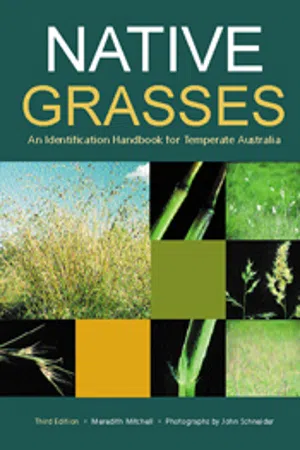
This book describes some native grasses which are common in south-eastern Australia.
Native grasses are those grasses that occurred in Australia before European settlement.
Many native grasses are perennial, deep-rooted and tolerant of acidic soils. They may play a role in helping to solve the problems of water erosion, induced soil acidity and dryland salinity. The aim of this book is to provide land managers with a better understanding of the characteristics, appearance and value of common native grasses.
The native grasses shown in this book are perennial. Perennial grasses have a life span of several years and they usually flower each year. Recognition of grasses is easiest when they are flowering, usually in late spring to summer. Most grasses are difficult to recognise when they are not flowering.
Key characteristics for identifying grasses
Recognition of a grass species depends on being familiar with the general appearance of grasses and one or two of their key characteristics.
The key characteristics for recognising grasses are:
• Height: This is a key feature in species recognition, but it may vary due to the season and stocking rate. The heights given in this book are from the ground surface to the top of the seedhead.
• Growth habit: Grasses may be upright, tufted, prostrate or spreading.
• Leaf texture: Soft, smooth or coarsely haired.
• Colour: The colour of the leaves, stems and seedheads may be useful; however colour may change with stage of growth and season.
• Flowering time: Grasses differ in the time of year that they flower. Flowering times vary from year to year but the times given in this book indicate when seedheads are likely to be present.
Agronomic values
The agronomic value of these grasses is covered in terms of:
Frost tolerance: How the grass tolerates frost.
Drought tolerance: The ability of a grass to persist under conditions of drought.
Forage value: Some average values for crude protein and digestibility as a percentage of total dry matter are presented. Clovers, for example, can reach over 20 per cent protein and over 65 per cent digestibility. Grazing stock generally require 7 to 8 per cent protein for maintenance. Crude protein and digestibility vary through the season.
Management
Native grass pastures usually consist of a number of species of native grass. The species that are dominant in these pastures may vary from year to year, depending on the rainfall, temperature, stocking rate, fertiliser applied and other factors. Land management may alter the composition of native grass pastures. For these pastures to be managed, individual species need to be recognised and their response to different grazing pressures and soil disturbance practices needs to be understood. The management adopted for a particular native grass will depend on the intended land use.
Knowledge of the response of individual species to land management, particularly grazing pressure and fertiliser use, provides a means of changing pasture composition. Response information given in this book has been taken from publications listed in the references.
Response to fertility: This is the response of the grass to improved soil fertility. Some native grasses increase as a percentage of the sward as fertility increases, while others disappear.
Response to grazing: This is the response of the grass to increased grazing pressure. Does the grass increase as a percentage of the sward with increased grazing or decrease and not persist?
Distribution
The distributions described in the text refer to south-eastern Australia, including Tasmania. The regions described are:
NC | North Coast, New South Wales |
CC | Central Coast, New South Wales |
SC | South Coast, New South Wales |
NT | Northern Tablelands, New South Wales |
CT | Central Tablelands, New South Wales |
ST | Southern Tablelands, New So... |