We have all seen the hilarious depiction of Mrs Miggins' coffee shop in "Blackadder", but what was it really like in the first cafes, as coffee drinking became more popular? What else did the shops sell? How did coffee shop life influence politics, the media and everyday life?
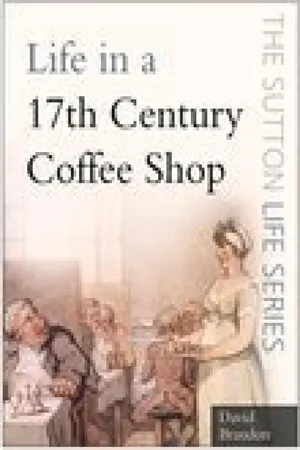
- 96 pages
- English
- ePUB (mobile friendly)
- Available on iOS & Android
eBook - ePub
Life in a 17th Century Coffee Shop
About this book
Information
CHAPTER 1
Introduction
O coffee! Loved and fragrant drink, thou drivest care away . . .
In St Michael’s Alley, a narrow, easy-to-miss and quiet passage off Cornhill in the heart of the bustling City of London, stands the Jamaica Wine House. A plaque on the wall explains that on this site stood the original London coffee house, opened in 1652.
Within the coffee houses of the seventeenth and eighteenth centuries a wide range of activities were carried on that had a very important influence on English and international history. The golden age of the coffee house coincided with what can fairly be said to have been an explosion in scientific enquiry and learning. Coffee houses were frequented by such cognoscenti of the arts and sciences as Wren, Dryden, Reynolds, Johnson, Boyle, Swift, Gainsborough, Garrick and Hogarth. The origins of many insurance companies and other businesses in the financial sector can be traced back to men talking to each other in coffee houses. Such was the central role that the coffee houses played in the life of late seventeenth- and eighteenth-century London that gentlemen were often associated more with the coffee houses they frequented than with the homes in which they lived.
Oxford and Cambridge both had coffee houses. Bristol is recorded as having four by 1666, there was at least one at York in 1669 and others in Edinburgh, Glasgow and Dublin. There were also coffee houses in Exeter, Bath, Norwich, Great Yarmouth, Chester, Preston and Warwick. While these were all important provincial towns, given London’s unassailable position as the political, economic, social and cultural focus of England, it was inevitable that the majority of coffee houses were to be found there – and it is those in London with which we will mainly be concerned. It is estimated that London, Westminster and their environs had at least 1,000 coffee houses in 1714. In their early days coffee houses were usually identified by a hanging sign, until in 1762 all such signs were banned. A common theme for the sign was either a coffee pot or the turbaned head of a Turk. Common activities of the coffee house, whether in London or elsewhere, were discussion of the news and the conducting of commerce.
Why did coffee-drinking catch on? How did the commodity arrive in Britain? How did the coffee houses operate and what kind of people patronised them? How did they contribute to economic, social and cultural history? Why did they eventually decline? Above all, what was the ‘coffee house experience’? What sights, sounds and smells were experienced by those who frequented them? How apt was Dr Johnson’s definition of a coffee house as ‘A house of entertainment where coffee is sold, and the guests supplied with newspapers’?
This book attempts to get under the skin of the coffee house. It probes the significance of these comparatively fleeting but highly influential institutions and tries to evoke a sense of the historical period of which they were a part and to which they made such a significant contribution. The last decade has seen a remarkable revival in the UK of establishments given over to the adoration and consumption of the roasted coffee bean in drink form. The arrival of this new generation of ‘coffee houses’ in towns and cities throughout Britain makes it particularly appropriate to go back and take a look at their ancestors.
CHAPTER 2
Early Days
They have in Turkey a drink called coffee made of a berry of the same name, as black as soot, and of a strong scent.
Francis Bacon, 1672
The origins of coffee are confused by a variety of appealing but probably apocryphal legends. The coffee plant bears white, sweet-smelling flowers from which green berries develop. These turn red when ripe. Each berry contains two beans and it is these which are the commercial product of the plant. We know that the coffee plant is almost certainly native to what used to be called Abyssinia, now Ethiopia. There, perhaps accidentally, the locals discovered that the beans of the wild plant, when chewed, helped to sustain their physical and mental spirits during demanding activities in the inhospitable conditions in which they lived and worked. The use of coffee as a drink was first recorded by the revered Arabian philosopher and physician with the Westernised name of Avicenna (980–1037). At that time it seems that the green unroasted beans were simply steeped in boiling water to produce a stimulating and refreshing drink.
The Abyssinians were eventually subjected to raids by Arab slave traders, who picked up the habit of masticating the berries. Finding themselves equally pleased with coffee’s stimulant effects, it is likely that these traders rooted up some of the bushes and took them away. It is thought that the coffee plant was first cultivated in the Yemen, probably as a result of the activities of returning slavers.
Legend has it that the real potential of coffee was discovered by an Arab goatherd who was amazed when the animals in his care, in their typically voracious way, not only consumed some of the leaves of a fairly nondescript nearby bush but then started gambolling about in an unusually frisky manner. As the story goes on it sounds even more improbable, with the goatherd telling the imam of the nearby monastery about this experience. It seems that the holy man’s main problem was keeping his brethren attentive during long services. Thinking laterally, he picked some of the berries himself, steeped them in water and told his lethargic acolytes to drink the liquid. To his great gratification, he found that they remained rapt in attention and devotion, no matter how tedious and drawn-out their religious offices were.
News spread about the remarkable properties of the fruit of the coffee bush, and the refreshing and stimulating drink was especially appreciated in Muslim countries, where the consumption of alcohol was officially disapproved of. Apparently two drinks were made from the berry. The first, which we would still recognise today, used roasted and ground berries. This was probably first done in the thirteenth century. The second was a wine made from the fermented skin and the sweetish soft pulp of the berry. This may have been made and consumed surreptitiously.
The consumption of coffee spread throughout the Muslim world in medieval times, and in 1554 seems to have reached Constantinople, which has the first recorded coffee house. So enthusiastically was coffee-drinking adopted there that prayers were neglected. This incurred the wrath of the Muslim authorities, and so the coffee houses were closed. The response of coffee-drinkers was simply to go to each other’s houses and enjoy a brew-up there instead.
Francis Bacon (1561–1626), the Tudor polymath, wrote in Sylva Sylvarum (published posthumously in 1627):
They have in Turkey a drink called Coffee, made of a berry of the same name, as Black as Soot, and of a strong scent, but not aromatical; which they take beaten in Pouder [sic], in Water, as Hot as they can drink it; and they take it and sit at it in the Coffee houses, which are like our Taverns. The drink comforteth the Brain, the Heart, and helpeth digestion.
The consumption of coffee proceeded along trade routes – it was a drink of cosmopolitan people and cosmopolitan places. The first European coffee house was opened in Venice in 1645, and perhaps we should not be surprised to hear that its consumption in the British Isles was first recorded at Oxford in 1637 by a member of Balliol College. A coffee house in Oxford called the Angel was opened in 1652 by a Lebanese, apparently called Jacob. University dons and students found coffee every bit as pleasant and stimulating a drink as had the Muslims. Further coffee houses opened in Oxford.
In the same year, as already mentioned, Pasqua Rosee opened what was probably London’s first coffee house, with a sign portraying a Turk’s head. He was probably a native of Smyrna, now called Izmir, a port in western Turkey where he had learned how to prepare coffee. He became the servant of a merchant named Daniel Edwards who loved nothing better than socialising and entertaining friends. The strange, even exotic drink that his servant prepared and served up for them was greatly appreciated, not least as a stimulating alternative to alcoholic drinks. Indeed, as its fame spread the bold decision was taken to launch a business selling coffee on premises open to the public.
At first the retailing was done from little more than a stall housed in a shed. The customers stood under an overhanging awning or in the yard of the nearby St Michael’s Church. The business was initially headed up by Pasqua Rosee himself. Rosee, clearly a man with an eye to the promotional value of the media, printed handbills that made extravagant claims for the medicinal properties of coffee. He claimed the drink helped to cure hangovers, and, not content with saying that it also cured dropsy, gout and scurvy, he enlarged on its virtues by explaining that it could prevent miscarriages. According to him, it even facilitated the breaking of wind. Rosee seems to have been something of a rascal: we hear later that he was forced to flee the country and he was last heard of running a coffee house in The Hague.
Hyperbole it may have been that gave coffee its initial impetus in London, but the drink caught on and before Rosee was forced to decamp he moved the business into a house close by. Establishments imitating Rosee’s coffee house and its style soon followed. The early ones included Farr’s, the Jerusalem, the Jamaica, Garraway’s and Jonathan’s (both in Change Alley) and Dick’s by Temple Bar. Coffee houses quickly became the centre-point of the social life of middle-class London. They owed at least some of their popularity to the fact that the preparation of the coffee involved boiling the water, which of course made the drink safer to consume than water itself.
Coffee was but one of a triumvirate of sober beverages that arrived in Britain within a decade or two of each other, the others being chocolate and tea. All caught on quickly, but coffee and chocolate especially became fashionable and popular. Coffee houses and chocolate houses sprang up like mushrooms in urban centres, and, as with new fashions, they were greeted with both a chorus of praise and mutters of disapproving dissent. The Puritans, whose censorious view of the world dominated England during the Commonwealth, initially approved of the coffee...
Table of contents
- Cover
- Title
- Copyright
- Contents
- 1. Introduction
- 2. Early Days
- 3. The Coffee Houses Come of Age
- 4. The Everyday Life of the Coffee House
- 5. Coffee House Sights, Sounds and Smells
- 6. A Coffee House for Every Cause and Interest
- 7. The Decline of the Coffee House
- 8. The Social and Economic Impact of the Coffee Houses
- Further Reading
Trusted by 375,005 students
Access to over 1.5 million titles for a fair monthly price.
Study more efficiently using our study tools.
Frequently asked questions
Yes, you can cancel anytime from the Subscription tab in your account settings on the Perlego website. Your subscription will stay active until the end of your current billing period. Learn how to cancel your subscription
No, books cannot be downloaded as external files, such as PDFs, for use outside of Perlego. However, you can download books within the Perlego app for offline reading on mobile or tablet. Learn how to download books offline
Perlego offers two plans: Essential and Complete
- Essential is ideal for learners and professionals who enjoy exploring a wide range of subjects. Access the Essential Library with 800,000+ trusted titles and best-sellers across business, personal growth, and the humanities. Includes unlimited reading time and Standard Read Aloud voice.
- Complete: Perfect for advanced learners and researchers needing full, unrestricted access. Unlock 1.5M+ books across hundreds of subjects, including academic and specialized titles. The Complete Plan also includes advanced features like Premium Read Aloud and Research Assistant.
We are an online textbook subscription service, where you can get access to an entire online library for less than the price of a single book per month. With over 1.5 million books across 990+ topics, we’ve got you covered! Learn about our mission
Look out for the read-aloud symbol on your next book to see if you can listen to it. The read-aloud tool reads text aloud for you, highlighting the text as it is being read. You can pause it, speed it up and slow it down. Learn more about Read Aloud
Yes! You can use the Perlego app on both iOS and Android devices to read anytime, anywhere — even offline. Perfect for commutes or when you’re on the go.
Please note we cannot support devices running on iOS 13 and Android 7 or earlier. Learn more about using the app
Please note we cannot support devices running on iOS 13 and Android 7 or earlier. Learn more about using the app
Yes, you can access Life in a 17th Century Coffee Shop by David Brandon in PDF and/or ePUB format, as well as other popular books in History & European Renaissance History. We have over 1.5 million books available in our catalogue for you to explore.